
SLIDE 1
Underwater Robotic Fish
Phase II: Buoyancy
Final Presentation Project #15029 Multidisciplinary Senior Design Rochester Institute of Technology
Page 1
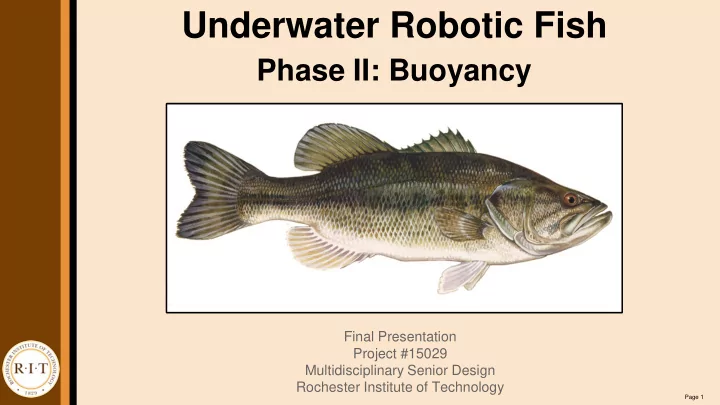
Underwater Robotic Fish Phase II: Buoyancy Final Presentation - - PowerPoint PPT Presentation
Underwater Robotic Fish Phase II: Buoyancy Final Presentation Project #15029 Multidisciplinary Senior Design Rochester Institute of Technology Page 1 Team Members and Roles Name Role Sarah Bailey Project Manager and Buoyancy Lead Chloe
Final Presentation Project #15029 Multidisciplinary Senior Design Rochester Institute of Technology
Page 1
Page 2
Name Role Sarah Bailey Project Manager and Buoyancy Lead Chloe Bohlman Webmaster and Electrical Support Mark Pitonyak Electrical Lead Igor Drobnjak Systems Lead Brandon Michale Biomedical Lead Frederick Cookhouse Mechanical Lead
Page 3
Page 3
The objective of this project is to create an underwater robot that looks and swims like a fish. The fish is to achieve these biomimetics by utilizing McKibben muscles to hydraulically propel the fish. The fish will be able to swim forward and turn, and have depth control using active buoyancy in both RC and autonomous modes.
Page 3
The fish was successfully able to dive to a depth of 3 ft and return to the surface utilizing manual control of the valves and ballast system. See Videos Posted on EDGE
Page 3
Problem: High frequency wireless systems are strongly attenuated in water. Solution: Developed a 315 MHz transceiver to communicate with the fish underwater. Results
Range in air: 300 ft Range in water: 3 ft Throughput: 10,000 bps
Page 3
Page 3
Page 3
Page 3
Page 3
Mechanical $ 232.81 Electrical $ 203.76 Main PCB $ 140.73 RF Transceiver $ 47.16 Controller PCB $ 8.81 TOTAL $ 633.26
Page 3
○ Devote more time and budget to testing shell materials ○ Make small samples as with skin ○ If molding on foam, use solid core ○ If using fabric strips, dip in the resin instead of painting it on ○ DO NOT LEAVE THIS UNTIL THE LAST FEW WEEKS BEFORE IMAGINE ■ You will not finish on time. This has been the case the past two years. Do not become the third team to fail at this.
○ Attach velcro by sewing it to the skin ○ This was a big concern for us, as when we went to use the ecoflex, the velcro peeled right off, leaving us with no practical method for holding the skin on the tail
Recommendations have been recorded in a document for future teams to reference. The left is an example of one major system that did not meet an engineering requirement and our recommendations to prevent this issue in the future.
Page 3