Understanding the Molecular Mechanisms of Totipotency using C. - - PowerPoint PPT Presentation

understanding the molecular mechanisms of totipotency
SMART_READER_LITE
LIVE PREVIEW

Understanding the Molecular Mechanisms of Totipotency using C. - - PowerPoint PPT Presentation

Understanding the Molecular Mechanisms of Totipotency using C. elegans By Chijioke Nze (CJ) Mentor: Dr. Nate Dudley Rothman Lab - MCDB C. elegans is a Great Model Organism small ~1mm Short generation time ~ 3 days Known developmental


slide-1
SLIDE 1

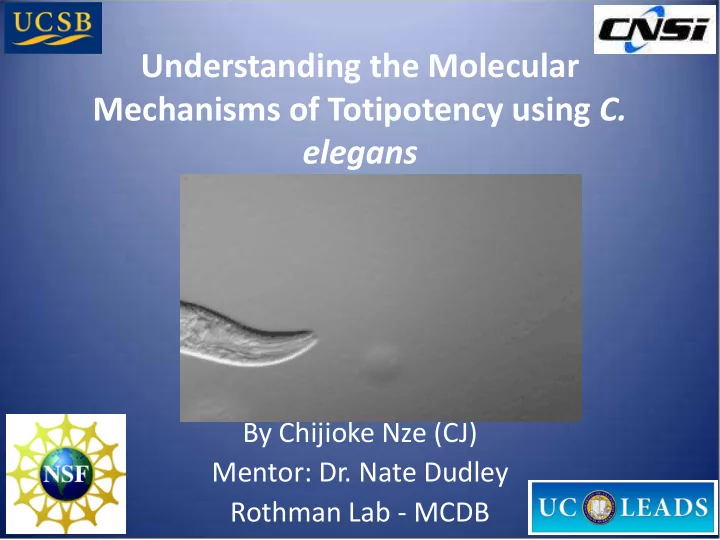
Understanding the Molecular Mechanisms of Totipotency using C. elegans

By Chijioke Nze (CJ) Mentor: Dr. Nate Dudley Rothman Lab - MCDB

slide-2
SLIDE 2
  • C. elegans is a Great Model Organism
  • small ~1mm
  • Short generation time ~ 3 days
  • Known developmental pattern
  • Transparent
  • Genome is sequenced
slide-3
SLIDE 3

The C. elegans 1-cell embryo harbors the potential to generate many specialized cell types

Pluripotent Restricted Potential Multipotent Totipotent

1 cell - hatching Adult animal

slide-4
SLIDE 4

Totipotency: extension of the competency window

  • Identify/Characterize genes required

for maintaining totipotency Early development late development

  • Injury and Disease - including tissue loss,

many cancers, multiple sclerosis, Alzheimer's etc.

Heroes:-Claire-Bear

T o t i p o t e n t Pluripotent Restricted Potential

slide-5
SLIDE 5

Understanding the role of humpty, in maintaining totipotency

Wild type = control

Pluripotent Restricted Potential Multipotent Totipotent Early development Late development humpty Totipotent Multipotent R e s t r i c t e d P o t e n t i a l

slide-6
SLIDE 6

Over-expression of humpty

  • we hypothesized that by over expressing

humpty, we could increase competency

Wild type = control Over-expressed humpty

T o t i p o t e n t Pluripotent Restricted Potential

Pluripotent Restricted Potential Multipotent Totipotent Early development Late development

slide-7
SLIDE 7

Methods:- Establishing control

  • Culture of worms
  • Building the competency window

20 40 60 80 100 8-14 cell 12-22 cell 22-42 cell 26-51 cell 46-86 86-170 percent transformed

Approximate cell stage

Competency time course

(-) heat shock (+) heat shock

slide-8
SLIDE 8

Competency window assay

GFP

elt-2

END-3 Heat-Shock

Candidate dsRNA

HEAT-SHOCK

slide-9
SLIDE 9

Heat-shock @ 33 0C Incubate for 24 hr @ 20 0C Heat-shock @ 33 0C Incubate for 24 hr @ 20 0C

slide-10
SLIDE 10

Testing the effects of genetic manipulation

  • RNAi
  • Score effects of knocking
  • ut humpty on competency
  • Building a transgenic worm,

via microinjection, that over expresses

slide-11
SLIDE 11

The competency window appears to be bimodal

12 42 94 26 47 34 33 45 5 10 20 30 40 50 60 70 80 90 100 1 cell 2-8 cells 10-20 cells22-40 cells42-80 cells ~ 85 cells ~100 cells ~170 cells 190- 300 cells ventral cleft bean stage >300 cells Percent transformed embryo stage

Percent transformed 1 10

slide-12
SLIDE 12

Knocking out humpty has no significant effect within the early period of the window

10 20 30 40 50 60 70 80 90 100 1 cell 2-10 cells 10-20 cells 20-40 cells 40-80 cells ~85 cell ~100 cells ~170 cells 190- 300 cells ventral cleft bean stage Percent transformed

Cell Stage

Effect of humpty and Unc-62 RNAi on competency w/ sterror

Control Unc 62 Nos 2

slide-13
SLIDE 13

Conclusion

  • The Competency window of wild-type worms

appears to be (stats need to be done to be conclusive) bi-modial with peaks at 20-40 cells and 100

  • Humpty does not influence competency early

in the window, competency in this period might be regulated by another gene

slide-14
SLIDE 14

Future direction

  • Define humpty and other related genes

competency early and late in the window

  • Create a construct for the over expression of

humpty

  • Create a worm that over-expresses humpty via

micro-injecting of our construct

  • Define the competency window for the

transgenic worm that over expresses humpty, and score the effects late in development.

slide-15
SLIDE 15

Acknowledgements

  • Professor Joel Rothman and the

amazing people in the Rothman lab

  • Dr. Nate Dudley
  • UCLEADS
  • Matt and Arica
  • CNSI
  • The audience
slide-16
SLIDE 16

Questions??

slide-17
SLIDE 17

Heat-shock @ 33 0C Incubate for 24 hr @ 20 0C Heat-shock @ 33 0C Incubate for 24 hr @ 20 0C

slide-18
SLIDE 18

RNAi mechanism