Underlying a Misrepresentation Claim or Defense Advocating the - - PowerPoint PPT Presentation

underlying a misrepresentation claim or defense
SMART_READER_LITE
LIVE PREVIEW

Underlying a Misrepresentation Claim or Defense Advocating the - - PowerPoint PPT Presentation

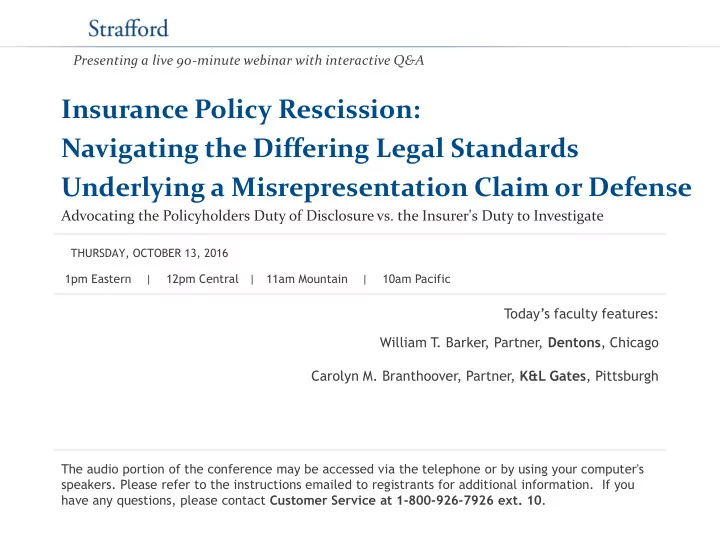
Presenting a live 90-minute webinar with interactive Q&A Insurance Policy Rescission: Navigating the Differing Legal Standards Underlying a Misrepresentation Claim or Defense Advocating the Policyholders Duty of Disclosure vs. the Insurer's


slide-1
SLIDE 1

The audio portion of the conference may be accessed via the telephone or by using your computer's

  • speakers. Please refer to the instructions emailed to registrants for additional information. If you

have any questions, please contact Customer Service at 1-800-926-7926 ext. 10.

Presenting a live 90-minute webinar with interactive Q&A

Insurance Policy Rescission: Navigating the Differing Legal Standards Underlying a Misrepresentation Claim or Defense

Advocating the Policyholders Duty of Disclosure vs. the Insurer's Duty to Investigate

Today’s faculty features:

1pm Eastern | 12pm Central | 11am Mountain | 10am Pacific THURSDAY, OCTOBER 13, 2016

William T . Barker, Partner, Dentons, Chicago Carolyn M. Branthoover, Partner, K&L Gates, Pittsburgh

slide-2
SLIDE 2

Tips for Optimal Quality

Sound Quality If you are listening via your computer speakers, please note that the quality

  • f your sound will vary depending on the speed and quality of your internet

connection. If the sound quality is not satisfactory, you may listen via the phone: dial 1-866-927-5568 and enter your PIN when prompted. Otherwise, please send us a chat or e-mail sound@straffordpub.com immediately so we can address the problem. If you dialed in and have any difficulties during the call, press *0 for assistance. Viewing Quality To maximize your screen, press the F11 key on your keyboard. To exit full screen, press the F11 key again.

FOR LIVE EVENT ONLY

slide-3
SLIDE 3

Continuing Education Credits

In order for us to process your continuing education credit, you must confirm your participation in this webinar by completing and submitting the Attendance Affirmation/Evaluation after the webinar. A link to the Attendance Affirmation/Evaluation will be in the thank you email that you will receive immediately following the program. For additional information about continuing education, call us at 1-800-926-7926

  • ext. 35.

FOR LIVE EVENT ONLY

slide-4
SLIDE 4

Program Materials

If you have not printed the conference materials for this program, please complete the following steps:

  • Click on the ^ symbol next to “Conference Materials” in the middle of the left-

hand column on your screen.

  • Click on the tab labeled “Handouts” that appears, and there you will see a

PDF of the slides for today's program.

  • Double click on the PDF and a separate page will open.
  • Print the slides by clicking on the printer icon.

FOR LIVE EVENT ONLY

slide-5
SLIDE 5

Insurance Policy Rescission: Navigating the Differing Standards Underlying a Misrepresentation Claim or Defense

Strafford Publications webinar October 13, 2016 Carolyn M. Branthoover, K&L Gates LLP William T. Barker, Dentons US LLP

slide-6
SLIDE 6

Functions of Misrepresentation Defense

  • Encourage parties to provide accurate information in

application process

  • Protect those misled to their detriment
  • Penalize those who mislead
  • "The efficient functioning of insurance markets requires that insurers receive

accurate information regarding potentially insured risks so that, among other reasons, insurers can price their policies accurately. The possibility of a claim denial or policy rescission can create incentives for the applicants to provide accurate information during the policy application and renewal process …. In addition, as a matter of fairness, policyholders who make intentional or reckless misrepresentations on their insurance applications should not be permitted to shift losses to insurance companies that have relied in good faith on the policyholders’ answers." Restatement of the Law of Liability Insurance ("RLLI") § 66 (Tent. Dr. No. 1 April 11, 2016).

October 13, 2016 6

slide-7
SLIDE 7

Legal Foundation of Misrepresentation Defense

  • Common law foundation
  • Statutory support in many states
  • Contractual basis when application

incorporated into policy

October 13, 2016 7

slide-8
SLIDE 8

Legal Standard

"(2) Subject to the rules governing defense obligations, an insurer

may deny a claim or rescind the applicable liability insurance policy on the basis of an incorrect representation made by a policyholder in an application for an insurance policy (hereinafter referred to as a misrepresentation) only if the following requirements are met: (a) The misrepresentation was material …; and (b) the insurer reasonably relied on the misrepresentation in issuing or renewing the policy …. "(3) When the policy is rescinded under subsection (2), the insurer must return all premiums paid for the policy." RLLI § 7.

October 13, 2016 8

slide-9
SLIDE 9

Legal Standard

  • RLLI states common law rules

also applicable to nonliability polices.

  • Statements not warranties

(except in marine insurance)

9 October 13, 2016

slide-10
SLIDE 10

Answers Must Be Complete

  • Applicant may not limit answers to facts it considers

material

  • H.J. Heinz Co. v. Starr Surplus Lines Ins. Co., No.

15-CV-00631 (W.D.Pa. 2016)

  • Insured failed to disclose "silent recall" that it

believed immaterial because it would not have been insured

  • But application called for disclosure of all

withdrawals, recalls and stock recoveries "whether

  • r not insured or insurable"

10 October 13, 2016

slide-11
SLIDE 11

Marine Insurance Is Different

  • Silence as to matters not asked in application

is not a misrepresentation (except in marine insurance)

  • Fireman’s Fund Ins. Co. v. Great American
  • Ins. Co., Case No. 14-1346-cv(L) (May 20,

2016) (applying “utmost good faith” standard under maritime law)

October 13, 2016 11

slide-12
SLIDE 12

Misleading Statements Can Be Misrepresentations

  • Even if none of the responses to application

questions is literally untrue, responses that are incomplete in a way that is misleading can be a basis for rescission

  • Fireman’s Fund Ins. Co. v. Great American
  • Ins. Co., Case No. 14-1346-cv(L) (May 20,

2016) (applying Mississippi law)

October 13, 2016 12

slide-13
SLIDE 13

Intent

  • Common law typically does not require any intent to deceive
  • f the party making an inaccurate representation
  • E.g., 128 Hester LLC v. New York Marin & Gen. Ins. Co.,5

N.Y.S.3d 69, 70 (N.Y. App. Div. 2015) (“even innocent misrepresentations are sufficient to allow an insurer to avoid the contract of insurance”)

  • But see Medicus Ins. Co. v. Todd, 400 S.W.3d 670, 679

(Tex. App. 2013) (to void a policy on the basis of misrepresentation, insurer must “prove[] the insured intended to deceive the insurer”)

October 13, 2016 13

slide-14
SLIDE 14

Intent

  • Statutes in some states require an intent to deceive
  • Arizona – Ariz. Rev. Stat. § 20-1109 – Requires showing of

a misrepresentation or omission that is fraudulent and material and upon which the insurer relied. Greves v. Ohio State Life Ins. Co., 821 P.2d 757, 763 (Ariz. Ct. App. 1991)

  • Louisiana – La. Rev. Stat. §22:860(A) – Requires showing

that “the misrepresentation or warranty is made with the intent to deceive.”

  • Washington – Wash. Rev. Code § 48.18090(1) – Requires

proof that “misrepresentation or warranty is made with the intent to deceive.”

October 13, 2016 14

slide-15
SLIDE 15

Materiality

"A misrepresentation by or on behalf of an

insured during the application or renewal of an insurance policy is material only if, in the absence of the misrepresentation, a reasonable insurer in this insurer's position would not have issued the policy or would have issued the policy only under substantially different terms." RLLI § 8.

October 13, 2016 15

slide-16
SLIDE 16

Materiality

  • Objective standard regarding significance of misrepresentation

to assessment of risk posed by insured. RLLI § 8, cmt. a.

  • Takes into account any special information insurer may have

regarding risk selection and classification. RLLI § 8, cmt. b.

  • What insurer knew or should have known about insured affects

whether insurer relied and whether doing so was reasonable, but not materiality. RLLI § 8, cmt. c.

  • Material if insurer had reasonable basis to think that, even if
  • ther insurers would not. RLLI § 8, cmt. d.
  • Variation among states regarding effect of practices of other

insurers.

October 13, 2016 16

slide-17
SLIDE 17

Reasonable Reliance

"The reliance requirement of § 7(2)(b) is met

  • nly if:

(1) Absent the misrepresentation, the insurer would not have issued the policy

  • r would have issued the policy only

under substantially different terms; and (2) Such actions would have been reasonable under the circumstances." RLLI § 9.

October 13, 2016 17

slide-18
SLIDE 18

Reasonable Reliance

  • Subjective requirement: insurer must show what it would

have done. RLLI § 9, cmt. a.

  • Insurer must not have known true facts. RLLI § 9, cmt. a.
  • Knowledge of insurer's agents will be imputed to it. RLLI §

9, cmt. C.

  • Policyholder may rely on agent assurance that fact is

immaterial if such reliance is reasonable. RLLI § 9, cmt. c.

October 13, 2016 18

slide-19
SLIDE 19

Reasonable Reliance

  • Some jurisdictions limit relief to cases in which the facts

misrepresented contributed to the loss.

  • Nebraska – Neb. Rev. Stat. § 44-358 – To void a policy, a

misrepresentation “shall exist at the time of the loss and contribute to the loss.”

  • Wisconsin – Wis. Stat. § 631.11 – A misrepresentation will not void a

policy unless the misrepresentation “contributes to the loss.”

  • Missouri – Mo. Rev. Stat. § 376.580 – In life insurance policies,

misrepresentations must “have actually contributed” to the loss to warrant voiding the policy.

  • Most jurisdictions and the Restatement reject this rule.

RLLI § 9, cmt. b.

October 13, 2016 19

slide-20
SLIDE 20

Reasonable Reliance: Inquiry Notice

  • To make the insurer's reliance reasonable, it must

"show that an objectively reasonable insurer in this insurer's position would not have discovered the misrepresentation in question before the claim arose." RLLI § 9, cmt. d.

  • "Thus, for example, if there is something suspicious

in an application that would cause an objectively reasonable insurer to undertake further investigation, the reasonable-reliance requirement would impose such a duty on the insurer." RLLI § 9,

  • cmt. d.

October 13, 2016 20

slide-21
SLIDE 21

Reasonable Reliance: Readily Available Facts

  • Acceptance of an applicant's representation

that the applicant has had no traffic tickets may be unreasonable if the insurer could have checked a readily available and inexpensive reference source that would have provided accurate information. See Barrera v. State Farm Mut. Auto. Ins. Co., 71

  • Cal. 2d 659, 677-78 (1969).

October 13, 2016 21

slide-22
SLIDE 22

Burden of Proof

  • Misrepresentation is a defense to coverage
  • Insurer bears the burden of proving all elements of its

defense: misrepresentation, materiality and reliance

  • See, e.g., Thompson v. Occidental Life Ins. Co., 513 P.2d

353, 362-63 (Cal. 1973)

  • Proof of materiality often requires evidence of underwriting

practices pertaining to similar risks

  • See, e.g., Curanovic v. N.Y. Cent. Mut. Fire Ins. Co., 307

A.D.2d 435, 437 (N.Y. App. Div. 2003) (insurer must “establish that it would not have issued the same policy if the correct information had been disclosed in the application”)

October 13, 2016 22

slide-23
SLIDE 23

Waiver

"A party to an insurance policy waives a right under

the policy if: (1)that party with actual or constructive knowledge of the facts giving rise to that right, expressly relinquishes the right, or engages in conduct that would be reasonably regarded by the counterparty as an intentional relinquishment of that right, and (2)The relinquishment of conduct is communicated to the counterparty." RLLI § 5.

October 13, 2016 23

slide-24
SLIDE 24

Waiver

  • Agency law determines who can waive on behalf of whom. RLLI § 5, cmt.

b.

  • Unlike estoppel, no requirement of detrimental reliance. RLLI § 5, cmt. c.
  • "[W]aiving party need not have detailed knowledge of the right being
  • waived. Rather, it is enough that the waiving party knows or reasonably

should know of the terms of the contract and of any acts or omissions of the nonwaiving party that might implicate a right under the contract." RLLI § 5, cmt. g.

  • Once communicated, a waiver is binding unless retracted before the

counterparty has detrimentally relied. RLLI § 5, cmt. h.

  • Nonwaiving party has burden of proof. RLLI § 5, cmt. k.

October 13, 2016 24

slide-25
SLIDE 25

Waiver

  • H.J. Heinz Co. v. Starr Surplus Lines Ins. Co., No.

15-CV-00631 (W.D.Pa. 2016)

  • Advisory jury found misrepresentation by insured but that

insurer had waived the right to assert rescission based on proof that the insurer had sufficient knowledge of the misrepresentation based on publicly available information.

  • Losses disclosed in 10-K
  • Newspaper articles reported on the losses
  • Trial court entered judgment contrary to advisory jury’s

finding of waiver noting that “perfection” in underwriting is not the standard.

October 13, 2016 25

slide-26
SLIDE 26

Estoppel

"A party to a liability insurance policy who

makes a promise or representation that can reasonably be expected to induce detrimental reliance by another party to the policy is estopped from denying the promise or representation if the other party does in fact reasonably and detrimentally rely on the promise or representation." RLLI § 6.

October 13, 2016 26

slide-27
SLIDE 27

Estoppel

  • Agency law determines who may

make representations on behalf of

  • whom. RLLI § 6, cmt. f.
  • Detrimental reliance must be

reasonable under the

  • circumstances. RLLI § 6, cmt. c.

October 13, 2016 27

slide-28
SLIDE 28

Prior Knowledge Exclusions

  • Related to misrepresentation: The same fact pattern may

support both a misrepresentation defense and application of a prior knowledge exclusion.

  • See Am. Special Risk Mgmt. Corp. v. Cahow, 192 P.3d 614, 621-

28 (Kan. 2008) (“[W]hether enforced through policy language or through a rescission of the insurance policy, an insured cannot

  • btain coverage for the risk of a known loss.”)
  • Distinct from misrepresentation: Prior knowledge exclusion

may defeat coverage for individual claim while a successful misrepresentation defense will void entire policy.

October 13, 2016 28

slide-29
SLIDE 29

Prior Knowledge Exclusions

  • Prior knowledge exclusion makes explicit the concept of

fortuity of loss.

  • Appears frequently in “claims made” policies.
  • Language of exclusion varies among insurance products and

insurers.

  • Can be limited by responsible persons language.
  • “Coverage does not apply . . . where, prior to the earlier of the

inception date of this Policy . . . the persons responsible for receiving notice of employment practice Claims in the Insured’s Law Department, Human Resources Department or Risk Management Department had actual knowledge of such Claims

  • r the circumstances giving rise thereto.”

October 13, 2016 29

slide-30
SLIDE 30

Prior Knowledge Exclusions - Examples

  • The policy does not apply to any claim “arising out of any act, error, or
  • mission committed prior to the inception date of the policy which the

insured knew or should have known could result in a claim, but failed to disclose to the Company at inception.” [From an excess professional liability policy]

  • Coverage is excluded for any claim “based on or directly or indirectly

arising from a ‘Legal Service’ rendered prior to the effective date of the Policy if any insured knew or could have reasonably foreseen that the ‘Legal Service’ could give rise to a claim.” [From professional liability policy]

October 13, 2016 30

slide-31
SLIDE 31

Prior Knowledge Exclusions

  • Severability Clauses in D&O Policies
  • Example: “No knowledge or information possessed by any

Insured will be imputed to any other Insured. If any of the particulars of statements in the Application is untrue, this Policy will be void with respect to any Insured who knew of such untruth.”

  • XL Speciality Ins. Co. v. Agoglia, 2009 WL 513747

(S.D.N.Y. Mar. 2, 2009) (uniquely worded severability clauses among excess policies applied such that imputed knowledge caused innocent insureds to lose excess coverage under certain policies but not others)

October 13, 2016 31

slide-32
SLIDE 32

Pursuing or Protecting Against Policy Rescission

  • Initial and renewal applications (Insurer)
  • Insurer should inquire about all facts it wishes to treat as

material.

  • Insurer should not use subjective questions, as discussed below.
  • Insurer should require agents to disclose all facts material to the

risk known to them.

October 13, 2016 32

slide-33
SLIDE 33

Pursuing or Protecting Against Policy Rescission

  • Initial and renewal applications (Insured)
  • Insured should consider incorporating by reference publicly

available documents (e.g., 10-K), previous applications, and

  • ther claims-related submissions previously provided to the

insured.

  • Insured should negotiate for limitations on those agents whose

knowledge is relevant, e.g., in prior knowledge exclusions.

October 13, 2016 33

slide-34
SLIDE 34

Pursuing or Protecting Against Policy Rescission

  • Underwriting
  • Insurer should investigate any application

statements that raise questions in light of

  • ther statements on application or other

facts known to insurer.

  • Insurer should investigate any application

statements that can be readily and cheaply verified.

October 13, 2016 34

slide-35
SLIDE 35

Reasonable Reliance

  • Insurers ought not to deny claims or

seek rescission without investigating to be sure that reliance on any misrepresentations was reasonable.

October 13, 2016 35

slide-36
SLIDE 36

Does Insurer Have Duty To Investigate Representations?

  • Some commentators and courts suggest that failure to

investigate renders later attempt to rescind improper "post- claim underwriting," which they consider a form of tortious bad faith. E.g., Thomas M. Cady & Georgia Lee Gates, Post- Claim Underwriting, 102 W. VA. L. REV. 809 (2000).

  • Supposedly, the insurer "'issues policies after only superficial

[or no] underwriting to realize large amounts of premium income, and then attempts to deny coverage on the grounds

  • f misrepresentation by engaging in aggressive investigation
  • f the risk after the insured makes a claim.'" Id. at 818

(footnote omitted).

October 13, 2016 36

slide-37
SLIDE 37

Leading Cases

  • Jury could find that insured made accurate

responses to questions posed by agent, who completed application, which insured signed without reading. Lewis v. Equity Nat'l Life Ins. Co., 637 So. 2d 183, 184 (Miss. 1994).

  • Court upholds rescission but attacks failure of

life insurers to investigate health of insured. Huff v. United Ins. Co., 674 So. 2d 21, 23 (Ala. 1995).

October 13, 2016 37

slide-38
SLIDE 38

Insurer Defense of Limited Pre-Issue Investigation

  • Without underwriting, prices would need to be

much higher.

  • Investigation is often not economic,

especially, for small policies or those with low premiums; insurer needs to rely on honesty of applicant.

  • Prices would be higher and insurance less

available were investigation required.

October 13, 2016 38

slide-39
SLIDE 39

Leading Authorities

  • Wesley v. Union Nat'l Life, 919 F. Supp. 232 (S.D. Miss. 1995) (insured's

false answers bypassed insurer's underwriting);

  • Nw. Mut. Life Ins. Co. v. Babayan, 430 F.3d 121, 138-39 (3rd Cir. 2005)

(PA law) (not bad faith to conduct thorough investigation of questionable claim; insurer did underwrite policy based on insured's false answers);

  • In insurer view, "[t]he insurer's obligation to follow up on that information

is triggered only when there is an indication of need, i.e., the representations cannot be relied on or the statements raise reasonable questions that require further inquiry." Gary Schuman, Post-Claim Underwriting: A Life & Health Insurer's Right To Investigate or Bad Faith?, 45 TORT & INS. L.J. 697, 757 (2010).

October 13, 2016 39

slide-40
SLIDE 40

Special Issue: Subjective Questions

  • Some applications ask only if applicant is in "good health" or "free from

any physical or mental disorder."

  • These ask only for a layman's opinion, which is false only if the insured

did not believe it. Fid. & Deposit Co. v. Hudson United Bank, 653 F.2d 766 (3d Cir. 1981).

  • Insurer bears burden of proving that; denial of a claim without evidence

to support falsity of insured's opinion can be bad faith and, in some circumstances, support punitive damages. Walston v. Monumental Life

  • Ins. Co., 129 Idaho 211 (1996).

October 13, 2016 40

slide-41
SLIDE 41

Thank You

Carolyn M. Branthoover K&L Gates LLP carolyn.branthoover@klgates.com William T. Barker Dentons US LLP william.barker@dentons.com

41 October 13, 2016