
SLIDE 1
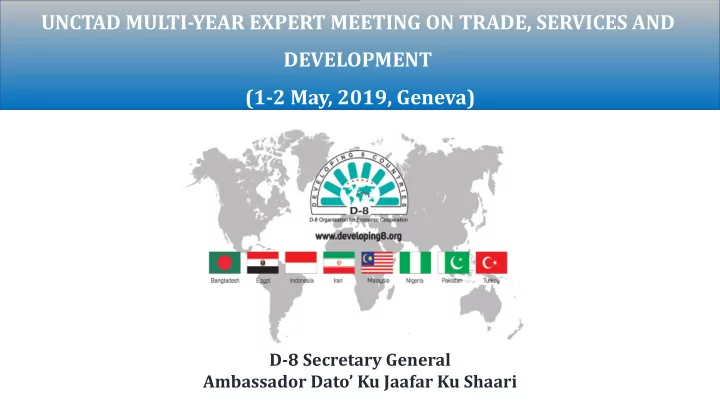
UNCTAD MULTI-YEAR EXPERT MEETING ON TRADE, SERVICES AND DEVELOPMENT (1-2 May, 2019, Geneva)
D-8 Secretary General Ambassador Dato’ Ku Jaafar Ku Shaari
UNCTAD MULTI-YEAR EXPERT MEETING ON TRADE, SERVICES AND DEVELOPMENT - - PowerPoint PPT Presentation
UNCTAD MULTI-YEAR EXPERT MEETING ON TRADE, SERVICES AND DEVELOPMENT (1-2 May, 2019, Geneva) D-8 Secretary General Ambassador Dato Ku Jaafar Ku Shaari Developing Eight (D-8): Who are we? D-8 is an international economic cooperation
D-8 Secretary General Ambassador Dato’ Ku Jaafar Ku Shaari
Malaysia, Nigeria, Pakistan and Turkey.
Government of eight Member States in Istanbul, Turkey.
namely Agriculture and Food Security, Trade, Industry, Tourism, Transportation and Energy.
Health, Education, SME Finance, Research and Development.
D-8 and TRADE IN SERVICES
4 trillion, total trade amounting to USD 1.5 trillion and 1.1 billion population, D-8 already is a major economic bloc. D-8 Member States will be in the list of the world’s top 24 economies in 2050 and the combined GDP of USD 38 trillion will make us the third biggest economy (Price Waterhouse Coopers)
make 23% of world trade with a total of USD 5.3 trillion. D-8 countries produce 4% of the total world output, 4.4% of the world merchandise exports but make only 2.8% of the global services exports, with USD 150 billion.
trade in services. In 2017 alone they ran a services deficit of USD 20 billion.
Services Trade Balance (2017)
Country Balance in value in 2017 Exported value in 2017 Imported value in 2017 Ranking United States of America 242.8 780.9 538.1 1 United Kingdom 135.7 350.7 214.9 2 Spain 62.8 139.1 76.3 3 China 33.7 38.3 4.6 4 India 30.0 184.0 154.0 5 Thailand 29.8 75.7 45.8 6 Hong Kong 26.5 103.7 77.2 7 Luxembourg 26.0 102.3 76.3 8 Poland 21.0 59.2 38.2 9 Turkey 19.9 44.0 24.1 10 Egypt 2.6 20.0 17.4 38 Pakistan
5.7 9.9 120 Malaysia
36.8 42.1 123 Bangladesh
3.9 9.3 124 Iran, Islamic Republic of
10.1 16.7 127 Indonesia
24.7 32.5 128 Nigeria
5.0 18.2 135
Source: ITC Trade Map
The Table ranks the countries according to their net export of services.
USD 242.8 billion trade balance.
run a trade surplus in services.
trade in services.
countries are net exporters of services, developing countries remain net importers. That holds true for the D-8 Member States as well.
them offering all-year round tourism services. Istanbul, Kuala Lumpur and Cairo airports rank among the busiest airports of their region. Malaysia is a financial hub especially for the Islamic finance products. In the past 30 years, Turkish contractors have undertaken 9000 projects in 115 countries, with a total value of 350 billion USD. Pakistan and Bangladesh are becoming regional powers in the export of software and IT services, with leaps amounting to 60-70% annually.
to the giants of the developed world and China.
These are US, UK, Germany, France and China. And what we see at the end of the day is an ever-
HOW TO DESIGN THE POLICY?
under the name of trade in services? To establish more two-star hotels, that will shut down at the instance of the first economic downturn? To sacrifice the industrial development for the sake of non-value adding services and being trapped in a “premature deindustrialization”? Absolutely not.
addition that will nurture other sectors, namely agriculture and industry through productive and efficient linkages.
IMPORTANCE OF DATA and ANALYSIS
services is that it is intangible hence very hard to quantify. I must commend the work of national institutions and all international organizations especially UNCTAD working so hard to extract and compile “trade in value added data”, for that it tells a rather different and somehow shocking story
the manufacturing industry. Indeed, in year 2015, it exported a total of USD 142 billion in this
Turkey has 33% foreign value-added component. It is as high as 27 % for motor vehicles sector. Given the pressing issue of current account deficit, how to address this problem is a priority.
ANALYSIS and SETTING NATIONAL PRIORITIES
We should read data carefully and find ways on how best to benefit from the global value chains. We should address three questions specifically, 1) Does the foreign value added to my exports, in other words the backward linkages, boost technology transfer? If not how may I ensure that through policy? 2) How much of this value addition can I substitute with domestic industry? 3) How should I increase my presence in the value chains and provide value addition to other markets? In
Every developing nation should work carefully on these questions and seek ways to increase their presence in the global value chains, especially in the services sector.
REGIONAL TRADE AGREEMENTS and TRADE
the regional trade agreements and services provisions.
12 of them have provisions related to services trade. Egypt, Nigeria, Bangladesh, Iran have none. Malaysia is the most progressive among all with 10 agreements. Turkey’s only RTA with service provisions is the one with Singapore, signed as recent as in 1 October, 2017.
expertise of making better investment deals, especially with the developed countries.
stands ready to partner with EU and international organizations with the relevant expertise to develop such
policy agenda.
TRADE FACILITATION IN SERVICES and A COMMON VOICE
level of policy coordination among the countries of the Global South.
feelings among developing countries can at best be defined as “mixed”. Some countries are for and some are against on various grounds. I believe the Global South is as strong as the common voice it has. Whatever our position is, we should start establishing a dialogue among ourselves and discuss the agreement.
domestic ratification process. Estimates show that the full implementation of the TFA could reduce trade costs by an average of 14.3% and boost global trade by up to $1 trillion per year, with the biggest gains in the poorest countries. We should work on the TFS in a similar fashion and see how best we can customize it to
D-8 INITIATIVES and TRADE in SERVICES UNCTAD-FAO-D8 Partnership
Meeting under the theme of “Strengthening Agro Business Value Chains”.
and are lagging behind in particular when it comes to exploiting the potential of services, especially in agriculture.
with a focus on small-holder farmers.
provide continous assistance and supervision to countries on ways to move up the Global Value Chain ladder.
D-8 INITIATIVES and TRADE in SERVICES KOMEPS FinTech and D8P Card
D-8 countries that will reduce financial intermediation from third parties and increase the financial services trade among D-8 Member States.
base, without the intermediation of leading currencies.
D-8 INITIATIVES and TRADE in SERVICES D-8 Aviation Network
Network.
States.
D-8 INITIATIVES and TRADE in SERVICES D-8 Industrial Zone
industry namely the manufacturing sector.
Zone.
with a priority to foster transfer of knowledge in airplane parts. The zone will nurture the value chain create new linkages for the trade in services.
Istanbul