Uncertainty of satellite-derived DNI data in arid regions from the - - PowerPoint PPT Presentation

uncertainty of satellite derived dni data in arid regions
SMART_READER_LITE
LIVE PREVIEW

Uncertainty of satellite-derived DNI data in arid regions from the - - PowerPoint PPT Presentation

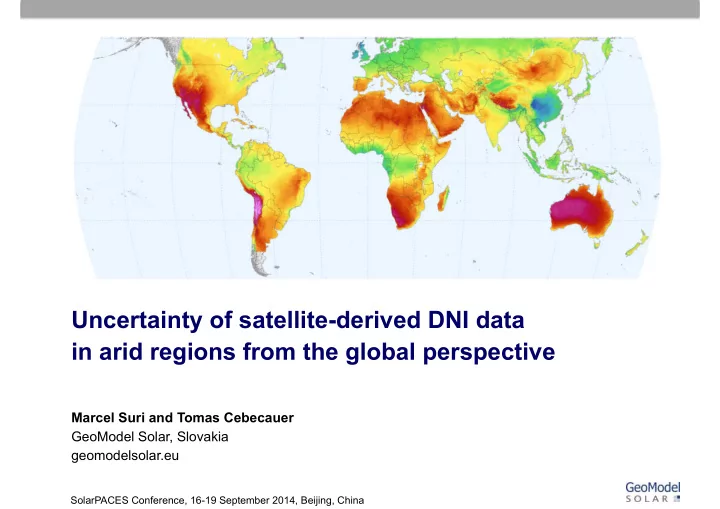
Uncertainty of satellite-derived DNI data in arid regions from the global perspective Marcel Suri and Tomas Cebecauer GeoModel Solar, Slovakia geomodelsolar.eu SolarPACES Conference, 16-19 September 2014, Beijing, China [1] SolarPACES


slide-1
SLIDE 1

SolarPACES Conference, 16-19 September 2014, Beijing, China [1]

Uncertainty of satellite-derived DNI data in arid regions from the global perspective

Marcel Suri and Tomas Cebecauer GeoModel Solar, Slovakia geomodelsolar.eu

SolarPACES Conference, 16-19 September 2014, Beijing, China

slide-2
SLIDE 2

SolarPACES Conference, 16-19 September 2014, Beijing, China [2]

About GeoModel Solar

Development and operation of SolarGIS online system

  • Solar resource and meteo database
  • Data services for solar energy:
  • Planning
  • Monitoring
  • Forecasting

Bankable expert services for CSP

  • Quality characterization of measured DNI
  • Site-adaptation and TMY
  • Solar resource assessment
  • Country studies

http://solargis.info

slide-3
SLIDE 3

SolarPACES Conference, 16-19 September 2014, Beijing, China [3]

Topics

  • 1. Ground measurements and satellite-based solar models
  • 2. Measures of model uncertainty - bias
  • 3. Site adaptation of satellite data
  • 4. Uncertainty - conclusions
slide-4
SLIDE 4

SolarPACES Conference, 16-19 September 2014, Beijing, China [4]

Topics

  • 1. Ground measurements and satellite-based solar models
  • 2. Measures of model uncertainty - bias
  • 3. Site adaptation of satellite data
  • 4. Uncertainty - conclusions
slide-5
SLIDE 5

SolarPACES Conference, 16-19 September 2014, Beijing, China [5]

Requirements for solar resource data

  • Data to be available at any location (continuous coverage)
  • Long climate record
  • High accuracy (validated)
  • High level of detailed (temporal, spatial)
  • Continuous:
  • Historical data
  • Data for monitoring, nowcasting
  • Data for forecasting
  • Correlation of satellite and ground data

This is available with satellite-based data, supported by high-quality ground measurements

SolarGIS database

slide-6
SLIDE 6

SolarPACES Conference, 16-19 September 2014, Beijing, China [6]

How ¡to ¡acquire ¡solar ¡resource ¡data ¡

Satellite-­‑based ¡models ¡

  • Extensive ¡geographical ¡coverage ¡and ¡con3nuity ¡
  • Historical ¡availability ¡(12 ¡to ¡20+ ¡years ¡available) ¡
  • Spa3al ¡and ¡temporal ¡stability ¡

¡ ¡ ¡ On-­‑site ¡measurements ¡

  • Accuracy ¡
  • Frequency ¡of ¡measurements ¡

¡

Source: GeoSUN Africa Source: SolarGIS

slide-7
SLIDE 7

SolarPACES Conference, 16-19 September 2014, Beijing, China [7]

On-­‑site ¡measurements ¡

Several companies offer a professional service:

  • Best available instruments and approaches
  • Site selection, meteo station configuration
  • Data logging
  • Cleaning, maintenance, calibration
  • Data quality control
  • Extreme climate needs special focus

Source: GeoSUN Africa

slide-8
SLIDE 8

SolarPACES Conference, 16-19 September 2014, Beijing, China [8]

On-­‑site ¡(ground) ¡measurements ¡

¡ ¡

¡ Instruments ¡and ¡their ¡accuracy1 ¡

¡

¡ ¡ ¡ ¡ Pyrheliometers ¡ RSR2 ¡ SPN1 ¡ Secondary ¡standard ¡ First ¡class ¡ ¡ ¡ ¡ ¡ Direct ¡Normal ¡ Irradiance, ¡DNI ¡ ±0.5% ¡ ±1.0% ¡ ±3 ¡to ¡±4% ¡ ±5% ¡ ¡ ¡ ¡ ¡ Pyranometers ¡ RSR2 ¡ SPN1 ¡ Secondary ¡standard ¡ First ¡class ¡ Second ¡class ¡ ¡ ¡ ¡ ¡ Global ¡Horizontal ¡ Irradiance, ¡GHI ¡ ±2% ¡ ±5% ¡ ±10% ¡ ±3.5% ¡ ±5% ¡

1 ¡Daily ¡summaries, ¡at ¡95% ¡confidence ¡level ¡in ¡laboratory ¡condi3ons; ¡ ¡

¡ ¡in ¡real ¡condi3ons ¡assuming ¡rigorous ¡opera3on ¡and ¡maintenance ¡prac3ces ¡

2 ¡AOer ¡post ¡processing ¡

slide-9
SLIDE 9

SolarPACES Conference, 16-19 September 2014, Beijing, China [9]

On-­‑site ¡(ground) ¡measurements ¡

¡ ¡

¡ Instruments ¡and ¡their ¡accuracy1 ¡

¡

¡ ¡ ¡ ¡ Pyrheliometers ¡ RSR2 ¡ SPN1 ¡ Secondary ¡standard ¡ First ¡class ¡ ¡ ¡ ¡ ¡ Direct ¡Normal ¡ Irradiance, ¡DNI ¡ ±0.5% ¡ ±1.0% ¡ ±3 ¡to ¡±4% ¡ ±5% ¡ ¡ ¡ ¡ ¡ Pyranometers ¡ RSR2 ¡ SPN1 ¡ Secondary ¡standard ¡ First ¡class ¡ Second ¡class ¡ ¡ ¡ ¡ ¡ Global ¡Horizontal ¡ Irradiance, ¡GHI ¡ ±2% ¡ ±5% ¡ ±10% ¡ ±3.5% ¡ ±5% ¡

1 ¡Daily ¡summaries, ¡at ¡95% ¡confidence ¡level ¡in ¡laboratory ¡condi3ons; ¡ ¡

¡ ¡in ¡real ¡condi3ons ¡assuming ¡rigorous ¡opera3on ¡and ¡maintenance ¡prac3ces ¡

2 ¡AOer ¡post ¡processing ¡

slide-10
SLIDE 10

SolarPACES Conference, 16-19 September 2014, Beijing, China [10]

Satellite-­‑based ¡models ¡

Modern ¡models ¡are ¡based ¡on ¡sound ¡theoreFcal ¡grounds ¡

  • Best ¡available ¡algorithms ¡(clear-­‑sky, ¡cloud, ¡components, ¡terrain, ¡transposi3on) ¡
  • Geographically ¡and ¡temporally ¡consistent ¡ ¡
  • Fast ¡and ¡computa3onally ¡stable ¡

¡ Input ¡data: ¡satellite, ¡aerosols, ¡water ¡vapor, ¡... ¡

  • Global ¡data ¡sets ¡
  • "High" ¡resolu3on ¡(spa3al ¡and ¡temporal) ¡
  • Systema3cally ¡updated ¡
  • Quality ¡controlled ¡and ¡validated ¡

¡ Support ¡data ¡and ¡algorithms ¡ ¡ Refresh ¡rate: ¡15 ¡and ¡30 ¡minutes ¡ Spa3al ¡resoluton ¡3 ¡to ¡6 ¡km ¡

slide-11
SLIDE 11

SolarPACES Conference, 16-19 September 2014, Beijing, China [11]

Satellite-based solar models

Semi-empirical approach: example SolarGIS

slide-12
SLIDE 12

SolarPACES Conference, 16-19 September 2014, Beijing, China [12]

Source: NOAA

Satellite data: calculation of cloud transmittance

PRIME IODC GOES ¡East Pacific GOES ¡West 0° 57.5°

  • ­‑75°

145°

  • ­‑135°

2013 2012 2011 2010 2009 2008 2007 2006 2005 2004 2003 2002 2001 2000 1999 1998 1997 1996 1995 1994 GOES ¡10, ¡11, ¡15 MSG ¡1,2,3 MFG ¡4-­‑7 MFG ¡5,7 GOES ¡8,12,13,14 MTSAT ¡1,2 GOES ¡9 GMS ¡5

slide-13
SLIDE 13

SolarPACES Conference, 16-19 September 2014, Beijing, China [13]

  • Satellite pixel integrates cloud signal

from an area ~3 to 6 km

  • Ground instrument provides

a pinpoint measurement

Attenuation of solar irradiance due to clouds

slide-14
SLIDE 14

SolarPACES Conference, 16-19 September 2014, Beijing, China [14]

Improvements in SolarGIS:

  • Snow/ice/fog conditions
  • Tropical clouds
  • High mountains
  • Deserts (reflecting surfaces,

high clouds, dust)

  • Coastal zones

Satellite model: adapted to different geographies

Source: EUMETSAT

slide-15
SLIDE 15

SolarPACES Conference, 16-19 September 2014, Beijing, China [15]

Satellite-based solar models

Semi-empirical approach: example SolarGIS

slide-16
SLIDE 16

SolarPACES Conference, 16-19 September 2014, Beijing, China [16]

Riyadh, Saudi Arabia (AERONET vs. MACC-II data)

Aerosols: key info on the state of the atmosphere

Atmospheric aerosols change rapidly (Daily values: MACC-II model)

Source: AERONET, ECMWF

slide-17
SLIDE 17

SolarPACES Conference, 16-19 September 2014, Beijing, China [17]

Aerosols: uncertainty due to spatial resolution

MACC AOD pixel 1.125x1.125 deg.

Malaga (Spain)

DNI bias +12%

Empirical altitude adaptation Complex geography: inter-pixel variability Site-adaptation for local climate

slide-18
SLIDE 18

SolarPACES Conference, 16-19 September 2014, Beijing, China [18]

Average deviation: AERONET measurements – MACC model data

  • More than 365 days of data: 235 sites
  • Overall slight overestimation by MACC
slide-19
SLIDE 19

SolarPACES Conference, 16-19 September 2014, Beijing, China [19]

Why satellite data do not match perfectly the ground measurements?

Ground ¡measured ¡data ¡may ¡deviate ¡from ¡satellite ¡DNI ¡because ¡of: ¡

  • Size ¡of ¡the ¡satellite ¡pixel ¡and ¡sampling ¡rate ¡
  • Resolu3on ¡and ¡limita3ons ¡of ¡the ¡input ¡amtospheric ¡data ¡
  • Imperfec3ons ¡of ¡the ¡solar ¡models ¡ ¡
  • Site ¡specific ¡microclimate ¡
  • Issues ¡in ¡ground ¡measurements ¡

3.5 km

slide-20
SLIDE 20

SolarPACES Conference, 16-19 September 2014, Beijing, China [20]

Topics

  • 1. Ground measurements and satellite-based solar models
  • 2. Measures of model uncertainty - bias
  • 3. Site adaptation of satellite data
  • 4. Uncertainty - conclusions
slide-21
SLIDE 21

SolarPACES Conference, 16-19 September 2014, Beijing, China [21]

Measures of solar model accuracy

Bias Systematic model deviation Root Mean Square Deviation (RMSD) Mean Average Deviation (MAD) Spread of error of instantaneous values Kolmogorov-Smirnoff index (KSI) Representativeness of distribution

  • f values

....

slide-22
SLIDE 22

SolarPACES Conference, 16-19 September 2014, Beijing, China [22]

Measures of solar model accuracy

Bias Systematic model deviation Relates to the accuracy of longterm estimates Root Mean Square Deviation (RMSD) Mean Average Deviation (MAD) Spread of error of instantaneous values Kolmogorov-Smirnoff index (KSI) Representativeness of distribution

  • f values

....

slide-23
SLIDE 23

SolarPACES Conference, 16-19 September 2014, Beijing, China [23]

How ¡to ¡understand ¡“Bias” ¡

Assessment ¡of ¡the ¡systemaFc ¡solar ¡model ¡behaviour: ¡

¡ Mean ¡bias ¡(MB) ¡

  • Shows ¡overall ¡tendency ¡of ¡the ¡model ¡to ¡overes3mate ¡or ¡to ¡underes3mate ¡

(e.g. ¡long-­‑term ¡yearly ¡es3mates) ¡ ¡ Standard ¡deviaFon ¡of ¡bias ¡values ¡(residuals, ¡SD) ¡

  • Range ¡of ¡devia3on ¡of ¡the ¡model ¡es3mates ¡
  • Shows ¡geographical ¡stability ¡of ¡the ¡model ¡(e.g. ¡in ¡areas ¡with ¡no ¡valida3on ¡sites) ¡

¡

slide-24
SLIDE 24

SolarPACES Conference, 16-19 September 2014, Beijing, China [24]

Example: ¡independent ¡evaluaFon ¡

MB: 0% SD: 2% MB: -2% SD: 6%

Ineichen ¡P., ¡2013. ¡Long ¡term ¡satellite ¡hourly, ¡daily ¡and ¡monthly ¡global, ¡beam ¡and ¡ ¡ diffuse ¡irradiance ¡valida3on. ¡interannual ¡variability ¡analysis. ¡University ¡of ¡Geneva, ¡IEA ¡Task ¡46. ¡

DNI GHI

slide-25
SLIDE 25

SolarPACES Conference, 16-19 September 2014, Beijing, China [25]

User’s ¡uncertainty ¡– ¡longterm ¡esFmate ¡

Standard deviation of bias values for all validation sites (STDEV) Probabilistic approach (normal distribution) for uncertainty:

  • 80% occurrence of values (90% exceedance, P90)

solar industry standard, 1.282*STDEV

  • 95% occurrence of values (97.5% exceedance, P97.5)

standard in meteo instruments, 1.960*STDEV Objective: lowest possible uncertainty, i.e. to have P90 as close as possible to P50

slide-26
SLIDE 26

SolarPACES Conference, 16-19 September 2014, Beijing, China [26]

User’s ¡uncertainty ¡– ¡longterm ¡esFmate ¡

  • Uncertainty of the model relative to the measurements
  • Uncertainty of measurements
  • Uncertainty due to interannual variability

!"#$%&!"#$ =! !"#$%&!"#$%

! + !"#$%&!"#$%&"!"'($ !!+!!"#$%&!"#$"%$& !!

slide-27
SLIDE 27

SolarPACES Conference, 16-19 September 2014, Beijing, China [27]

DNI ¡uncertainty ¡due ¡to ¡interannual ¡variability ¡

Availability ¡of ¡satellite ¡data: ¡

  • Data ¡for ¡12+ ¡to ¡20+ ¡years ¡
  • Large ¡volcano ¡erup3ons ¡not ¡considered ¡ ¡

(stratosferic ¡aerosols) ¡ ¡ ¡

Standard ¡devia3on ¡of ¡yearly ¡DNI ¡ from ¡the ¡longterm ¡average: ¡ ¡

  • Any ¡year: ¡±14% ¡to ¡±3%

¡ ¡

  • 15 ¡or ¡more ¡years: ¡±4% ¡to ¡±1% ¡
slide-28
SLIDE 28

SolarPACES Conference, 16-19 September 2014, Beijing, China [28]

User’s ¡uncertainty ¡– ¡SolarGIS ¡DNI ¡longterm ¡esFmate ¡

  • Uncertainty of the model relative to the measurements
  • Uncertainty of measurements
  • Uncertainty due to interannual variability: about ±1% in longterm*

* In desert zones, not considering stratospheric volcano eruptions

slide-29
SLIDE 29

SolarPACES Conference, 16-19 September 2014, Beijing, China [29]

GHI DNI

±4.4%* ±7.7%*

User’s uncertainty − SolarGIS

* 80% occurrence

slide-30
SLIDE 30

SolarPACES Conference, 16-19 September 2014, Beijing, China [30]

GHI DNI

±4.4%* ±7.7%*

User’s uncertainty − SolarGIS

* 80% occurrence

slide-31
SLIDE 31

SolarPACES Conference, 16-19 September 2014, Beijing, China [31]

User’s ¡uncertainty ¡– ¡longterm ¡esFmate ¡

Model uncertainty Uncertainty

  • f the model and

measurements Annual value GHI DNI GHI DNI

  • Uncert. of instruments*
  • 2.0

1.0 Number of sites 189 134 189 134 Standard deviation 3.0 6.0 3.6 6.0 Uncertainty (probability

  • f occurrence)

80% P90 3.9 7.6 4.4 7.7 90% P95 5.0 9.8 5.4 9.9 95% P97.5 5.9 11.7 6.3 11.7 99% P99.5 7.8 15.4 8.1 15.4

* Vuilleumier et al., 2014. Performance evaluation of radiation sensors for the solar energy sector. MACC–II OSC, Brussels.

SolarGIS global performance: estimate of yearly GHI and DNI

slide-32
SLIDE 32

SolarPACES Conference, 16-19 September 2014, Beijing, China [32]

  • Uncertainty of the model relative to the measurements: ±7% to ±15%
  • Uncertainty of measurements*

: ±1%

  • Uncertainty due to interannual variability

!"#$%&!"#$ =! !"#$%&!"#$%

! + !"#$%&!"#$%&"!"'($ !!+!!"#$%&!"#$"%$& !!

* Assuming DNI measurements by well-maintained first-class pyrheliometres

User’s ¡uncertainty ¡– ¡SolarGIS ¡DNI ¡longterm ¡esFmate ¡

slide-33
SLIDE 33

SolarPACES Conference, 16-19 September 2014, Beijing, China [33]

Hourly values Daily Monthly Yearly

SolarGIS: Uncertainty of Global Horizontal Irradiance

The uncertainty for ground sensors considers that they are well maintained, calibrated and data are quality controlled

Uncertainty of annual values for probability of exceedance: P99: 8.1% P95: 6.3% P90: 4.4%

SolarGIS high uncertainty

  • high latitudes
  • high mountains
  • high and changing aerosols
  • reflecting desert surfaces
  • snow and ice
  • tropical regions

SolarGIS low uncertainty

  • arid and semiarid regions
  • low and medium aerosols

Pyranometer: ¡ ±2%

slide-34
SLIDE 34

SolarPACES Conference, 16-19 September 2014, Beijing, China [34]

Hourly values Daily Monthly Yearly

Uncertainty of yearly values for probability of exceedance: P99: 15.4% P95: 11.7% P90: 7.7%

SolarGIS: Uncertainty of Direct Normal Irradiance

SolarGIS high uncertainty

  • high latitudes
  • high mountains
  • high and changing aerosols
  • reflecting desert surfaces
  • snow and ice
  • tropical regions

SolarGIS low uncertainty

  • arid and semiarid regions
  • low and medium aerosols

Pyrrheliometer: ¡ ±1%

slide-35
SLIDE 35

SolarPACES Conference, 16-19 September 2014, Beijing, China [35]

Topics

  • 1. Ground measurements and satellite-based solar models
  • 2. Measures of model uncertainty - bias
  • 3. Site adaptation of satellite data
  • 4. Uncertainty - conclusions
slide-36
SLIDE 36

SolarPACES Conference, 16-19 September 2014, Beijing, China [36]

Why site adaptation of satellite data

Ground measurements: short period (1-2 years), gaps, high accuracy, pinpoint Satellite data: long period (12 to 20 years), gaps free, lower accuracy, average

  • ver a region

Objective: Improve accuracy of satellite-based solar resource time series using information from ground measurements

GROUND MEASUREMENTS SATELLITE MODEL DATA

slide-37
SLIDE 37

SolarPACES Conference, 16-19 September 2014, Beijing, China [37]

  • High quality local DNI and GHI measurements
  • At least 12 months of measurements (24 and more recommended)
  • High quality satellite data
  • Systematic difference must be observed between ground data

and satellite data

  • Bias
  • Deviation in distribution of values

Conditions for site adaptation

slide-38
SLIDE 38

SolarPACES Conference, 16-19 September 2014, Beijing, China [38]

Systematic errors in the model inputs – overestimation of aerosols (example)

Conditions for site adaptation

slide-39
SLIDE 39

SolarPACES Conference, 16-19 September 2014, Beijing, China [39]

Only high quality ground data can be used for site adaptation

  • Erroneous and suspicious measurements are excluded
  • Ground and satellite data are compared using only valid data pairs
  • Aggregated data (daily, monthly, yearly) cannot be compared

Blue – excluded data; red - valid data

Qualification of ground measurements

slide-40
SLIDE 40

SolarPACES Conference, 16-19 September 2014, Beijing, China [40]

Site adaptation of satellite data

Original satellite data Satellite data after site adaptation

Mean Bias RMSD KSI Hourly Daily Monthly W/m2 % % % % DNI original

  • 23.7
  • 4.1

22.6 15.9 7.2 186 DNI adapted 3.4 0.6 21.0 13.4 4.5 23 GHI original

  • 4.0
  • 0.9

11.7 5.8 2.0 46 GHI adapted 0.1 0.0 11.2 4.7 1.0 17

slide-41
SLIDE 41

SolarPACES Conference, 16-19 September 2014, Beijing, China [41]

Topics

  • 1. Ground measurements and satellite-based solar models
  • 2. Measures of model uncertainty - bias
  • 3. Site adaptation of satellite data
  • 4. Uncertainty - conclusions
slide-42
SLIDE 42

SolarPACES Conference, 16-19 September 2014, Beijing, China [42]

SolarGIS ¡satellite ¡data ¡uncertainty ¡

DNI: ±4% GHI: ±2.5%

Best Achievable uncertainty today

DNI: 134 validation sites GHI: 189 validation sites

slide-43
SLIDE 43

SolarPACES Conference, 16-19 September 2014, Beijing, China [43]

Conclusions ¡2 ¡

Uncertainty ¡of ¡SolarGIS ¡DNI ¡longterm ¡es3mate ¡is ¡approximately: ¡

  • ±8% ¡at ¡P90 ¡
  • ±15% ¡at ¡P99.5 ¡

¡ Valida3on ¡over ¡134 ¡DNI ¡sites ¡and ¡235 ¡AERONET ¡sites ¡proves ¡stability ¡of ¡SolarGIS ¡ model ¡in ¡3me ¡and ¡across ¡all ¡geographies ¡ ¡ Site ¡adapta3on ¡based ¡on ¡several ¡years ¡of ¡high ¡quality ¡ground ¡measurements ¡ ¡ can ¡reduce ¡uncertainty ¡of ¡annual ¡DNI ¡to ¡±4% ¡ ¡ Uncertainty ¡of ¡satellite-­‑based ¡solar ¡resource ¡cannot ¡be ¡lower ¡than ¡those ¡of ¡ ground ¡instruments ¡(even ¡if ¡bias ¡to ¡the ¡measured ¡data ¡is ¡0, ¡data ¡uncertainty ¡ remains) ¡ ¡

slide-44
SLIDE 44

SolarPACES Conference, 16-19 September 2014, Beijing, China [44]

Thank ¡you! ¡

Marcel ¡Suri ¡ Tomas ¡Cebecauer ¡ ¡

¡

GeoModel ¡Solar, ¡Slovakia ¡ hgp://gemodelsolar.eu ¡

¡