12/11/2012 International Crops Research Institute for the Semi-Arid - - PDF document

12 11 2012
SMART_READER_LITE
LIVE PREVIEW

12/11/2012 International Crops Research Institute for the Semi-Arid - - PDF document

12/11/2012 International Crops Research Institute for the Semi-Arid Tropics Water4Crops-I ndia The only Global R&D Organization I ntegrating bio-treated wastewater for Semi-Arid Agriculture reuse with enhanced water use ICRISATs


slide-1
SLIDE 1

12/11/2012 1

I ntegrating bio-treated wastewater reuse with enhanced water use efficiency to support the green economy in EU and I ndia (I ndia side)

SP Wani and Team

I nternational Crops Research I nstitute ffor the Semi-Arid Tropics (I CRI SAT) Patancheru 502 324, Andhra Pradesh, I ndia

SP Wani and Team

I nternational Crops Research I nstitute ffor the Semi-Arid Tropics (I CRI SAT) Patancheru 502 324, Andhra Pradesh, I ndia

Water4Crops-I ndia

The only Global R&D Organization for Semi-Arid Agriculture International Crops Research Institute for the Semi-Arid Tropics

ICRISAT’s Vision

A prosperous, food-secure and resilient dryland tropics

ICRISAT’s Mission

Reduce poverty, hunger, malnutrition and environmental degradation in the dryland tropics

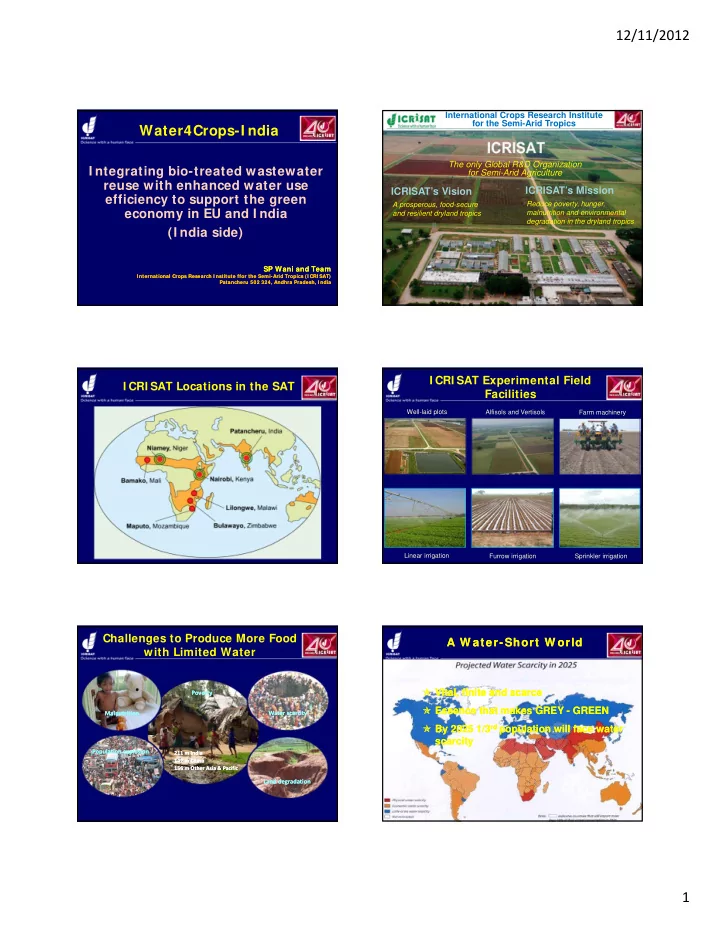
I CRI SAT Locations in the SAT

Alfisols and Vertisols Farm machinery Well-laid plots Furrow irrigation Sprinkler irrigation Linear irrigation

I CRI SAT Experimental Field Facilities

Poverty Poverty Population explosion Population explosion Water scarcity Water scarcity Land degradation Land degradation Malnutrition Malnutrition

211 m India 142 m China 156 m Other Asia & Pacific 211 m India 142 m China 156 m Other Asia & Pacific

Challenges to Produce More Food with Limited Water A W ater-Short W orld A W ater-Short W orld

 Vital, finite and scarce  Essence that makes GREY - GREEN  By 2025 1/3rd population will face water scarcity  Vital, finite and scarce  Essence that makes GREY - GREEN  By 2025 1/3rd population will face water scarcity  Vital, finite and scarce  Essence that makes GREY - GREEN  By 2025 1/3rd population will face water scarcity  Vital, finite and scarce  Essence that makes GREY - GREEN  By 2025 1/3rd population will face water scarcity

slide-2
SLIDE 2

12/11/2012 2

Rainfed Agriculture in Need of Resource Conservation Technology Rainfed Agriculture in Need of Resource Conservation Technology

Vulnerability of impacts

  • f climate change

Land degradation Low water use efficiency Water scarcity and drought Source: Falkenmark and Rockstrom 2004

2 000 4 000 6 000 8 000 10 000 1960 1970 1980 1990 2002 2015 2030 2050 year km

3

Increase to reach the Hunger Goal 2015 2002 base line

Balanced diet will need 1300 m3 person‐1 year‐1 With improved water productivity (1800 1200 m3 t‐1) additional water demand will be: By 2015 1815 km3 By 2030 3000 km3

Water Demand to meet MDG

Present and Anticipated Future Fresh Water Demand for Food Production and Other uses in I ndia

Source: Central water commission, 2005

Year Population (Million) Per capita water availability M3/year 1951 361 5177 1955 395 4732 1991 846 2209 2001 1027 1820 2025 1394 1341 2050 1640 1140

Source: Govt. of India, Ministry of Water Resources, 2009

Per Capita Water Availability in I ndia

Year

1970 1980 1990 2000 2010 2020 2030 2040 2050 2060

Urban Population (Millions)

200 400 600 800 1000 1200

Wastewater Generation (Million m3/day)

20 40 60 80 100 120 140

Urban Population Wastewater generation

Present and Anticipated Future Urban Population and Wastewater Generation in I ndia

Source: Ministry of Environment & Forests, 2007

Water4Crops‐India

Collaborative Projects KBBE.2012.3.5‐03: Biotechnological wastewater treatments and reuse in agronomical systems Proposal Title Integrating bio‐treated wastewater reuse with enhanced water use efficiency to support the green economy in EU and India (India side) Duration 48 months Call identifier FP7‐KBBE‐2012‐6‐Singlestage

About the Project

slide-3
SLIDE 3

12/11/2012 3

Sustainable I ntensification of Agriculture

  • To provide food for growing
  • To produce biomass as population feed and

resource to produce chemicals and energy

  • Water availability and soil health are critical

factors

Water 4 Crops

To provide sustainable solutions through

  • Increasing water availability by developing

new technologies to treat and reuse wastewater

  • Using water more efficiently in irrigation
  • Better management of water, land and

crops to develop viable, stronger and green economy

  • Develop and demonstrate integrated treatment processes for

agro-food industry effluents targeted for recovery of economically useful components and recycling of water suitable for irrigation

  • Selection and optimization of fungal consortium to remove

contaminants from municipal wastewater for re-use in agriculture

  • Enhancing water use efficiency through improved irrigation

systems, agronomic practices and using validated simulation models

  • Assess impacts of treated wastewater on soil, crop produce

and groundwater quality

  • I ncreasing sea water use efficiency through I ntegrated

Mangrove-Fishery Farming System

Objectives

 Mapping and characterization of quantitative trait loci (QTL) for drought tolerance related traits in maize, sorghum, pearl millet and chickpea  I mproving drought adaptation using marker-assisted breeding and trait-based selection approaches in maize, sorghum, pearl millet and chickpea, and transgenic approaches in chickpea  Evaluate and optimize the proposed combinations of bio- treatment and wastewater reuse from a perspective of supporting green growth and to boost interaction between knowledge organisations and industries of the European and I ndian parties

Continued

Objectives (Cont..)

  • Production of water for irrigation from wastewater and return
  • f nutrients and fertilizer to the land
  • Recovery of specific high-value products from the wastewater
  • Develop an easy and cheap microbial monitoring method to

control irrigation water quality for pathogens

  • Optimize domestic wastewater treatment, recycling and

discharge via constructed wetlands

  • Development of irrigation products, systems and strategies

coupling with irrigation systems

  • Modeling the impact of using poor quality water on crop and

soil quality

Objectives of Water 4 Crops (EU Side)

  • I mproved water use efficiency at field level through

genomics and breeding

  • Development of green economy by transdisciplinary co-

creation of agribusiness opportunities and water bio- treatment

  • Stimulate cross fertilization and knowledge transfer

between the WPS and activities in Europe and I ndia

  • Disseminate the newly developed technologies, new

economic concepts and local business demand

Objectives of Water 4 Crops (EU Side) (Cont..)
slide-4
SLIDE 4

12/11/2012 4

Work package Title WP1 Agro‐food industry wastewater valorization and reuse WP2 Municipal wastewater bio‐treatment and reuse WP3 Agricultural water management WP4 Development of water efficient crop varieties WP5 Enabling green growth using water treatment and reuse innovations WP6 Dissemination and technology exchange WP7 Management & Coordination

Work Packages

1 International Crops Research Institute for the Semi‐Arid Tropics (ICRISAT) 2 The Energy and Resources Institute (TERI) 3 Amity University Uttar Pradesh (AUUP) 4 University of Agricultural Sciences Dharwad (UASD) 5 MS Swaminathan Research Foundation (MSSRF) 6 National Environmental Engineering Research Institute (NEERI) 7 Jain Irrigation Systems Limited (JISL) 8 Euro India Research Centre (EIRC) 9 SABMiller (SABM) 10 University of Agricultural Sciences Bangalore (UASB) 11 PRAJ Matrix (PRAJM) 12 Ugar Sugar (UGSG) 13 Larsen & Toubro (L&T) 14 Ion Exchange

Consortium Partners

  • Consortium approach – Public Private Partnership
  • Mirror case approach
  • I nnovative modular biotechnological process
  • Co-learning and evolutionary
  • Co-creation of new products leading to new

business opportunities

Water 4 Crops: Strategy The Water4crops Principle

Waste water treatment plant, Bari IRSA Laboratory Bari/Rome Membrane treatment Sparta olive oil waste water treatment Laboratories BOLOGNA FHVW CEMAGREF Aix

Technology Development Hot Spots (Europe)

Ugar sugar works with Praj and Larsen & Toubro TERI Laboratory and field experiment facilities Jain Laboratory and field experiment facilities

Technology Development Hot Spots (India) Integration with EBCT Dissemination and technology transfer activities Mirror case (Europe) “Emalia Romagna” Mirror case (India) “Hyderabad” Technological option

Technological demand Technological demand

Technological option

  • Discuss

technological advances

  • Exploit business
  • pportunities
  • Facilitate

targeted training

  • Discuss

technological advances

  • Exploit business
  • pportunities
  • Facilitate

targeted training

Concept of the Mirror Cases

Partners WP1 WP2 WP3 WP4 WP5 WP6 WP7 ICRISAT Y Y Y Y Y Y Y TERI Y Y Y Y AUUP Y Y Y Y UASD Y Y Y Y Y MSSRF Y Y Y Y Y NEERI Y Y Y Y Y JISL Y Y Y Y Y EIRC Y Y Y SABMiller Y Y Y Y Y UASB Y Y Y Y PRAJ Matrix Y Y Y Y Ugar Sugar Y Y Y Y Larsen & Toubro Y Y Y Y Ion Exchange Y Y

Distribution of Work Packages

slide-5
SLIDE 5

12/11/2012 5

No. Deliverable name Nature Months 1.1 Characterized samples of selected wastewater R 12 1.2 CW and HRTS systems demonstrated D 30 1.3 Demonstrated fungal decolourization system D 42 1.4 Algal treatment system demonstrated D 48 1.5 Carbons and membranes for the recovery of phenolics / pigments developed R 48 1.6 Impact of treated and untreated wastewater use on soil, crop and groundwater quality assessed R 48

WP1: Deliverables Agro-Food I ndustry Wastewater Valorization and Reuse

No. Deliverable name Nature Months 2.1 Selected efficient strains for fungal consortium identified R 12 2.2 Optimized fungal consortium for wastewater treatment developed R, O 24 2.3 Trials with fungal consortium, P. indica, and nano‐coated silver gravel for removal of contaminants from wastewater conducted R, O 36 2.4 Fungal active ingredient within consortium developed Gel with R, O 36 2.5 Impact of treated wastewater use in agriculture assessed R 48 WP2: Deliverables for I nnovations in Municipal Wastewater bio-treatment and Reuse No. Deliverable name Nature Months

3.1 Benchmark sites characterized R 12 3.2 Efficient irrigation system evaluated R, D 36 3.3 Impact of wastewater on crops, soil and groundwater documented R 48 3.4 Models for enhancing WUE at field and micro‐watershed level validated R 48 3.5 Increased land and sea water productivity D 48 3.6 Replicable model demonstrated as integrated bioshield and livelihood option D 48 3.7 Package of halophyte farming systemdeveloped D 48 3.8 Enhanced capacity of community, other stakeholders and MSSRF staff on sea water farming O 48 3.9 Availability of tool kit on IMFFS in print and multimedia format P 48

WP3: Deliverables for Agricultural Water Management

No. Deliverable name Nature Months 4.1 Information on the most adequate combinations of species/genotypes x environment x management for different drought scenarios in India and EU R 36 4.2 Information on QTL (QTL combination) underlying the drought adaptation traits in maize, sweet sorghum and pearl millet at particular drought stress environments R 36 4.3 Mechanisms for water use efficiency and salinity tolerance characterized across crop species R 48 4.4 Chickpea breeding lines with improved drought adaptation R 48 4.5 Well characterized DREB1A and P5CSF transgenic events of chickpea with improved drought tolerance R 46 4.6 Transgenic tomato over expressing PgNHX1, AVP1 and co- expressing PgNHX1 and AVP1 genes for salt tolerance R 48 4.7 Trained human resources in research on drought adaptation of crops and integrated breeding for drought adaptation O 48

WP4: Deliverables for Development of Water Efficient Crop Cultivars

No. Deliverable name Nature Months WP5- Enabling Green Growth using water treatment and reuse innovations 5.1 Database of stakeholders R 12 5.2 Report of agribusiness opportunities R 24 5.3 Position papers on wastewater topics R 48 WP6-Dissemination and technology exchange 6.1 Internal report on customer / entrepreneur demands and technological offer R 12 6.2 Webpage and Public Dissemination material R 6,12, 24, 36, 42 6.3 Report on training course including online curricula R 36 WP7-Management & Coordination 7.1 First year annual report to DBT R 12 7.2 Second year annual report to DBT R 24 7.3 Third year annual report to DBT R 36 7.4 Fourth year annual report to DBT R 48

Deliverables for WP5, WP6 and WP7

Similarity in Proposed Modules

  • f Europe and I ndia
slide-6
SLIDE 6

12/11/2012 6

Management Structure of the European and I ndian WATER4CROPS

project

Grey to Green Revolution by Greening the Drylands With your Help and Support, We can Make a Difference! Consortium Partners