
SLIDE 1
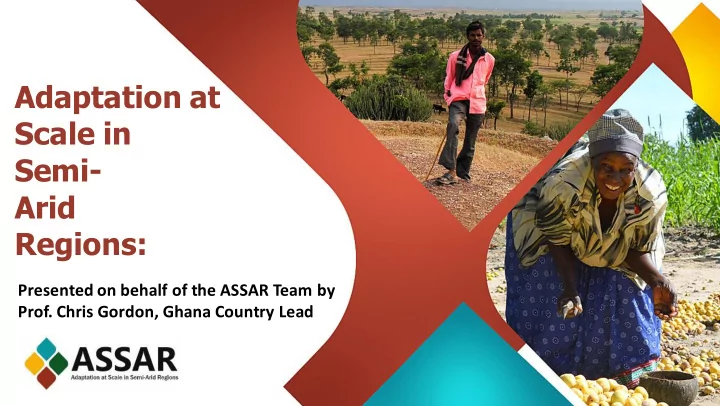
Adaptation at Scale in Semi- Arid Regions:
Presented on behalf of the ASSAR Team by
- Prof. Chris Gordon, Ghana Country Lead
Adaptation at Scale in Semi- Arid Regions: Presented on behalf - - PowerPoint PPT Presentation
Adaptation at Scale in Semi- Arid Regions: Presented on behalf of the ASSAR Team by Prof. Chris Gordon, Ghana Country Lead Adapt to climate change India and climate Mali variability Ghana Ethiopia Kenya Botswana Namibia Semi-arid
Namibia Botswana Ethiopia Kenya India Mali Ghana
Namibia Botswana Ethiopia Kenya India Mali Ghana
Namibia Botswana Ethiopia Kenya India Mali Ghana
WEST AFRICA SOUTHERN AFRICA INDIA EAST AFRICA Project Management Unit
Barriers and enablers Shifting the adaptation narrative Effective adaptation Research / practice interface Transformation Transformative scenario planning Migration/ Mobility
Ecosystems + Land change Knowledge Systems Governance Social Differences Wellbeing
Debt Death of household head Conflict Falsely accused of murder Conflict between families Drought
Job opportunities
Access to land and housing Conflict
Insecurity reduce access to livestock market
Traditional & no education Fear of the unknown
Obligation
Work mother’s farm Muslim wife Run aunt’s business Work farm and look after grandma
Community
Church provides school fees and food Support of Muslim community Recognition in the community
Established business
Hard to get new land
Moving out: reduced exposure to uncertainty from farm livelihoods BUT signals a narrowing of livelihood opportunities when we make agricultural systems unviable Moving in: increased exposure to non-climatic risks and potential narrowing of adaptation option space as they move into cities Adaptation is a behavioural change (towards more flexible, forward-looking decision-making); not seeing the same in migration process Broader implications of development pathways, trade-offs, thresholds
SDG1: No Poverty
inheritance, microfinance
SDG4: Quality education
SDG5: Gender equality
SDG8: Decent work and economic growth
SDG11: Sustainable cities and Communities
SDG13: Climate action
Research and Evidence Needs to help Policy makers and Communities: Which Critical investments into agriculture should be prioritized to support farming all year around? What Enterprise training and funding programmes should be promoted as alternative livelihood sources? How to support communities (religious/social etc.) serving as safety nets for vulnerable people? Who should be targeted to close the resource gap between urban and rural centers to reduce the rural- urban migration? Is it possible to address the challenges of rural urban drift by implementation of integrated Adaptation and SDGs policies.?
Supported by:
Project Website: www.assar.uct.za
Institute for Environment and Sanitation Studies Website: http://iess.ug.edu.gh/