UN ESCAP WORKSHOP Manila, 27-28/8/2019 MOTORCYCLISTS DRINK-DRIVING - - PowerPoint PPT Presentation

un escap workshop
SMART_READER_LITE
LIVE PREVIEW

UN ESCAP WORKSHOP Manila, 27-28/8/2019 MOTORCYCLISTS DRINK-DRIVING - - PowerPoint PPT Presentation

UN ESCAP WORKSHOP Manila, 27-28/8/2019 MOTORCYCLISTS DRINK-DRIVING BEHAVIOR AND SAFETY IMPACTS IN VIETNAM Dr. V Anh Tun Director, Vietnamese-German Transport Research Centre : +84 (0)913997953 : drtuan.va@vgtrc.vgu.edu.vn CONTENTS


slide-1
SLIDE 1

UN ESCAP WORKSHOP

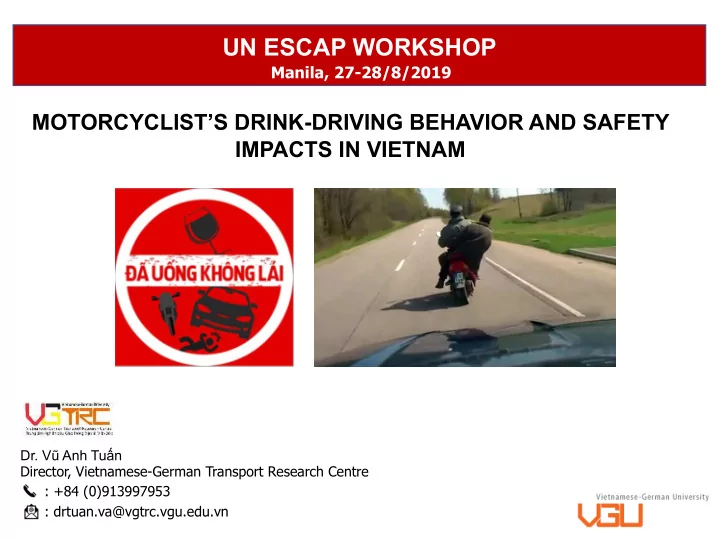
MOTORCYCLIST’S DRINK-DRIVING BEHAVIOR AND SAFETY IMPACTS IN VIETNAM

Manila, 27-28/8/2019

  • Dr. Vũ Anh Tuấn

Director, Vietnamese-German Transport Research Centre : +84 (0)913997953 : drtuan.va@vgtrc.vgu.edu.vn

slide-2
SLIDE 2

CONTENTS

27.08.19 VGU I VIETNAMESE-GERMAN UNIVERSITY 2

NECESSITY, OBJECTIVES, METHODS, DATA TRAFFIC ACCIDENT ANALYSIS DRINK-DRIVING OBSERVATION PSYCHOLOGICAL BEHAVIOR ANALYSIS EXPERIMENT ON SCOOTER DRIVING SIMULATOR PROPOSED SOLUTIONS

slide-3
SLIDE 3

NECESSITY OF RESEARCH (1)

27.08.19 VGU I VIETNAMESE-GERMAN UNIVERSITY 3

Drink-driving is an increasingly serious problem to traffic safety in Asia

  • 62% of victims of traffic accidents had a blood alcohol concentration

exceeding the permitted level (Global Alcohol Policy Alliance, 2002)

  • 45% of the victims died due to drink-driving behavior (Global Alcohol Policy

Alliance, 2002)

Drinking culture has been popular in Vietnam for a long time

  • 36% of motorbike drivers had a BAC exceeding the permitted level (WHO,

2012)

  • 40% of traffic accidents and 11% of fatal traffic accidents caused by

drink driving (NTSC, 2016) Implemented solutions to address the drink and drive behavior

  • Strengthening police patrol and punishment
  • Propagating the harmful effects of drink and drive
  • Promoting services to bring drinkers home from restaurants

The situation of drink-driving is still popular and traffic safety has not been significantly improved

slide-4
SLIDE 4

NECESSITY OF RESEARCH (2)

27.08.19 VGU I VIETNAMESE-GERMAN UNIVERSITY 4

International studies on drink and drive

  • Many studies on automobile drivers
  • Quite a few studies on large-displacement motorcycle drivers

Vietnam, no study on drink-driving behavior of MC drivers à lack of a comprehensive understanding of the problem

slide-5
SLIDE 5

RESEACH OBJECTIVES

27.08.19 VGU I VIETNAMESE-GERMAN UNIVERSITY 5

Determine relationships between drink-driving behavior and traffic accidents Quantify the effect of different BAC level on crash risk for motorbike drivers Suggest innovative solutions to cut down the number of drink-drive accidents

slide-6
SLIDE 6

SCOPE OF RESEARCH

27.08.19 VGU I VIETNAMESE-GERMAN UNIVERSITY 6

  • Motorcycle drivers in general
  • Motorcyclists who suffered from traffic

accidents due to drink-driving behavior

  • The others (Bus, Car, Truck drivers)

Subjects of research

  • HCMC
  • Binh Duong province
  • Hanoi City

Study areas

Source: Internet

slide-7
SLIDE 7

27.08.19 VGU I VIETNAMESE-GERMAN UNIVERSITY 7

Current Situation of Drink- Driving Behavior Traffic accident data (traffic police, hospital) Observation survey (6 restaurants) Cognitive and Psychological Factors One to one interview (309 samples) In-depth interview (88 samples) Effects of BAC level

  • n driving performance and

crash risk Experimental study on motorcycle simulation (38 people)

Proposing innovative solutions

Study findings & literature review Question 1 Question 2 Question 3

Relationship btw drink-driving and traffic accidents Effect of BAC level

  • n crash risk

Innovative solutions

RESEARCH FRAMEWORK AND DATA

slide-8
SLIDE 8

DATA COLLECTION / SURVEYS

27.08.19 VGU I VIETNAMESE-GERMAN UNIVERSITY 8

# Content Scope 1 General accident data Nationwide (C67) 2 Detailed accident data HCMC (PC67) Bình Dương (PC67) 3 Data collection at hospital Việt Đức hospital (Hà Nội) 4 Observation of drink-driving behavior HCMC (3 restaurants) Bình Dương (3 restaurants) 5 General interview HCMC Bình Dương 6 In-depth interview Việt Đức hospital (Hà Nội) 7 Scooter driving simulator experiment VGTRC/VGU (Bình Dương)

slide-9
SLIDE 9

27.08.19 VGU I VIETNAMESE-GERMAN UNIVERSITY 9

TRAFFIC ACCIDENTS BY DRINK-DRIVING IN VIETNAM

28% of motorcycle drivers hospitalized due to traffic accidents had BAC exceeding the permitted level (BAC = 50 mg / 100 ml) (Nguyen et al., 2013)

8.820% 26.470% 9.789% 8.845% 7.172% 3.980% 1.199% 6.670% 0.570% 1.556% 0.367% 0.138% 3.040% 21.400% 0.000% 5.000% 10.000% 15.000% 20.000% 25.000% 30.000%

S p e e d i n g W r

  • n

g w a y d r i v i n g I l l e g a l O v e r p a s s I l l e g a l t u r n i n g N

  • g

i v e w a y D r i n k D r i v i n g R u n n i n g t r a f f i c s i g n s V i

  • l

a t i

  • n
  • f

r u l e s I l l e g a l P a r k i n g N

  • D

r i v i n g L i c e n s e U n s a f e V e h i c l e , E q u i p m e n t U n s a f e R

  • a

d C

  • n

d i t i

  • n

P e d e s t r i a n O t h e r s

(NTSC, 2017)

slide-10
SLIDE 10

27.08.19 VGU I VIETNAMESE-GERMAN UNIVERSITY 10

LOCATIONS OF SURVEYED RESTAURANTS

Hùng Vương (Small) - BD Tiến Dũng REST (Medium) - BD Ngọc Mai (Large)

  • BD

Nam Định (Small) - HCMC 39 (Medium) - HCM Năm Cường (Large) - HCMC

Bình Dương HCMC

slide-11
SLIDE 11

27.08.19 VGU I VIETNAMESE-GERMAN UNIVERSITY 11

MODES USED FOR COMING AND GOING

62% people drove a motorcycle before and after drinking 6% people drove a car before and after drinking

62% 62% 26% 28% 6% 6% 4% 3% 1% 0% 1% 0% 20% 40% 60% 80% 100%

Arival ( N=433) Departure(N= 461) Walk Others ( self driving ) Taxi Car ( self driving ) To be carried MC ( self driving )

slide-12
SLIDE 12

27.08.19 VGU I VIETNAMESE-GERMAN UNIVERSITY 12

Normal 37% Reddish face 54% Red face 9%

Face Color

Normal 61% Unsteady 34% Wobbly 5%

Walking Characteris2cs

FACE COLOR AND WALKING FEATURE WHEN LEAVING

slide-13
SLIDE 13

27.08.19 VGU I VIETNAMESE-GERMAN UNIVERSITY 13 Yes 83% No 17%

The light on

No 64% Yes 36%

Signal while crossing the road

Yes 98% No 2%

Helmet wearing

Yes 26% No 74%

Driving in a wrong way

VIOLATIONS AT THE TIME OF LEAVING RESTAURANT

slide-14
SLIDE 14

IN-DEPTH INTERVIEW OF THE VICTIMS

27.08.19 VGU I VIETNAMESE-GERMAN UNIVERSITY 14

# Information Factors Quantity Ratio 1 Gender Male 85 97% Female 3 3% 2 Age 18-24 14 16% 25-30 25 28% 31-40 21 24% 41-60 16 18% >=61 12 14% 3 Occupation Worker 17 19% Office staff 15 17% Famer 9 10% Student 3 10% Small business 4 5% Seasonal worker 1 3% Housewife, retirement 9 1% Others 30 34% # Information Factor Quantity Ratio 4 Income <3M 39 44% 3-6M 9 10% 6-10M 37 42% 10-20M 2 2% >20M 1 1% 5 Residential area suburban 31 35% Downtown 30 34% Rural 27 31% 6 Daily used mode Motorcycle 77 88% Car 2 2% Bike, Ebike 5 6% Walk 4 5%

Demographic characteristics of respondents

  • Interview Period: Oct-Nov 2018
  • 88 respondents successfully interviewed (58 recovered + 30 still in hospital)

Interviewing motorcycle driver patients at Viet Duc hospital (Hanoi)

slide-15
SLIDE 15

REASONS FOR DECIDING DRIVING AFTER DRINKING

27.08.19 VGU I VIETNAMESE-GERMAN UNIVERSITY 15 45% 26% 15% 4% 4% 3% 3% 0% 0% 10% 20% 30% 40% 50%

I can ride motorcycles safely after drinking alcohol as always I take short distances so I think it is safe I don't want to disturb friends or call relatives I think with a little bit alcohol in my body, I will drive better I do not like motorcycle-taxi because it is not safe Taxi is expensive , and calling grab / uber will have to wait and also cost money There is no parking space for overnight parking I want to drive a motorbike because I have to go to another place

  • key misperception
slide-16
SLIDE 16

Status When Leaving and Severity Level

27.08.19 VGU I VIETNAMESE-GERMAN UNIVERSITY 16 18% 0% 27% 8% 55% 92% 0% 10% 20% 30% 40% 50% 60% 70% 80% 90% 100% Normal Unsteady

Walking Status and Severity Level

Moderate Serious Very Serious Normal 40% Unsteady 49% Wobbly 10% Fall down 1%

Walking status when taking the motorbike home

  • The victims who thought they were still

"normal" or being able to control their motorcycle had actually had higher rates

  • f injury than those who felt "unusual".
slide-17
SLIDE 17

0% 16% 14% 33% 38% 19% 55% 16% 7% 3% 0% 10% 20% 30% 40% 50% 60%

No drink 1-2 pint glass (1 ~ 2 can) 3-4 pint glass (3 ~ 5 can) 5-6 pint glass (6 ~ 8 can) >6 pint glass (8 can)

Before After 27.08.19 VGU I VIETNAMESE-GERMAN UNIVERSITY 17

Change in drink behavior “before” and “after” the accident (58 respondents)

A=er the traffic accident:

  • About 75% stop drinking or drink less (1-2 cups ~ 1-2 cans/ bo0les)
  • 10% sKll drink with high does (>5 cups ~ >6 cans/ bo0les)
slide-18
SLIDE 18

27.08.19 VGU I VIETNAMESE-GERMAN UNIVERSITY 18 7% 78% 14% 2% 15% 46% 21% 19% 0% 10% 20% 30% 40% 50% 60% 70% 80% 90% To be carried MC (self driving) Car (self driving) taxi

Vehicles used after being drunk

Before After

67%

Change in drink-driving behavior “before” and “after” the accident (58 respondents)

  • Since nearly two-thirds of the vicRms/respondents conRnue doing drink-

driving behavior à stronger soluRons and/or stricter regulaRons

slide-19
SLIDE 19

SIMULATOR-BASED EXPERIMENT

27.08.19 VGU I VIETNAMESE-GERMAN UNIVERSITY 19

To evaluate the influence of blood alcohol concentration on motorcycle driving performance To determine the relationship between blood alcohol concentration and probability of crash for motorcyclists

Objective 2 Objective 1

slide-20
SLIDE 20

27.08.19 VGU I VIETNAMESE-GERMAN UNIVERSITY 20

EXPERIMENTAL PROCEDURE

Steps in the experimental process

Blood alcohol concentration (BAC)

BAC = 50 BAC = 80 BAC = 100 BAC = 20

(mg/dL)

BAC = 0 Urban Highway Traffic environment

38 par3cipants running 359 3mes

slide-21
SLIDE 21

27.08.19 VGU I VIETNAMESE-GERMAN UNIVERSITY 21

EXPERIMENT FINDINGS qBAC range [ 0 mg to 20mg/100mL] has a little influence on motorcycle driving capacity qWhen BAC > 20mg/100mL, it has significant influences on the driver capacity to drive a motorcycle safely

FINDINGS

slide-22
SLIDE 22

45 49 54 60 60 27 29 33 37 39 10 20 30 40 50 60 70 20 50 80 100 km/h BAC (mg/100mL) Quốc lộ Đô thị

+ 8% (BAC=0) + 8% (BAC=0)

+25% ( BAC=0)

27.08.19 VGU I VIETNAMESE-GERMAN UNIVERSITY 22

  • Vehicle speed increases while BAC increases
  • BAC has a higher influence to vehicle speed on urban road than

national highway

+ 21% (BAC=0) + 32% (BAC=0) + 34% (BAC = 0) + 46% (BAC=0) + 38% (BAC=0)

THE FLUENCE ON SPEED

slide-23
SLIDE 23

27.08.19 VGU I VIETNAMESE-GERMAN UNIVERSITY 23

1.25 1.31 1.46 1.51 1.57

0.0 0.3 0.5 0.8 1.0 1.3 1.5 1.8 20 50 80 100 (second)

BAC (mg/100mL)

Reaction time

+ 5% (BAC=0)

  • The reaction time increases as BAC increases à BAC reduces the driver reaction capacity
  • Strongly increase at BAC = 20 or higher

+ 17% (BAC=0) + 21% (BAC=0) + 26% (BAC=0)

THE INFLUENCE ON REACTION TIME (time to brake or time to steer the wheel)

slide-24
SLIDE 24

27.08.19 VGU I VIETNAMESE-GERMAN UNIVERSITY 24

THE INFLUENCE ON REDLIGHT RUNNING

5% 9% 14% 31% 40% 3% 8% 17% 25% 34% 0% 10% 20% 30% 40% 50% 20 50 80 100 (red-light running percentage) BAC (mg/100mL)

Re Red light running rate

Quốc lộ Đô thị

  • The rate of red-light running increases as BAC increases
  • Strongly increase at BAC = 0.02 or higher
slide-25
SLIDE 25

27.08.19 25

THE INFLUENCE ON RELATIVE CRASH RISK

2.5 6.7 9.5 11.8 3.3 7.4 9.8 10.5 2.9 7.1 9.6 11.0 2 4 6 8 10 12 14 20 50 80 100 Relative risk increase (compared to BAC=0) (times) BAC (mg/100mL)

Đô thị Quốc lộ Chung

BAC = 50, the crask risk is higher 7 times (compare BAC = 0), BAC = 100, the crask risk is higher 11 times (compare BAC = 0). BAC = 20, the crask risk is higher 3 times (compare BAC = 0)

slide-26
SLIDE 26

THE VICTIMS’OPINION ON SUGGESTED SOLUTIONS

27.08.19 VGU I VIETNAMESE-GERMAN UNIVERSITY 26

70% 61% 74% 74% 71% 55% 30% 39% 26% 26% 29% 45%

0% 10% 20% 30% 40% 50% 60% 70% 80%

Encourage the use of non alcoholic beverages Test alcohol content on the spot and on the road Increasing fines twice the current level Increasing duration of temporary dentention… suspension of driver's license propaganda programs to prevent the harm done…

Solutions to prevent the violation (prevention)

No effectiveness Effectiveness

76% 63% 69% 24% 37% 31% 0% 20% 40% 60% 80% Restaurant have customer services to bring… Vehicles will not start when the driver has… installation of surveillance equipment on road

Solutions to mitigate the negative impacts (mitigation)

No effectiveness Effectiveness

slide-27
SLIDE 27

27.08.19 VGU I VIETNAMESE-GERMAN UNIVERSITY 27

PROPOSED LAWS & LAW ENFORCEMENT

# Solution Content Illustrations 1 Revision of Decree

  • No. 46 and Road

Law Apply Zero BAC as applied to car drivers (*) 2 Increase Penalty levels & Add new Penalties Applying stronger deterrent penalties, in addition, providing new educational penalties, such as public labor, traffic regulation participation 3 Enhance random BrAC test Police forces enhance random BrAC test on suspicious drivers; Establishing BrAC checkpoints on highways to identify suspicious drivers through observation devices

slide-28
SLIDE 28

27.08.19 VGU I VIETNAMESE-GERMAN UNIVERSITY 28

PROPOSED PROPAGANDA, EDUCATION & TRAINING (1)

# Solution Content Illustrations 4 Propaganda by victims of drink- driving accidents The victims of traffic accidents related to drink driving will present and sharing their story to students and communities 5 Establish a poster at restaurants, alcohol service places Information about accidents, the consequences of drink driving behavior will poste at the restaurant and places that serve alcohol 6 Warnings from relatives (mother, wife, etc.) Propaganda information should be disseminated to each household, warnings from relatives will help raise awareness for their man

slide-29
SLIDE 29

27.08.19 VGU I VIETNAMESE-GERMAN UNIVERSITY 29

PROPOSED PROPAGANDA, EDUCATION & TRAINING (2)

# Solution Content Illustrations

8 Education program for recidivist Recidivists will have to take an intensive training course about drink-driving behavior before they can drive their motorcycle on road again 9 Communication campaigns Advertising posters at public places, schools, hospitals, on roads, television, internet, social networks, vlogs, celebrities, and people have a great influence with key messages from this study 10 Education programs for children at schools Raise awareness for children, guide children with ways to remind family members about drink-driving behavior (using the results of this study & other studies)

slide-30
SLIDE 30

27.08.19 VGU I VIETNAMESE-GERMAN UNIVERSITY 30

PROPOSED ENGINEERING, TECHNOLOGY & SERVICES

# Solution Content Illustrations 11 Enhance taxi service to bring guests home safely Taxi, transport service companies shall coordinate with restaurants and bars to provide transport services to take drunk people home safely at appropriate cost 12 Encourage the use

  • f non- or low-

alcoholic beverages Coordinate with restaurants and convenience shops to provide non- and/or low-alcoholic drinking products for guests 13 Apply smartphone apps to warn alcohol concentration People will know how much they have been dirking, whether they violate the alcohol regulation, and give them advices on safety 14 Applying interlock

  • n motor vehicles

and motorcycles The system will request the driver to test their alcohol content. The engine will not work if excessive alcohol concentration in the breath is detected