UMBC A B M A L T F O U M B C I M Y O R T 1 - - PowerPoint PPT Presentation

umbc
SMART_READER_LITE
LIVE PREVIEW

UMBC A B M A L T F O U M B C I M Y O R T 1 - - PowerPoint PPT Presentation

Digital Systems Crosstalk I CMPE 650 Crosstalk Ground and power planes serve to: Provide stable reference voltages Distribute power to logic devices Control crosstalk Here, we derive formulas for computing crosstalk and show how


slide-1
SLIDE 1

Digital Systems Crosstalk I CMPE 650 1 (4/4/06)

UMBC

U M B C U N I V E R S I T Y O F M A R Y L A N D B A L T I M O R E C O U N T Y 1 9 6 6

Crosstalk Ground and power planes serve to:

  • Provide stable reference voltages
  • Distribute power to logic devices
  • Control crosstalk

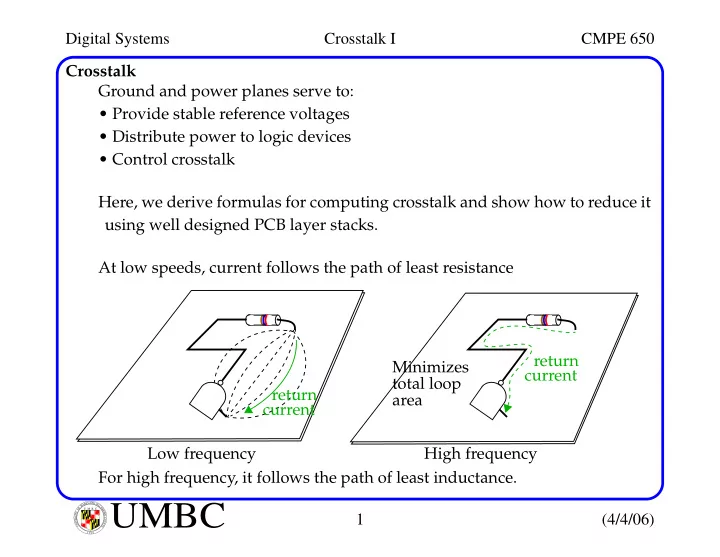
Here, we derive formulas for computing crosstalk and show how to reduce it using well designed PCB layer stacks. At low speeds, current follows the path of least resistance For high frequency, it follows the path of least inductance. return current Low frequency High frequency return current Minimizes total loop area

slide-2
SLIDE 2

Digital Systems Crosstalk I CMPE 650 2 (4/4/06)

UMBC

U M B C U N I V E R S I T Y O F M A R Y L A N D B A L T I M O R E C O U N T Y 1 9 6 6

Crosstalk The return current distribution: Here, we see a balance between two opposing forces. Too narrow a distribution increases inductance (skinny wires have more inductance than broad ones) and too broad a distribution increases inductance (by increasing loop area). The real distribution minimizes inductance. The current distribution given by this equation also minimizes the total energy stored in the magnetic field surrounding the signal wire. Cross section of PCB W Ground Signal trace Current density H D Current density for a point D inches away from trace. i D ( ) I0 πH

  • 1

1 D H ⁄ ( )2 +

  • A in.

⁄ =

slide-3
SLIDE 3

Digital Systems Crosstalk I CMPE 650 3 (4/4/06)

UMBC

U M B C U N I V E R S I T Y O F M A R Y L A N D B A L T I M O R E C O U N T Y 1 9 6 6

Crosstalk in Solid Ground Planes Crosstalk depends on the amount of mutual inductance and capacitance. We focus on inductive crosstalk since it is usually as big or bigger than capacitive crosstalk in digital systems. We covered the theory of mutual inductance coupling earlier. Returning signal currents generate magnetic fields, which induce volt- ages in other circuit traces. The induced voltages are proportional to the derivative of the driving sig- nal, e.g., faster rise times produce a more significant effect. Ground Signal traces H D Crosstalk K 1 D H ⁄ ( )2 +

  • =

where K depends on the rise time and length of interfering traces (<1). Ratio of measured noise voltage and driving step size

slide-4
SLIDE 4

Digital Systems Crosstalk I CMPE 650 4 (4/4/06)

UMBC

U M B C U N I V E R S I T Y O F M A R Y L A N D B A L T I M O R E C O U N T Y 1 9 6 6

Crosstalk in Solid Ground Planes Experiment to test the D/H dependency in this equation. Here, the height H can be changed by adding dielectric plates. 0.080 0.020 H D Er = 4.5 cross section Height can be varied 26 in. long Each trace 3.6V step 10 ns/div 200 H 0.010 mV/div see txt for others no GND plane D/H 1 2 5 10 50 20 10 5 2 (nH) Mutual inductance area method

slide-5
SLIDE 5

Digital Systems Crosstalk I CMPE 650 5 (4/4/06)

UMBC

U M B C U N I V E R S I T Y O F M A R Y L A N D B A L T I M O R E C O U N T Y 1 9 6 6

Crosstalk in Slotted Ground Planes Slotted GND planes are a big mistake: You may be tempted to do this when you run out of room on the regular routing layers and cram a trace in on the GND plane. The effective inductance in series with A-B is approximated by: Inductance is almost completely independent of slot width, i.e., making the slot narrow does NOT help. Hole in GND plane A B Large loop increases inductance and increases rise time

  • f signal at B.

C D Overlap with C-D return current increases mutual inductance. For connectors BAD GOOD L 5D D W

   ln = D = perpendicular extent of current diversion away from signal trace, in. W = trace width, in.

slide-6
SLIDE 6

Digital Systems Crosstalk I CMPE 650 6 (4/4/06)

UMBC

U M B C U N I V E R S I T Y O F M A R Y L A N D B A L T I M O R E C O U N T Y 1 9 6 6

Crosstalk in Slotted Ground Planes Rise time degradation depends on the termination conditions. The worse case is a long line with an apparent src resistance on either side of the inductance of Z0. The resulting 10-90% rise time of the L/R filter (weighted in with the natural signal rise time) is: For a short line driving a heavy capacitive load C, the 10-90% rise time (assuming critical damping) is: The Q of this circuit depends on RS. If Q > 1, it rings, if Q is near 1, this equation approximates rise time well, if Q < 1, the rise time is actually slower than this approximation. T10-90 L/R 2.2 L 2Z0

  • =

Tcomposite T10-90 L/R ( )2 T10-90 signal ( )2 + = T10

90 –

3.4 LC =

slide-7
SLIDE 7

Digital Systems Crosstalk I CMPE 650 7 (4/4/06)

UMBC

U M B C U N I V E R S I T Y O F M A R Y L A N D B A L T I M O R E C O U N T Y 1 9 6 6

Crosstalk in Slotted Ground Planes If a second trace, e.g. C-D also intersects the slot, the mutual inductance between the two traces is given by the previous inductance formula. The cross coupling voltage is derived by the mutual inductance and the time rate of change in current in the driver. For a long line, the ∆I is the drive voltage/characteristic impedance. For short lines driving a large capacitive load, the time rate of change in cur- rent is the second derivative of voltage: Vcrosstalk ∆I T10-90

  • LM

= Vcrosstalk ∆V T10-90Z0

  • LM

= Vcrosstalk 1.52∆VC T10-90 ( )2

  • LM

=

slide-8
SLIDE 8

Digital Systems Crosstalk I CMPE 650 8 (4/4/06)

UMBC

U M B C U N I V E R S I T Y O F M A R Y L A N D B A L T I M O R E C O U N T Y 1 9 6 6

Crosstalk in Cross-Hatched Ground Planes If you are forced to use a two layer board: Note that signals are interleaved with the power and GND routing. This layout increases mutual inductance. Appropriate for low-speed CMOS and TTL design -- not high-speed logic. Current returns equally well through the GND and power wires. GND VDD Returning current must follow power and ground wires to stay close to outgoing signal path. Top Bottom layer layer By-pass caps

slide-9
SLIDE 9

Digital Systems Crosstalk I CMPE 650 9 (4/4/06)

UMBC

U M B C U N I V E R S I T Y O F M A R Y L A N D B A L T I M O R E C O U N T Y 1 9 6 6

Crosstalk in Cross-Hatched Ground Planes Will your circuit work with the increased mutual inductance (over solid GND planes)? First estimate the self-inductance: Here, trace length is the directed distance between the src and driver. This equation can also be used to estimate the mutual inductance, LM, for a 2nd trace that runs closely to the first. If two traces are separated by a larger distance D, the mutual inductance decreases, modeled with D in the denominator as before: Rise time degradation and cross-talk voltage computed as before. L 5Y X W

   ln ≈ X = hatch width, in. W = trace width, in. Y = trace length, in. LM 5Y X W ⁄ ( ) ln 1 D X ⁄ ( )2 +

  • =
slide-10
SLIDE 10

Digital Systems Crosstalk I CMPE 650 10 (4/4/06)

UMBC

U M B C U N I V E R S I T Y O F M A R Y L A N D B A L T I M O R E C O U N T Y 1 9 6 6

Crosstalk with Power and Ground Fingers This scheme saves even more board area: Both power and GND are routed on the same layer. The diversion of the current introduces a huge amount of self and mutual inductance, both modeled as. Return current forced to flow around edge of board BAD DESIGN STYLE Fattening the power and GND trace widths does not help L 5Y X W

   ln ≈ X = board width! W = trace width Y = trace length

slide-11
SLIDE 11

Digital Systems Crosstalk I CMPE 650 11 (4/4/06)

UMBC

U M B C U N I V E R S I T Y O F M A R Y L A N D B A L T I M O R E C O U N T Y 1 9 6 6

Guard Traces These are used a lot in analog design: However, for digital, solid GND planes provide most of the benefits of guard traces (guard traces help very little). As a rule of thumb, coupling between microstrip signal lines is cut in half by inserting a third line (GNDed at both ends) between them. Coupling is halved yet again if the third line is frequently tied (through vias) to the GND plane. In digital with a solid GND plane, the reduction in crosstalk is not significant even if it’s possible to insert a guard trace between two traces. Grounded guard traces Signal trace Can reduce crosstalk by an

  • rder of

magnitude See text for

  • ther illustrations
slide-12
SLIDE 12

Digital Systems Crosstalk I CMPE 650 12 (4/4/06)

UMBC

U M B C U N I V E R S I T Y O F M A R Y L A N D B A L T I M O R E C O U N T Y 1 9 6 6

Near-End and Far-End Crosstalk The crosstalk examples considered thus far use a lumped circuit model. This inductive coupling model does not work well for long lines. Coupling between long, distributed transmission lines involves both mutual inductance and mutual capacitance. Let’s consider mutual inductive coupling first. Wire A-B carries the signal whose magnetic fields induce voltages on wire C- D. A B C D Far end LM CM Near end k k + 1 k + 2 Negative forward coupling from transformer k Positive reverse coupling from transformer k Driving signal

slide-13
SLIDE 13

Digital Systems Crosstalk I CMPE 650 13 (4/4/06)

UMBC

U M B C U N I V E R S I T Y O F M A R Y L A N D B A L T I M O R E C O U N T Y 1 9 6 6

Near-End and Far-End Crosstalk Mutual inductance normally acts like a transformer. The distributed nature of the inductance makes it appear as a sequence

  • f transformers.

Under the assumption that the coupling is small, the effect on the propaga- tion of signal A-B is small. At each transformer, a small blip is produced on the adjacent line that propa- gates both forward and backwards. Consider transformer k. Upon arrival of the step, the inductor on line A-B produces: The transformer reproduces this blip on line C-D with the polarity indicated. Positive blip to the left, negative blip to the right. Vreverse t ( ) LM di dt

  • =
slide-14
SLIDE 14

Digital Systems Crosstalk I CMPE 650 14 (4/4/06)

UMBC

U M B C U N I V E R S I T Y O F M A R Y L A N D B A L T I M O R E C O U N T Y 1 9 6 6

Near-End and Far-End Crosstalk Forward and reverse mutual inductance coupling: The negative blip size at the far end is proportional to the total mutual induc- tance (sum of LMs). Lengthening the line increases the size of the blip at D. Note that the "height" of the positive reverse coupling peak does not increase with a longer line, only its duration. Tp t10-90 A B D C 2Tp Derivative of input signal Areas are the same Negative blips all arrive together at far end Positive blips arrive at different times

slide-15
SLIDE 15

Digital Systems Crosstalk I CMPE 650 15 (4/4/06)

UMBC

U M B C U N I V E R S I T Y O F M A R Y L A N D B A L T I M O R E C O U N T Y 1 9 6 6

Near-End and Far-End Crosstalk Now let’s consider mutual capacitance coupling. It is very similar to mutual inductance (blips propagate in both directions along C-D) except for the polarity of the forward blip: The two forward effects cancel (D) while the reverse effects reinforce (C). Striplines are well balanced between inductive and capacitive couplings. Microstrip electric field lines travel through air (capacitive coupling smaller), yielding a small negative forward coupling coefficient. Tp t10-90 A B D C 2Tp Derivative of input signal Areas are the same Positive blips all arrive together at far end Reverse blips arrive at different times

slide-16
SLIDE 16

Digital Systems Crosstalk I CMPE 650 16 (4/4/06)

UMBC

U M B C U N I V E R S I T Y O F M A R Y L A N D B A L T I M O R E C O U N T Y 1 9 6 6

Near-End and Far-End Crosstalk The inductive component is much larger over slotted, hatched or finger type GND plane arrangements. The forward crosstalk component is never larger than the reverse crosstalk. The model just analyzed assumes the forward and reverse crosstalk propa- gate and then terminate at C and D. In digital applications without src terminations, the driver connected on the left end of the wire is usually low impedance. A B C D Tp 2Tp 3Tp Reverse coupling reflects at C and appears at D one transit time later Assume reflection coefficient is almost -1 Text gives experimental results

slide-17
SLIDE 17

Digital Systems Crosstalk I CMPE 650 17 (4/4/06)

UMBC

U M B C U N I V E R S I T Y O F M A R Y L A N D B A L T I M O R E C O U N T Y 1 9 6 6

Characterizing Crosstalk Between Two Lines Forward crosstalk is proportional to the derivative of the driving signal and to the line length. The constant of proportion depends on the balance between inductive and capacitive coupling. Reverse crosstalk looks like a square pulse, with rise/fall times comparable to the input signal and height proportional to the driving signal amplitude. The amplitude is independent of the line length and depends on the line parameters. The duration of the pulse is 2Tp. This model holds for fast edges, but once known for fast edges, a model for slow edges (or any signal) can be derived: with V(t) representing the driving wfm, αR the reverse coupling coeffi- cient for fast-edged signal, and Tp is the propagation delay of the line. Reverse coupling t ( ) αR V t ( ) V t 2T p – ( ) – [ ] =

slide-18
SLIDE 18

Digital Systems Crosstalk I CMPE 650 18 (4/4/06)

UMBC

U M B C U N I V E R S I T Y O F M A R Y L A N D B A L T I M O R E C O U N T Y 1 9 6 6

Characterizing Crosstalk Between Two Lines For lines longer than half the signal rise time, the reverse coupling has time to build up to its full value. In this case, the reverse coupling coefficient equals: For shorter lines, the reverse coupling ramps up and then back down, never reaching the maximum value. A series termination eliminates reverse-coupled crosstalk while an end ter- mination attenuates the returning refl ection of the main signal. The use of both types of terminations is the best approach. αR 1 1 D H ⁄ ( )2 +

  • =

D = separation between lines H = line height above GND plane