UMBC A B M A L T F O U M B C I M Y O R T 1 (May - - PowerPoint PPT Presentation

umbc
SMART_READER_LITE
LIVE PREVIEW

UMBC A B M A L T F O U M B C I M Y O R T 1 (May - - PowerPoint PPT Presentation

Systems Design and Programming Bus Interface CMPE 310 Bus Interfaces Different types of buses: ISA (Industry Standard Architecture) EISA (Extended ISA) VESA (Video Electronics Standards Association, VL Bus) PCI (Periheral


slide-1
SLIDE 1

Systems Design and Programming Bus Interface CMPE 310 1 (May 6, 2002)

UMBC

U M B C U N I V E R S I T Y O F M A R Y L A N D B A L T I M O R E C O U N T Y 1 9 6 6

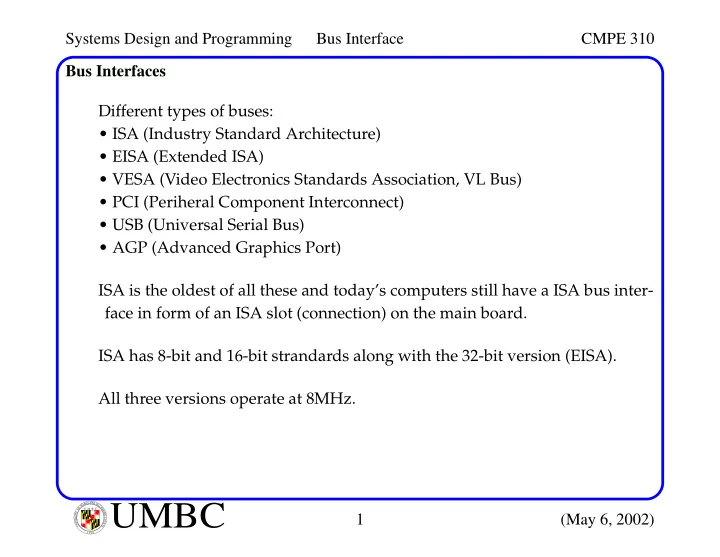
Bus Interfaces Different types of buses:

  • ISA (Industry Standard Architecture)
  • EISA (Extended ISA)
  • VESA (Video Electronics Standards Association, VL Bus)
  • PCI (Periheral Component Interconnect)
  • USB (Universal Serial Bus)
  • AGP (Advanced Graphics Port)

ISA is the oldest of all these and today’s computers still have a ISA bus inter- face in form of an ISA slot (connection) on the main board. ISA has 8-bit and 16-bit strandards along with the 32-bit version (EISA). All three versions operate at 8MHz.

slide-2
SLIDE 2

Systems Design and Programming Bus Interface CMPE 310 2 (May 6, 2002)

UMBC

U M B C U N I V E R S I T Y O F M A R Y L A N D B A L T I M O R E C O U N T Y 1 9 6 6

8-Bit ISA Bus connector

GND 1 31 30 29 28 27 26 25 24 23 22 21 20 19 18 17 16 15 14 13 12 11 10 3 4 5 6 7 8 9 2 RESET +5V IRQ7

  • 5V

DRQ2

  • 12V

OWS +12V GND MEMW MEMR IOW IOR DACK3 DACK1 DACK0 DRQ3 DRQ1 CLOCK IRQ6 IRQ4 IRQ3 IRQ5 DACK2 T/C ALE +5V IRQ9 OSC GND IO CHK IO RDY AEN }

A0-A19

}

Pin # D0-D7 ISA Bus Connector Contains 8- bit Data Bus Demultiplexed 20-bit address Bus I/O and Memory Control Signals Interrupt Request Lines (IRQ2->IRQ9) DMA channels 1-3 Control Signals Power, RESET and misc. signals

slide-3
SLIDE 3

Systems Design and Programming Bus Interface CMPE 310 3 (May 6, 2002)

UMBC

U M B C U N I V E R S I T Y O F M A R Y L A N D B A L T I M O R E C O U N T Y 1 9 6 6

8-Bit ISA Bus Output Interface

D7 D0

. . .

D7 D0 .

. .

D7 D0

. . .

D7 D0

. . .

OC CLK OC OC OC CLK CLK CLK

74LS374 74LS374 74LS374 74LS374

Q7 Q0

. . .

Q7 Q0

. . .

Q7 Q0

. . .

Q7 Q0

. . .

2Y1 1Y1

. . .

D7 D0

. . . 74LS244

Y7 Y0

. . .

Y7 Y0

. . .

Y7 Y0

. . .

A B C G1 G2A G2B A B C G1 G2A G2B A B C G1 G2A G2B

74LS138 74LS138 74LS138

A0 A1 IOW A3 A4 A5 A9 A8 A11 A12 A13 A10 A14 A15 A7 A6

Connector DB37

DIP Switch D0-D7

slide-4
SLIDE 4

Systems Design and Programming Bus Interface CMPE 310 4 (May 6, 2002)

UMBC

U M B C U N I V E R S I T Y O F M A R Y L A N D B A L T I M O R E C O U N T Y 1 9 6 6

8-Bit ISA Bus Output Interface 4, 8-bit latches interfaced using an ISA interface for 32 bit parallel data. 74LS244 buffers used to ensure only one lower power TTL load on the bus. Loading is important as many cards can be connected on the bus. The DIP switch can be used to change the address thus avoiding address con- flicts with other cards in the system. See text for examples of output interface using a PLD and also an ISA bus input interface for A-to-D converters. 16-bit ISA bus has an additional connector attached behind the 8-bit connec- tor. Although 8 additional data bits, D8-D15, are available, the features most often

used are the additional interrupt request and DMA request signals.

slide-5
SLIDE 5

Systems Design and Programming Bus Interface CMPE 310 5 (May 6, 2002)

UMBC

U M B C U N I V E R S I T Y O F M A R Y L A N D B A L T I M O R E C O U N T Y 1 9 6 6

16-Bit ISA BUS Back of computer 16-bit extension 8-bit connector MCS16 1 18 17 16 15 14 13 12 11 10 3 4 5 6 7 8 9 2 IOCS16 IRQ10 IRQ12 IRQ15 IRQ14 DACK0 DRQ0 DACK5 DRQ5 DACK6 DRQ6 DACK7 DRQ7 MASTER +5V GND IRQ11 BHE A23 A22 A20 A19 A18 A17 MEMR D8 D9 D10 D11 D12 D14 D13 D15 A21 16-bit connector MEMW 1 18 31 1

slide-6
SLIDE 6

Systems Design and Programming Bus Interface CMPE 310 6 (May 6, 2002)

UMBC

U M B C U N I V E R S I T Y O F M A R Y L A N D B A L T I M O R E C O U N T Y 1 9 6 6

EISA Bus Extended ISA (EISA) has a 32-bit data bus but still operates at 8MHz. It is rarely used -- mainly as a disk controller or video graphics adapter. New pins for EISA bus are interspersed with the older pins in the 16-bit ISA connector to preserve compatibility with the old standard. Most of the new EISA connections are used for the 32-bit data and 32-bit latched address bus. ISA EISA ISA Key 1 2 5 3 4 6 7 1 2 5 3 4 6 7 1 2 5 3 4 7 Details of ISA Card Details of EISA Card

slide-7
SLIDE 7

Systems Design and Programming Bus Interface CMPE 310 7 (May 6, 2002)

UMBC

U M B C U N I V E R S I T Y O F M A R Y L A N D B A L T I M O R E C O U N T Y 1 9 6 6

VESA Local Bus VESA (VL bus) is a 33MHz extension of the ISA bus used of high-speed data transter applications. It contains 32-bit address and data bus and is mainly used for video and disk interfaces. Requires a third connector (VESA connector) to be added behind the stan- dard 16-bit ISA connector. VESA local Bus Card VESA 16-bit 8-bit

slide-8
SLIDE 8

Systems Design and Programming Bus Interface CMPE 310 8 (May 6, 2002)

UMBC

U M B C U N I V E R S I T Y O F M A R Y L A N D B A L T I M O R E C O U N T Y 1 9 6 6

Peripheral Component Interconnect (PCI) Bus PCI is the most common bus found in computers today due to plug-and-play characteristics and ability to function with 64-bit data bus. A PCI interface contains a series of registers, located in a small memory device, that contain information about the board. The information in this registers allow the computer to automatically config- ure the PCI card (Plug-and-Play PnP feature). The microprocessor connects to the PCI bus through an integrated circuit called a PCI Bridge thus making the PCI bus independent of processor type and architecture. PCI functions with either a 32-bit or 64-bit address and data bus. The address and data buses are multiplexed to reduce the size of the edge connector. 32-bit and 64-bit cards. Newest versions run at 66 MHz (twice the older 33 MHz version).

slide-9
SLIDE 9

Systems Design and Programming Bus Interface CMPE 310 9 (May 6, 2002)

UMBC

U M B C U N I V E R S I T Y O F M A R Y L A N D B A L T I M O R E C O U N T Y 1 9 6 6

PCI Bus System Structure PCI Bus ISA Bus Resident Local Bus Microprocessor Cache Dynamic RAM System Bios PCI Bus Controller Video Disk Controller ISA Bus Controller Printer Interface FAX/ MODEM 100 MHz 66 MHz 8 MHz

slide-10
SLIDE 10

Systems Design and Programming Bus Interface CMPE 310 10 (May 6, 2002)

UMBC

U M B C U N I V E R S I T Y O F M A R Y L A N D B A L T I M O R E C O U N T Y 1 9 6 6

PCI Timing Diagram PCICLK Data1 Data3 Data2 Data4 Command BE’s BE’s BE’s BE’s FRAME AD Bus C/BE Address T0 T1 T2 T3 T4 T5

slide-11
SLIDE 11

Systems Design and Programming Bus Interface CMPE 310 11 (May 6, 2002)

UMBC

U M B C U N I V E R S I T Y O F M A R Y L A N D B A L T I M O R E C O U N T Y 1 9 6 6

PCI Bus Commands The following commands can appear on the C/BE pins in cycle T1. INTA Sequence: Get the interrupt vector from the interrupt controller. The interrupt vector byte is returned during a read operation. Special Cycle: Used to transfer data to all PCI components, e.g. processor shutdown. I/O Read Cycle: Data are read from an I/O device at address AD0-AD15. I/O Write Cycle: Data are written to an I/O device. Memory Read Cycle: Data are read from memory device. Memory Write Cycle: Data are written to memory device. Configuration Read: Configuration information is read from PCI device Configuration Write: Configuration information is written to PCI device. Memory Multiple Access: Multiple data are read from memory device. Dual Addressing Cycle: Used for transferring data to a 64-bit PCI device which only contains a 32-bit data path. Line Memory Access: Used to read more than two 32-bit numbers. Memory Write with Invalidation: Same as line memory access, but used with write and bypasses write-back function of the cache.

slide-12
SLIDE 12

Systems Design and Programming Bus Interface CMPE 310 12 (May 6, 2002)

UMBC

U M B C U N I V E R S I T Y O F M A R Y L A N D B A L T I M O R E C O U N T Y 1 9 6 6

PCI Bus Configuration Space 00H 40H 3FH FFH Header (64 bytes) Available (192 bytes) Identification Status|Command Class|Power Down BIST Base Address Reserved Reserved Extra ROM address Reserved Reserved Special 00H 04H 08H 0CH 10H 24H 28H 2CH 04H 08H 3CH 30H Header 256-byte configuration memory

slide-13
SLIDE 13

Systems Design and Programming Bus Interface CMPE 310 13 (May 6, 2002)

UMBC

U M B C U N I V E R S I T Y O F M A R Y L A N D B A L T I M O R E C O U N T Y 1 9 6 6

PCI Bus Configuration Space The PCI interface contains 256-byte configuration memory that allows plug- and-play feature. The header holds information about the PCI interface. The header contains the unit ID, vendor ID, class code and manufacturer defined bits. The vendor ID and class ID are allocated by PCI SIG. The base address space consists of a base address for the memory, a second for the I/O space and the third for the expansion ROM. When a PCI bus is present, the system BIOS is extended to support it. Access to this extended BIOS is through interrupt vector 1AH. (See text for the currently available functions.) Once the presence of the BIOS is established, the contents of the configu- ration memory can be read using other BIOS functions.

slide-14
SLIDE 14

Systems Design and Programming Bus Interface CMPE 310 14 (May 6, 2002)

UMBC

U M B C U N I V E R S I T Y O F M A R Y L A N D B A L T I M O R E C O U N T Y 1 9 6 6

PCI Interface Block Diagram PCI Bus System User AD0-AD31 PAR PERR SERR FRAME IRDY REQ GNT DEVSEL STOP TRDY Parity Circuit Base Address Register Base Address Register 1 Command Status Register Initiator Interrupt Register Latency Timer Vendor ID Etc. Target Due to the complexity of the PCI Interface, a PCI controller is often used that includes these components.

slide-15
SLIDE 15

Systems Design and Programming Bus Interface CMPE 310 15 (May 6, 2002)

UMBC

U M B C U N I V E R S I T Y O F M A R Y L A N D B A L T I M O R E C O U N T Y 1 9 6 6

The Universal Serial Bus (USB) Allows access of up to 127 different connections via a 4 wire serial connec- tion. This interface is ideal for keyboards, sound cards, modems, etc. Sound cards can derive their power from an external (no-PC) power supply. Cable lengths are limited to 5 meters (for the full-speed interface). Maximum power is given by 100mA x 5V. 1 2 3 4 2 1 4 3

Pin # Signal 1 5.0V 2

  • Data

3 +Data 4 GND

The +/-Data signals are 180 degrees out of phase.

slide-16
SLIDE 16

Systems Design and Programming Bus Interface CMPE 310 16 (May 6, 2002)

UMBC

U M B C U N I V E R S I T Y O F M A R Y L A N D B A L T I M O R E C O U N T Y 1 9 6 6

The Universal Serial Bus (USB) The following circuit can be used to generate the biphase signals. Data packets are sent and received using a NRZI (non-return to zero, inverted) data encoding. Transmit data 27 27 Noise suppression +

  • +Data
  • Data

USB Data 15 15 OE Receive data Digital Data NRZI

slide-17
SLIDE 17

Systems Design and Programming Bus Interface CMPE 310 17 (May 6, 2002)

UMBC

U M B C U N I V E R S I T Y O F M A R Y L A N D B A L T I M O R E C O U N T Y 1 9 6 6

The Universal Serial Bus (USB) Since the transmitter and receiver must remain synchronized and a large string of 1’s do not generate any pulses, a bit may be “stuffed”. Here, a bit is added to force a change in the signal line. USB Commands: Communication begins with a sync byte (80H), followed by a packet identification byte (PID). The PID contains 8 bits -- the rightmost four bits contain the type of packet that follows (if any). The leftmost 4 bits are the compliment (used for error detection.) For example, if command is 1000 and 0111 1000 is sent. Digital Data NRZI 1 2 3 4 5 6 Stuffed bit

slide-18
SLIDE 18

Systems Design and Programming Bus Interface CMPE 310 18 (May 6, 2002)

UMBC

U M B C U N I V E R S I T Y O F M A R Y L A N D B A L T I M O R E C O U N T Y 1 9 6 6

The Universal Serial Bus (USB) PIDs are available for token indicators, data indicators and handshaking: Formats of the data, token, handshaking and start-of-frame are as follows:

PID Name Type Description E1H OUT Token Host->function transaction D2H ACK Handshake Receiver accepts packet C3H Data0 Data Data packet PID even A5H SOF Token Start of Frame 69H IN Token Function -> host transaction 5AH NAK Handshake Reciever does not accept data 4BH Data1 Data Data packet PID odd 3CH PRE Special Host preamble 2DH Setup Token Setup command 1EH Stall Token Stalled

PID ADDR ENDP CRC5 8 7 4 5 Token SOF PID Frame Number CRC5 8 11 5 Data PID Data CRC16 8 1 to 1023 bytes 16 PID 8 Handshake

slide-19
SLIDE 19

Systems Design and Programming Bus Interface CMPE 310 19 (May 6, 2002)

UMBC

U M B C U N I V E R S I T Y O F M A R Y L A N D B A L T I M O R E C O U N T Y 1 9 6 6

The Universal Serial Bus (USB) Two types of CRC (cyclic redundancy check): 5-bit CRC for tokens, SOF, etc. Primitive polynomial is X5 + X2 + 1 16-bit CRC for data. Primitive polynomial is X16 + X15 + X2 + 1 The handshaking PID packets are used to signal errors between the transmit- ter and receiver. A NAK causes the transmitter to resend the data. This is called stop and wait flow control since the transmitter must wait for an ACK before sending any additional packets.

slide-20
SLIDE 20

Systems Design and Programming Bus Interface CMPE 310 20 (May 6, 2002)

UMBC

U M B C U N I V E R S I T Y O F M A R Y L A N D B A L T I M O R E C O U N T Y 1 9 6 6

AGP Graphics Port Operates at system bus speed, e.g. 528M bytes/sec under the 2X compliant system and over 1 G bytes/sec under a 4X. PCI maximum is ~100 M bytes/sec. Pentium II 64 Local Bus 440LX chip set memory AGP Video Local frame buffer 32 I/O I/O PIIX4 bridge PCI ISA I/O I/O (66/100MHz) AGP Bus (66MHz)