UMBC A B M A L T F O U M B C I M Y O R T 1 - - PowerPoint PPT Presentation

umbc
SMART_READER_LITE
LIVE PREVIEW

UMBC A B M A L T F O U M B C I M Y O R T 1 - - PowerPoint PPT Presentation

Digital Systems PCB Layer Stacking CMPE 650 Layer Stack Guidelines Layer stack defines: The ordering of the signal, power and GND layers The dielectric constant of the substrate The spacing between layers Optionally, the trace


slide-1
SLIDE 1

Digital Systems PCB Layer Stacking CMPE 650 1 (4/15/08)

UMBC

U M B C U N I V E R S I T Y O F M A R Y L A N D B A L T I M O R E C O U N T Y 1 9 6 6

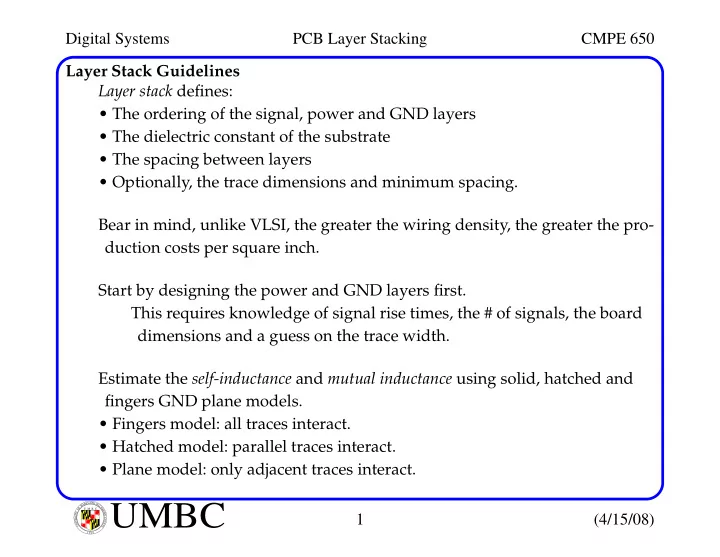
Layer Stack Guidelines Layer stack defines:

  • The ordering of the signal, power and GND layers
  • The dielectric constant of the substrate
  • The spacing between layers
  • Optionally, the trace dimensions and minimum spacing.

Bear in mind, unlike VLSI, the greater the wiring density, the greater the pro- duction costs per square inch. Start by designing the power and GND layers first. This requires knowledge of signal rise times, the # of signals, the board dimensions and a guess on the trace width. Estimate the self-inductance and mutual inductance using solid, hatched and fingers GND plane models.

  • Fingers model: all traces interact.
  • Hatched model: parallel traces interact.
  • Plane model: only adjacent traces interact.
slide-2
SLIDE 2

Digital Systems PCB Layer Stacking CMPE 650 2 (4/15/08)

UMBC

U M B C U N I V E R S I T Y O F M A R Y L A N D B A L T I M O R E C O U N T Y 1 9 6 6

Layer Stack Guidelines Try to use power and GND planes in pairs. Single planes offset to one side or the other can cause warping. Power planes can be used as low-inductance signal-current paths (just like GND planes) assuming adequate by-pass capacitors are installed. In this case, transmission lines work as well as they do over a GND plane. Transmission striplines routed between one power and GND layer or two power layers also work. A Chassis Layer may be needed for driving signals off the board, otherwise external radiation will cause FCC problems. Start by choosing a low-speed or controlled rise time driver. Connecting the driver to the ordinary digital logic ground on board is probably not a good idea.

slide-3
SLIDE 3

Digital Systems PCB Layer Stacking CMPE 650 3 (4/15/08)

UMBC

U M B C U N I V E R S I T Y O F M A R Y L A N D B A L T I M O R E C O U N T Y 1 9 6 6

Chassis Layer Consider the following: Digital logic GNDs (on board) are notorious for high-frequency noise voltages. These GNDs carry many returning currents acting across their self- inductance. The high-frequency fluctuations are too small to cause trouble for digital logic on board. However, the driver acts to broadcast the ground noise outside the cabi- net, and the level will almost always exceed FCC limits. +

  • Vdrive

True Earth GND +

  • Vlogic

+

  • Vout = Vdrive + Vlogic

Output signal

slide-4
SLIDE 4

Digital Systems PCB Layer Stacking CMPE 650 4 (4/15/08)

UMBC

U M B C U N I V E R S I T Y O F M A R Y L A N D B A L T I M O R E C O U N T Y 1 9 6 6

Chassis Layer One solution is to add a chassis plane adjacent to the GND plane on the board. This provides a high level of capacitance coupling between the planes. The chassis layer is then screwed, soldered or welded to the external chassis along one continuous axis near the controlled rise-time driver. This effectively shorts the digital GND plane to the chassis. Ordinary capacitors will not function as a short between the digital logic GND and the chassis GND (lead inductance is too high). The separate plane approach ensure the electrical separation of these two GNDs. If separation is not important, short the digital GND directly to the chassis (no separate chassis GND plane is needed).

slide-5
SLIDE 5

Digital Systems PCB Layer Stacking CMPE 650 5 (4/15/08)

UMBC

U M B C U N I V E R S I T Y O F M A R Y L A N D B A L T I M O R E C O U N T Y 1 9 6 6

Selecting Trace Dimensions Since board cost is proportional to the number of layers and its surface area, we tend to squeeze traces tightly together. This increases crosstalk and reduces routing area available for power/GND. Therefore, crosstalk, routing density and power are traded off to reduce cost. The power-handling capacity of a PCB trace depends on its cross-sectional area and allowable temperature increase (typically 10 degrees). 100 10 1 0.1 10-6 10-5 10-4 10-3 10-2 5 Temperature rise (degrees C) 10 20 40 100 RMS current (A) Cross-sectional area of trace (in.2) 0.010 in. wide 1-oz copper (0.00135) 1.35 X 10⁻⁵ in.2 750 mA max

slide-6
SLIDE 6

Digital Systems PCB Layer Stacking CMPE 650 6 (4/15/08)

UMBC

U M B C U N I V E R S I T Y O F M A R Y L A N D B A L T I M O R E C O U N T Y 1 9 6 6

Selecting Trace Dimensions Power is rarely a serious constraint except for large power buses. However, as thin-film technology becomes more widely available, this may become an issue. Other than power, manufacturing tolerances also lower bound trace width. Most designers won’t use the min-width since yield goes down (cost up). Also, line width variations and variations in the electrical permittivity of the sub- strate make it difficult to keep impedance within tolerance at min widths. Trace width: Set by power, cost (yield) and impedance constraints. Trace height: Set by impedance once trace width is established. Process Min line width (in.) Gold screened onto thick film substrate 0.010 Etched copper on epoxy board with plating 0.004 Etched copper on epoxy board with no plating 0.003 Gold evaporated onto thin film substrate and etched 0.001

slide-7
SLIDE 7

Digital Systems PCB Layer Stacking CMPE 650 7 (4/15/08)

UMBC

U M B C U N I V E R S I T Y O F M A R Y L A N D B A L T I M O R E C O U N T Y 1 9 6 6

Selecting Trace Dimensions Trace spacing is determined using our crosstalk formula: Trace spacing is measured center-to-center and is called trace pitch. The unused space between traces is called trace separation. Therefore, trace width + trace separation = trace pitch. Of course, using more layers allows larger pitches but higher cost. So a trade-off between cost and crosstalk determines acceptable pitch. The optimization problem is "route N connections of average wire length X using M layers". Average wire length can be approximated from Rent’s rule. "Half the wires in a quadrant cross the quadrant boundary." Crosstalk K 1 D H ⁄ ( )2 +

  • =
slide-8
SLIDE 8

Digital Systems PCB Layer Stacking CMPE 650 8 (4/15/08)

UMBC

U M B C U N I V E R S I T Y O F M A R Y L A N D B A L T I M O R E C O U N T Y 1 9 6 6

Selecting Trace Dimensions From this, we can estimate the average pitch to route N connections: Here, N is assumed distributed according to Rent’s rule, X and Y are the dimensions of the board (in.), and M is the # of board layers. For example, an 8X12 in. board having 800 connections routed on 4 layers yields a trace pitch of 0.132 in. If the board has a lot of DIP through-holes, this requires traces to be run between the pins. On average, no more than half of the space between pins can be filled. However, for through-hole boards, the average pitch (above eq) and the mini- mum pitch (from crosstalk considerations) can be very different. For surface mount boards, the average pitch and the minimum pitch may be similar for the inner layers. pave XY N

  • 2.7M

=

slide-9
SLIDE 9

Digital Systems PCB Layer Stacking CMPE 650 9 (4/15/08)

UMBC

U M B C U N I V E R S I T Y O F M A R Y L A N D B A L T I M O R E C O U N T Y 1 9 6 6

Layer Stacks 4, 6 and 10 layer stacks are commonly used in the ordinary epoxy multilayer fabrication process. 0.010 0.0014 0.040 Core Layer 2 (GND) Layer 1 (signal, horz) Layer 3 (PWR) Layer 4 (signal, vert) 0.0014 0.010 0.063 Prepreg Prepreg (all 1-oz copper) 0.005 0.0014 0.040 Core 0.0014 0.005 0.063 0.005 0.005 0.005 0.0014 0.016 0.0014 0.005 0.063 0.005 0.006 0.005 0.006 0.006 0.006 microstrip embedded microstrip

  • ffset stripline

Alternating core and prepreg layers from top to bottom. Core Prepreg

slide-10
SLIDE 10

Digital Systems PCB Layer Stacking CMPE 650 10 (4/15/08)

UMBC

U M B C U N I V E R S I T Y O F M A R Y L A N D B A L T I M O R E C O U N T Y 1 9 6 6

Layer Stacks These layer stacks are designed for high-speed computer products embed- ded in well-shielded card cages. Traces on successive layers traditionally run perpendicular with each other. Core and prepreg are materials used in the substrate lamination process. The fabrication process involves etching (for inner layers) two sided "cores" and then stacking the "cores" separated with "prepreg". Prepreg melts into an epoxy glue when heated and pressed, and then hard- ens with the same dielectric constant as the core material. Drilling is then performed exposing the inner metal layers and the plating step covers the inside surfaces of the drill holes. For very high-speed boards, make the power and GND planes adjacent and add extra GND planes to isolate routing layers. Use plenty of vias to tie the multiple GND planes together.