UMBC A B M A L T F O U M B C I M Y O R T 1 - - PowerPoint PPT Presentation

umbc
SMART_READER_LITE
LIVE PREVIEW

UMBC A B M A L T F O U M B C I M Y O R T 1 - - PowerPoint PPT Presentation

Digital Systems Basic Circuit Theory Review IV CMPE 650 Bode Plots Previously, we plotted the magnitude and phase of a network function, N(j ) , as: N j ( ) vs. Arg N j ( ( ) ) vs. Here, we will use a logarithmic scales for


slide-1
SLIDE 1

Digital Systems Basic Circuit Theory Review IV CMPE 650 1 (4/7/03)

UMBC

U M B C U N I V E R S I T Y O F M A R Y L A N D B A L T I M O R E C O U N T Y 1 9 6 6

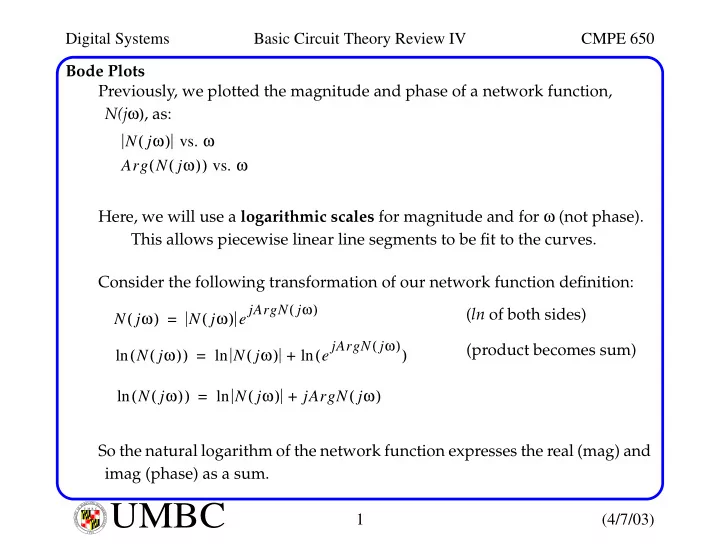
Bode Plots Previously, we plotted the magnitude and phase of a network function, N(jω), as: Here, we will use a logarithmic scales for magnitude and for ω (not phase). This allows piecewise linear line segments to be fit to the curves. Consider the following transformation of our network function definition: So the natural logarithm of the network function expresses the real (mag) and imag (phase) as a sum. N jω ( ) vs. ω Arg N jω ( ) ( ) vs. ω N jω ( ) N jω ( ) e jArgN jω

( )

= N jω ( ) ( ) ln N jω ( ) e jArgN jω

( )

( ) ln + ln = (ln of both sides) (product becomes sum) N jω ( ) ( ) ln N jω ( ) jArgN jω ( ) + ln =

slide-2
SLIDE 2

Digital Systems Basic Circuit Theory Review IV CMPE 650 2 (4/7/03)

UMBC

U M B C U N I V E R S I T Y O F M A R Y L A N D B A L T I M O R E C O U N T Y 1 9 6 6

Bode Plots The units of Amplitude to decibels: Note that -3 dB corresponds to 1/1.41 = 0.707. Take the reciprocal of A when A dB is negative. AdB A AdB A 1.00

30 31.62

3 1.41

40 100.00

6 2.00

60 103

10 3.16

80 104

15 5.62

100 105

20 10.00

120 106

N jω ( ) ln jArgN jω ( ) neper (mag in dB = 8.6859 X mag in nepers) radians (arg in degrees = 57.2958 X arg in radians)

slide-3
SLIDE 3

Digital Systems Basic Circuit Theory Review IV CMPE 650 3 (4/7/03)

UMBC

U M B C U N I V E R S I T Y O F M A R Y L A N D B A L T I M O R E C O U N T Y 1 9 6 6

Bode Plots Real, first order poles and zeros: Put it in standard form by dividing out the poles and zeros: Re-expressing N(jω) in polar form: Rearranging terms: N jω ( ) K jω z1 + ( ) jω jω p1 + ( )

  • =

N jω ( ) Kz1 1 jω z1 ⁄ + ( ) p1 jω ( ) 1 jω p1 ⁄ + ( )

  • =

N jω ( ) Ko 1 jω z1 ⁄ + φ1 ∠ ω 90° ∠ ( ) 1 jω p1 ⁄ + θ1 ∠

  • =

with Ko Kz1 ( ) p1 ⁄ = N jω ( ) Ko 1 jω z1 ⁄ + ω 1 jω p1 ⁄ +

  • φ1

90° – θ1 – ( ) ∠ =

slide-4
SLIDE 4

Digital Systems Basic Circuit Theory Review IV CMPE 650 4 (4/7/03)

UMBC

U M B C U N I V E R S I T Y O F M A R Y L A N D B A L T I M O R E C O U N T Y 1 9 6 6

Bode Plots Separating into magnitude and phase terms: Consider the amplitude: converting to decibels: Plotting involves plotting each term separately and then combining them graphically. We approximate each term with a straight line. N jω ( ) Ko 1 jω z1 ⁄ + ω 1 jω p1 ⁄ +

  • =

ArgN jω ( ) φ1 90° θ1 – – = with φ1 tan 1

ω z1 ⁄ ( ) = θ1 tan 1

ω p1 ⁄ ( ) = AdB 20 Ko 1 jω z1 ⁄ + ω 1 jω p1 ⁄ +

  • log

= AdB 20 Ko log 20 1 jω ( ) z1 ⁄ + log 20 ω log 20 1 jω p1 ⁄ + log – – + =

slide-5
SLIDE 5

Digital Systems Basic Circuit Theory Review IV CMPE 650 5 (4/7/03)

UMBC

U M B C U N I V E R S I T Y O F M A R Y L A N D B A L T I M O R E C O U N T Y 1 9 6 6

Bode Plots The term Ko is a straight line (not a function of ω). Note that its value is zero when Ko = 1. We use two straight lines to approximate: On a log frequency scale, 20log(ω/z1) is a straight line with a slope of 20 dB/ decade (a 10-to-1 change in frequency). The line intersects the 0 dB at ω = z1. This value of w is called the corner frequency. Similarly, the term -20logω is a line with slope -20 dB/decade And the term -20log|1+jω/p1|is approximated by two lines. 20 1 jω z1 ⁄ + log When ω is small this term is ~1 This function -> 0 When ω is large this term is ~ω/z1 20 ω z1 ⁄ ( ) log ω → ω ∞ →

slide-6
SLIDE 6

Digital Systems Basic Circuit Theory Review IV CMPE 650 6 (4/7/03)

UMBC

U M B C U N I V E R S I T Y O F M A R Y L A N D B A L T I M O R E C O U N T Y 1 9 6 6

Bode Plots Straight line approximations for: The function with Ko = sqrt(10), z1 = 0.1 rad/s and p1 = 5 rad/s. 1 2 5 10 20 50 100

  • 5

5 10 15 20 25 ω (rad/s) AdB z1 20log(w/z1) First order zero 1 2 5 10 20 50 100

  • 5

5

  • 10
  • 15
  • 20
  • 25

ω (rad/s) AdB p1

  • 20log(w/p1)

First order pole AdB 20 10 log 20 1 jω ( ) 0.1 ⁄ + log 20 ω log 20 1 jω 5 ⁄ + log – – + = 1.0 10 100 20 30 40 10

  • 10
  • 20

ω (rad/s) AdB 50 0.1 20log|1+jω/z1| 20logKo

  • 20log|1+jω/p1|
  • 20logω

20log|N(jω)|

slide-7
SLIDE 7

Digital Systems Basic Circuit Theory Review IV CMPE 650 7 (4/7/03)

UMBC

U M B C U N I V E R S I T Y O F M A R Y L A N D B A L T I M O R E C O U N T Y 1 9 6 6

Bode Plots +

  • Vo

C=10mF R=11Ω L=100mH +

  • Vs

N jω ( ) 0.11 jω 1 j ω 10

   + 1 j ω 100

   +

  • =

N jω ( ) jωR L ⁄ ω –

2

jωR L ⁄ 1 LC

  • +

+

  • =

N jω ( ) jω110 ω – 2 jω110 1000 + +

  • jω110

jω 10 + ( ) jω 100 + ( )

  • =

=

1.0 10 100 20 30 40 10

  • 10
  • 20

AdB

  • 30
  • 40
  • 50
  • 60

1000 AdB 10 0.11 20 jω log 20 1 j ω 10

  • +

log 20 1 j ω 100

  • +

log – – + log = ω (rad/s)

slide-8
SLIDE 8

Digital Systems Basic Circuit Theory Review IV CMPE 650 8 (4/7/03)

UMBC

U M B C U N I V E R S I T Y O F M A R Y L A N D B A L T I M O R E C O U N T Y 1 9 6 6

Bode Plots The accuracy of the amplitude plot can be improved by correcting at the cor- ner frequencies (+/- indicates this applies to zeros and poles): Similar corrections can be made at 1/2c and 2c Graphically, this amounts to: AdBc 20 1 j1 + log ± 20 2 log ± 3dB ± ≈ = = AdBc 20 1 j1 2

  • +

log ± 20 5 4

  • log

± 1dB ± ≈ = = c/2 c 2c

  • 5

5

  • 10
  • 15
  • 20
  • 25

10 15 20 25 AdB

1 dB 1 dB 3 dB 1 dB

slide-9
SLIDE 9

Digital Systems Basic Circuit Theory Review IV CMPE 650 9 (4/7/03)

UMBC

U M B C U N I V E R S I T Y O F M A R Y L A N D B A L T I M O R E C O U N T Y 1 9 6 6

Bode Plots Straight line approximations can be drawn for phase as well: The phase angle of a constant, Ko, is 0. First order zeros and poles at the origin are a constant +/- 90 degrees For first order zeros and poles not at the origin:

  • For ω less than 10X the corner frequency, its 0
  • For ω greater than 10X greater, its +/- 90, for zeros and poles, respectively.

z1/10 p1/10 z1

  • 30
  • 60
  • 90

30 60 90 ArgN p1 10p1 10z1 45 degrees Actual

slide-10
SLIDE 10

Digital Systems Basic Circuit Theory Review IV CMPE 650 10 (4/7/03)

UMBC

U M B C U N I V E R S I T Y O F M A R Y L A N D B A L T I M O R E C O U N T Y 1 9 6 6

Bode Plots From our previous example: N jω ( ) 0.11 jω 1 j ω 10

   + 1 j ω 100

   +

  • =

N jω ( ) 0.11 jω 1 j ω 10

   + 1 j ω 100

   +

  • α1

β1 β2 – – ∠ = ArgN jω ( ) α1 β1 β2 – – ∠ = α1 90° = β1 tan 1

ω 10

   = β2 tan 1

ω 100

   =

  • 30
  • 60
  • 90

30 60 90 ArgN ω (rad/s) 1 5 10 50 100 500 1000

slide-11
SLIDE 11

Digital Systems Basic Circuit Theory Review IV CMPE 650 11 (4/7/03)

UMBC

U M B C U N I V E R S I T Y O F M A R Y L A N D B A L T I M O R E C O U N T Y 1 9 6 6

Bode Plots Note that this type of analysis works fine for second order circuits as long as the damping factor is greater than 1. When the damping factor is less than 1, the roots of the quadratic factor are complex and a different procedure is required. See your favorite BCT text for the discussion. Sinusoidal Steady-State Power: