
SLIDE 1
ULTRAVIOLET PULSE FROM TYPE IA SUPERNOVAE
Yi Cao (Caltech)
Collaborators: S. R. Kulkarni (Advisor), P . E. Nugent, M. M. Kasliwal, A. Goobar, A. Gal-Yam, and the intermediate Palomar Transient Factory collaboration
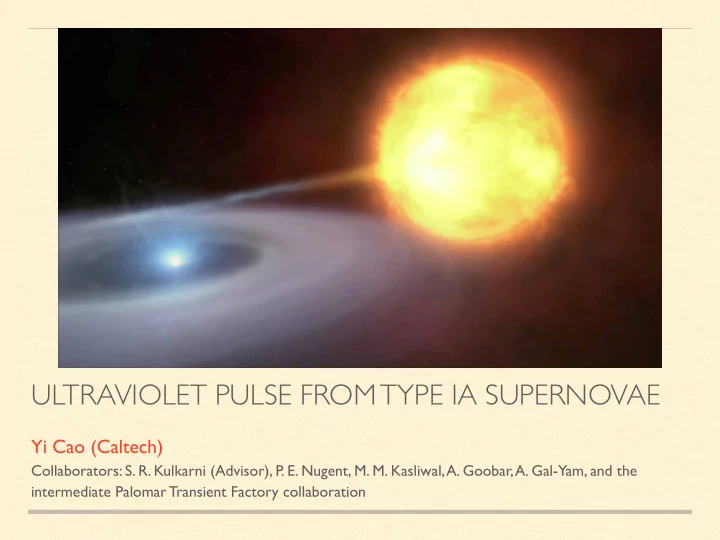
ULTRAVIOLET PULSE FROM TYPE IA SUPERNOVAE Yi Cao (Caltech) - - PowerPoint PPT Presentation
ULTRAVIOLET PULSE FROM TYPE IA SUPERNOVAE Yi Cao (Caltech) Collaborators: S. R. Kulkarni (Advisor), P . E. Nugent, M. M. Kasliwal, A. Goobar, A. Gal-Yam, and the intermediate Palomar Transient Factory collaboration X - ray UV ( Kasen 2010 ) 2
Yi Cao (Caltech)
Collaborators: S. R. Kulkarni (Advisor), P . E. Nugent, M. M. Kasliwal, A. Goobar, A. Gal-Yam, and the intermediate Palomar Transient Factory collaboration
2
(Kasen 2010)
23.22 upper limit 24.17 1st detection 24.21 2nd detection 23.69 Explosion Date 24.82
24.86 1st spec 24.93 Swift obs. (Nugent et al. 2011; Brown et al. 2012) 3
(Milne et al. 2010; Brown et al. 2012a, 2012b)
4
5
6
23.22 upper limit 24.17 1st detection 24.21 2nd detection 23.69 Explosion Date 24.82
24.86 1st spec 24.93 Swift obs.
1st spec Swift obs.
7
(Cao et al. 2015 Nature)
8
(Cao et al. 2015 Nature)
9
1000 2000 3000 4000 5000 6000 7000 8000 9000
WDvelengWh (Å)
0.0 0.5 1.0 1.5 2.0 2.5
)lux DensiWy (ergs/s/cm2 /Å)
1e−16
(Cao et al. 2015 Nature)
10
4000 5000 6000 7000 8000 9000
5esW-)rame WaveOenJWh (Å) 6FaOed )Oux + 2IIseW
0ay 6.96 0ay 15.96 0ay 24.46
6i II C II 2 I 6 II 7i II Ca II Ca II 0J II )e II/III
612002es@max 612002es@+1 weeN 4000 5000 6000 7000 8000 9000
2bserver-)rame WaveOenJWh (Å)
(Cao et al. 2015 Nature)
11
(SN1991bg: Filippenko et al. 1992; SN2005hk: Philmips et al. 2007; SN2002es: Ganeshalingam et al. 2012; iPTF14atg: Cao et al. 2015 Nature)
12
3000 4000 5000 6000 7000 8000 9000 10000
2bserved WaveOengWh (Å)
1 2 3 4 5 6 7 8
λFλ (ergs s−1 cm1 )
1e−11
13
iPTF14atg is a thermonuclear supernova. We observed a strong and declining UV flare in iPTF14atg within a few days of its explosion. This UV flare is consistent with the supernova-companion interaction
exists. The observations of iPTF14atg together with other recent
multiple origins.
14
15
O I @ 8000 km/s
16 SN2011fe
Si II @ 8000 km/s 17
(Kasen 2010)
18
19
−20 −10 10 20 30 40 50
0-D-56430.2 (dDyV)
10 12 14 16 18 20 22 24 26
ASSHUDnW 0DJniWudH + 2IIVHW
348 uSSHU OiPiW 348 5 360 J-2.5 360 U 360 i+0.7 127 8-4 127 B-3 127 V-1 5A7I5 i+0.7 5A7I5 U 5A7I5 z+2.0 5A7I5 -+5.0 5A7I5 ++7.0 5A7I5 Y+3.0 6wiIW 8V02-11 6wiIW 8VW2-10
−26 −24 −22 −20 −18 −16 −14 −12
AbVROuWH 0DJniWudH + 2IIVHW
6 6 6 6 6 6 6 6 66 6 6 6 6 6
−20 20 40 60 80 −18 −16 −14 −12 −10 −8 −6
Absolute 0Dgnitude uvm2
−20 20 40 60 80
DDys since B-bDnd mDximum
−18 −16 −14 −12 −10 −8
Absolute 0Dgnitude uvw2
(Cao et al. in prep.) 20
−15 −10 −5 5 10 15 20
DDyV VinFe B-bDnd PDxiPuP
6 8 10 12 14 16 18 20
9eloFity (103 km s−1 ) i37)13DVv 612003fg 612006gz 612007if 612009dF
(Cao et al. in prep.) 21
The strong UV flare from iPTF14atg is probably from the supernova- companion collision. More observations and detailed modelings are both needed for better understanding the physics of supernova-companion collision, such as line emissions and viewing angle dependence. Type Ia supernovae probably have multiple channels. In order to determine branch fractions of different channels, better understanding to the luminosity functions of normal events, SD events and DD events is required.
22
23