Ultrasound Guided Percutaneous Tenotomy for the Treatment of - - PowerPoint PPT Presentation

ultrasound guided percutaneous tenotomy for the treatment
SMART_READER_LITE
LIVE PREVIEW

Ultrasound Guided Percutaneous Tenotomy for the Treatment of - - PowerPoint PPT Presentation

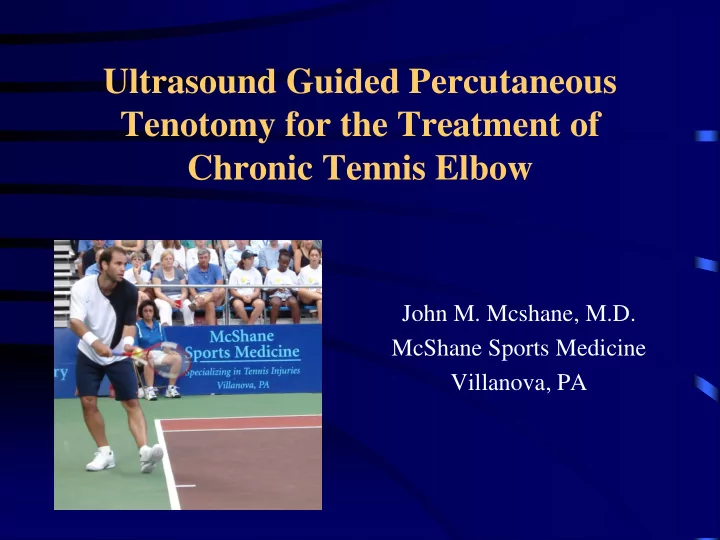
Ultrasound Guided Percutaneous Tenotomy for the Treatment of Chronic Tennis Elbow John M. Mcshane, M.D. McShane Sports Medicine Villanova, PA Tennis Elbow Disorder affecting the common extensor tendon at the the lateral epicondyle

slide-1
SLIDE 1

Ultrasound Guided Percutaneous Tenotomy for the Treatment of Chronic Tennis Elbow

John M. Mcshane, M.D. McShane Sports Medicine Villanova, PA

slide-2
SLIDE 2

Tennis Elbow

  • Disorder affecting the

common extensor tendon at the the lateral epicondyle

  • One of the most

common tendon problems seen in musculoskeletal practice

slide-3
SLIDE 3

Tennis Elbow: Symptoms can be quite debilitating

  • Pain at the lateral

elbow with -.

– picking up a cup of coffee. – brushing teeth. – golf, tennis, etc. – keeping elbow in one position (sleeping, telephone).

slide-4
SLIDE 4

Tennis Elbow: Why does it happen?

  • Repetitive stress to the

tendon leads to collagen breakdown

  • “Inefficient” healing

leads to fibrosis and even calcification

  • Loss of elasticity leads to

interstitial tearing

  • Tears become “walled-
  • ff” from blood vessels
slide-5
SLIDE 5

Terminology - “Epicondylitis”

  • -itis implies inflammation

– Tendinitis implies inflammation of a tendon

  • Surgical specimens of

affected tendons show NO signs of inflammation

– No WBC’s, no chemical mediators of inflammation, etc.

slide-6
SLIDE 6

Inflammation

  • A fundamental pathologic

process consisting of … cytologic & histologic reactions that occur in response to an injury, including …the responses that lead to repair and healing.

  • A NECESSARY component
  • f healing
  • Efforts to inhibit

inflammation also inhibit healing

slide-7
SLIDE 7

Tennis Elbow is NOT Tendinitis: IS Tendinosis

Degeneration of the tendon

slide-8
SLIDE 8

Histology of Healthy Tendon

  • Dense fibers
  • Clearly-defined
  • Parallel
  • Slightly wavy bundles
slide-9
SLIDE 9

HEALTHY TENDON

  • Densely packed
  • Few nucleii
  • Sparse amount of

blood vessels

slide-10
SLIDE 10

Normal Tendon

  • Has wavy pattern of

regularity

  • Termed “Crimp”
  • Crimp provides

“elasticity”

slide-11
SLIDE 11

Tendon Crimp

  • “Elasticity” is actually

the opening up of the wave pattern to straighten the collagen

slide-12
SLIDE 12

Tendinosis

slide-13
SLIDE 13

Tendinosis

  • Disorganized array of

Collagen fibers

  • Loss of crimp
  • Loss of elasticity
  • Diffuse tendon

degeneration

slide-14
SLIDE 14

Tendinosis

  • Dense, thick mass of scar

tissue

  • Inelastic
  • Collagen microtears
  • Attempted proliferation
  • f vessels
  • Tenocyte hypertrophy

and hyperplasia

  • NO inflammation!
slide-15
SLIDE 15

Tendinosis

A Chronic, Degenerative Process

slide-16
SLIDE 16

So, What About Treatment?

  • If no inflammation, do

anti-inflammatory modalities, NSAIDS

  • r steroid injections

make sense?

  • If the tendon is

damaged, can the tendon remodel?

slide-17
SLIDE 17

NSAIDs

  • May help reduce pain,

but...

  • ...No evidence that

they improve long term outcome.

  • In fact, they may

impede healing

slide-18
SLIDE 18

Corticosteroid injections

  • Rationale for use is unclear if there is no

inflammation

  • Treatment has lost favor in tendinopathy.
  • Possibly beneficial in early phase
slide-19
SLIDE 19

Corticosteroid injection

2-6 Weeks

slide-20
SLIDE 20

Corticosteroid injection

> 6 weeks

Assendelft WJJ, Brit J Gen Pract, 1996.

slide-21
SLIDE 21

Corticosteroid Injections

  • Anecdotally, there is

short-term, rapid symptom relief after injections.

  • Why they help is unclear,

but benefit is clearly short lived.

  • NO EVIDENCE of long

term benefit!

slide-22
SLIDE 22

“I’ve tried every brace on the market, every medication available, I’ve had 3 cortisone shots and 6 months of physical therapy. I’m still in pain! What now?!?”

  • Frustrated Patient
slide-23
SLIDE 23

Surgery?

  • Variable outcomes reported.

– 46-85% success rate – Cochrane Review: “At this time there are no published controlled trials of surgery for lateral elbow pain. Without a control group, it is not possible to draw any conclusions about the value

  • f this modality of treatment.

– Most patients required 6-9 months after surgery to return to full activity.

slide-24
SLIDE 24

If Surgery, When?

  • Reserved for failure of a non-operative

treatment.

  • Many surgeons will wait up to one year of

symptoms.

slide-25
SLIDE 25

Technique

  • Variety of techniques described
  • Open debridement, release of ECRB most

common

slide-26
SLIDE 26

Any Other Option?

slide-27
SLIDE 27

Stages of Healing

  • Break down scar
  • Open up channels for blood flow
  • Stimulate body’s healing response
  • Guide tissue remodeling
  • Restore strength and endurance
slide-28
SLIDE 28

Novel Procedure

  • Diagnostic sonography
  • Percutaneus

needle tenotomy

slide-29
SLIDE 29

Diagnostic Ultrasound

  • Tendinosis of Common Extensor Tendon is

easily seen with US

– Hypoechoic regions – Calcifications – Bony irregularities – Fissures and peritendinous fluid – Thickening of tendinous insertion

slide-30
SLIDE 30

Sonographic Diagnosis

  • Normal Common

Extensor tendon

– Homogeneous – Smooth bone – Not thickened

slide-31
SLIDE 31

Tendinopathy

  • Irregular bone surface
  • Heterogeneous
  • Thickened
  • Tearing
slide-32
SLIDE 32

Novel Procedure

  • Based on the actual

pathology involved

  • Attempt to break up

scar

  • Stimulate a healing

response

  • Guide that response

with physical therapy

slide-33
SLIDE 33

Ultrasound Guided Tenotomy

  • Local Anesthetic
  • 20g Needle
slide-34
SLIDE 34

Percutaneous Needling

  • Tendinotic tissue is

repeatedly fenestrated

  • Calcification is broken

up

  • Not just random

“poking”

  • Systematic needling of

the entire abnormal tendon

slide-35
SLIDE 35

Ultrasound Guided Tenotomy

  • Post-Procedure
  • Aggressive rehab begun immediately!
slide-36
SLIDE 36

Post-Procedure

  • Elbow is NEVER

immobilized!

  • MUST begin active

stretching, isometrics immediately

  • Elbow will be sore for

several days, but will improve quickly with aggressive rehab

slide-37
SLIDE 37

Rehab

  • Lasts @ 12 weeks
  • AGGRESSIVE!

– DFM – Stretching – Isometrics – Eccentrics – Push the envelope! – Activity as tolerated

slide-38
SLIDE 38

OUTCOMES

  • Sonographically Guided Needle Tenotomy

for Treatment of Common Extensor Tendinosis In The Elbow.

McShane, Shah, Nazarian. J Ultrasound Med, 2008;27: 1137 - 44

slide-39
SLIDE 39

Patients

  • 52 patients

– Chronic “tennis elbow” – Average symptom length: 9 months

  • Failed corticosteroid injection, NSAIDs,

counterforce bracing, PT, wrist splints, and/or previous surgery

slide-40
SLIDE 40

Procedure

  • All patients underwent percutaneous

needling of origin of Common Extensor Tendon under US guidance

  • 12 week rehab protocol immediately

following the procedure

slide-41
SLIDE 41

Study Design

  • Phone Interviews
  • Pt’s at least 6 months
  • ut from procedure
  • Asked patients to rate:

– Current limitations – Current pain – Perceived success of procedure – Would they recommend it?

slide-42
SLIDE 42

Results

  • 92 % of patients contacted

reported EXCELLENT or GOOD results and would recommend the procedure to a friend or relative.

  • NO ADVERSE EVENTS

REPORTED.

slide-43
SLIDE 43

Since Study Ended

  • Have treated several hundred additional

patients

  • Outcomes consistent
  • Physical therapy protocol has made the

biggest difference

slide-44
SLIDE 44

Summary

  • Must understand the true pathology of “Tennis

Elbow”

– Tendinosis-- not tendinitis.

  • Treatments must be aimed at treating the actual

pathology

  • Physical therapy should be aimed at tendon

remodeling

– Stretch, Isometrics, Eccentrics.

  • Ultrasound guided percutaneous tenotomy

provides a valuable option for recalcitrant cases.