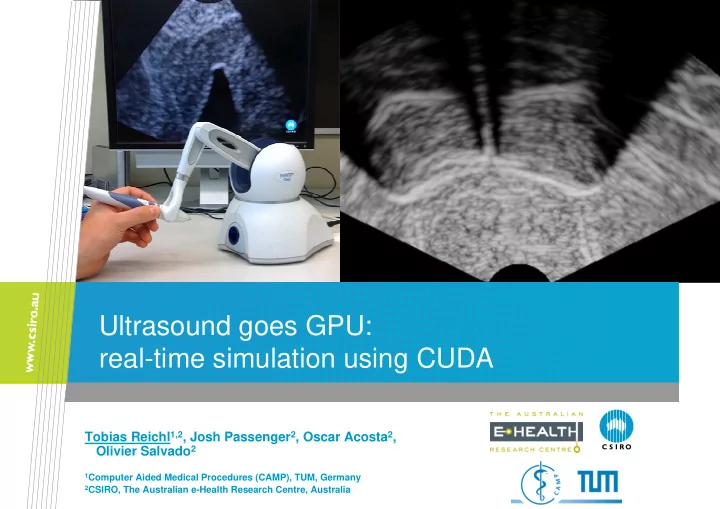
Ultrasound goes GPU: real-time simulation using CUDA Tobias Reichl - - PowerPoint PPT Presentation

ultrasound goes gpu real time simulation using cuda
SMART_READER_LITE
LIVE PREVIEW

Ultrasound goes GPU: real-time simulation using CUDA Tobias Reichl - - PowerPoint PPT Presentation

Ultrasound goes GPU: real-time simulation using CUDA Tobias Reichl 1,2 , Josh Passenger 2 , Oscar Acosta 2 , Olivier Salvado 2 1 Computer Aided Medical Procedures (CAMP), TUM, Germany 2 CSIRO, The Australian e-Health Research Centre, Australia


slide-1
SLIDE 1

Ultrasound goes GPU: real-time simulation using CUDA

Tobias Reichl1,2, Josh Passenger2, Oscar Acosta2, Olivier Salvado2

1Computer Aided Medical Procedures (CAMP), TUM, Germany 2CSIRO, The Australian e-Health Research Centre, Australia

slide-2
SLIDE 2

Ultrasound goes GPU: real-time simulation using CUDA - Reichl et al.

Clinical Problem

  • Despite increasing use of CT, MRI, etc. medical US remains

widely in use because of low cost, non-invasiveness, real-time visual feedback, etc.

  • Many procedures like US-guided needle insertion require a

high degree of hand-eye coordination and extensive training.

  • For ethical and patient safety reasons training on simulations is

preferred.

slide-3
SLIDE 3

Ultrasound goes GPU: real-time simulation using CUDA - Reichl et al.

Related Work

  • Jensen 1996: exhaustive simulation of US imaging on the scatterer level
  • Aiger and Cohen-Or 1998: real-time simulation by slicing 2D US images from

3D volume

  • Hostettler et al. 2005: ray-tracing US waves, combined with CT textures
  • Zhu et al. 2006: using synthetic 3D textures based on 2D US samples
  • Wein et al. 2007: physically derived estimation of US reflection
  • Shams et al. 2008: combination of US reflection (cf. Wein 2007) with scatter

image (cf. Jensen 1996)

Common problem: computational effort, e.g. resolution is limited in favor

  • f real-time simulation.

Idea: take advantage of modern graphics processors (GPU) and their capabilities for parallel processing Goal: realistic simulation in real-time

slide-4
SLIDE 4

Ultrasound goes GPU: real-time simulation using CUDA - Reichl et al.

  • US reflection at tissue boundaries
  • US attenuation in tissue, shadowing
  • Speckle noise
  • Radial blur

Ultrasound Artifacts

slide-5
SLIDE 5

Ultrasound goes GPU: real-time simulation using CUDA - Reichl et al.

Implementation: Overview

slide-6
SLIDE 6

Ultrasound goes GPU: real-time simulation using CUDA - Reichl et al.

US Physics: Acoustic Impedance

  • Estimation of acoustic impedance

from CT values (Wein et al. 2007)

  • Using quadratic instead of linear

interpolation

1.48 M 1480 1000 Water 1000 ~7 M 4330 1800 Bone

  • 1000

~400 330 1.2 Air CT [HU] Z [Rayl] C [m/s] [kg/m3]

ρ

c Z × = ρ

ρ

Density of the tissue

c

Speed of sound Bone Water Air

slide-7
SLIDE 7

Ultrasound goes GPU: real-time simulation using CUDA - Reichl et al.

US Physics: Snell‘s Law

  • Specular reflection:
  • Simplification:
  • Combination of specular and diffuse reflection:
  • Using n=2:

n i r

I I ) ( cos α =

2 1 2 1 2

cos cos cos cos         ⋅ + ⋅ ⋅ − ⋅ =

t i t i i r

Z Z Z Z I I θ θ θ θ

2 1 2 1 2

        + − = Z Z Z Z I I

i r

i

θ

2

) ( 2 ) ( ) (         ⋅ ∇ ⋅ = x Z x Z d x I I

T i r

slide-8
SLIDE 8

Ultrasound goes GPU: real-time simulation using CUDA - Reichl et al.

US Physics: Absorption

  • Approx. 95-100% of attenuation due to absorption
  • Exponential law, similar to X-ray attenuation:

10 / . .

10

f d

I I

α −

=

α

attenuation coefficient US frequency

f

Bone Water Air

slide-9
SLIDE 9

Ultrasound goes GPU: real-time simulation using CUDA - Reichl et al.

Transmitted Intensity

O 1 2 3 . . . x

. .

              − ⋅ Π ⋅ =

≤ ≤

) , ( 1 ) ( ) ( d k I I k I I I x I

i a i t x k t

Transmission Absorption

slide-10
SLIDE 10

Ultrasound goes GPU: real-time simulation using CUDA - Reichl et al.

Reflected Intensity

) ( ) , ( 1 ) ( ) (

2

x R d k I I k I I I x I

i a i t x k r

⋅               −       Π =

≤ ≤

Transmission Reflection Absorption

slide-11
SLIDE 11

Ultrasound goes GPU: real-time simulation using CUDA - Reichl et al.

Implementation: Real-time Simulation

Demo 2: Interaction Demo 1: Image quality

slide-12
SLIDE 12

Ultrasound goes GPU: real-time simulation using CUDA - Reichl et al.

Implementation: Simulation Options

slide-13
SLIDE 13

Ultrasound goes GPU: real-time simulation using CUDA - Reichl et al.

Results: Timing

  • ~3.3 ms for main computation
  • Transfer between OpenGL and

CUDA might become unnecessary with CUDA 2

  • Much time needed for post-

processing (blurring, compression)

slide-14
SLIDE 14

Ultrasound goes GPU: real-time simulation using CUDA - Reichl et al.

Results: Image Quality

  • Comparison: simulated image (left), real image (right)
  • Positive feedback from clinicians, collaboration for comparing

and validating our results (Robarts Research, Canada)

slide-15
SLIDE 15

Ultrasound goes GPU: real-time simulation using CUDA - Reichl et al.

Conclusion

  • New physically plausible approach where computation is

possible within the virtual US scan plane, i.e. using only one 2D slice from the original 3D CT volume

  • No manual annotation or adjustment of the input data

necessary

  • Real-time simulation with „maximum“ resolution (i.e. same as

CT data)

  • Artifacts simulated: shadowing / attenuation, speckle noise,

radial and lateral blurring

  • All virtual acquisition parameters can be interactively changed:

US frequency, US intensity, time-gain compensation, field geometry

slide-16
SLIDE 16

Ultrasound goes GPU: real-time simulation using CUDA - Reichl et al.

Acknowledgements

Medical imaging team:

Olivier Salvado, PhD Team Leader Pierrick Bourgeat, PhD Oscar Acosta, PhD Jurgen Fripp, PhD Jason Dowling Parnesh Raniga David Raffelt Erik Bonner Colonoscopy simulator: Josh Passenger Project Leader Hans de Visser, PhD David Conlan David Hellier Mario Cheng Chris Russ Tobias Reichl Brendon Evans

slide-17
SLIDE 17

Ultrasound goes GPU: real-time simulation using CUDA - Reichl et al.

Thank you for your attention!

  • Questions?