
SLIDE 1
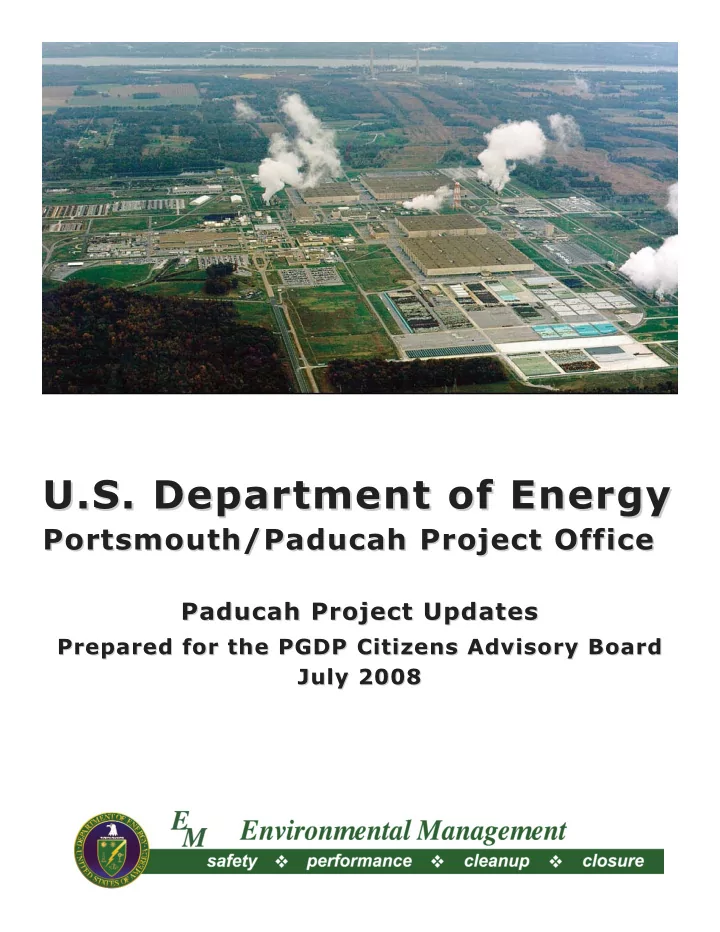
U.S. Department of Energy U.S. Department of Energy - - PDF document
U.S. Department of Energy U.S. Department of Energy Portsmouth/Paducah Project Office Portsmouth/Paducah Project Office Paducah Project Updates Paducah Project Updates Prepared for the PGDP Citizens Advisory Board Prepared for the PGDP
The scope for the Burial Grounds Operable Unit (BGOU) includes a Remedial Investigation (RI), Feasibility Study (FS), baseline risk assessment, evaluation of remedial alternatives, remedy selection, and implementation of actions, as necessary, for protection of human health and the environment. The material in the burial grounds includes hazardous radioactive and pyrophoric wastes. For a list of the burial grounds included in the unit, see the map on the reverse side.
A sample boring is taken during the Burial Grounds Operable Unit Remedial Investigation.
An RI/FS Scoping Document and Work Plan have been developed utilizing information collected on and around PGDP over the course of the last 10 years. The BGOU includes Solid Waste Management Units (SWMUs) 2, 3, 4, 5, 6, 7, 30, and 145. Sample borings drilled for the RI/FS Work Plan are complete.
Work planned in next 60 days:
Submit D1 RI Report to Kentucky and EPA on 7/25/08 Continue scoping for FS
RI sample borings completed RI/FS Work Planimplementation complete
RI/FS Work Plan Remedial Investigation RI Report (Jul ‘08) Feasibility Study (Feb ‘09) Proposed Plan (Sep ‘09) Record of Decision (2010) Remedial Action Remedial Action Completion Report (Sep ‘19)
Portsmouth/Paducah Project Office Portsmouth/Paducah Project Office Paducah Project Update Paducah Project Update
Burial Grounds Operable Unit Burial Grounds Operable Unit
(July 2008) (July 2008)
Contacts: DOE: Jeff Snook/Jennifer Woodard PRS: Tracey Duncan/Karen Holland Kentucky: Ed Winner/Brian Begley U.S. EPA: Turpin Ballard Next Document: D1 RI Report for the BGOU due July 25, 2008.
DOE Project Manager - Jennifer Woodard, (270) 441-6820, jennifer.woodard@lex.doe.gov DOE Project Manager - Jennifer Woodard, (270) 441-6820, jennifer.woodard@lex.doe.gov
The C-404 Burial Ground (SWMU 3) as it appears today. This map shows the SWMUs included in the BGOU.
DOE is responsible for dispositioning and/or recycling legacy wastes (wastes generated at the PGDP prior to establishment of USEC on July 1, 1993); wastes generated from ongoing DOE projects; and a limited amount of waste generated by USEC. After characterization to assure selection of the appropriate disposition method, nonhazardous and nonradioactive wastes are disposed of in the DOE Solid Waste Contained
Landfill fact sheet.) Hazardous and radioactive wastes are treated, if necessary, and shipped off-site to approved DOE or commercial disposal facilities. Wastewater (collected from sumps in diked areas in DOE waste storage facilities at PGDP) is treated and discharged in accordance with the Kentucky Pollutant Discharge Elimination System permit. Nearly two-thirds of the about 572,000 ft3 of legacy waste once stored at the site has been removed. The project is scheduled to be completed 9/30/09.
Portsmouth/Paducah Project Office Portsmouth/Paducah Project Office Paducah Project Update Paducah Project Update
Legacy Waste Disposition Legacy Waste Disposition
(July 2008) (July 2008)
Above, the C-746-B storage facility is shown before and after recent
contaminated debris.
Contacts: DOE: Rob Seifert PRS: Matt LaBarge/Greg Shaia Kentucky: Ed Winner U.S. EPA: Turpin Ballard Next Document: Site Treatment Plan Quarterly Report, July 31, 2008
wastes by 9/30/09 (Site Treatment Plan milestone).
that may have reclamation potential to support Expression of Interest.
DOE Project Manager - Rob Seifert, (270) 441-6823, rob.seifert@lex.doe.gov DOE Project Manager - Rob Seifert, (270) 441-6823, rob.seifert@lex.doe.gov
Above, waste is loaded onto a truck for off-site disposal.
Work planned in next 60 days: Treat and discharge wastewater Continue disposal of legacy waste Will issue Expression of Interest to potential vendors for reuse of cylinder wash sludge
The Surface Water Operable Unit (On-Site) Project includes a site investigation to identify contamination zones posing unacceptable risks in ditches and outfalls, including Sections 3, 4, and 5 of the North-South Diversion Ditch. The site investigation scope also includes an evaluation of whether additional sediment control measures are needed, as well as actions for potential legacy releases associated with the storm sewer system. Project documents that have been submitted to regulators include a Site Investigation and Baseline Risk Assessment Report and a Non-Time-Critical Removal Notification. These will be followed by an Engineering Evaluation/Cost Analysis, Action Memorandum, and Removal Action Work Plan. A Surface Water (Off- Site) action will follow. This action will focus on creeks and contaminant migration from internal ditches and will include an ecological risk assessment.
Outfall 15 is one of the areas where DOE is evaluating an action to remove contamination “hot spots.”
Work planned in next 60 days: Issue the D2 EE/CA Continue development of Removal Action Work Plan
The regulatory milestone for the Action Memorandum is October 2008; the Removal Action Work Plan milestone is December 2008.
Portsmouth/Paducah Project Office Portsmouth/Paducah Project Office Paducah Project Update Paducah Project Update
Surface Water Operable Unit Surface Water Operable Unit
(July 2008) (July 2008)
Issued the D1 Engineering Evaluation/Cost Analysis issued to Kentucky and EPA on 2/10/08 Site Investigation and Baseline Risk Assessment approved February 2008
Included in the scope of the “hot spot” evaluation are portions of the North-South Diversion Ditch located outside the plant security fence. Portions inside the fence previously were remediated.
DOE Project Manager - David Dollins (270) 441-6819, dave.dollins@lex.doe.gov DOE Project Manager - David Dollins (270) 441-6819, dave.dollins@lex.doe.gov
Contacts: DOE: David Dollins PRS: Tracey Duncan/Craig Jones/Jana White Kentucky: Ed Winner U.S. EPA: Jennifer Tufts Next Document: D2 EE/CA 8/02/08
SI Work Plan Site Investigation SI/RA Report EE/CA Action Memo (Sept ‘08) Removal Action Work Plan (Jan ‘09) Removal Action (June ‘09) Removal Action Completion Report (August ‘10)
This project addresses environmental remediation of groundwater contamination on a sitewide basis at PGDP. The main contaminants of concern are trichloroethene (TCE) and technetium-99 (Tc-99). The contaminants are present in three “plumes”: Northeast, Northwest, and Southwest. Remedial/removal actions will be designed and implemented after completion and signing of Records of Decision (RODs). Specific projects include:
Northwest Plumes Pump and Treat - Treatment systems that extract contaminated groundwater from the Northwest and Northeast Plumes and return it to beneficial use
decision on addressing contamination for the third plume is being developed (see reverse side for more detail)
Remedial Action - In 2009, operation begins of a system that will significantly reduce the amount of TCE under the surface at the major source of off-site contamination
Plumes Remedy - DOE has begun the process of determining the best long- term solution for off-site
includes a study TCE degradation in the groundwater.
Overhead power lines are run to the area where a treatment system is to begin extracting TCE from beneath the surface and significantly reduce the site’s largest source
Work planned in next 60 days:
Design Report (submitted 7/9/08)
Action Work Plan (submitted 6/20/08)
Southwest Plume Focused Feasibility Study
submitted February 2008
Implementation Plan submitted February 2008
Portsmouth/Paducah Project Office Portsmouth/Paducah Project Office Paducah Project Update Paducah Project Update
Groundwater Operable Unit Groundwater Operable Unit
(July 2008) (July 2008)
Power to the C-400 treatment system will be supplied by both
transmission lines.
DOE Project Manager - David Dollins (270) 441-6819, dave.dollins@lex.doe.gov DOE Project Manager - David Dollins (270) 441-6819, dave.dollins@lex.doe.gov
Contacts: DOE: David Dollins PRS: Tracey Duncan/Mike Clark/Bryan Clayton Kentucky: Edward Winner U.S. EPA: Turpin Ballard Next Document: Final approval of the Remedial Design Report and the Remedial Action Work Plan
Remedial Investigation
GWOU Feasibility Study
Remedial Design Report LUCIP Remedial Action Work Plan (Mar ‘08)
Remedial Action (2008-2009) Remedial Action Completion Report (Oct ‘10) Treatability Study Proposed Plan Record of Decision Remedial Design Work Plan
Site Investigation Feasibility Study (Dec ‘08)
Remedial Design Report LUCIP Remedial Action Work Plan
Remedial Action Remedial Action Completion Report (2014) Proposed Plan Record of Decision (Feb ‘10) Remedial Design Work Plan
Previous Remedial Investigation TCE Degradation Analysis
Natural Attenuation Report Treatability Study Proposed Plan Record of Decision (2011) Remedial Action Work Plan Remedial Action Completion Report
The scope of this project includes decontamination and decommissioning of inactive PGDP facilities that have no reuse potential. To date, 21 facilities have been designated for removal and 12 of those have been removed. Major projects within the scope of the D&D project include the following:
Infrastructure
(piping, equipment, and material) removal and demolition of the C-410/C-411/C-420 Feed Plant Complex (ongoing)
Infrastructure
removal and demolition
Plant (planned)
Surveillance and
maintenance of the C-340 Metals Reduction Facility (ongoing)
inactive facilities, including the C-746-A West End Smelter (complete); the C-342 Ammonia Facility (under way); and the C-611-M and N Sanitary Water Storage Tanks (planned for 2008)
Workers remove pipes leading to process equipment located inside C-342.
The C-746-A West End Smelter was built as a storage facility in the early 1950s. Two furnaces later were added for smelting metals, including gold, nickel, and aluminum. The facility continued operation through the 1970s. The structure was demolished in April 2008. Prior to demolition, loose material, debris, equipment, furnaces, and interior offices had to be removed.
Work is continuing on a proposed new process for comprehensive D&D Removal Action documentation. The proposed new process will streamline gaining regulatory approval prior to implementing D&D activities. The process will save time and money now spent on writing regulatory
DOE, Kentucky, and EPA are meeting to discuss the proposal.
Regulatory approval of Removal Action Completion Reports (RACR) for Incinerator and West End Smelter, 2008; Generic EE/CA, 2/2/10.
Removed C-410 HF Tank Farm Removed Hydrogen Holder Tank Removed C-603 Nitrogen Complex Removed C-402 Lime House Removed C-405 Incinerator Removed C-746-A West End Smelter Removed C-612 Clamshell
Portsmouth/Paducah Project Office Portsmouth/Paducah Project Office Paducah Project Update Paducah Project Update
D&D Operable Unit D&D Operable Unit
(July 2008) (July 2008)
Left, one of the C-611 Water Towers located in the West Kentucky Wildlife Management Area. A contract to demolish the towers is pending. Below left, one of two 20,000-gallon tanks in the C-342 Ammonia Dissociator facility. The tanks will be removed, refurbished, and sent to the C-746-U Landfill for use as leachate storage tanks.
DOE Project Manager - Rob Seifert (270) 441-6823, rob.seifert@lex.doe.gov DOE Project Manager - Rob Seifert (270) 441-6823, rob.seifert@lex.doe.gov
Contacts: DOE: Rob Seifert PRS: Don Ulrich/Brad Montgomery Kentucky: Brian Begley U.S. EPA: Turpin Ballard
The C-410 Feed Plant Complex consists of nine facilities covering nearly 200,000 ft2. It was built in 1955 to convert reactor returns from other DOE facilities to uranium hexafluoride. The facility, which is contaminated with various radionuclides, operated until 1977. D&D work involves three phases that must be completed before structural demolition can begin. These phases overlap. The phases are as follows:
and debris - Work continues to dispose of loose material once stored inside the facility.
asbestos insulation was used inside the complex. Removal work continues.
potentially hazardous chemical residue inside the
second half of 2008. Building demolition is scheduled to begin by 2012.
The C-342 Ammonia Dissociator Complex (two facilities) now is scheduled for demolition in late July or early August 2008. Loose material removal in the complex has been completed and asbestos abatement is continuing. The C-611 M&N Water Towers located in the West Kentucky Wildlife Management Area will be demolished later in 2008. A contract for a demolitions company to topple the towers is pending. Plans call for the towers to be removed before hunting season starts in the WKWMA.
The 160 DMSAs are nonleased areas inside buildings, as well as outdoor
and equipment they contained from USEC on December 31, 1996, to facilitate Nuclear Regulatory Commission certification of the plant. At that time, most of the contents needed detailed inventory, characterization, and disposition. Since then, DOE and its contractors have been documenting contents; resolving environmental concerns, such as draining and disposing of oils from old equipment; and segregating and disposing of wastes. The DMSAs initially contained more than 800,000 ft3 of material that needed characterization and about 600,000 ft3 of material that needed dispositioning.
A worker labels asbestos samples. Drums of waste are loaded onto a pallet for shipment.
Complete characterization of Priority “C” DMSAs by 9/30/09
Completed characterization of Priority “A” DMSAs by 9/30/2004 Completed characterization of Priority “B” DMSAs by 9/30/2006
(NOTE: DMSAs were separated into three categories for characterization and disposition. The “A” areas were those with the greatest risk, followed by “B” and “C,” depending on potential for risks to human health and the environment.)
Portsmouth/Paducah Project Office Portsmouth/Paducah Project Office Paducah Project Update Paducah Project Update
DOE Material Storage Areas DOE Material Storage Areas
(July 2008) (July 2008)
Work planned in next 60 days:
Continued characterization and packaging of DMSA materials
in C-335, C-400, C-337, and C-310.
Disposition remaining 19 of 42 process motors to NTS.
The lid of a waste container is rigged for removal so that the contents can be inventoried prior to disposition.
DOE Project Manager - Jeff Snook (270) 441-6814, jeff.snook@lex.doe.gov DOE Project Manager - Jeff Snook (270) 441-6814, jeff.snook@lex.doe.gov
Contacts: DOE: Rob Seifert PRS: John Samples Kentucky: Leo Williamson U.S. EPA: Turpin Ballard
Characterization is 93% finished; completion estimated in December 2008. Disposition is 88% finished; completion estimated in March 2009.
The short-term objectives of the Soils Operable Unit include evaluation of newly identified areas
removal of three inactive facilities where soil contamination is present. These are the facilities: C-218 Firing Range C-403 Neutralization Pit C-410-B Sludge Lagoon Planning for the removal of the facilities has begun and the first phase of sampling for the soil and rubble pile areas has been completed. Long-term, the project includes a Remedial Investigation to identify any soils contaminated with PCBs or
2012 ROD and a Removal Action for contaminated soils above action
by 2016.
The C-403 Neutralization Pit is one of three inactive facilities with soil contamination included in the Soils Operable Unit.
Work planned in next 60 days:
Issue D2 EE/CA for the removal of three inactive
facilities with soil contamination
Continue development of Action Memorandum
for inactive facility removal
Issue Site Evaluation Report for Phase I
sampling of soil areas (7/18/08)
Removal of five DOE rubble piles currently is
being planned as a maintenance action to be implemented in Aug/Sept.
Issued D1 Engineering Evaluation/Cost Analysis
for the three inactive facilities on 3/24/08
EPA and Kentucky approved Sampling and
Analysis Plan (SAP) 1A for the soil piles
Issued Rubble Piles SAP on 5/19/08 D2 Addendum 1-B and 2 issued on 6/16/08
4th quarter 2011 – D1 Removal Decision
Document
3rd quarter 2012 – D1 ROD September 30, 2015 – D1 Remedial Action
Completion Report
Portsmouth/Paducah Project Office Portsmouth/Paducah Project Office Paducah Project Update Paducah Project Update
Soils Operable Unit Soils Operable Unit
(July 2008) (July 2008)
Above, sampling one of the Soil Pile areas along Little Bayou Creek; above right, the C-410-B Sludge Pit; below right, the C-218 Firing Range.
DOE Project Manager - David Dollins (270) 441-6819, dave.dollins@lex.doe.gov DOE Project Manager - David Dollins (270) 441-6819, dave.dollins@lex.doe.gov
Soils Removal Action Documents Scheduled (D1 versions) Soils Removal Action Documents Scheduled (D1 versions) Soil/Rubble Areas Documents Scheduled (D1 versions) Soil/Rubble Areas Documents Scheduled (D1 versions)
Contacts: DOE: David Dollins/Rich Bonczek PRS: Tracey Duncan/Craig Jones Kentucky: Ed Winner U.S. EPA: Turpin Ballard Next Document: D2 Soils Inactive Facilities Engineering Evaluation/Cost Analysis, July 27, 2008
Removal Notification (Feb 07) EE/CA (Mar ‘08) Action Memo (Oct ‘08) Removal Action Work Plan (Feb ‘09) Removal Action (June ‘09) Removal Action Completion Report (June ‘10) Site Evaluation Reports (Jan ‘09) EE/CA (Jun ‘09) Action Memo (Nov ‘09) Removal Action Work Plan (Nov ‘09) Removal Action (2010) Removal Action Completion Report (Feb ‘11)
The C-746-U Contained Landfill and support facilities are located on 60 acres of DOE property near Ogden Landing Road, operating under a permit from the Kentucky Division of Waste Management. Landfill disposal operations began in 1997. DOE uses the landfill for disposal of solid waste generated from its operations at the Paducah site. Examples of wastes accepted include nonhazardous soil and debris from DOE projects, such as protective clothing worn by workers, paper, packaging, and landfill
No material classified as hazardous waste or low- level radioactive waste is accepted.
The C-746-U Contained Landfill also receives non waste materials produced by USEC operations at the Paducah Gaseous Diffusion Plant. The materials are used by landfill
The water level in one of the landfill’s 31,000- gallon leachate storage tanks is measured.
Continued accepting waste and debris from DOE and USEC operations; treated and discharged leachate; submitted minor permit modification to add leachate storage capacity.
DOE Project Manager - Jeff Snook, DOE Project Manager - Jeff Snook, (270) 441-6814, (270) 441-6814, jeff.snook@lex.doe.gov jeff.snook@lex.doe.gov
Contacts: DOE: Jeff Snook PRS: Paul Corpstein/Matt LaBarge/ Paul Gagnon Kentucky: Todd Hendricks U.S. EPA: Turpin Ballard
Portsmouth/Paducah Project Office Portsmouth/Paducah Project Office Paducah Project Update Paducah Project Update
C-746-U Contained Landfill C-746-U Contained Landfill
(July 2008) (July 2008)
DOE is evaluating waste management options for the disposal of wastes generated at PGDP from CERCLA response actions and PDGP D&D. The intent of this evaluation will be to support a comprehensive sitewide decision for the disposal of hazardous,low- level radioactive, and mixed waste resulting from CERCLA response actions at PGDP and PDGP D&D. Waste disposal action alternatives that will be evaluated in the RI/FS are expected to include off-site and on-site disposal and combinations of these alternatives. The waste disposal
by following the RI/FS evaluation and decision documentation process required by CERCLA. DOE has sought early public input in the evaluation process.
An estimated 3.7 million yd3 of waste will be generated during CERCLA response actions and D&D. In order to more effectively manage these wastes, a sitewide waste management strategy is being examined to determine a reliable protective solution for the disposal of those wastes. The CERCLA RI/FS process will be used to identify and evaluate waste management alternatives. By following the CERCLA decision and documentation process, documents prepared after the scoping document will include an RI/FS Work Plan, RI/FS Report, Proposed Plan, and Record of Decision.
Issued D1 Scoping Document April 7, 2008
Work planned in next 60 days:
Continue meetings with KY and EPA to discuss the
project
Continued drafting RI/FS Work Plan Continue developing material for first planned
planned public meeting
Documents Scheduled (D1 versions) Documents Scheduled (D1 versions)
Scoping Document (Apr ‘08) RI/FS Work Plan (Nov ‘08) RI/FS Report (July ‘09) Proposed Plan (Feb ‘10) Record
(Oct ‘10)
Contacts: DOE: Jeff Snook PRS: Fraser Johnstone Kentucky: Ed Winner U.S. EPA: Turpin Ballard Next Document: RI/FS Work Plan, November 18, 2008
DOE Project Manager - Jeff Snook, DOE Project Manager - Jeff Snook, (270) 441-6814, (270) 441-6814, jeff.snook@lex.doe.gov jeff.snook@lex.doe.gov
Portsmouth/Paducah Project Office Portsmouth/Paducah Project Office Paducah Project Update Paducah Project Update
Waste Disposal Options Project Waste Disposal Options Project
(July 2008) (July 2008)