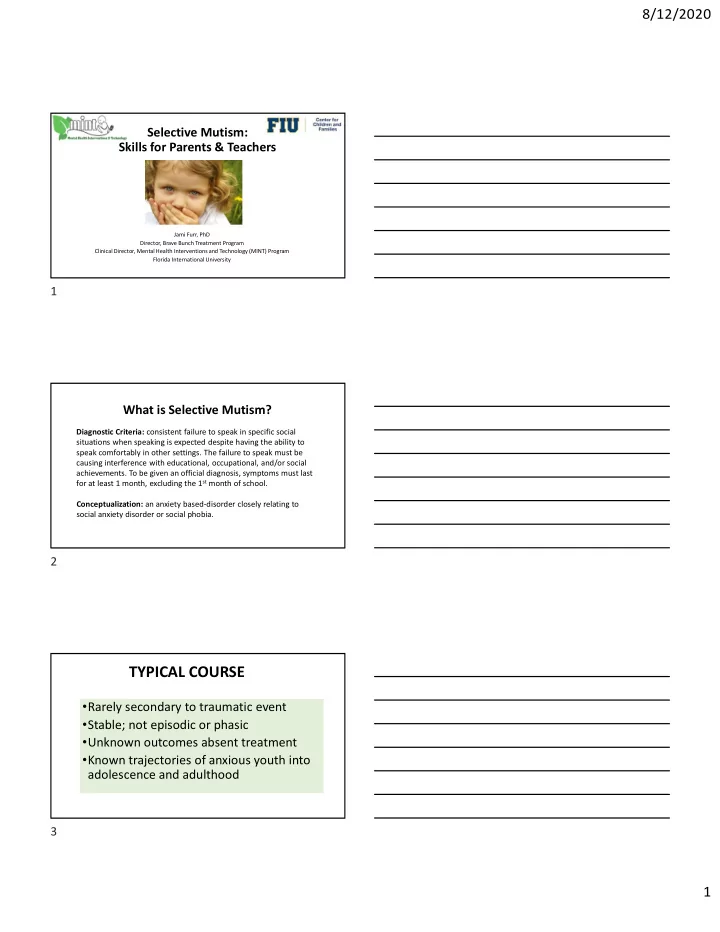
TYPICAL COURSE Rarely secondary to traumatic event Stable; not - - PDF document

typical course
SMART_READER_LITE
LIVE PREVIEW

TYPICAL COURSE Rarely secondary to traumatic event Stable; not - - PDF document

8/12/2020 Selective Mutism: Skills for Parents & Teachers Jami Furr, PhD Director, Brave Bunch Treatment Program Clinical Director, Mental Health Interventions and Technology (MINT) Program Florida International University 1 What is


slide-1
SLIDE 1

8/12/2020 1

Selective Mutism: Skills for Parents & Teachers

Jami Furr, PhD Director, Brave Bunch Treatment Program Clinical Director, Mental Health Interventions and Technology (MINT) Program Florida International University

What is Selective Mutism?

Diagnostic Criteria: consistent failure to speak in specific social situations when speaking is expected despite having the ability to speak comfortably in other settings. The failure to speak must be causing interference with educational, occupational, and/or social

  • achievements. To be given an official diagnosis, symptoms must last

for at least 1 month, excluding the 1st month of school. Conceptualization: an anxiety based-disorder closely relating to social anxiety disorder or social phobia.

TYPICAL COURSE

  • Rarely secondary to traumatic event
  • Stable; not episodic or phasic
  • Unknown outcomes absent treatment
  • Known trajectories of anxious youth into

adolescence and adulthood 1 2 3

slide-2
SLIDE 2

8/12/2020 2

PREVALENCE

  • More common in girls than in boys
  • Occurs in less than 1% of children in elementary school settings
  • Bergman, Piacentini, & McCracken (2002)
  • .7% Kg – 2nd grade
  • This is equivalent to 1 per 140
  • Bilingual children are over-represented in SM (Toppelberg,

Tabors, & Coggins, 2005), although our knowledge is scarce regarding this issue.

10 20 30 40 50 60 70 80 90 100 ADHD OCD Tic +/or Trich ODD Speech/Lang OAD Enuresis +/or Encopresis SAD Simple Phobia Avoidance +/or SP Percent

Comorbidity with SM

Black & Uhde (1995) Dummit et al. (1997) Black & Uhde (1994) Dummit et al. (1996)

(1) Child is prompted to talk or engage in conversation (2) Child gets

  • verly

anxious (3) Child avoids (4) Adult rescues* (5) Child’s and adult’s anxiety are lowered* (6) Negative reinforcement

Behavioral Conceptualization

Cycle of Negative Reinforcement: Selective Mutism

Kurtz, 2010, Personal Communication

4 5 6

slide-3
SLIDE 3

8/12/2020 3

CONTAMINATION

  • The school and others in their lives are associated

with prior histories of not talking  CONTAMINATED

  • New school & the therapist are not associated with

any history of not talking

  • Important to not ask any questions at all when first

meeting the child

  • “You do the math!” approach

Kurtz, 2010, Personal Communication

Education about Fear and Anxiety

  • Fear is…
  • Natural
  • Necessary
  • Harmless
  • Fear is designed to…
  • Draw our attention to an immediate threat
  • Keep us safe by activating our fight-or-flight system

Education about Anxiety: Habituation

  • “Riding the Wave” of Anxiety

Time Level of Anxiety

Low Anxiety High Anxiety

7 8 9

slide-4
SLIDE 4

8/12/2020 4

Child Directed Interaction (CDI)

PCIT International, 2011

CDI: Skills

  • Labeled Praise
  • Reflection
  • Description

PCIT International, 2011

CDI: Skills

  • Labeled Praise: a positive statement regarding what the child is doing in

the moment. Examples:

Adult Great job using your voice to answer my question! I like that you are playing with the toys so gently. Nice job sharing! I love that you looked at me while you told me that. It’s fantastic that you stayed calm with me while mom left the room.

PCIT International, 2011

10 11 12

slide-5
SLIDE 5

8/12/2020 5

CDI: Skills

  • Reflection: a statement that repeats back to the child their verbalization.

Avoid “tip-ups” in tone of voice.

Child Adult La la la la la la. La la la la la la. I’m hungry. You said you are hungry! What’s your name? You’re wondering what my name is. (whisper) I want to read. Sarah just told me she wants to read! (teacher says aloud to classroom peers) Where is the bathroom? You want to know where the bathroom is.

PCIT International, 2011

CDI: Skills

  • Description: a statement about the child’s moment-to-moment behavior.

Examples:

Adult I see you shaking your head. You are bouncing the ball. You are coloring a flower with the red crayon. You are putting the two puzzle pieces together. I see you smiling.

PCIT International, 2011

CDI: Rules

  • Allow child to lead the play
  • Avoid commands
  • Avoid questions
  • Do not criticize child or use negative talk
  • Ignore minor misbehavior
  • Do not interpret but rather describe behavior
  • Be enthusiastic and enjoy your time with the child!

PCIT International, 2011

13 14 15

slide-6
SLIDE 6

8/12/2020 6

Verbal Directed Interaction (VDI)

Kurtz, 2010, Personal Communication

VDI: Types of Questions

  • Forced-choice
  • Open-ended
  • Yes/No (Avoid)

Kurtz, 2010, Personal Communication

VDI: Types of Questions

  • Forced Choice: a question in which two or more possible responses are

given within the question. Examples:

Adult Is pink or blue your favorite color? Is this a butterfly, a dog, or a cat? Would you rather play on the swings, the slide, or you don’t know? Do you want to see the movie Frozen or another movie? Did you brush your teeth: yes or no?

16 17 18

slide-7
SLIDE 7

8/12/2020 7

VDI: Types of Questions

  • Open-Ended: a question in which a possible answer is not suggested

within the question. Typically, this question starts with “who,” “what,” “where,” “when,” “why,” or “how.” Examples: Examples:

Adult Who is your best friend? What did you learn today at school? Where did you go over the winter break? When did you go to Hawaii? Why do you like cookies more than ice cream? How did you meet your friend Joseph?

VDI: Types of Questions

  • Yes or No: a question in which a possible or expected response is either

“yes” or “no.” These questions are to be avoided. Examples: Examples:

Yes or No Questions (Avoid) Forced Choice Do you like seafood?  Do you like seafood: yes or no? Did you do your homework?  Did you do your homework or not yet? Have you eaten dessert?  Have you eaten dessert or have you not eaten dessert? Do you need to go to the bathroom?  Do you need to go to the bathroom now or can you wait? Did you make it yourself?  Did you make it yourself or did someone help you? Is the party on December 5th ?  Is the party on December 5th or a different day?

VDI: Skills

  • Modeling
  • Coping Strategies
  • Practice
  • Contingency Management
  • Fade-in
  • Shaping
  • Exposure

2

19 20 21

slide-8
SLIDE 8

8/12/2020 8

VDI: Skills

  • Modeling: having a child observe another child or adult interacting

adaptively with the feared situation; this can be live or filmed. Example:

Adult Modeling Public speaking amongst a crowd (in front of child). Expressing to the child coping behavior the adult uses in stressful situations. Introducing their self to a stranger (in front of child). Ordering food at a restaurant (in front of child). Staying calm during fearful situation (in front of child).

3

VDI: Skills

  • Coping Strategies: relaxation techniques used to aid in dealing with a

stressful situation.

  • Pizza Breaths
  • Squeezing Lemons
  • Coping Thoughts

Example:

Coping Thoughts I am brave. I have done it before, I can do it again. The fear will go down. It will be worth it. When this is over, I’ll be glad that I did it.

Coping Cat; Kendall & Hedtke, 2006

VDI: Skills

  • Practice: repeated performance of a structured exercise for the purpose
  • f acquiring skill and habituating to a feared stimuli.

Example:

Child Practice Behavior Introducing their self to a stranger. Asking a “favorites” question to peers. Practicing show-and-tell. Asking to use the bathroom in class. Ordering food at a restaurant.

22 23 24

slide-9
SLIDE 9

8/12/2020 9

VDI: Skills

  • Contingency Management: rewards for brave behaviors.

Example:

Rewards Checks on a chart Stickers Tokens Food Playing time

VDI: Skills

  • Fade-in: gradually introducing a new individual (person child has not

verbalized with before) into child’s speaking circle. The new individual gets closer in proximity to the child as old individual (person child has verbalized with before) moves further away. Also known as “slide-in.” Example:

VDI: Skills

  • Shaping: rewarding successive approximations to a desired behavior.

Example:

Adult Child Adult Parent: What is your favorite color? Pink (while looking at parent). Thank you for answering me! Parent: What is your favorite color? Pink (while looking at parent and parent is closer to new individual, John). Great job answering me with John close by. Parent: What is your favorite color? Pink (while looking at parent and parent is side-by-side with John). It’s wonderful that you used your brave voice with John right by me! Parent: Please answer my following question while looking at John. What is your favorite color? Pink (while looking at John). Nice work answering me while looking at John! John: What is your favorite color? Pink (while looking a John). That was amazing you answered John!

25 26 27

slide-10
SLIDE 10

8/12/2020 10

VDI: Skills

  • Exposure: having child interact with a feared stimulus, live or recorded.

Example:

Child Verbal Interactions Asking a stranger for help. Answering a teacher’s question. Initiating conversation with a peer. Getting a person’s attention. Expressing feelings to a family member.

Brave Talking Ladder

Low Anxiety High Anxiety Outside of school grounds with counselor and parent Survey around asking questions Inside classroom with class present Inside classroom with teacher and a few other peers Inside classroom with teacher and counselor In room with parent only In room with counselor, then add more people In room with counselor and parent Inside classroom with counselor and parent Conducting “show and tell” in front of a class

VDI: Rules

  • Avoid yes/no questions (instead, change them to forced-choice questions)
  • Allow the opportunity of 5-10 seconds for the child to answer
  • Describe any non-verbal behavior instead of interpreting it
  • Repeat the question up to 3 times, move on if the child does not answer
  • If the child struggles to respond, practice with them in a separate space

Kurtz, 2010, Personal Communication

28 29 30

slide-11
SLIDE 11

8/12/2020 11

VDI: Rules

  • If the child still struggles to respond, return to the last situation they were

successful in answering a question

  • Revisit the question later if necessary, never leave a question unanswered
  • If child only whispers to an individual while in a group setting, the

individual should reflect aloud to others what child said

  • Always use CDI skills (during CDI and VDI phases)

Kurtz, 2010, Personal Communication

VDI: Rules

Examples:

Adult Avoid yes/no questions Do you want to eat this, yes or no? (  forced choice) Allow 5-10 seconds How was school today? (5 seconds) How was school today? Describe non-verbal behavior, do not interpret I see you’re shaking your head. Does that mean you’re hungry or you’re not hungry? Repeat question up to 3 times What is your favorite color? (5 seconds) Is your favorite color blue or something else? (5 seconds) Is your favorite color blue, yes or no? Practice in a separate space Let’s step outside just you and I and we can practice answering this question. Return to previous situation child was successful It may be hard for you to answer that question right now. I know you were able to tell Sabrina your favorite color a few minutes ago. Go practice with her and I will ask you this question afterward. Revisit question later That’s okay. Think about the answer and I will ask you that question later. Always use CDI skills I really like how you are making eye-contact with me. What is your name? (1) Child is prompted to talk or engage in conversation (2) Child gets

  • verly

anxious (3) Child avoids (4) Adult rescues* (5) Child and adult’s anxiety are lowered* (6) Negative reinforcement

Behavioral Conceptualization

Cycle of Negative Reinforcement: Selective Mutism

Kurtz, 2010, Personal Communication

31 32 33

slide-12
SLIDE 12

8/12/2020 12

(1) Child is prompted to talk or engage in conversation (2) Child becomes

  • verly

anxious (3) Child tries to avoid (4) Adult gives the child the opportunity to

  • respond. Adult shapes

verbal behavior. (5) Child answers question and is rewarded with a labeled-praise (6) Positive reinforcement for brave talking

Cycle of Positive Reinforcement: Brave Talking

Reverse the Cycle! 

Additional Tips for Teachers

  • Conduct a fade-in procedure in collaboration with the parent and child as

soon as possible

  • May take multiple practices – twice a week preferable
  • At first, practice when other children are not present in the school, then

transition to including more children

  • If child whispers to teacher only, the teacher should reflect aloud to others
  • Use contingency management within the classroom, particularly focused
  • n brave-talking with the child
  • Some children may require high frequency reinforcers
  • Great to integrate into system already being used in the classroom
  • Daily communication with home very helpful at first, faded out over time

Additional Tips for Teachers

  • When allotting classroom jobs, give the child a job that involves

speaking

  • Do not allow others to speak for the child or label child as not able

to speak

  • Appropriately reward brave talking without overwhelming child

with too much praise (especially in front of other classmates – some may need understated praise)

  • May help to read a book about SM to class or any book that talks

about that all kids feel scared sometimes (some suggestions at the end of

presentation)

34 35 36

slide-13
SLIDE 13

8/12/2020 13

Additional Tips for Teachers

  • Child may create audio recording to present to teacher and/or class
  • May benefit child to have teacher or parent play the recording

first without child present as to explain what is occurring to the class and how best to respond to the child

  • Explain that we all feel scared about something
  • Be supportive, smile, and if you don’t hear the child, ask the child to

speak-up!

  • Child may then play the recording so child is responsible for
  • thers hearing his/her voice
  • Communicate with parents any difficulties the child may have at

school

Good Books for the Classroom

Sophie’s Story (Joffe) Maya’s Voice (Cheng) Charlie’s Choices (Moldan) My friend Daniel doesn’t talk (Longo)

Helpful Resources

  • www.selectivemutism.org
  • www.selectivemutismnetwork.org
  • www.childanxiety.net

37 38 39

slide-14
SLIDE 14

8/12/2020 14

Helpful Resources

Aimee Kotrba: Selective Mutism: An Assessment and Intervention Guide for Therapists, Educators, & Parents Angela McHolm: Helping your Child with Selective Mutism Christopher Kearney: Helping Children with Selective Mutism and Their Parents Ruth Perednik: The Selective Mutism Guide Deborah Beidel & Samuel Turner: Childhood Anxiety Disorders

Helpful Resources

Growing up Brave, Donna Pincus You and Your Anxious Child: Free Your Child from Fears and Worries and Create a Joyful Family Life, Anne Marie Albano and Leslie Pepper Helping your Anxious Child: A Step-by-Step Guide for Parents, Ronald Rapee, Anne Wignall, Susan Spence, Heidi Lyneham, Vanessa Cobhanm Keys to Parenting Your Anxious Child, Katharina Manassis Freeing Your Child from Anxiety: Powerful, Practical Solutions to Overcome Your Child’s Fears, Worries, and Phobias , Tamar E. Chansky

Contact Information

Center for Children and Families FIU, AHC 1 Room 140 11200 SW 8th St., Miami, FL 33199

(305) 348-0477

Email: jfurr@fiu.edu Web: www.mint.fiu.edu www.ccf.fiu.edu

40 41 42

slide-15
SLIDE 15

8/12/2020 15

Special Thank You

Production Team: Nasreen Hidmi Alejandra Golik Cast & Crew: Alejandra Golik Ashley Cieri Michael Palmer Tommy Chou Greilys Lopez Emily Caproni Carolina Scaramutti Nasreen Hidmi Danielle Cornacchio Special thank you to all counselors, teachers, and parents for their efforts in supporting children with selective mutism!

Brave Bunch Treatment Program Miami, FL

References

Eyberg, S. M., & Funderburk, B. W. (2011). Parent-Child Interaction Therapy Protocol. Gainesville, FL: PCIT International. Kendall, P.C., & Hedtke, K. (2006). Coping Cat Workbook. (2nd ed). Ardmore, PA: Workbook Publishing.

43 44