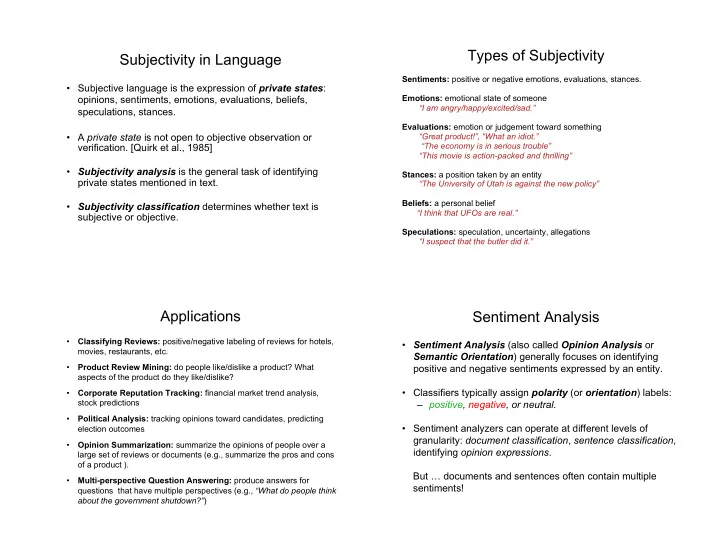
Types of Subjectivity Subjectivity in Language Sentiments: positive - - PowerPoint PPT Presentation

types of subjectivity subjectivity in language
SMART_READER_LITE
LIVE PREVIEW

Types of Subjectivity Subjectivity in Language Sentiments: positive - - PowerPoint PPT Presentation

Types of Subjectivity Subjectivity in Language Sentiments: positive or negative emotions, evaluations, stances. Subjective language is the expression of private states : Emotions: emotional state of someone opinions, sentiments, emotions,


slide-1
SLIDE 1
  • Subjectivity in Language
  • Subjective language is the expression of private states:
  • pinions, sentiments, emotions, evaluations, beliefs,

speculations, stances.

  • A private state is not open to objective observation or
  • verification. [Quirk et al., 1985]
  • Subjectivity analysis is the general task of identifying

private states mentioned in text.

  • Subjectivity classification determines whether text is

subjective or objective.

  • Types of Subjectivity

Sentiments: positive or negative emotions, evaluations, stances. Emotions: emotional state of someone “I am angry/happy/excited/sad.” Evaluations: emotion or judgement toward something “Great product!”, “What an idiot.” “The economy is in serious trouble” “This movie is action-packed and thrilling” Stances: a position taken by an entity “The University of Utah is against the new policy” Beliefs: a personal belief “I think that UFOs are real.” Speculations: speculation, uncertainty, allegations “I suspect that the butler did it.”

  • Applications
  • Classifying Reviews: positive/negative labeling of reviews for hotels,

movies, restaurants, etc.

  • Product Review Mining: do people like/dislike a product? What

aspects of the product do they like/dislike?

  • Corporate Reputation Tracking: financial market trend analysis,

stock predictions

  • Political Analysis: tracking opinions toward candidates, predicting

election outcomes

  • Opinion Summarization: summarize the opinions of people over a

large set of reviews or documents (e.g., summarize the pros and cons

  • f a product ).
  • Multi-perspective Question Answering: produce answers for

questions that have multiple perspectives (e.g., “What do people think about the government shutdown?”)

  • Sentiment Analysis
  • Sentiment Analysis (also called Opinion Analysis or

Semantic Orientation) generally focuses on identifying positive and negative sentiments expressed by an entity.

  • Classifiers typically assign polarity (or orientation) labels:

– positive, negative, or neutral.

  • Sentiment analyzers can operate at different levels of

granularity: document classification, sentence classification, identifying opinion expressions. But ! documents and sentences often contain multiple sentiments!

slide-2
SLIDE 2
  • Opinion Extraction

Information extraction systems aim to decompose an opinion into its components:

  • 1. Opinion Expression: phrase that describes an attitude

toward or evaluation of something

  • 2. Opinion Holder (Source): the entity whose opinion is

being expressed (usually a person or organization)

  • 3. Opinion Target: the entity, object, or concept that the
  • pinion is about

According to UN officials, the human rights record in Syria is horrendous.

  • Sentiment Lexicons
  • General (Harvard) Inquirer [Stone et al., 1966]
  • Liu et al’s opinion lexicon [Liu et al., 2005]
  • OpinionFinder lexicon [Wiebe & Riloff, 2005]
  • SentiWordNet [Esuli and Sebastiani, 2006]
  • Micro-WNOp [Cerini et al. 2007]
  • AFINN, designed for microblogs [Nielson, 2011]

Many sentiment lexicons and lists have been created, for example:

  • Learning Subjective Expressions

[Riloff, Wiebe, Wilson, 2003] expressed <dobj> condolences, hope, grief, views, worries indicative of <np> compromise, desire, thinking inject <dobj> vitality, hatred reaffirmed <dobj> resolve, position, commitment voiced <dobj>

  • utrage, support, skepticism,
  • pposition, gratitude, indignation

show of <np> support, strength, goodwill, solidarity <subj> was shared anxiety, view, niceties, feeling

  • Bootstrapped Learning of Subjective

Nouns and Expressions

Unannotated Texts Best Extraction Patterns Extractions (Nouns) Ex: hope, grief, joy, concern, worries expressed <dobj> voiced <dobj> indicative of <np> Ex: happiness, relief, condolences

slide-3
SLIDE 3

Examples of Strong Subjective Nouns

anguish exploitation pariah antagonism evil repudiation apologist fallacies revenge atrocities genius rogue barbarian goodwill sanctimonious belligerence humiliation scum bully ill-treatment smokescreen condemnation injustice sympathy denunciation innuendo tyranny devil insinuation venom diatribe liar exaggeration mockery

Examples of Weak Subjective Nouns

aberration eyebrows resistant allusion failures risk apprehensions inclination sincerity assault intrigue slump beneficiary liability spirit benefit likelihood success blood peaceful tolerance controversy persistent trick credence plague trust distortion pressure unity drama promise eternity rejection

  • Contextual Polarity
  • Sentiment lexicons capture the prior polarity of words and

phrases.

  • However, the polarity of a word often depends on context

due to polysemy, negation, polarity shifters, scoping, expressions, etc. Philip Clapp, president of the National Environment Trust, sums up well the general thrust of the reaction of environmental movements: “There is no reason at all to believe that the polluters are suddenly going to become reasonable. Example from [Wilson, Wiebe, & Hoffmann 2005]: !

  • Why is sentiment analysis so hard?
  • Idiosyncratic expressions

– “oh well”, “good grief”, “you are bad”, “that’s rad”

  • Clausal multi-word expressions

– “stepped on [someone’s] toes” – “drove [person] up the wall”

  • Sarcasm

– “I’m going to the dentist today, so thrilled.” – “He read about it in the bible of Cat Fancy.”

  • World Knowledge

– “My new phone has very long battery life.” – “That restaurant always has very long lines.”

Subjective language is often among the most colorful and creative! For example:

slide-4
SLIDE 4
  • Why is sentiment analysis so hard?
  • Metaphor

– “Parliament attacked ...”

  • Hyperbole

– “We wish to see the blood of the opponents...”

  • Rhetorical Argumentation

– “The fact is!”

  • Hypotheticals

– “If another earthquake hits, further damage to the reactor would be catastrophic.”

Extracting Opinion Propositions and Holders

[Bethard et al., 2004] developed one of the earliest systems to identify propositional opinions and the opinion holders (sources).

  • Opinion: answer to the question “How does X feel about Y”
  • Propositional Opinion: an opinion localized in an argument
  • f a verb, generally a sentential complement.
  • Opinion Holder: the entity who holds the opinion

For example: – I believe [you have to use the system to change it]. – Still, Vista officials realize [they’re relatively fortunate]. – [“I’d be destroying myself”] replies Mr. Korotich.

  • Sentence Classification
  • The first step is to classify sentences into 3 categories: NON-

OPINION, OPINION-PROPOSITION, or OPINION-SENTENCE.

  • An OPINION-SENTENCE contains an opinion that extends

beyond the scope of a verb argument. Examples:

  • NON-OPINION: “I surmise this is because they are unaware of the

shape of humans.” [surmise represents prediction, not a feeling]

  • OPINION-PROPOSITION: “It makes the system more flexible argues

a Japanese businessman.”

  • OPINION-SENTENCE: “It might be imagined by those who are not

themselves Anglican that the habit of going to confession is limited only to markedly High churches but that is not necessarily the case.”

  • Gold Standard Sentences

Manually annotated sentences as: NON-OPINION, OPINION-

PROPOSITION, or OPINION-SENTENCE.

  • sentences from FrameNet that have a verbal argument

labeled PROPOSITION

  • identified verbs in these FrameNet sentences that highly

correlated with OPINION sentences.

  • labeled sentences from PropBank that have these verbs

accuse argue believe castigate chastise comment confirm criticize demonstrate doubt express forget frame know persuade pledge realize reckon reflect reply scream show signal suggest think understand volunteer!

Source !Sentences !NON-OP !OP-PROP !OP-SENT! FrameNet !3,041 ! !1,910 !631 !573! PropBank !2,098 ! !1,203 !618 !390!

slide-5
SLIDE 5

Gold Standard Opinion Holders

  • For each OPINION-PROPOSITION sentence, the OPINION-

HOLDER was manually labeled.

“[OPINION-HOLDER You] can argue [OPINION-PROPOSITION] these wars are corrective.”

  • The authors observed that most opinion holders were the

agents of verbs, so all agents were automatically labeled as opinion holders and then mistakes were fixed. – Ultimately,10% of the opinion holders were not agents

  • For 10% of the sentences, no opinion holder was labeled

– the opinion holder was the speaker: 6% – the opinion holder was not the speaker but implicit: 4%

Opinion Word Features

  • Use 1,286 strong and 1,687 weak subjective nouns learned

by Basilisk bootstrapping algorithm [Riloff et al., 2003].

  • Acquired new opinion words by computing the ratio of

relative frequencies of words in opinion-heavy vs. fact- heavy articles (mostly WSJ from TREC collections).

– 2,877 editorials and 1,685 letters to the editor – 2,009 business and 3,714 news articles

  • Using1,336 manually annotated “semantically oriented”

adjectives [Hatzivassiloglou & McKeown, 1997], they identified open class words that co-occur with these adjectives using a modified log-likelihood ratio. In general: log-likelihood ratio = log (L(H1) / L(H2))

  • Opinion Noun Classifier
  • They also created a supervised Naïve Bayes classifier to

can label any arbitrary noun as FACT or OPINION.

  • Manually annotated randomly selected nouns from the

TREC corpus and used 500 FACT nouns and 500 OPINION nouns for training.

  • The features for a noun are the set of hypernyms in the

WordNet hierarchy.

  • The classifier was not meant to be sufficient on its own,

but is used to further filter opinion noun lists acquired from

  • ther methods.
  • Opinion Word Results

Discovered that different methods worked best for different syntactic classes.

Verbs: fact-heavy vs. opinion-heavy doc freqs worked best. Nouns & Adverbs: adj co-occurrence worked best. Nouns: WordNet filtering was also applied. Adjectives: fact-heavy vs. opinion-heavy document freqs was used because it obtained higher recall.

  • Subjective

Objective Precision Recall Adj 19,107 14,713 .58 .47 Adv 305 302 .79 .37 Noun 3,188 22,279 .90 .38 Verb 2,329 1,663 .78 .18 Accuracy using strong opinion words as the gold standard:

slide-6
SLIDE 6

One-Tiered Architecture

  • The first system is an SVM classifier that labels syntactic

constituents as either OPINION-PROPOSITION or NULL.

Example

  • OPINION-PROPOSITION

Opinion-Proposition Classifier

  • They followed the same design as a semantic role labeling

classifier by [Pradhan et al., 2003] with 8 syntactic features:

  • 1. the verb
  • 2. verb’s cluster
  • 3. subcategorization type of the verb
  • 4. syntactic phrase type of the potential argument
  • 5. head word of the potential argument
  • 6. before/after position of the argument relative to the verb
  • 7. parse tree path between verb and potential argument
  • 8. voice (active/passive) of the verb

This feature set was later augmented with features derived from the acquired opinion words.

Opinion Word Features

Given a constituent to classify, the following features captured

  • pinion word information:
  • Counts: the number of opinion words in the constituent.
  • Score Sum: the sum of the opinion scores for each opinion

word in the constituent, sometimes with a minimum score threshold.

  • ADJP: a binary feature indicating whether the constituent

contains a complex adjective phrase. (Simple adjectives produce many false hits.) For example: excessively affluent more bureaucratic

[Note: I’ve observed “ADV ADJ” to be a useful pattern too.]

slide-7
SLIDE 7

Two-Tiered Architecture

The second system performs two steps:

  • 1. A SRL classifier is trained to

label constituents only for the PROPOSITION role.

  • 2. A second classifier

determines whether the proposition is an OPINION- PROPOSITION, using a sentence-level approach.

Labeling Propositions as Opinions

Three Naïve Bayes classifiers were trained to determine whether a proposition is an OPINION-PROPOSITION.

  • 1. The first model is trained using approximate sentence labels

from the fact-heavy vs. opinion-heavy texts.

– Sentences in editorials and letters to the editor are assumed to contain opinions. – Sentences in news and business articles are assumed to be factual. – The sentence containing each proposition is classified and the proposition is assigned the label of its sentence.

  • 2. The second model is trained at the sentence-level but

predictions are based only on the text of the proposition.

  • 3. For the third model, both training and testing use only the

text of the propositions (with the same approximate labeling during training).

Two-Tiered Architecture Training

  • All three models used the same set of features:

– unigrams, bigrams, and trigrams – part-of-speech tags – presence of opinion and positive/negative words

  • The first and second models used:

– 20,000 random sentences from 2,877 editorials and 3,714 news articles from the WSJ.

  • The third model was trained on 5,147 propositions extracted

from these documents.

  • All three models were evaluated the manually annotated

propositions from 5,139 FrameNet and PropBank sentences.

  • Evaluation Data
  • The FrameNet and PropBank data were normalized and

divided into subsets of 70% for training, 15% for development, and 15% for testing. Additional models were trained to also identify constituents that correspond to an OPINION-HOLDER, for a 3-way classification task. The distribution of gold standard constituent labels is:

slide-8
SLIDE 8

Results for One-Tiered Architecture for 2-Way Classification Task

  • Results for One-Tiered Architecture

for 3-Way Classification Task

  • Results for Two-Tiered Architecture

The first component that labels PROPOSITION constituents achieved 62% recall with 82% precision. (This was a 10% precision gain over the more general semantic role classifier.) The results for the 3 models to determine which PROPOSITION constituents are opinions are shown below:

Summary

  • This work focused on one type of opinion recognition,

propositional opinions, and identified the opinion holders.

  • This approach is very syntactically-oriented, requiring an

alignment between the propositions/holders and syntactic constituents.

– This approach cannot identify cases where a proposition spans multiple sentences, or the holder is in a different sentence than the proposition.

  • The two architectures exhibited a recall/precision trade-off:

51% R with 58% P for 1 Tiered

43% R with 68% P for 2 Tiered.

  • The automatically learned opinion words improved

performance and complex ADJPs proved to be useful.