. Two Keywords . . . The Shore-Slaman Join Theorem (1999) 1 It - - PowerPoint PPT Presentation

two keywords the shore slaman join theorem 1999
SMART_READER_LITE
LIVE PREVIEW

. Two Keywords . . . The Shore-Slaman Join Theorem (1999) 1 It - - PowerPoint PPT Presentation

. An Application of Turing Degree Theory to the -Decomposability Problem on Borel Functions . . . Takayuki Kihara Japan Advanced Institute of Science and Technology (JAIST) Japan Society for the Promotion of Science (JSPS) research fellow


slide-1
SLIDE 1

. . . .

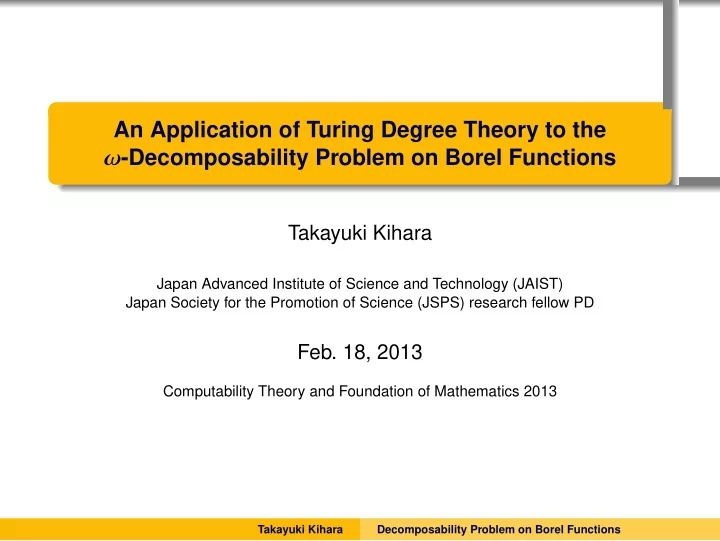
An Application of Turing Degree Theory to the

ω-Decomposability Problem on Borel Functions

Takayuki Kihara

Japan Advanced Institute of Science and Technology (JAIST) Japan Society for the Promotion of Science (JSPS) research fellow PD

  • Feb. 18, 2013

Computability Theory and Foundation of Mathematics 2013

Takayuki Kihara Decomposability Problem on Borel Functions

slide-2
SLIDE 2

. Two Keywords . . . . . .

1

The Shore-Slaman Join Theorem (1999)

It was proved by using Kumabe-Slaman forcing. It was used to show the first-order definability of the Turing jump in DT.

. .

2

The Decomposability Problem of Borel Functions

The original decomposability problem was proposed by Luzin (191?) and negatively answered by Keldis (1934). The modified decomposability problem was proposed by Andretta (2007), Semmes (2009), Pawlikowski-Sabok (2012), Motto Ros (201?).

Takayuki Kihara Decomposability Problem on Borel Functions

slide-3
SLIDE 3

. . . . Decomposing a hard function F into easy functions . .

Takayuki Kihara Decomposability Problem on Borel Functions

slide-4
SLIDE 4

. . . . Decomposing a discontinuous function F into easy functions . .

Takayuki Kihara Decomposability Problem on Borel Functions

slide-5
SLIDE 5

. . . . Decomposing a discontinuous function F into continuous functions . .

Takayuki Kihara Decomposability Problem on Borel Functions

slide-6
SLIDE 6

. . . . Decomposing a discontinuous function F into continuous functions

F

. .

Takayuki Kihara Decomposability Problem on Borel Functions

slide-7
SLIDE 7

. . . . Decomposing a discontinuous function F into continuous functions

G 2 G 1 G F I I 1 I 2

. . . . F(x) =

            

G0(x) if x ∈ I0 G1(x) if x ∈ I1 G2(x) if x ∈ I2

Takayuki Kihara Decomposability Problem on Borel Functions

slide-8
SLIDE 8

. . . . Decomposing a discontinuous function into continuous functions

F

. .

Takayuki Kihara Decomposability Problem on Borel Functions

slide-9
SLIDE 9

. . . . Decomposing a discontinuous function into continuous functions

F G

. .

Takayuki Kihara Decomposability Problem on Borel Functions

slide-10
SLIDE 10

. . . . Decomposing a discontinuous function into continuous functions

F P 1 x 7!

. .

Takayuki Kihara Decomposability Problem on Borel Functions

slide-11
SLIDE 11

. . . . Decomposing a discontinuous function into continuous functions

F P 1 G

. . . . F(x) =

      

G0(x) if x P1 if x ∈ P1

Takayuki Kihara Decomposability Problem on Borel Functions

slide-12
SLIDE 12

. . . . Decomposing a discontinuous function into continuous functions . . . . Dirichlet(x) = lim

m→∞ lim n→∞ cos2n(m!πx)

= ⇒

Dirichlet(x) =

      

1, if x ∈ Q. 0, if x ∈ R \ Q.

Takayuki Kihara Decomposability Problem on Borel Functions

slide-13
SLIDE 13

. . . . If F is a Borel measurable function on R, then can it be presented by using a countable partition {Pn}n∈ω of dom(F) and a countable list {Gn}n∈ω of continuous functions as follows? F(x) =

                            

G0(x) if x ∈ P0 G1(x) if x ∈ P1 G2(x) if x ∈ P2 G3(x) if x ∈ P3

. . . . . .

. Luzin’s Problem (almost 100 years ago) . . . . . Can every Borel function on R be decomposed into countably many continuous functions?

Takayuki Kihara Decomposability Problem on Borel Functions

slide-14
SLIDE 14

. Luzin’s Problem (almost 100 years ago) . . . . . Can every Borel function on R be decomposed into countably many continuous functions? . . . . . .

Takayuki Kihara Decomposability Problem on Borel Functions

slide-15
SLIDE 15

. Luzin’s Problem (almost 100 years ago) . . . . . Can every Borel function on R be decomposed into countably many continuous functions? =

⇒ No! (Keldis 1934)

An indecomposable Borel function exists! . . . . . .

Takayuki Kihara Decomposability Problem on Borel Functions

slide-16
SLIDE 16

. Luzin’s Problem (almost 100 years ago) . . . . . Can every Borel function on R be decomposed into countably many continuous functions? =

⇒ No! (Keldis 1934)

An indecomposable Borel function exists! . Example . . . . . The Turing jump TJ : 2ω → 2ω is Σ0

2-measurable,

but it is indecomposable! . . .

Takayuki Kihara Decomposability Problem on Borel Functions

slide-17
SLIDE 17

. Luzin’s Problem (almost 100 years ago) . . . . . Can every Borel function on R be decomposed into countably many continuous functions? =

⇒ No! (Keldis 1934)

An indecomposable Borel function exists! . Example . . . . . The Turing jump TJ : 2ω → 2ω is Σ0

2-measurable,

but it is indecomposable! . Question . . . . . Which Borel function is decomposable into countably many continuous functions?

Takayuki Kihara Decomposability Problem on Borel Functions

slide-18
SLIDE 18

. . . . Borel =

α<ω1

Σ0

α

. Definition . . . . . .

1

A function F : X → Y is Borel if A ∈

α<ω1

Σ0

α(Y) =

⇒ F−1[A] ∈ ∪

α<ω1

Σ0

α(X).

. .

2

A function F : X → Y is Σ0

α-measurable if

A ∈ Σ0

1(Y) =

⇒ F−1[A] ∈ Σ0

α(X).

. .

3

A function F : X → Y is Σα,β if A ∈ Σ0

α(Y) =

⇒ F−1[A] ∈ Σ0

β(X).

Takayuki Kihara Decomposability Problem on Borel Functions

slide-19
SLIDE 19

. . . . A function F : X → Y is Σα,β if A ∈ Σ0

α(Y) =

⇒ F−1[A] ∈ Σ0

β(X).

  • 1;1
  • 1;2
  • 2;2
  • 1;3
  • 2;3
  • 3;3
  • 1;4
  • 2;4
  • 3;4
  • 4;4
  • 1;5
  • 2;5
  • 3;5
  • 4;5
  • 5;5
  • 1;6
  • 2;6
  • 3;6
  • 4;6
  • 5;6

Takayuki Kihara Decomposability Problem on Borel Functions

slide-20
SLIDE 20

. . . . A function F : X → Y is Σα,β if A ∈ Σ0

α(Y) =

⇒ F−1[A] ∈ Σ0

β(X).

  • 1;1
  • 1;2
  • 2;2
  • 1;3
  • 2;3
  • 3;3
  • 1;4
  • 2;4
  • 3;4
  • 4;4
  • 1;5
  • 2;5
  • 3;5
  • 4;5
  • 5;5
  • 1;6
  • 2;6
  • 3;6
  • 4;6
  • 5;6
Con ti. Heviside's fun tion Diri hlet's fun tion Thomae's fun tion Leb esgue's fun tion

Takayuki Kihara Decomposability Problem on Borel Functions

slide-21
SLIDE 21

. Definition . . . . . F ∈ dec(Σα) if it is decomposable into countably many Σ0

α-measurable functions

. . . . (Keldis 1934) Σ1,α+1 ⊈ dec(Σα) i.e., there is a Σ0

α+1-measurable function which is not

decomposable into countably many Σ0

α-measurable functions!

The α-th Turing jump x → x(α) is such a function. . . .

Takayuki Kihara Decomposability Problem on Borel Functions

slide-22
SLIDE 22

. Definition . . . . . F ∈ dec(Σα) if it is decomposable into countably many Σ0

α-measurable functions

. . . . (Keldis 1934) Σ1,α+1 ⊈ dec(Σα) i.e., there is a Σ0

α+1-measurable function which is not

decomposable into countably many Σ0

α-measurable functions!

The α-th Turing jump x → x(α) is such a function. . Problem . . . . . Given (α, β, γ) ∈ (ω1)3, determine whether or not ✞ ✝ ☎ ✆ Σα,β ⊆ ✞ ✝ ☎ ✆

dec(Σγ)

Takayuki Kihara Decomposability Problem on Borel Functions

slide-23
SLIDE 23

. Definition . . . . . F: a function from a top. sp. X into a top. sp. Y. F ∈ dec(Σα) if it is decomposable into countably many Σ0

α-measurable functions.

F ∈ decβ(Σα) if it is decomposable into countably many Σ0

α-measurable functions with Π0 β domains,

that is, there are a list {Pn}n∈ω of Π0

β subsets of X with

X = ∪

n Pn and a list {Gn}n∈ω of Σ0 α-measurable functions

such that F ↾ Pn = Gn ↾ Pn holds for all n ∈ ω. . . . ,

Takayuki Kihara Decomposability Problem on Borel Functions

slide-24
SLIDE 24

. Definition . . . . . F: a function from a top. sp. X into a top. sp. Y. F ∈ dec(Σα) if it is decomposable into countably many Σ0

α-measurable functions.

F ∈ decβ(Σα) if it is decomposable into countably many Σ0

α-measurable functions with Π0 β domains,

that is, there are a list {Pn}n∈ω of Π0

β subsets of X with

X = ∪

n Pn and a list {Gn}n∈ω of Σ0 α-measurable functions

such that F ↾ Pn = Gn ↾ Pn holds for all n ∈ ω. . The Jayne-Rogers Theorem 1982 . . . . . X, Y: metric separable,X: analytic For the class of all functions from X into Y, ✞ ✝ ☎ ✆ Σ2,2 = ✞ ✝ ☎ ✆

dec1(Σ1)

Takayuki Kihara Decomposability Problem on Borel Functions

slide-25
SLIDE 25

. . . . Borel Functions and Decomposability 1 2 3 4 5 6 1 Σ1 Σ2 Σ3 Σ4 Σ5 Σ6 2 –

dec1Σ1

? ? ? ? 3 – – ? ? ? ? 4 – – – ? ? ? 5 – – – – ? ? 6 – – – – – ? . The Jayne-Rogers Theorem 1982 . . . . . X, Y: metric separable,X: analytic For the class of all functions from X into Y, ✞ ✝ ☎ ✆ Σ2,2 = ✞ ✝ ☎ ✆

dec1(Σ1)

Takayuki Kihara Decomposability Problem on Borel Functions

slide-26
SLIDE 26

. Generalizing the Jayne-Rogers Theorem . . . . . Gandy-Harrington topology (Solecki 1998) Generalization of Solecki dichotomy (Zapletal 2004; Motto Ros 2012; Pawlikowski-Sabok 2012) Infinite games and Wadge determinacy (Duparc 2001; Andretta 2007; Semmes 2009) . Theorem (Semmes 2009); determinacy + priority argument . . . . For the class of functions on ωω, ✞ ✝ ☎ ✆ Σ2,3 = ✞ ✝ ☎ ✆

dec2(Σ2)

✞ ✝ ☎ ✆ Σ3,3 = ✞ ✝ ☎ ✆

dec2(Σ1)

Takayuki Kihara Decomposability Problem on Borel Functions

slide-27
SLIDE 27

. . . . The second level decomposability of Borel functions 1 2 3 4 5 6 1 Σ1 Σ2 Σ3 Σ4 Σ5 Σ6 2 –

dec1Σ1 dec2Σ2

? ? ? 3 – –

dec2Σ1

? ? ? 4 – – – ? ? ? 5 – – – – ? ? 6 – – – – – ? . Theorem (Semmes 2009); determinacy + priority argument . . . . For the class of functions on ωω, ✞ ✝ ☎ ✆ Σ2,3 = ✞ ✝ ☎ ✆

dec2(Σ2)

✞ ✝ ☎ ✆ Σ3,3 = ✞ ✝ ☎ ✆

dec2(Σ1)

Takayuki Kihara Decomposability Problem on Borel Functions

slide-28
SLIDE 28

. . . . The Decomposability Problem 1 2 3 4 5 6 1 Σ1 Σ2 Σ3 Σ4 Σ5 Σ6 2 –

dec1Σ1 dec2Σ2 dec3Σ3 dec4Σ4 dec5Σ5

3 – –

dec2Σ1 dec3Σ2 dec4Σ3 dec5Σ4

4 – – –

dec3Σ1 dec4Σ2 dec5Σ3

5 – – – –

dec4Σ1 dec5Σ2

6 – – – – –

dec5Σ1

. The Decomposability Conjecture (Andretta, Motto Ros et al.) . . . . . ✞ ✝ ☎ ✆ Σm+1,n+1 = ✞ ✝ ☎ ✆

decn(Σn−m+1)

Takayuki Kihara Decomposability Problem on Borel Functions

slide-29
SLIDE 29

. . . . Overview of Previous Research

■ ■ ■ ■ ■ ■ ■ ■ ■ ■ ■ ■ ■ ■ ■ ■ ■ ■ ■ ■ ■ ■ ■ ■ ■ ■ ■ ■ ■ ■ ■ ■ ■ ■ ■ ■ ■ ■ ■ ■ ■ ■ ■ ■ ■ ■ ■ ■ ■ ■ ■ ■ ■ ■ ■ ■ ■ ■ ■ ■ ■ ■ ■ ■ ■ ■ ■ ■ ■ ■ ■ ■ ■ ■ ■ ■ ■ ■ ■ ■ ■ ■ ■ ■ ■ ■ ■ ■ ■ ■ ■ ■ ■ ■ ■ ■ ■ ■ ■ ■ ■ ■ ■ ■ ■ ■ ■ ■ ■ ■ ■ ■ ■ ■ ■ ■ ■ ■ ■ ■ ■ ■ ■ ■ ■ ■ ■ ■ ■ ■ ■ ■ ■ ■ ■ ■ ■ ■ ■ ■ ■ ■ ■ ■

Takayuki Kihara Decomposability Problem on Borel Functions

slide-30
SLIDE 30

. . . . Main Theorem

■ ■ ■ ■ ■ ■ ■ ■ ■ ■ ■ ■ ■ ■ ■ ■ ■ ■ ■ ■ ■ ■ ■ ■ ■ ■ ■ ■ ■ ■ ■ ■ ■ ■ ■ ■ ■ ■ ■ ■ ■ ■ ■ ■ ■ ■ ■ ■ ■ ■ ■ ■ ■ ■ ■ ■ ■ ■ ■ ■ ■ ■ ■ ■ ■ ■ ■ ■ ■ ■ ■ ■ ■ ■ ■ ■ ■ ■ ■ ■ ■ ■ ■ ■ ■ ■ ■ ■ ■ ■ ■ ■ ■ ■ ■ ■ ■ ■ ■ ■ ■ ■ ■ ■ ■ ■ ■ ■ ■ ■ ■ ■ ■ ■ ■ ■ ■ ■ ■ ■ ■ ■ ■ ■ ■ ■ ■ ■ ■ ■ ■ ■ ■ ■ ■ ■ ■ ■ ■ ■ ■ ■ ■ ■

Takayuki Kihara Decomposability Problem on Borel Functions

slide-31
SLIDE 31

. Definition (de Brecht-Pauly 2012) . . . . . F is Σα,β iff F−1[·] ↾ Σ0

α is a function from Σ0 α into Σ0 β.

F is Σ∗

α,β if F−1[·] ↾ Σ0 α is continuous, as a function from Σ0 α

into Σ0

β.

Here the class of all Σ0

α subsets of a topological space is

endowed with the quotient topology given by the canonical Borel code up to Σ0

α.

. Remark (Brattka 2005) . . . . . Σ1,α = Σ∗

1,α for every α < ω1.

Takayuki Kihara Decomposability Problem on Borel Functions

slide-32
SLIDE 32

. The Decomposability Problem . . . . . ✞ ✝ ☎ ✆ Σm+1,n+1 = ✞ ✝ ☎ ✆

decn(Σn−m+1)

. Main Theorem (K.) . . . . . For every m, n ∈ N, ✞ ✝ ☎ ✆ Σ∗

m+1,n+1 ⊆

☛ ✡ ✟ ✠

dec(Σ0

n−m+1)

Moreover, if 2 ≤ m ≤ n < 2m then ✞ ✝ ☎ ✆ Σ∗

m+1,n+1 =

☛ ✡ ✟ ✠

decn(Σ0

n−m+1)

Takayuki Kihara Decomposability Problem on Borel Functions

slide-33
SLIDE 33

. . . . The decomposability of continuously Borel functions 1 2 3 4 5 6 1 Σ1 Σ2 Σ3 Σ4 Σ5 Σ6 2 –

dec1Σ1 dec2Σ2

? ? ? 3 – –

dec2Σ1 dec3Σ2

? ? 4 – – –

dec3Σ1 dec4Σ2 dec5Σ3

5 – – – –

dec4Σ1 dec5Σ2

6 – – – – –

dec5Σ1

. Main Theorem (K.) . . . . . For every m, n ∈ N, ✞ ✝ ☎ ✆ Σ∗

m+1,n+1 ⊆

☛ ✡ ✟ ✠

dec(Σ0

n−m+1)

Moreover, if 2 ≤ m ≤ n < 2m then ✞ ✝ ☎ ✆ Σ∗

m+1,n+1 =

☛ ✡ ✟ ✠

decn(Σ0

n−m+1)

Takayuki Kihara Decomposability Problem on Borel Functions

slide-34
SLIDE 34

. . . . Sketch of Proof of Σ∗

m+1,n+1 ⊆ dec(Σn−m+1)

. Lemma (Lightface Analysis) . . . . . Let F : 2ω → 2ω be a function, and let p, q be oracles. Assume that the preimage F−1[A] of any lightface Σ0,p

m class A

under F forms a lightface ∆0,p⊕q

n+1

class, and one can effectively find an index of F−1[A] from an index of A. Then (F(x) ⊕ p)(m) ≤T (x ⊕ p ⊕ q)(n) for every x ∈ 2ω. . Lemma (Boldface) . . . . . F ∈ Σ∗

m+1,n+1 iff the preimage of any Σ0 m class under F forms a

∆0

n+1 class.

. Lemma (Boldface Analysis) . . . . . If F ∈ Σ∗

m+1,n+1, then there exists q ∈ 2ω such that

(F(x) ⊕ p)(m) ≤T (x ⊕ p ⊕ q)(n) for all p ∈ 2ω.

Takayuki Kihara Decomposability Problem on Borel Functions

slide-35
SLIDE 35

. . . . Sketch of Proof of Σ∗

m+1,n+1 ⊆ dec(Σn−m+1)

. Shore-Slaman Join Theorem 1999 . . . . . The following sentence is true in the Turing degree structure.

(∀a, b)(∃c ≥ a)[((∀ζ < ξ) b ≰ a(ζ)) → (c(ξ) ≤ b ⊕ a(ξ) ≤ b ⊕ c)

. Lemma (Boldface Analysis; Restated) . . . . . If F ∈ Σ∗

m+1,n+1, then there exists q ∈ 2ω such that

(F(x) ⊕ p)(m) ≤T (x ⊕ p ⊕ q)(n) for all p ∈ 2ω.

. Decomposition Lemma . . . . . F ∈ Σ∗

m+1,n+1 ⇒ (∃q) F(x) ≤T (x ⊕ q)(n−m).

Takayuki Kihara Decomposability Problem on Borel Functions

slide-36
SLIDE 36

. . . . Sketch of Proof of Σ∗

m+1,n+1 ⊆ dec(Σn−m+1)

. Decomposition Lemma; Restated . . . . . F ∈ Σ∗

m+1,n+1 ⇒ (∃q) F(x) ≤T (x ⊕ q)(n−m).

. Corollary . . . . . F ∈ Σ∗

m+1,n+1 ⇒ (∀x)(∃e) F(x) = Φe((x ⊕ q)(n−m)).

. .

Takayuki Kihara Decomposability Problem on Borel Functions

slide-37
SLIDE 37

. . . . Sketch of Proof of Σ∗

m+1,n+1 ⊆ dec(Σn−m+1)

. Decomposition Lemma; Restated . . . . . F ∈ Σ∗

m+1,n+1 ⇒ (∃q) F(x) ≤T (x ⊕ q)(n−m).

. Corollary . . . . . F ∈ Σ∗

m+1,n+1 ⇒ (∀x)(∃e) F(x) = Φe((x ⊕ q)(n−m)).

. . . . Ge : x → Φe(x ⊕ q)(n−m) is Σ0

n−m+1-measurable.

Pe := {x ∈ dom(Ge) : F(x) = Ge(x)}.

Takayuki Kihara Decomposability Problem on Borel Functions

slide-38
SLIDE 38

. . . . Sketch of Proof of Σ∗

m+1,n+1 ⊆ dec(Σn−m+1)

. Decomposition Lemma; Restated . . . . . F ∈ Σ∗

m+1,n+1 ⇒ (∃q) F(x) ≤T (x ⊕ q)(n−m).

. Corollary . . . . . F ∈ Σ∗

m+1,n+1 ⇒ (∀x)(∃e) F(x) = Φe((x ⊕ q)(n−m)).

. . . . Ge : x → Φe(x ⊕ q)(n−m) is Σ0

n−m+1-measurable.

Pe := {x ∈ dom(Ge) : F(x) = Ge(x)}. Then F ↾ Pe = Ge ↾ Pe, and dom(F) = ∪

e Pe.

Takayuki Kihara Decomposability Problem on Borel Functions

slide-39
SLIDE 39

. . . . Sketch of Proof of Σ∗

m+1,n+1 ⊆ dec(Σn−m+1)

. Decomposition Lemma; Restated . . . . . F ∈ Σ∗

m+1,n+1 ⇒ (∃q) F(x) ≤T (x ⊕ q)(n−m).

. Corollary . . . . . F ∈ Σ∗

m+1,n+1 ⇒ (∀x)(∃e) F(x) = Φe((x ⊕ q)(n−m)).

. . . . Ge : x → Φe(x ⊕ q)(n−m) is Σ0

n−m+1-measurable.

Pe := {x ∈ dom(Ge) : F(x) = Ge(x)}. Then F ↾ Pe = Ge ↾ Pe, and dom(F) = ∪

e Pe.

Consequently, Σ∗

m+1,n+1 ⊆ dec(Σn−m+1)

Takayuki Kihara Decomposability Problem on Borel Functions

slide-40
SLIDE 40

. . . . Main Theorem

■ ■ ■ ■ ■ ■ ■ ■ ■ ■ ■ ■ ■ ■ ■ ■ ■ ■ ■ ■ ■ ■ ■ ■ ■ ■ ■ ■ ■ ■ ■ ■ ■ ■ ■ ■ ■ ■ ■ ■ ■ ■ ■ ■ ■ ■ ■ ■ ■ ■ ■ ■ ■ ■ ■ ■ ■ ■ ■ ■ ■ ■ ■ ■ ■ ■ ■ ■ ■ ■ ■ ■ ■ ■ ■ ■ ■ ■ ■ ■ ■ ■ ■ ■ ■ ■ ■ ■ ■ ■ ■ ■ ■ ■ ■ ■ ■ ■ ■ ■ ■ ■ ■ ■ ■ ■ ■ ■ ■ ■ ■ ■ ■ ■ ■ ■ ■ ■ ■ ■ ■ ■ ■ ■ ■ ■ ■ ■ ■ ■ ■ ■ ■ ■ ■ ■ ■ ■ ■ ■ ■ ■ ■ ■

Takayuki Kihara Decomposability Problem on Borel Functions

slide-41
SLIDE 41

. . . . The decomposability of continuously Borel functions 1 2 3 4 5 6 1 Σ1 Σ2 Σ3 Σ4 Σ5 Σ6 2 –

dec1Σ1 dec2Σ2

? ? ? 3 – –

dec2Σ1 dec3Σ2

? ? 4 – – –

dec3Σ1 dec4Σ2 dec5Σ3

5 – – – –

dec4Σ1 dec5Σ2

6 – – – – –

dec5Σ1

. Main Theorem (K.) . . . . . For every m, n ∈ N, ✞ ✝ ☎ ✆ Σ∗

m+1,n+1 ⊆

☛ ✡ ✟ ✠

dec(Σ0

n−m+1)

Moreover, if 2 ≤ m ≤ n < 2m then ✞ ✝ ☎ ✆ Σ∗

m+1,n+1 =

☛ ✡ ✟ ✠

decn(Σ0

n−m+1)

Takayuki Kihara Decomposability Problem on Borel Functions