TWG Review and Reporting Template TWG Network Meeting 27-28 - - PDF document

twg review and reporting template twg network meeting 27
SMART_READER_LITE
LIVE PREVIEW

TWG Review and Reporting Template TWG Network Meeting 27-28 - - PDF document

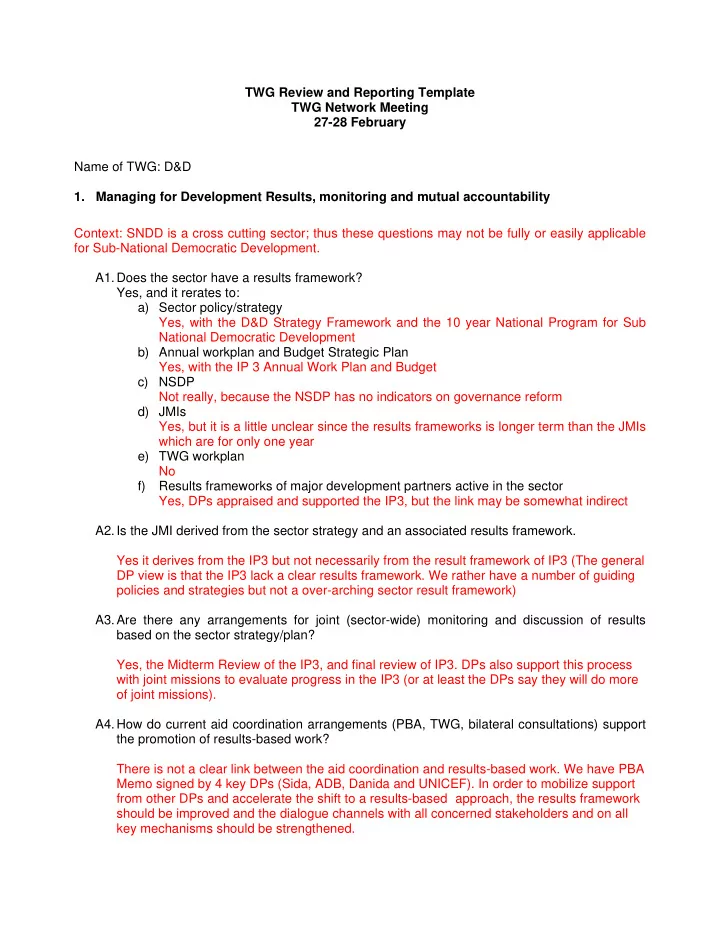
TWG Review and Reporting Template TWG Network Meeting 27-28 February Name of TWG: D&D 1. Managing for Development Results, monitoring and mutual accountability Context: SNDD is a cross cutting sector; thus these questions may not be fully


slide-1
SLIDE 1

TWG Review and Reporting Template TWG Network Meeting 27-28 February Name of TWG: D&D

  • 1. Managing for Development Results, monitoring and mutual accountability

Context: SNDD is a cross cutting sector; thus these questions may not be fully or easily applicable for Sub-National Democratic Development.

  • A1. Does the sector have a results framework?

Yes, and it rerates to: a) Sector policy/strategy Yes, with the D&D Strategy Framework and the 10 year National Program for Sub National Democratic Development b) Annual workplan and Budget Strategic Plan Yes, with the IP 3 Annual Work Plan and Budget c) NSDP Not really, because the NSDP has no indicators on governance reform d) JMIs Yes, but it is a little unclear since the results frameworks is longer term than the JMIs which are for only one year e) TWG workplan No f) Results frameworks of major development partners active in the sector Yes, DPs appraised and supported the IP3, but the link may be somewhat indirect

  • A2. Is the JMI derived from the sector strategy and an associated results framework.

Yes it derives from the IP3 but not necessarily from the result framework of IP3 (The general DP view is that the IP3 lack a clear results framework. We rather have a number of guiding policies and strategies but not a over-arching sector result framework)

  • A3. Are there any arrangements for joint (sector-wide) monitoring and discussion of results

based on the sector strategy/plan? Yes, the Midterm Review of the IP3, and final review of IP3. DPs also support this process with joint missions to evaluate progress in the IP3 (or at least the DPs say they will do more

  • f joint missions).
  • A4. How do current aid coordination arrangements (PBA, TWG, bilateral consultations) support

the promotion of results-based work? There is not a clear link between the aid coordination and results-based work. We have PBA Memo signed by 4 key DPs (Sida, ADB, Danida and UNICEF). In order to mobilize support from other DPs and accelerate the shift to a results-based approach, the results framework should be improved and the dialogue channels with all concerned stakeholders and on all key mechanisms should be strengthened.

slide-2
SLIDE 2

Issues for discussion and further action

  • A5. Based on the questions above, what are the priorities (including for training and support) for

strengthening results frameworks at sector level as well as their linkage to the JMIs, NSDP and project-level monitoring arrangements? The IP3 and its results framework should be reviewed to ensure the linkage with the new NSDP, PAR and PFMR. The possibility to develop cross-cutting JMIs should be explored. We also feel that a “cluster” TWG approach around the three key reform agendas (PFM, PAR, SNDD) would be useful, inviting representatives of all other related TWGs (PFM, PAR, health, education, infrastructure, etc.) to attend regular “cluster SNDD meetings” to cover cross-cutting issues.

  • A6. Has the JMI recently been up-dated? If not, would it be timely to do so based on 2012
  • perational plans and performance targets? Could a new JMI be developed in line with a

sector results framework? In what ways could the JMI preparation and monitoring process itself be improved?

  • Yes. The JMIs has been updated. JMIs could be prepared in a more integrated manner –

linking more closely to the sector analyses and results frameworks.

  • A7. Are monitoring targets (outcomes and outputs) effectively linked to the process of

programming resources (budgets, annual plans, Budget Strategic Plans etc? (Consider the main strengths of the current arrangements – inter-departmental cooperation etc – and the areas in which the resource-results relationship can be improved). Yes, but it needs improvement.

slide-3
SLIDE 3
  • 2. Use

strengthen Questions

  • B1. The

a P Con The PBA use the pol incl

  • B2. The

res con Yes to i Dev bot Nat

  • B3. Has

cou stre stre OD Yes

  • pe

smo

  • f program

n country s s and issues e basic com PBA (or oth nsider the m e basic comp A Memo. Th e of country s dialogue str icy issues, le lude 1, 4, 6 a e objective o ults". Does ntribution to t s, Under SN mplement th

  • velopment. T

h in fund su tional Progra s PBA (or m untry system engthening? engthening o DA programm s, Under SN erational and

  • othly imple

mme-based systems s for review ponents of a her existing main focus of ponents are he PBA Mem

  • systems. Th

ructure (5 an earning and and 7 below

  • f a PBA (A

the PBA, or this objectiv DD Reform, he Governm This arrange pport and in

  • am. But as s

more genera ms? How h Which syst

  • ver the ne

ming and bud DD reform, d Sub-Nation ementation o approach w a PBA are s partnership f work over t there but th mo is only to he PBA need nd 8 below) adaptation. w. April 2011 tr r current par

  • e. Why (or w

, PBA has be ent 10 Years ement will he kind with fo stated above al aid coordi have the m tems can be ext few year dget integrat the PBA has nal Administ

  • f IP3 and its

es to prom set out below p managem the past yea here is a nee a limited ex ds to be mad is not set-up Other comp raining) is "t rtnership ma why not)? een set up a s-National P elp and coor

  • cusing to ac

e, the PBA m ination work major reform e the most a rs (e.g. resu tion, capacit s promoted t tration Finan s 6 Sub-prog mote deve

  • w. Discuss th

ment arrange ar and priority ed to look int xtent used to de more incl p in a way th ponents that to promote anagement a and agreed b Program for S rdinate with chievement might needs k) promoted m program appropriate ults framewo ty developm the strength ncing system grams have elopment e he status of ements) in y areas for t to, and poss

  • promote eff

usive, result hat promotes t would need better organ arrangement between NC Sub Nationa DPs to prov

  • f the object

to improve. the strengt mes contrib focus of ca

  • rks and m

ent)? hening and u

  • ms. The well

contributed effectivenes each main your TWG/ the year ahe sibly revise, t fectiveness ts-oriented. A s discussion d more work nisation and ts, make a p CDD and key al Democrati vide their sup tives of the thening and buted to s pacity suppo monitoring sy use of NCDD design and to the syste ss and area of /sector. ead. the and Also

  • n

k d better positive y DPs ic pports use of ystems

  • rt and

ystems, D ms

slide-4
SLIDE 4
  • strengthening. The Sub-National Administration financing, institutional capacity development

and monitoring systems can be the most appropriate focus of capacity support and strengthening over the next few years. It should be noted however that the systems developed are mainly used for donor funding there should be an increased focus on strengthening systems for RGC funding as well.

  • B4. Is your TWG willing to work with CRDB/CDC to develop a pilot country systems assessment

tool? (If so, in which area, e.g. results frameworks and monitoring, ODA programming and budget integration, capacity development?) Yes, the area of results framework and monitoring

  • B5. What other kind of support is required from CRDB/CDC (or other RGC agency, e.g. in core

reforms) to promote development effectiveness through PBAs, improved organisation and strengthening country systems? Coordination with DPs to encourage the using of NCDD-S, and in the medium term the regular government systems, to promote government ownership and ensure that the DPs support can be the most effective catalyst for sustainable Sub-National Democratic Development.

slide-5
SLIDE 5
  • 3. Partnership and dialogue mechanisms

Partnership and dialogue mechanisms were discussed during the April 2011 GDCC meeting. The Government paper for this meeting emphasised that "The Royal Government is committed to working together with development partners to find ways to ensure the continued effectiveness of the GDCC meeting. Indeed, all levels in our coordination mechanism are linked together and we need to strengthen them individually and also collectively." A number of reviews have been conducted since 2006, training has been provided and a TWG Network was established in 2007 to promote dialogue, learning and relationship-building. Recognising the challenging nature of partnerships, a dedicated initiative – "Making Partnerships Effective in Cambodia" – was implemented in four stages from 2009 to 2011. This exercise found that:

Partnership-based approaches to sustainable development and to the MDGs are not new, but it is increasingly clear that genuine partnering is not a ‘quick fix’ or an easy option. In fact, partnering requires a significant adaptation of skills, systems and procedures for its contribution as a key delivery mechanism to be achieved. Partnerships are not ‘business as usual’. They require some adjustments in practice and may even be perceived as ‘challenging’ to the status quo since they are based on a collaborative approach – building from the diversity of the different partners – rather than a more traditional ‘command and control’ scenario.

http://www.cdc-crdb.gov.kh/cdc/twg_network/resource_mpe_stage4/default.htm

Following the April 2011 GDCC meeting, development partners organised their own 1-day meeting to consider how they can organise themselves for more effective partnering and dialogue with Government, civil society organizations and the private sector (summary paper available at the TWG Network meeting). Effective partnering is central to realising the objectives of "development effectiveness" in

  • Cambodia. Topics addressed earlier in this meeting – results-based monitoring, PBAs, country

systems – are also highly dependent on effective partnership arrangements and dialogue. Issues for discussion and questions for review C1. How well has TWG performed over last year in terms of the following: a) Structured work around an annual plan with indicators linked to sector/thematic plan? The functioning of the TWG has improved and there is a regular discussion and sharing of feedback in the process of IP3 AWPB. DPs however need to be better harmonized in their dialogue in the TWG and there is a need for more in-depth discussions on the overall priorities and policy choices. b) Strengthening coordination across Government with

  • ther

relevant ministries/agencies? IP3 implementing agencies participate the TWG meeting to share the progress and issues in IP3 implementation. c) Identifying partnering opportunities with South-South partners, private sector & civil society? Only limited action in terms of south-south and private sector partnerships. Engagement with civil society is a key issue for the SNDD agenda from the outset. Discussions ongoing how to further strengthen CSO engagement in the process. 2 representatives from civil society (Star Kampuchea) are members of the TWG.

slide-6
SLIDE 6

d) Dialogue and agreement on issues that relate to effective development (in terms of achieving sector and national development goals?) As noted above (questions A) the results framework at “sector” level could be

  • improved. A substantial dialogue on the results framework is also needed.

C2. Do RGC and DP members share the same views on TWG performance (if not, on what issues do they differ?) DPs are rather critical about the effectiveness of the TWG meetings as such. On the other hand, looking at the TWG in a broader sense, it should be fair to say that both DPs and the RGC view the performance in a very positive way. C3. What are the major issues to address in order to consolidate and strengthen partnerships at sector level and in the TWGs? DPs should continue to promote coordination among themselves and when possible agree

  • n common positions in their dialogue within the TWG. The NCDD-S could also be more

proactive in promoting the active engagement of the IP3 implementing agencies in the TWG. C4. Is there any additional support – from CRDB/CDC or other agencies – that could support effective dialogue and coordination? Promotion of the awareness of results-based management across the RGC, by top officials

  • f the CDC and key line ministries.