Tutoring Construction and Learners TUTORIAL DIALOG evaluation of - - PowerPoint PPT Presentation

tutoring
SMART_READER_LITE
LIVE PREVIEW

Tutoring Construction and Learners TUTORIAL DIALOG evaluation of - - PowerPoint PPT Presentation

Tutoring Construction and Learners TUTORIAL DIALOG evaluation of Discussion or knowledge knowledge at the demonstration assessment MD. FAISAL MAHBUB same time CHOWDHURY LECTURER: DR. IVANA KRUIJFF-KORBAYOV Advanced Dialogue


slide-1
SLIDE 1

TUTORIAL DIALOG

  • MD. FAISAL MAHBUB

CHOWDHURY LECTURER:

  • DR. IVANA KRUIJFF-KORBAYOVÁ

Advanced Dialogue Modeling For Practical Application’08-09

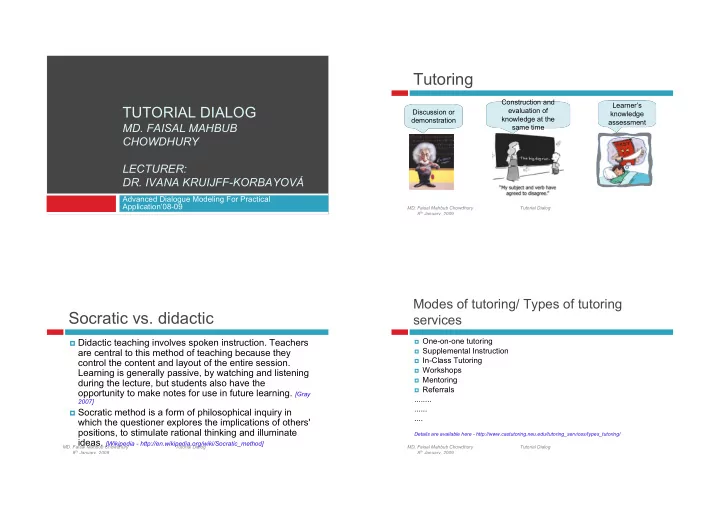
Tutoring

  • MD. Faisal Mahbub Chowdhury

Tutorial Dialog 8th January, 2009

Discussion or demonstration Learner’s knowledge assessment Construction and evaluation of knowledge at the same time

Socratic vs. didactic

Didactic teaching involves spoken instruction. Teachers

are central to this method of teaching because they control the content and layout of the entire session. Learning is generally passive, by watching and listening during the lecture, but students also have the

  • pportunity to make notes for use in future learning. [Gray

2007] Socratic method is a form of philosophical inquiry in

which the questioner explores the implications of others' positions, to stimulate rational thinking and illuminate

  • ideas. [Wikipedia - http://en.wikipedia.org/wiki/Socratic_method]
  • MD. Faisal Mahbub Chowdhury

Tutorial Dialog 8th January, 2009

Modes of tutoring/ Types of tutoring services

One-on-one tutoring Supplemental Instruction In-Class Tutoring Workshops Mentoring Referrals

........ ...... ....

Details are available here - http://www.castutoring.neu.edu/tutoring_services/types_tutoring/

  • MD. Faisal Mahbub Chowdhury

Tutorial Dialog 8th January, 2009

slide-2
SLIDE 2

The Goals

“A master can tell you what he expects of you. A teacher, though, awakens your own expectations.” Patricia Neal “The mediocre teacher tells. The good teacher explains. The superior teacher demonstrates. The great teacher inspires.” William Arthur Ward

Simulate ideal human tutors Monitor and guide student’s

progress while supporting the student’s sense of control and self-confidence.

Active construction of

student knowledge rather than information delivery system

Collaborative answering of

deep reasoning questions

Approximate evaluation of

student knowledge rather than detailed student modeling [Rickel et al. 2002]

  • MD. Faisal Mahbub Chowdhury

Tutorial Dialog 8th January, 2009

Modeling Human Teaching Tactics in a Computer Tutor

[Core et al. 2000]

  • MD. Faisal Mahbub Chowdhury

Tutorial Dialog 8th January, 2009

BEETLE (Basic Electricity and Electronics Tutorial Learning

Environment)

The tutoring tactics are designed based on the analysis of a collection of dialogues

where the students performed labs using GUI with the help of human tutors. Tutors and students communicated from different machine through chat. Tutor could monitor student's progress from her machine.

The teaching tactics are identified and annotated in these dialogues for training the

system.

Some of the human teaching tactics identified from the data are – If a student rephrases a wrong answer for a question again, the tutor does not repeat the

same question and tries a different utterance.

Tutor is careful not to perform steps of a teaching tactic that are unnecessary. Sometimes, even if the tutor thinks the student knows the instructions, the tutor does the

followings –

  • Make the instruction salient
  • Make the student’s action salient
  • Ask the student what steps remain

etc …

  • MD. Faisal Mahbub Chowdhury

Tutorial Dialog 8th January, 2009

BEETLE (Basic Electricity and Electronics Tutorial Learning

Environment)

Focus on two aspects to support coherent tutorial dialogue:

Content planning: plan how

to teach a student a particular concept. [Recursive Transition Network]

Communication

management planning: maintain the conversation (e.g., signaling topic shifts, acknowledging and accepting student utterances etc).

  • MD. Faisal Mahbub Chowdhury

Tutorial Dialog 8th January, 2009

slide-3
SLIDE 3

BEETLE (Basic Electricity and Electronics Tutorial Learning

Environment)

The tutor’s curriculum contains a list of tutoring goals. Unachieved tutoring goals are placed in a data

structure, called agenda.

Plans are constructed using plan operators to achieve

these goals.

Plan operators are obtained from the plan library. If a plan operator contains certain actions to be

performed, they are pushed onto the agenda followed by the preconditions of the operator.

  • MD. Faisal Mahbub Chowdhury

Tutorial Dialog 8th January, 2009

Conversational Game

A conversational game is a

recursive transition networks where the link represent complex actions such as giving instructions

  • r actions to the GUI.

Each game handles the

communication management associated with the system’s utterances.

  • MD. Faisal Mahbub Chowdhury

Tutorial Dialog 8th January, 2009

Control Flow Through The Architecture

  • If the student types input then the parser produces an

underspecified logical form that the interpreter attempts to fully specify.

  • The interpreter uses the problem solving manager,

dialogue context, expectations, and curriculum to evaluate input (note, input to the tutor may simply be that the student is idle).

  • The interpreter updates the student model.
  • The interpreter may send messages directly to the

dialogue planner (e.g., an evaluation of the student’s answer to a question or an alert when one of the values in the student model falls below threshold)

  • If a conversational game is in progress, then the

conversational game engine runs it, else the reactive planner is run to load a new conversational game.

  • The reactive planner is run if a conversational game

ends or there is unexpected student input (e.g., the student says red wire instead of red lead).

  • MD. Faisal Mahbub Chowdhury

Tutorial Dialog 8th January, 2009

Dialogue on Measuring Current

(BEETLE)

  • MD. Faisal Mahbub Chowdhury

Tutorial Dialog 8th January, 2009

slide-4
SLIDE 4

Dialogue on Measuring Current

(BEETLE)

Wrong answer Wrong terminology, vague, incomplete answer

  • MD. Faisal Mahbub Chowdhury

Tutorial Dialog 8th January, 2009

Dialogue on Measuring Current

(BEETLE)

  • MD. Faisal Mahbub Chowdhury

Tutorial Dialog 8th January, 2009

Dialogue Planning Operators

(BEETLE)

  • MD. Faisal Mahbub Chowdhury

Tutorial Dialog 8th January, 2009

Dialogue Planning Operators

(BEETLE)

  • MD. Faisal Mahbub Chowdhury

Tutorial Dialog 8th January, 2009

slide-5
SLIDE 5

Dialogue Planning Operators

(BEETLE)

  • MD. Faisal Mahbub Chowdhury

Tutorial Dialog 8th January, 2009

At a Glance

Tutor’s curriculum contains a list of tutoring goals. Unachieved tutoring goals are tracked by the

Agenda.

Maintains updated student model during teaching. Constructs plans for achieving goals. Contents planning and communication

management handled separately by different modules.

  • MD. Faisal Mahbub Chowdhury

Tutorial Dialog 8th January, 2009

AutoTutor

[Graesser et al. 2004]

  • MD. Faisal Mahbub Chowdhury

Tutorial Dialog 8th January, 2009

A different perspective

Authors have videotaped over 100 h of naturalistic tutoring,

transcribed the data, classified the speech act utterances into discourse categories, and analyzed the rate of particular discourse patterns.

These analyses revealed that human tutors rarely implement

intelligent pedagogical techniques such as bona fide Socratic tutoring strategies, modeling–scaffolding–fading, reciprocal teaching, frontier learning, building on prerequisites, cascade learning, and diagnosis/remediation of deep misconceptions.

Instead, tutors tend to coach students in constructing

explanations according to the EMT dialogue patterns.

The EMT dialogue strategy is substantially easier to implement

computationally than are sophisticated tutoring strategies.

  • MD. Faisal Mahbub Chowdhury

Tutorial Dialog 8th January, 2009

slide-6
SLIDE 6

A different perspective

Although, an ideal answer (for the type question

AutoTutor asks a student) is approximately three to seven sentences in length, the initial answers to these questions by learners are typically only one word to two sentences in length.

AutoTutor engages the learner in a dialogue that

assists the learner in the evolution of an improved answer that draws out more of the learner’s knowledge that is relevant to the answer.

The dialogue between AutoTutor and the learner

typically lasts 30–100 turns.

  • MD. Faisal Mahbub Chowdhury

Tutorial Dialog 8th January, 2009

Design inspirations

Explanation based constructivist theories of learning Learning is more effective and deeper when the learner must

actively generate explanations, justifications, and functional procedures than when he or she is merely given information to read.

Adaptive intelligent tutoring systems The tutors give immediate feedback on the learner’s actions

and guide the learner on what to do next in a fashion that is sensitive to what the system believes the learner knows.

Empirical research on tutorial dialogue The patterns of discourse uncovered in naturalistic tutoring are

imported into the dialogue management facilities of AutoTutor.

  • MD. Faisal Mahbub Chowdhury

Tutorial Dialog 8th January, 2009

What does AutoTutor do? [Graesser et al.

2005]

Hints Prompts for specific

information

Adds information that is

missed

Corrects some bugs and

misconceptions

Answers student question Holds mixed-initiative dialog

in natural language

Asks questions and presents

problems

Why? How? What-if? What is the

difference?

Evaluates meaning and

correctness of the learner’s answers (LSA and computational linguistics)

Gives feedback on answers Face displays emotions + some

gestures

  • MD. Faisal Mahbub Chowdhury

Tutorial Dialog 8th January, 2009

Latent Semantic Analysis (LSA)

The underlying idea of LSA is that the aggregate of all the word contexts (inside a given large corpus) in which a given word does and does not appear provides a set of mutual constraints that largely determines the similarity of meaning of words and sets

  • f words to each other [Landauer et al. 1998].

In other words, LSA is a statistical technique that measures the conceptual similarity of any two pieces

  • f text, such as words, paragraphs, sentences etc.
  • MD. Faisal Mahbub Chowdhury

Tutorial Dialog 8th January, 2009

slide-7
SLIDE 7

How the learner’s answer handled

Expectations-and-misconception-tailored (EMT) dialogue – as the

learner articulates the answer, the content is compared with the expectations (anticipated correct answers) and misunderstanding (anticipated misunderstandings) using LSA. The tutor responds appropriately when particular expectations or misconceptions is expressed.

Curriculum script (more in next slide) Dialogue moves facilitate covering the information that is

anticipated by the curriculum script.

  • MD. Faisal Mahbub Chowdhury

Tutorial Dialog 8th January, 2009

Curriculum script

Curriculum script includes content associated with a question or

problem.

1)

the ideal answer

2)

a set of expectations

3)

families of potential hints, correct hint responses, prompts, correct prompt responses, and assertions associated with each expectation

4)

a set of misconceptions and corrections for each misconception

5)

a set of key words and functional synonyms

6)

a summary

7)

markup language for the speech generator and gesture generator for components in (1) through (6) that require actions by the animated agents.

  • MD. Faisal Mahbub Chowdhury

Tutorial Dialog 8th January, 2009

Managing One AutoTutor Turn

Short feedback on the student’s previous turn Advance the dialog by one or more dialog moves that

are connected by discourse markers

End turn with a signal that transfers the floor to the

student

Question Prompting hand gesture Head/gaze signal

  • MD. Faisal Mahbub Chowdhury

Tutorial Dialog 8th January, 2009

Dialog Moves [Graesser et al. 2005]

Positive immediate feedback: “Yeah” “Right!” Neutral immediate feedback: “Okay” “Uh huh” Negative immediate feedback: “No” “Not quite” Pump for more information: “What else?” Hint: “How does tossing the pumpkin affect horizontal velocity?” Prompt for specific information: “Vertical acceleration does not affect horizontal

_______.”

Assert: “Vertical acceleration does not affect horizontal velocity.” Correct: “Air resistance is negligible” Repeat: “So, once again, how does tossing the pumpkin affect horizontal

velocity?”

Summarize: “So to recap, [succinct summary].”

  • MD. Faisal Mahbub Chowdhury

Tutorial Dialog 8th January, 2009

slide-8
SLIDE 8

How does AutoTutor select the next expectation? [Graesser et al. 2005]

Don’t select expectations that the student has covered cosine(student answers, expectation) > threshold Coherence Select next expectation that has highest overlap with

previously covered expectation

  • MD. Faisal Mahbub Chowdhury

Tutorial Dialog 8th January, 2009

How does AutoTutor know which dialog move to deliver? [Graesser et al. 2005]

  • MD. Faisal Mahbub Chowdhury

Tutorial Dialog 8th January, 2009

Sample dialogue

  • MD. Faisal Mahbub Chowdhury

Tutorial Dialog 8th January, 2009

Demo

http://www.youtube.co

m/watch?v=aPcoZPjL 2G8

http://www.youtube.co

m/watch?v=ZDivTscX 4j0&NR=1.

  • MD. Faisal Mahbub Chowdhury

Tutorial Dialog 8th January, 2009

slide-9
SLIDE 9

Experiment on computer literacy

Students were given three types of test questions –

shallow and deep multiple-choice questions, and questions with ideal answers (with four content words deleted for each answer) used for AutoTutor training.

The result revealed AutoTutor didn’t facilitate learning on

shallow multiple-choice test questions.

  • MD. Faisal Mahbub Chowdhury

Tutorial Dialog 8th January, 2009

Experiment on conceptual physics

The participants were given a pretest, completed training,

and were given a posttest. The conditions were AutoTutor, textbook, and read nothing.

The two tests tapped deeper comprehension and

consisted of either multiple-choice questions or conceptual physics problems that required essay answers.

  • MD. Faisal Mahbub Chowdhury

Tutorial Dialog 8th January, 2009

Experimental findings

First, AutoTutor is effective in promoting learning gains at deep levels

  • f comprehension in comparison with the typical ecologically valid

situation in which students read nothing, start out at pretest, or read the textbook for an amount of time equivalent to that involved in using AutoTutor.

Second, reading the textbook is not much different than reading

nothing (surprising!). It appears that a tutor is needed to encourage the

learner to focus on deeper levels of comprehension.

Third, AutoTutor is as effective as a human tutor who communicates

with the student over terminals in computer-mediated conversation.

  • MD. Faisal Mahbub Chowdhury

Tutorial Dialog 8th January, 2009

Experimental findings

Fourth, the impact of AutoTutor on learning gains is

considerably reduced when a comparison is made with reading of text that is carefully tailored to exactly match the content covered by AutoTutor.

Finally, performance is very much dependent on

curriculum script.

  • MD. Faisal Mahbub Chowdhury

Tutorial Dialog 8th January, 2009

slide-10
SLIDE 10

Open questions

Is it the dialogue content or the animated agent that

accounts for the learning gains?

What role do motivation and emotions play, over and

above the cognitive components?

  • MD. Faisal Mahbub Chowdhury

Tutorial Dialog 8th January, 2009

Questions

Milos – …... What actually is tutoring? …. Elahi - How does the tutor skip a step which is already performed by the student? Alexander - .... The fact that surprises me is that the system doesn't try to find out what

kind of user it is tutoring..... It starts with instructions right away and backs off to teaching only in situations when the student doesn't know how to execute a particular action..... Do I have a wrong view of tutoring?

Fabian - ......what does "one-to-one tutoring" have to do with a computer system

"explaining" tasks to a user? In my opinion, human factors play the most important role in teaching. It is essential for the teacher to motivate the student, to give a smile and to think positive ......even if the student's ideas do not contribute to the actual goal...... The computer system does not have any of those properties of "one-to-one tutoring", that's why I think that this is a bad comparison.

  • MD. Faisal Mahbub Chowdhury

Tutorial Dialog 8th January, 2009

Questions

Raveesh - In the described approach the notion of "action library" is something similar

to the notion of "recipe" which we have seen in earlier seminars. I believe, domain knowledge about 'learning some X' is used to define these "action libraries" e.g. Fig 4 A-to-G, right? Authors also mentioned learning "tactics" from corpora, but what I am not sure is how the authors are using these "tactics" to alter the predefined action plan in the action library.

Lisa - …… they want to test their teaching tactics in other domains. Do you know the

results? Have they succeeded in building domain independent tutoring strategies? …….. Do they have human examples from other domains? Are there universal teaching strategies, that are independent of the domain, the student and the specific tutor?

  • Charles Callaway et al. (2007), "The Beetle and BeeDiff Tutoring Systems"
  • MD. Faisal Mahbub Chowdhury

Tutorial Dialog 8th January, 2009

Integrating Collaborative Dialogue Systems (CDS) with Intelligent Tutoring Systems (ITS) [Rickel et al. 2002]

  • MD. Faisal Mahbub Chowdhury

Tutorial Dialog 8th January, 2009

slide-11
SLIDE 11

ITS and CDS

Research on Intelligent Tutoring Systems (ITS)

focuses on computer tutors that adapt to individual students based on the target knowledge the student is expected to learn and the presumed state of the student’s current knowledge.

Research on Collaborative Tutoring Systems focuses

  • n computational models of human dialogue for

collaborative tasks. >> Tutoring is inherently collaborative.

  • MD. Faisal Mahbub Chowdhury

Tutorial Dialog 8th January, 2009

Mixed-Initiative and Collaboration

[Rich et al. 2005]

  • MD. Faisal Mahbub Chowdhury

Tutorial Dialog 8th January, 2009

Collaboration: A process in which two or more participants coordinate their actions toward achieving shared goals. [Grosz & Sidner]

Collaboration Mixed-Initiative

implies

i.e., all collaborative systems are mixed-initiative Mixed-Initiative

strongly suggests

Collaboratio n i.e., most interesting mixed-initiative systems are collaborative

Mixed Initiative: …efficient, natural interleaving of contributions by users and automated services… [Horvitz]

Paco (Pedagogical Agent for

Collagen)

Paco teaches students procedural tasks in

simulated environments.

It expresses various tutorial behaviors as rules for

generating candidate discourse acts in Collagen.

  • MD. Faisal Mahbub Chowdhury

Tutorial Dialog 8th January, 2009

Collagen

Collagen is a middleware

system based on collaborative discourse.

Collagen maintains a model of

the discourse state shared by the user and the computer agent.

Agents constructed using

Collagen use the discourse state to generate an agenda of candidate discourse acts, including both utterances and domain actions, and then choose one (discourse act) to utter or perform.

Collagen’s declarative language

can be used to represent domain-specific procedural

  • knowledge. This knowledge

serves as a model of how domain tasks should be performed.

Each task is associated with one

  • r more recipes (i.e., procedures

for performing the task).

Each recipe consists of several

elements drawn from a relatively standard plan representation.

  • MD. Faisal Mahbub Chowdhury

Tutorial Dialog 8th January, 2009

slide-12
SLIDE 12

Collagen as a Foundation for Teaching Procedural Tasks

Collagen model of collaborative dialogue includes two main

parts:

a representation of discourse state and a discourse interpretation algorithm, which specifies how to update

the discourse state given a new action or utterance by either the user

  • r agent. Its objective is to determine how the current act contributes

to the collaboration.

Collagen partitions the discourse state into three interrelated

components:

linguistic structure, attentional state, and intentional structure.

  • MD. Faisal Mahbub Chowdhury

Tutorial Dialog 8th January, 2009

Collagen as a Foundation for Teaching Procedural Tasks

The linguistic structure groups the dialogue history into a

hierarchy of discourse segments. Each segment is a

contiguous sequence of actions and utterances that contribute to some purpose (e.g., performing a subtask).

The attentional state represents what the user and agent

are talking about or working on at a given moment. It is

represented as a stack of discourse purposes, called the focus

  • stack. When a new discourse segment is begun, its purpose is

pushed onto the stack. When a discourse segment is completed or discontinued, its purpose is popped off the stack.

The intentional structure represents the decisions that

have been made as a result of the actions and utterances (reflected by the linguistic structure and attentional state), independent of their order. The intentional structure is

represented as plan trees. Nodes in the tree represent mutually agreed upon intentions (e.g., to perform a task), and the tree structure represents the sub-goal relationships among these intentions.

  • MD. Faisal Mahbub Chowdhury

Tutorial Dialog 8th January, 2009

Paco’s Architecture

  • MD. Faisal Mahbub Chowdhury

Tutorial Dialog 8th January, 2009

Discourse acts (representing tutorial

behaviors)

  • MD. Faisal Mahbub Chowdhury

Tutorial Dialog 8th January, 2009

slide-13
SLIDE 13

Demo

  • MD. Faisal Mahbub Chowdhury

Tutorial Dialog 8th January, 2009

References

  • MD. Faisal Mahbub Chowdhury

Tutorial Dialog 8th January, 2009

  • Gray, C. (2007). "Essential teaching skills". http://student.bmj.com/issues/07/10/careers/361.php
  • Core, M.G., Moore, J.D., Zinn, C., & Wiemer-Hastings, p. (2000). "Modeling human teaching

tactics in a computer tutor." Proceedings of the ITS Workshop on Modelling Human Teaching Tactics and Strategies.

  • Graesser, A.C., Lu, S., Jackson, G.T., Mitchell, H., Ventura, M., Olney, A., & Louwerse, M.M.

(2004). AutoTutor: A tutor with dialogue in natural language". Behavioral Research Methods, Instruments, and Computers, 36, 180-193.

  • Graesser, A.C., Chipman, P., Haynes, B.C., & Olney, A. (2005). "AutoTutor: An intelligent

tutoring system with mixed-initiative dialogue". IEEE Transactions in Education, 48, 612–618

  • Landauer, T.K., Foltz, P.W., & Laham, D. (1998). "Introduction to Latent Semantic Analysis".

Discourse Processes, 25, 259-284.

  • Rich, C., & Sidner, C.L. (2005) "Collagen: Middleware for Building Mixed-Initiative Problem

Solving Assistants". Symposium on Mixed-Initiative Problem-Solving Assistants, AAAI

  • Rickel, J., Lesh, N.B., Rich, C., Sidner, C.L., & Gertner, A. (2002) "Collaborative Discourse

Theory as a Foundation for Tutorial Dialogue", International Conference on Intelligent Tutoring Systems (ITS), Vol 2363, pps 542-551, June 2002. Springer Lecture Notes in Computer Science.

Thanks for your patience.