Tuning the WCET of Embedded Why Reduce the WCET? Applications more - - PowerPoint PPT Presentation

tuning the wcet of embedded why reduce the wcet
SMART_READER_LITE
LIVE PREVIEW

Tuning the WCET of Embedded Why Reduce the WCET? Applications more - - PowerPoint PPT Presentation

Tuning the WCET of Embedded Why Reduce the WCET? Applications more likely to meet timing Wankang Zhao 1 , Prasad Kulkarni 1 , David Whalley 1 ,Christopher Healy 2 , constraints Frank Mueller 3 , Gang-Ryung Uh 4 can lower clock rate to


slide-1
SLIDE 1

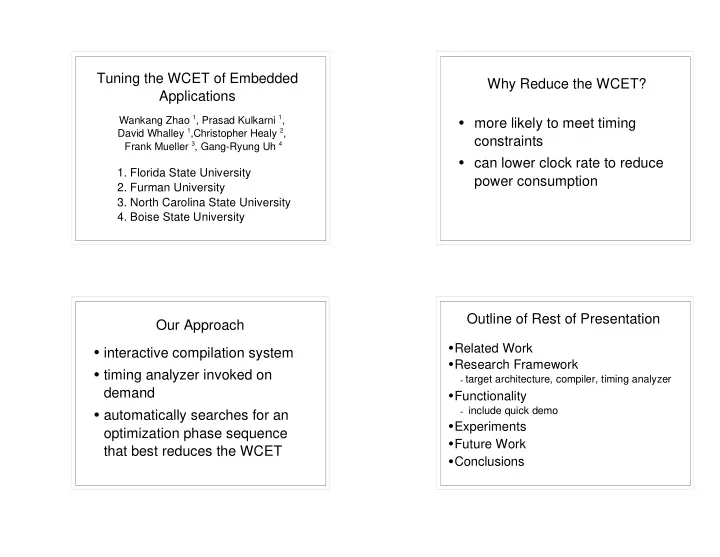
Tuning the WCET of Embedded Applications

Wankang Zhao 1, Prasad Kulkarni 1, David Whalley 1,Christopher Healy 2, Frank Mueller 3, Gang-Ryung Uh 4

  • 1. Florida State University
  • 2. Furman University
  • 3. North Carolina State University
  • 4. Boise State University

Why Reduce the WCET?

more likely to meet timing

constraints

can lower clock rate to reduce

power consumption Our Approach

interactive compilation system timing analyzer invoked on

demand

automatically searches for an

  • ptimization phase sequence

that best reduces the WCET Outline of Rest of Presentation

Related Work Research Framework

  • target architecture, compiler, timing analyzer

Functionality

  • include quick demo

Experiments Future Work Conclusions

slide-2
SLIDE 2

Related Work

methods to reduce WCET in critical sections

  • Marlowe, et al, System Integration '92
  • Hong, et al, PLDI '93

reduce WCET on a dual instruction set

processor

  • Lee, et al, WCET '03

genetic algorithms to search for effective

  • ptimization sequences to improve speed,

space, or a combination of both

  • Cooper, et al, LCTES '99
  • Kulkarni, et al, LCTES '03

Framework for This Research Target Architecture: StarCore SC100 Processor

A digital signal processor for embedded

systems.

No caches and no operating system. A simple five stage pipeline machine with

transfer-of-control and target misalignment penalties.

The size of instructions varies from 1 word to

5 words.

Our Timing Analyzer

Calculates WCET for each path, loop, and

function in the program.

Features

WCET pipeline analysis - RTSS '95

WCET cache analysis - RTSS '94, RTAS '97

automatically calculates the number of loop

iterations - RTAS '98

detects infeasible paths due to branch

constraints - RTAS '99

slide-3
SLIDE 3

Estimating WCET with Transfer of Control Penalties

What is the WC path?

Has been previously used to tune

applications for ACET and code size.

Now interacts with our timing analyzer

to determine WCET improvement.

VPO Interactive System for Tuning Applications (VISTA) VISTA: Functionality

Provides a graphical display of the low-level

program representation.

Directs order and scope in which the

  • ptimization phases are applied.

Shows feedback on the WCET and code size

improvement.

Reverses previously applied transformations. Uses a genetic algorithm to search for the best

  • rder of optimization phases.

Main Window of VISTA

slide-4
SLIDE 4

Select Optimization Phases Main Window of VISTA (again) Select the Candidate Phases Selecting Search Options

slide-5
SLIDE 5

Window Showing the Search Status GA Results Experiments

Evaluated effectiveness of VISTA's GA

search for improving WCET.

Each phase is considered a gene. Each sequence of phases is considered a

chromosome.

Much faster to interact with a timing

analyzer to obtain WCET than a simulator to obtain ACET.

Candidate Optimization Phases

branch chaining remove useless blocks remove unreachable code common subexpression elimination register allocation block reordering minimize loop jumps remove useless jumps loop transformations merge basic blocks evaluation order determination dead assignment elimination strength reduction reverse jumps instruction selection

slide-6
SLIDE 6

Genetic Algorithm (GA) Parameters

Sequence length (chromosome) is 1.25 times the

number of phases that were successfully applied by the batch compiler.

Population size: 20 sequences Generations: 200 4 sequences are replaced by crossover

  • perations.

Mutation rate: 10% lower half, 5% upper half 3 different fitness criteria:

100% WCET,100% code size, 50% WCET and

50% code size

DSPstone Benchmarks Other Benchmarks WCET vs. Observed Cycles

slide-7
SLIDE 7

Tuning for WCET Tuning for Code Size 50% WCET and 50% Code Size Result of the Three Fitness Criteria

slide-8
SLIDE 8

Future Work

Develop compiler optimizations that use

worst-case path information to improve WCET.

Example:

change order of basic blocks to

reduce transfer of control penalties for worst-case paths

Conclusions

Developed the first system where a

compiler can invoke a timing analyzer on demand.

Showed that WCET can be used as a

fitness value to a genetic algorithm to find an effective optimization sequence.

WCET and code size were simultaneously

improved by 6% and 5%, respectively.