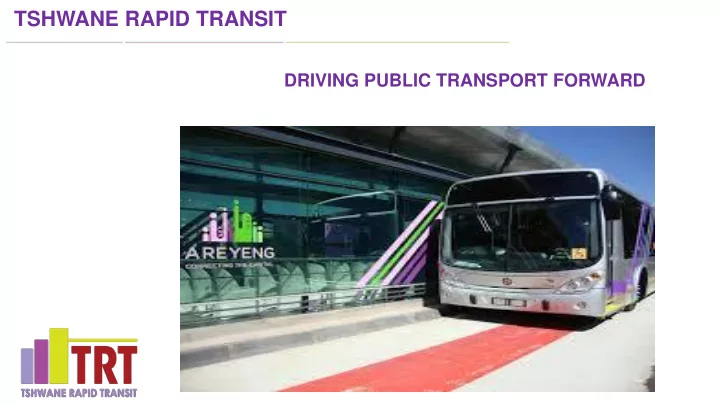
TSHWANE RAPID TRANSIT DRIVING PUBLIC TRANSPORT FORWARD Our Vision: - - PowerPoint PPT Presentation

tshwane rapid transit
SMART_READER_LITE
LIVE PREVIEW

TSHWANE RAPID TRANSIT DRIVING PUBLIC TRANSPORT FORWARD Our Vision: - - PowerPoint PPT Presentation

TSHWANE RAPID TRANSIT DRIVING PUBLIC TRANSPORT FORWARD Our Vision: To be the leading passenger transport operator in the continent Our Mission: To operate reliable, safe and commercially viable passenger transport services 2 Values


slide-1
SLIDE 1

TSHWANE RAPID TRANSIT

DRIVING PUBLIC TRANSPORT FORWARD

slide-2
SLIDE 2

Our Vision:

To be the leading passenger transport operator in the continent

Our Mission:

To

  • perate

reliable, safe and commercially viable passenger transport services

2

slide-3
SLIDE 3

Values

  • Social responsibility
  • Excellence
  • Integrity
  • Teamwork
  • Accountability

1

slide-4
SLIDE 4

TRT Value Chain

4

slide-5
SLIDE 5

TRT structure

CHIEF EXECUTIVE OFFICER

Chief Financial Officer

Finance Manager Accountant Junior Accountant Procurement Officer Driver Messenger

Human Resources Manager

Learning & Development Manager Human Resources Officer

Human Resources Admin Officer

Operations Manager

Operations Support Officer Depot Manager (Unfunded/Vacant) Supervisors (4)

Senior Dispatcher (1)

Dispatchers (5)

Bus Driver Conductors (139) Technical Manager

Technical Foreman

Assistant Body Builder Fuel Attendants (2) Shunt drivers (4) Scheduling Officer Industrial Engineer (Unfunded/V acant) Company Secretary

OFFICE OF THE CEO - OFFICE MANAGER

Receptionist

5

5 Interns & 40 Apprentices( TETA funded)

slide-6
SLIDE 6

BRT Operations

  • Rainbow Junction to Hatfield
  • Low passengers versus plan
  • Started in 2014 with an inception phase
  • Not yet in the 12 year fee per kilometre operations
  • 4th year of Cost recovery
  • Shareholder identification, onboarding and impact
  • Compensation payment challenges

6

slide-7
SLIDE 7

BRT Operations

  • Fares managed by the City
  • Low passengers versus plan
  • No direct communication with the passengers
  • No marketing activities within the Areyeng brand
  • Latent design faults within the system and buses
  • Bus life cycle costs
  • Infrastructure delays
  • Depot, fuel stations, routes, transfer facilities

7

slide-8
SLIDE 8

Mamelodi Bus Operations

  • Started on 2 October 2017 for a 6 months’ contract, extended to 30 September

2018

  • Operating 46 buses instead of 73
  • Operating licences for leased buses
  • Subsidised and unsubsidised routes
  • Buses used not specified for the operation and therefore costs high
  • Partnered with MATRANS (Mamelodi Transport Solutions)

8

slide-9
SLIDE 9

Mamelodi Bus Operations

  • Current Fare structure has existed since 2016, due to contracts being ceded

and therefore no price increases.

  • Operating routes from 1996, new development not taken into considerations.
  • No infrastructure for bus stops and terminals.
  • Riots within the community.
  • Cashless operations.
  • Short term nature of contracts hinder investments & permanent employment

9

slide-10
SLIDE 10

Allocation of operational subsidies

  • Allocations are based on contracts done in 1996.
  • Route networks and developments point to different areas of origin and

destinations.

  • Most townships developed post 1999 and these are not covered.
  • If one operates per allocations, passengers collected do not make business

sense due to numbers.

  • Co-operation with the local taxi industries to make sure that there is a beneficial

program in place to benefit the poor and business interests

10

slide-11
SLIDE 11

Operational subsidies

  • Subsidies have made a few bus companies very big and these companies

have created barriers to entry.

  • No impact in some areas as newer developments do not have subsidies

covering them and Taxis are the sole operators there.

  • Regulations of pricing is required in the public transport to protect the poor.
  • Extension of the subsidies to all modes of transport.
  • These can be done through fuel support instead of cash for the qualifying
  • modes. Fuel constitute 30-45% of Operating expenditure in transport.

11

slide-12
SLIDE 12

Implementation of BRT

  • BRT is meant to improve mobility, be affordable and provide a safe and reliable transport

system that integrates with other modes.

  • Cost structures in Transport for BRT’s are not easily understood. They provide for cheaper

travel when utilised effectively.

  • The mind of people is focused on pay as you use and this model becomes costly.
  • BRT trunks should cover main nodes operated by buses.
  • Feeders and complimentary routes should be a mix of buses and taxis
  • Automated fare collection (AFC) integration on both modes and user education becomes a key

focus area.

12

slide-13
SLIDE 13

Transformation

  • Shareholding in any business needs to make financial sense. Profitability

versus Social responsibility in Transport needs to be clarified by government for both Taxis and Buses.

  • Alternative investment vehicles needs to be made available.
  • Participative leadership from the top to the bottom within government and

Previously Disadvantaged Individuals (PDIs) group.

  • Business forum used for education, advise and incubation.
  • Focus on longer term contracts to maintain longer benefits into the PDIs

13

slide-14
SLIDE 14

Transformation

  • Strong partnership within the Taxi Industry bodies and government is imperative

for longer term survival and success of the BRTs.

  • Clear terms of reference and rules of engagements that are sustainable and

can stand the test of leadership changes in both.

  • Commitment to the projects by both stakeholders.
  • Determination to developing new ways of benefit in transport.

14

slide-15
SLIDE 15

Price setting mechanisms

  • Price is a factor of input costs.
  • Public transport is for public good and therefore pricing should have an element
  • f regulation by government in line with costs.
  • In BRT, pricing is determined by the Cities and Operators paid on a Cost per

Kilometres (CPK) basis. However, TRT is in its 4th year of Cost recovery. This has long term implications to the business and profitability.

  • Marketing of the service is critical to increase passengers in that the higher the

ridership, the lower pricing can be. This has been started by Reavaya and is encouraged in the industry.

15

slide-16
SLIDE 16

Price setting mechanisms

  • In the Commuter environment, TRT has been faced with specific challenges.
  • Taking over a contract means you taking over even pricing.
  • Impact was that Autopax knowing they are departing in September 2017, did not increase

their fares in July 2017. Same as Putco in 2015.

  • Taxi Industry complaining that buses are therefore too cheap in Mamelodi and negatively

impacts their means of livelihood.

  • Implementing an Automated Fare Collection system adapted from BRT and City buses

meant some parameters were limited and therefore direct pricing matrix was not possible to match.

  • Results were low revenue collections, but a good thing to the passengers.

16

slide-17
SLIDE 17

Price setting mechanisms

  • Overloads in the buses as a result of favourable pricing, which leads to

Breakdowns and safety concerns.

  • Unhappiness amongst stakeholders and possible violence.
  • Resistance to high price increases due to historical facts and realities of

economics to the passengers.

  • Considerations to other modes of transport and their impact by our pricing.
  • Volatility of the townships of operations.

17

slide-18
SLIDE 18

18