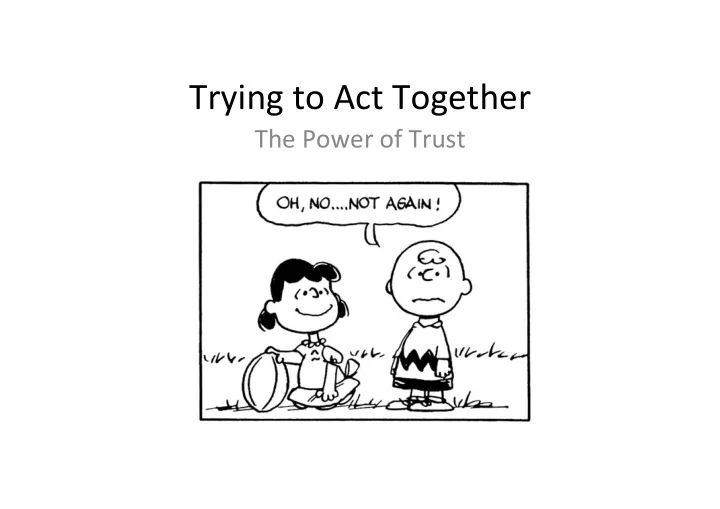
SLIDE 1
Trying ¡to ¡Act ¡Together ¡
The ¡Power ¡of ¡Trust ¡
SLIDE 2
The ¡Ques4on ¡
What ¡kind ¡of ¡a"tude ¡do ¡agents ¡have ¡to ¡have ¡towards ¡ their ¡partners ¡in ¡joint ¡ac4on? ¡ How ¡do ¡the ¡inten4ons ¡of ¡par4cipants ¡in ¡joint ¡ac4on ¡ “represent” ¡their ¡partners? ¡ ¡
SLIDE 3 Three ¡Answers ¡
- 1. The ¡Cogni4vist ¡View ¡(agents ¡cogni-vely ¡expect ¡their ¡
partners ¡to ¡cooperate ¡[representa4on ¡with ¡mind-‑to-‑ world ¡direc4on ¡of ¡fit]: ¡cogni-ve ¡a"tude) ¡
- 2. The ¡Norma4vist ¡View ¡(agents ¡norma-vely ¡expect ¡
their ¡partners ¡to ¡cooperate ¡[representa4on ¡with ¡ world-‑to-‑mind ¡direc4on ¡of ¡fit]: ¡norma-ve ¡a"tude) ¡
- 3. An ¡Affec)ve ¡Account ¡(agents ¡represent ¡their ¡
partners’ ¡behavior ¡in ¡such ¡a ¡way ¡as ¡to ¡cogni4vely ¡and ¡ norma4vely ¡expect ¡that ¡behavior ¡to ¡be ¡influenced ¡by ¡ this ¡representa-on: ¡trust) ¡
SLIDE 4 Raimo ¡Tuomela’s ¡Account ¡
A ¡member ¡Ai ¡of ¡a ¡collec-ve ¡g ¡we-‑intends ¡to ¡do ¡X ¡iff ¡ (i) ¡ ¡Ai ¡intends ¡to ¡do ¡his ¡part ¡of ¡X ¡(as ¡his ¡part ¡of ¡X); ¡ (ii) ¡ ¡Ai ¡has ¡a ¡belief ¡to ¡the ¡effect ¡that ¡the ¡joint ¡ac4on ¡opportuni4es ¡for ¡ an ¡inten4onal ¡performance ¡of ¡X ¡will ¡obtain ¡(or ¡at ¡least ¡probably ¡ will ¡obtain), ¡especially ¡that ¡a ¡right ¡number ¡of ¡the ¡full-‑fledged ¡and ¡ adequately ¡informed ¡members ¡of ¡g, ¡as ¡required ¡for ¡the ¡ performance ¡of ¡X, ¡will ¡(or ¡at ¡least ¡probably ¡will) ¡do ¡their ¡parts ¡of ¡X, ¡ which ¡will ¡under ¡normal ¡condi4ons ¡result ¡in ¡an ¡inten4onal ¡joint ¡ performance ¡of ¡X ¡by ¡the ¡par4cipants; ¡ (iii) ¡ ¡Ai ¡believes ¡that ¡there ¡is ¡(…) ¡a ¡mutual ¡belief ¡among ¡the ¡ par4cipa4ng ¡members ¡of ¡g ¡(…) ¡to ¡the ¡effect ¡that ¡the ¡joint ¡ac4on ¡
- pportuni4es ¡for ¡an ¡inten4onal ¡performance ¡of ¡X ¡will ¡obtain ¡(or ¡at ¡
least ¡probably ¡will ¡obtain); ¡ (iv) (i) ¡in ¡part ¡because ¡of ¡(ii) ¡and ¡(iii) ¡(R. ¡Tuomela, ¡2009) ¡
SLIDE 5 Is ¡Inten4on ¡Belief? ¡
Focus ¡on ¡individual ¡inten4on: ¡to ¡intend ¡to ¡𝞆 ¡is ¡to ¡expect ¡(believe) ¡ that ¡one ¡will ¡𝞆 ¡(Grice ¡1978). ¡ Intending ¡with ¡uncertainty: ¡In ¡order ¡to ¡intend ¡to ¡𝞆, ¡A ¡does ¡not ¡ have ¡to ¡believe ¡that ¡he ¡or ¡she ¡will ¡𝞆. ¡
“In ¡wri4ng ¡heavily ¡on ¡this ¡page ¡I ¡may ¡be ¡intending ¡to ¡produce ¡ten ¡ legible ¡carbon ¡copies. ¡I ¡do ¡not ¡know, ¡or ¡believe ¡with ¡any ¡confidence, ¡ that ¡I ¡am ¡succeeding. ¡But ¡if ¡I ¡am ¡producing ¡ten ¡legible ¡carbon ¡copies, ¡I ¡ am ¡certainly ¡doing ¡it ¡inten4onally. ¡[…] ¡It ¡is ¡hard ¡to ¡imagine ¡that ¡the ¡ point ¡does ¡not ¡carry ¡over ¡to ¡pure ¡intending.” ¡(Davidson ¡1978, ¡92; ¡cf. ¡ Harman’s ¡[1986] ¡sniper ¡case). ¡
à ¡ ¡Is ¡inten4on ¡no ¡belief, ¡or ¡rather ¡a ¡probabilis-c ¡belief ¡(incl. ¡ “believing ¡with ¡diffidence”) ¡or ¡some ¡(however ¡minimal) ¡ degree ¡of ¡belief? ¡ ¡
SLIDE 6 Trying ¡Beyond ¡Belief ¡
Incompa)bility ¡of ¡inten)on ¡with ¡a ¡conflic(ng ¡categorical ¡or ¡fully ¡ certain ¡belief: ¡(Most ¡philosophers ¡think ¡that) ¡A ¡cannot ¡intend ¡to ¡ 𝞆 ¡if ¡A ¡is ¡certain ¡that ¡he ¡or ¡she ¡will ¡not ¡𝞆 ¡(cf., ¡e.g., ¡Baier ¡1971). ¡ But: ¡A ¡may ¡s4ll ¡try! ¡
“Suppose ¡that ¡for ¡some ¡ridiculous ¡reason ¡Ken ¡desires ¡desperately ¡to ¡ move ¡the ¡North ¡leg ¡of ¡the ¡St. ¡Louis ¡Gateway ¡Arch ¡one ¡foot ¡to ¡the ¡North ¡ at ¡its ¡founda4on, ¡with ¡his ¡bare ¡hands ¡and ¡no ¡mechanical ¡devices. ¡[…] ¡ Ken ¡places ¡his ¡feet ¡firmly ¡upon ¡the ¡ground, ¡gets ¡a ¡good ¡grip, ¡and ¡pushes ¡ against ¡the ¡stainless ¡steel ¡wall ¡of ¡the ¡North ¡leg ¡of ¡the ¡Arch ¡with ¡all ¡of ¡his ¡ might; ¡all ¡the ¡while ¡knowing ¡full ¡well ¡that ¡it ¡is ¡impossible ¡for ¡him ¡to ¡ move ¡the ¡Arch ¡one ¡foot ¡Northward.” ¡(Adams ¡1995, ¡553) ¡
Ken ¡tries ¡to ¡𝞆 ¡without ¡intending ¡to ¡𝞆. ¡ ¡
Imagine ¡that ¡the ¡Arch ¡actually ¡moves. ¡Even ¡though ¡Ken ¡would ¡be ¡ pleased ¡with ¡the ¡result ¡eventually ¡(remember ¡his ¡desire), ¡he ¡would ¡ certainly ¡be ¡deeply ¡shocked ¡at ¡the ¡effect ¡of ¡his ¡doing, ¡very ¡much ¡unlike ¡ a ¡person ¡whose ¡inten4on ¡has ¡just ¡reached ¡its ¡condi4ons ¡of ¡sa4sfac4on! ¡ ¡
SLIDE 7
Two ¡Concepts ¡of ¡Trying ¡
Ken ¡does ¡not ¡need ¡to ¡𝞆 ¡for ¡his ¡inten4on ¡to ¡reach ¡its ¡ condi4ons ¡of ¡sa4sfac4on). ¡“Intending ¡to ¡𝞆” ¡and ¡ “intending ¡to ¡try ¡to ¡𝞆” ¡have ¡different ¡condi)ons ¡of ¡ sa)sfac)on ¡-‑-‑> ¡they ¡are ¡different ¡ac)ons! ¡ But ¡there ¡is ¡a ¡sense ¡in ¡which ¡any ¡ac4on ¡implies ¡trying ¡ (to ¡intend ¡to ¡𝞆, ¡when ¡it ¡is ¡inten4on-‑in-‑ac4on, ¡is ¡to ¡try ¡ to ¡𝞆). ¡ Confident ¡trying: ¡intending ¡to ¡𝞆 ¡(the ¡intended ¡ ac4on ¡is ¡to ¡𝞆) ¡ Diffident ¡trying: ¡trying ¡to ¡𝞆 ¡(the ¡intended ¡ac4on ¡is ¡ to ¡try ¡to ¡𝞆). ¡
¡
¡
SLIDE 8
Confidence ¡and ¡Op4mism ¡
How ¡can ¡Carbon-‑Copy-‑Davidson ¡intend ¡to ¡𝞆 ¡“without ¡any ¡ confidence” ¡that ¡he ¡will ¡𝞆? ¡ ¡ The ¡word ¡“confidence” ¡is ¡ambiguous: ¡ 1) Confidence ¡as ¡complementary ¡to ¡diffidence: ¡less-‑than-‑full ¡ confidence ¡is ¡a ¡degree ¡of ¡diffidence; ¡less-‑than-‑full ¡diffidence ¡is ¡ a ¡degree ¡of ¡confidence. ¡ 2) Confidence ¡as ¡exclusive ¡of ¡diffidence ¡(op)mism!): ¡an ¡agent ¡is ¡ either ¡confident ¡(es4mated ¡probability ¡very ¡high) ¡or ¡diffident ¡ (es4mated ¡probability ¡less ¡than ¡very ¡high). ¡ à ¡Carbon-‑Copy-‑Davidson ¡intends ¡to ¡𝞆 ¡without ¡any ¡op)mism ¡ that ¡he ¡will ¡𝞆. ¡(If ¡he ¡is ¡reasonable, ¡Davidson ¡must ¡have ¡a ¡ reason ¡for ¡which ¡this ¡seems ¡to ¡him ¡to ¡be ¡ ¡worth ¡trying.) ¡
SLIDE 9 Condi4ons ¡of ¡Inten4on ¡
Confidence ¡Condi)on: ¡If ¡an ¡agent ¡intends ¡to ¡𝞆, ¡he ¡or ¡ she ¡is, ¡to ¡some ¡degree, ¡confident ¡that ¡he ¡or ¡she ¡will ¡𝞆. ¡ If ¡he ¡or ¡she ¡is ¡fully ¡diffident, ¡he ¡or ¡she ¡may ¡intend ¡to ¡try ¡ to ¡𝞆. ¡ ¡ Op)mism ¡Condi)on: ¡if ¡a ¡reasonable ¡agent ¡intends ¡to ¡𝞆 ¡ he ¡or ¡she ¡is ¡op)mis)c ¡that ¡he ¡or ¡she ¡will ¡𝞆. ¡If ¡he ¡or ¡she ¡ is ¡pessimis)c, ¡but ¡has ¡a ¡reason ¡for ¡which ¡it ¡is ¡worth ¡ trying, ¡he ¡or ¡she ¡may ¡intend ¡to ¡try ¡to ¡𝞆. ¡ Sufficient ¡Reason ¡Condi)on: ¡a ¡reasonable ¡agent ¡does ¡ not ¡ignore ¡reasons ¡for ¡confidence ¡or ¡diffidence ¡/ ¡for ¡
- p4mism ¡or ¡pessimism ¡systema4cally ¡(e.g., ¡learning ¡
from ¡experience). ¡ ¡
SLIDE 10 A ¡Cogni4vist ¡View ¡
A ¡reasonable ¡member ¡Ai ¡of ¡a ¡collec-ve ¡g ¡we-‑intends ¡to ¡do ¡X ¡ iff: ¡ (i) ¡ ¡Ai ¡intends ¡to ¡do ¡his ¡or ¡her ¡part ¡of ¡X ¡(as ¡his ¡part ¡of ¡X); ¡ (ii) ¡ ¡Ai ¡is ¡op)mis)c ¡that ¡g ¡will ¡X, ¡i.e. ¡that ¡he ¡or ¡she ¡and ¡the ¡ relevant ¡others ¡will ¡do ¡their ¡parts ¡of ¡X. ¡ (iii) ¡ ¡Ai ¡is ¡op)mis)c ¡and ¡has ¡no ¡reason ¡for ¡pessimism ¡that ¡g ¡ will ¡X; ¡he ¡or ¡she ¡does ¡not ¡have ¡to ¡take ¡his ¡or ¡her ¡
- p4mism ¡to ¡be ¡universally ¡shared, ¡let ¡alone ¡to ¡be ¡
common ¡knowledge, ¡as ¡long ¡as ¡he ¡or ¡she ¡assumes ¡that ¡ the ¡pessimis)c ¡and ¡the ¡totally ¡diffident ¡members ¡of ¡g ¡ will ¡try ¡(diffidently) ¡to ¡do ¡their ¡parts ¡of ¡X ¡successfully. ¡ (iv) (i) ¡in ¡part ¡because ¡of ¡(ii) ¡and ¡(iii) ¡ (No ¡mutual ¡belief ¡required; ¡joint ¡ac4on ¡may ¡include ¡totally ¡ diffident ¡and ¡pessimis4c ¡[as ¡well ¡as ¡indifferent] ¡group ¡ members.) ¡ ¡
SLIDE 11
Puong ¡Cogni4vism ¡to ¡the ¡Test ¡
SLIDE 12 The ¡Test ¡Case ¡
November ¡14, ¡1951 ¡ November ¡16, ¡1952 ¡ Charles ¡M. ¡Schulz’ ¡Football ¡Gag ¡1951-‑1999 ¡ ¡
SLIDE 13
50 ¡Years ¡of ¡Geong ¡Suckered ¡
1953-‑1999: ¡Charlie ¡Brown ¡“killing ¡himself” ¡(his ¡own ¡words) ¡
SLIDE 14
What ¡Does ¡Charlie ¡Think ¡he’s ¡Doing? ¡
SLIDE 15 The ¡Cogni4vist ¡Verdict ¡
- Charlie’s ¡reac4on ¡at ¡the ¡end ¡of ¡most ¡rounds ¡clearly ¡shows ¡that ¡
his ¡trying ¡is ¡of ¡the ¡op)mis)c ¡kind: ¡his ¡inten4on ¡is ¡to ¡kick ¡the ¡ ball ¡rather ¡than ¡just ¡to ¡try ¡(diffidently) ¡to ¡kick ¡the ¡ball ¡(his ¡ inten4on ¡clearly ¡does ¡not ¡reach ¡its ¡condi4ons ¡of ¡sa4sfac4on: ¡ he ¡is ¡surprised ¡and ¡disappointed). ¡Charlie’s ¡inten4on ¡to ¡kick ¡the ¡ ball ¡represents ¡Lucy ¡(cogni4vely) ¡as ¡doing ¡her ¡part ¡(holding ¡the ¡ ball ¡steady). ¡ ¡
- Charlie ¡and ¡Lucy ¡do ¡not ¡grow ¡older, ¡but ¡this ¡does ¡not ¡mean ¡
that ¡Charlie ¡does ¡not ¡accumulate ¡experience ¡(he ¡osen ¡refers ¡to ¡ past ¡rounds ¡explicitly). ¡Already ¡in ¡the ¡1950ies, ¡it ¡becomes ¡ increasingly ¡clear ¡that ¡Lucy ¡will ¡not ¡hold ¡the ¡ball ¡steady. ¡This ¡ evidence ¡is ¡further ¡corroborated ¡through ¡the ¡60ies, ¡70ies, ¡and ¡
- 80ies. ¡Given ¡the ¡evidence, ¡Charlie ¡has ¡ample ¡reason ¡not ¡be ¡
- p)mis)c. ¡By ¡con4nuing ¡to ¡intend ¡to ¡kick ¡the ¡ball, ¡Charlie ¡
violates ¡the ¡sufficient ¡reason ¡condi)on. ¡ ¡
SLIDE 16
What ¡the ¡Public ¡Thinks ¡
The ¡fault ¡isn’t ¡Charlie’s. ¡ ¡ Lucy ¡rather ¡than ¡Charlie ¡has ¡reason ¡to ¡change ¡her ¡aTtude! ¡ This ¡may ¡not ¡be ¡the ¡most ¡reasonable ¡advice; ¡but ¡it ¡seems ¡ wrong ¡to ¡say ¡that ¡it ¡is ¡always ¡unreasonable ¡to ¡trust ¡in ¡the ¡ face ¡of ¡past ¡contrary ¡experience. ¡
SLIDE 17
A ¡Norma4vist ¡Account ¡
Individuals ¡A1…..An ¡form ¡a ¡plural ¡subject ¡of ¡X-‑ing ¡(for ¡some ¡ ac4on ¡X ¡or ¡psychological ¡atribute ¡X) ¡if ¡and ¡only ¡if ¡A1...An ¡form ¡a ¡ joint ¡commitment ¡to ¡X-‑ing ¡as ¡a ¡body. ¡ Joint ¡commitments ¡are ¡formed ¡when ¡each ¡of ¡a ¡number ¡of ¡ people ¡(implicitly) ¡expresses ¡his ¡or ¡her ¡willingness ¡to ¡par4cipate ¡ in ¡the ¡relevant ¡joint ¡commitment ¡with ¡the ¡others. ¡Once ¡the ¡joint ¡ commitment ¡is ¡established, ¡each ¡individual ¡is ¡individually ¡ ‘obligated’ ¡to ¡do ¡his ¡or ¡her ¡part ¡to ¡make ¡it ¡the ¡case ¡that ¡he ¡or ¡ she ¡acts ¡according ¡to ¡the ¡joint ¡commitment, ¡and ¡has ¡a ¡‘right’ ¡to ¡ expect ¡the ¡same ¡from ¡the ¡other ¡par4cipants. ¡ (M. ¡Gilbert) ¡ ¡ ¡The ¡par)cipants ¡expect ¡their ¡partner’s ¡behavior ¡ norma)vely ¡rather ¡than ¡cogni)vely ¡
SLIDE 18 Norma-ve ¡Expecta4ons ¡
Inverted ¡Direc)on ¡of ¡fit/direc)on ¡of ¡‘responsibility’: ¡mind-‑to ¡ world ¡(cogni4ve ¡expecta4on); ¡world-‑to-‑mind ¡(norma4ve ¡ expecta4on) ¡(inverse ¡“direc4on ¡of ¡‘blame’” ¡in ¡the ¡case ¡of ¡ disappointment) ¡
Limited ¡range ¡of ¡possible ¡objects: ¡to ¡expect ¡norma4vely ¡is ¡to ¡ conceive ¡of ¡the ¡addressee ¡as ¡suscep)ble ¡to ¡norma)ve ¡reasons, ¡ i.e. ¡to ¡be, ¡to ¡some ¡degree, ¡confident ¡that ¡under ¡suitable ¡ circumstances, ¡he ¡or ¡she ¡will ¡act ¡accordingly ¡(ought ¡implies ¡ can). ¡
Ra)onal ¡immunity ¡to ¡disconfirma)on ¡(“counterfactual ¡ stability” ¡[Luhmann]; ¡just ¡that ¡A ¡did ¡not ¡𝞆, ¡and ¡that ¡it ¡is ¡likely ¡ that ¡he ¡will ¡not ¡𝞆, ¡does ¡not ¡mean ¡that ¡it ¡was ¡wrong ¡to ¡ norma)vely ¡expect ¡A ¡to ¡𝞆) ¡à ¡past ¡disappointments ¡do ¡not ¡per ¡ se ¡make ¡an ¡agent’s ¡confidence ¡in ¡another ¡agent ¡unjus4fied. ¡ ¡
SLIDE 19
Defending ¡Charlie ¡
Insofar ¡as ¡Charlie ¡is ¡jus4fied ¡in ¡assuming ¡that ¡Lucy ¡is ¡a ¡person ¡(a ¡ creature ¡who ¡is ¡suscep4ble ¡to ¡norma4ve ¡reasons) ¡and ¡knows ¡ what ¡she ¡ought ¡to ¡do, ¡and ¡that ¡she ¡ought ¡to ¡hold ¡the ¡ball ¡ steady, ¡he ¡has ¡sufficient ¡reason ¡for ¡being ¡confident ¡about ¡her ¡ holding ¡the ¡ball ¡steady, ¡and ¡thus ¡for ¡trying ¡to ¡kick ¡the ¡ball. ¡ ¡ ¡ This ¡confidence ¡is ¡such ¡that ¡it ¡is ¡not ¡ra4onally ¡undermined ¡by ¡ past ¡ ¡contrary ¡experience. ¡ ¡ ¡ à ¡Charlie ¡is ¡jus)fied ¡in ¡not ¡giving ¡up! ¡ ¡ ¡
SLIDE 20
Puong ¡Norma4vism ¡to ¡the ¡Test ¡
SLIDE 21 Norma4vism ¡Fails, ¡too! ¡
- 1. The ¡claim ¡Charlie ¡has ¡sufficient ¡reason ¡to ¡intend ¡to ¡do ¡his ¡part ¡
because ¡of ¡his ¡agreement ¡with ¡Lucy ¡begs ¡the ¡ques4on ¡of ¡ whether ¡there ¡is ¡sufficient ¡reason ¡for ¡Charlie ¡to ¡enter ¡into ¡an ¡ agreement ¡with ¡Lucy. ¡(The ¡norma4vist ¡response ¡to ¡this ¡ ques4on ¡sets ¡off ¡an ¡infinite ¡regress ¡[cf. ¡Charles ¡M. ¡Schulz’ ¡ meta-‑agreements].) ¡
- 2. Norma4ve ¡expecta4ons ¡ra4onalize ¡diffident ¡trying, ¡but ¡not ¡
confident ¡trying: ¡While ¡it ¡seems ¡true ¡that ¡Charlie ¡has ¡ sufficient ¡reason ¡for ¡confidence ¡(ought ¡implies ¡can), ¡he ¡clearly ¡ does ¡not ¡have ¡reasons ¡for ¡op)mism. ¡It ¡seems ¡that ¡given ¡the ¡ evidence, ¡his ¡norma4ve ¡expecta4on ¡licenses ¡him ¡only ¡to ¡ intend ¡to ¡try ¡to ¡do ¡his ¡part ¡(diffidently). ¡à ¡Insofar ¡as ¡he ¡ con4nues ¡to ¡intend ¡to ¡kick ¡the ¡ball ¡rather ¡than ¡just ¡intending ¡ to ¡try ¡to ¡kick ¡the ¡ball, ¡he ¡has ¡insufficient ¡reason ¡and ¡is ¡
¡
SLIDE 22
Taking ¡Stock ¡
Neither ¡the ¡cogni)vist ¡nor ¡the ¡norma)vist ¡view ¡can ¡ accommodate ¡the ¡intui)on ¡that ¡Charlie’s ¡con)nued ¡confident ¡ trying ¡to ¡hit ¡the ¡ball ¡is ¡not ¡(en)rely) ¡unreasonable. ¡ ¡ Is ¡the ¡intui4on ¡wrong, ¡or ¡is ¡there ¡something ¡wrong ¡with ¡the ¡ views? ¡ An ¡indica4on ¡towards ¡the ¡later: ¡The ¡(pure) ¡cogni4vist ¡view ¡ misconstrues ¡of ¡coopera4ve-‑mindedness ¡because ¡it ¡is ¡blind ¡for ¡ the ¡role ¡of ¡norma)ve ¡expecta)ons ¡in ¡coopera4on; ¡the ¡(pure) ¡ norma4vist ¡view ¡misconstrues ¡of ¡coopera4ve-‑mindedness ¡ because ¡it ¡is ¡blind ¡for ¡the ¡reasonableness ¡constraints ¡placed ¡by ¡ cogni)ve ¡expecta)ons. ¡ à ¡ ¡How ¡can ¡the ¡two ¡views ¡be ¡combined? ¡How ¡do ¡cogni)ve ¡ and ¡norma)ve ¡expecta)ons ¡work ¡together? ¡ ¡
SLIDE 23 Three ¡Steps ¡Towards ¡an ¡Alterna4ve ¡Account ¡
- 1. At ¡the ¡basic ¡level, ¡cooperators ¡“represent” ¡their ¡partners ¡as ¡doing ¡their ¡parts ¡in ¡the ¡
same ¡way ¡as ¡individual ¡inten4ons ¡implicitly ¡“represent” ¡the ¡agent ¡as ¡con4nuing ¡to ¡ be ¡willing ¡and ¡able ¡to ¡perform ¡the ¡ac4on ¡un4l ¡the ¡inten4on’s ¡condi4ons ¡of ¡ sa4sfac4on ¡are ¡reached ¡(individual ¡agents ¡of ¡temporally ¡extended ¡ac4ons ¡ “represent” ¡their ¡own ¡future ¡behavior ¡in ¡the ¡same ¡way ¡in ¡which ¡cooperators ¡ “represent” ¡their ¡partners’ ¡behavior). ¡
- 2. An ¡individual ¡agent’s ¡“representa4on” ¡of ¡his ¡own ¡future ¡behavior ¡(and ¡self) ¡is ¡neither ¡
purely ¡cogni4ve ¡nor ¡purely ¡norma4ve ¡(an ¡individual ¡with ¡a ¡purely ¡cogni4ve ¡stance ¡ towards ¡his ¡own ¡future ¡self’s ¡behavior ¡and ¡no ¡norma4ve ¡expecta4on ¡is ¡a ¡predictor ¡of ¡ his ¡behavior ¡rather ¡than ¡an ¡intender ¡of ¡his ¡future ¡ac4on; ¡similarly, ¡an ¡individual ¡with ¡ a ¡purely ¡norma4ve ¡stance ¡towards ¡his ¡own ¡future ¡behavior ¡is ¡a ¡valuator ¡his ¡future ¡ behavior ¡rather ¡than ¡an ¡agent). ¡
- 3. In ¡individual ¡inten4on, ¡cogni4on ¡(predic4on) ¡and ¡norma4ve ¡expecta4on ¡are ¡related ¡
in ¡such ¡a ¡way ¡that ¡the ¡agent ¡takes ¡himself ¡to ¡be ¡jus)fied ¡to ¡assume ¡that ¡he ¡will ¡ con4nue ¡the ¡intended ¡course ¡of ¡ac4on ¡in ¡the ¡future ¡partly ¡because ¡the ¡current ¡ inten4on ¡that ¡represents ¡him ¡as ¡doing ¡so ¡provides ¡him, ¡in ¡the ¡future, ¡with ¡a ¡(further) ¡ norma)ve ¡and ¡mo)va)ng ¡reason ¡to ¡do ¡so ¡and ¡therefore ¡makes ¡it ¡more ¡likely ¡that ¡ he ¡will ¡do ¡so ¡(bootstrapping). ¡The ¡kind ¡of ¡representa4on ¡that ¡does ¡this ¡is ¡self-‑trust. ¡
SLIDE 24 The ¡Power ¡of ¡Trust ¡
In ¡coopera4on, ¡interpersonal ¡trust ¡works ¡in ¡the ¡same ¡way ¡as ¡self-‑trust ¡(self-‑ confidence) ¡does ¡in ¡the ¡case ¡of ¡individual ¡ac4on: ¡
A ¡cooperator’s ¡basic ¡aotude ¡towards ¡his ¡partner ¡is ¡such ¡that ¡he ¡(implicitly) ¡ assumes ¡that ¡by ¡represen4ng ¡the ¡other ¡as ¡doing ¡his ¡part ¡he ¡makes ¡it ¡more ¡ likely ¡that ¡the ¡other ¡will ¡in ¡fact ¡do ¡his ¡part ¡because ¡it ¡provides ¡the ¡other ¡with ¡a ¡ mo4va4ng ¡and ¡a ¡norma4ve ¡reason ¡to ¡do ¡so ¡(the ¡Power ¡of ¡Trust). ¡
The ¡Power ¡of ¡Trust ¡is ¡based ¡on ¡the ¡addressee’s ¡trust-‑responsiveness ¡(PeTt) ¡ (à ¡psychol. ¡cost ¡of ¡“betraying” ¡trust) ¡as ¡well ¡as ¡his ¡assumed ¡trust-‑ suscep)veness ¡(being ¡actually ¡relied ¡upon ¡adds ¡a ¡further ¡norma)ve ¡reason ¡to ¡ the ¡fact ¡that ¡one ¡is ¡under ¡an ¡obliga4on). ¡
The ¡Audacity ¡of ¡Trust: ¡Because ¡of ¡the ¡partly ¡self-‑fulfilling ¡nature ¡of ¡trust, ¡the ¡ limits ¡for ¡ra4onal ¡trust ¡are ¡difficult ¡(or ¡perhaps ¡impossible) ¡to ¡ascertain ¡(on ¡the ¡ background ¡of ¡nega4ve ¡past ¡experience, ¡a ¡bold ¡display ¡of ¡trust ¡may ¡well ¡be ¡ assumed ¡to ¡be ¡par-cularly ¡effec-ve; ¡cf. ¡the ¡public’s ¡nega4ve ¡response ¡to ¡L.). ¡ ¡
SLIDE 25 Trying ¡to ¡Act ¡Together ¡
What ¡Charlie ¡intends ¡to ¡do ¡is ¡to ¡try ¡to ¡act ¡together ¡(with ¡Lucy) ¡ rather ¡than ¡to ¡act ¡together ¡(with ¡Lucy). ¡Intending ¡to ¡try ¡to ¡act ¡ together ¡with ¡Lucy ¡is ¡to ¡do ¡whatever ¡is ¡necessary ¡to ¡act ¡ together ¡with ¡Lucy ¡without ¡being ¡op4mis4c ¡about ¡the ¡outcome. ¡ Since ¡ac4ng ¡together ¡involves ¡trust, ¡Charlie ¡has ¡to ¡trust ¡Lucy ¡in ¡
- rder ¡to ¡be ¡able ¡to ¡intend ¡to ¡try ¡to ¡act ¡together. ¡Therefore, ¡a ¡
condi)on ¡of ¡his ¡intending ¡to ¡try ¡to ¡act ¡together ¡with ¡Lucy ¡is ¡his ¡
- p)mis)c ¡trying ¡to ¡kick ¡the ¡ball ¡(he ¡cannot ¡just ¡pessimis)cally ¡
intend ¡to ¡try ¡to ¡kick ¡the ¡ball, ¡since ¡this ¡does ¡not ¡represent ¡Lucy ¡ as ¡doing ¡her ¡part ¡and ¡thus ¡does ¡not ¡have ¡the ¡power ¡of ¡trust). ¡ ¡ In ¡order ¡to ¡be ¡a ¡proper ¡intender ¡of ¡the ¡trying ¡to ¡act ¡jointly, ¡he ¡ must ¡appear, ¡under ¡the ¡given ¡circumstances, ¡to ¡be ¡a ¡ unreasonable ¡par)cipant ¡in ¡the ¡coopera4on. ¡ ¡
SLIDE 26
October ¡24, ¡1999: ¡Charlie’s ¡Last ¡Run ¡
Did ¡the ¡Power ¡of ¡Trust ¡Ul4mately ¡Prevail? ¡