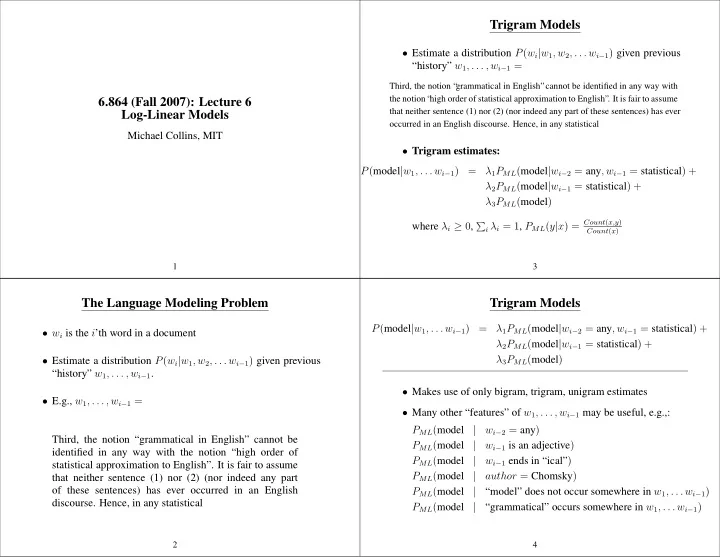
Trigram Models Estimate a distribution P ( w i | w 1 , w 2 , . . . w - - PowerPoint PPT Presentation

trigram models
SMART_READER_LITE
LIVE PREVIEW

Trigram Models Estimate a distribution P ( w i | w 1 , w 2 , . . . w - - PowerPoint PPT Presentation

Trigram Models Estimate a distribution P ( w i | w 1 , w 2 , . . . w i 1 ) given previous history w 1 , . . . , w i 1 = Third, the notion grammatical in Englishcannot be identified in any way with the notion high


slide-1
SLIDE 1

6.864 (Fall 2007): Lecture 6 Log-Linear Models

Michael Collins, MIT

1

The Language Modeling Problem

  • wi is the i’th word in a document
  • Estimate a distribution P(wi|w1, w2, . . . wi−1) given previous

“history” w1, . . . , wi−1.

  • E.g., w1, . . . , wi−1 =

Third, the notion “grammatical in English” cannot be identified in any way with the notion “high order of statistical approximation to English”. It is fair to assume that neither sentence (1) nor (2) (nor indeed any part

  • f these sentences) has ever occurred in an English
  • discourse. Hence, in any statistical

2

Trigram Models

  • Estimate a distribution P(wi|w1, w2, . . . wi−1) given previous

“history” w1, . . . , wi−1 =

Third, the notion “ grammatical in English”cannot be identified in any way with the notion “ high order of statistical approximation to English”. It is fair to assume that neither sentence (1) nor (2) (nor indeed any part of these sentences) has ever

  • ccurred in an English discourse. Hence, in any statistical
  • Trigram estimates:

P(model|w1, . . . wi−1) = λ1PML(model|wi−2 = any, wi−1 = statistical) + λ2PML(model|wi−1 = statistical) + λ3PML(model) where λi ≥ 0,

  • i λi = 1, PML(y|x) = Count(x,y)

Count(x)

3

Trigram Models

P(model|w1, . . . wi−1) = λ1PML(model|wi−2 = any, wi−1 = statistical) + λ2PML(model|wi−1 = statistical) + λ3PML(model)

  • Makes use of only bigram, trigram, unigram estimates
  • Many other “features” of w1, . . . , wi−1 may be useful, e.g.,:

PML(model | wi−2 = any) PML(model | wi−1 is an adjective) PML(model | wi−1 ends in “ical”) PML(model | author = Chomsky) PML(model | “model” does not occur somewhere in w1, . . . wi−1) PML(model | “grammatical” occurs somewhere in w1, . . . wi−1)

4

slide-2
SLIDE 2

A Naive Approach

P(model|w1, . . . wi−1) = λ1PML(model|wi−2 = any, wi−1 = statistical) + λ2PML(model|wi−1 = statistical) + λ3PML(model) + λ4PML(model|wi−2 = any) + λ5PML(model|wi−1 is an adjective) + λ6PML(model|wi−1 ends in “ical”) + λ7PML(model|author = Chomsky) + λ8PML(model|“model” does not occur somewhere in w1, . . . wi−1) + λ9PML(model|“grammatical” occurs somewhere in w1, . . . wi−1) This quickly becomes very unwieldy...

5

A Second Example: Part-of-Speech Tagging

INPUT: Profits soared at Boeing Co., easily topping forecasts on Wall Street, as their CEO Alan Mulally announced first quarter results. OUTPUT: Profits/N soared/V at/P Boeing/N Co./N ,/, easily/ADV topping/V forecasts/N on/P Wall/N Street/N ,/, as/P their/POSS CEO/N Alan/N Mulally/N announced/V first/ADJ quarter/N results/N ./.

N = Noun V = Verb P = Preposition Adv = Adverb Adj = Adjective . . . 6

A Second Example: Part-of-Speech Tagging Hispaniola/NNP quickly/RB became/VB an/DT important/JJ base/?? from which Spain expanded its empire into the rest of the Western Hemisphere .

  • There are many possible tags in the position ??

{NN, NNS, Vt, Vi, IN, DT, ...}

  • The task: model the distribution

P(ti|t1, . . . , ti−1, w1 . . . wn) where ti is the i’th tag in the sequence, wi is the i’th word

7

A Second Example: Part-of-Speech Tagging

Hispaniola/NNP quickly/RB became/VB an/DT important/JJ base/?? from which Spain expanded its empire into the rest of the Western Hemisphere .

  • The task: model the distribution

P(ti|t1, . . . , ti−1, w1 . . . wn) where ti is the i’th tag in the sequence, wi is the i’th word

  • Again: many “features” of t1, . . . , ti−1, w1 . . . wn may be relevant

PML(NN | wi = base) PML(NN | ti−1 is JJ) PML(NN | wi ends in “e”) PML(NN | wi ends in “se”) PML(NN | wi−1 is “important”) PML(NN | wi+1 is “from”)

8

slide-3
SLIDE 3

Overview

  • Log-linear models
  • The maximum-entropy property
  • Smoothing, feature selection etc. in log-linear models

9

The General Problem

  • We have some input domain X
  • Have a finite label set Y
  • Aim is to provide a conditional probability P(y | x)

for any x, y where x ∈ X, y ∈ Y

10

Language Modeling

  • x is a “history” w1, w2, . . . wi−1, e.g.,

Third, the notion “ grammatical in English”cannot be identified in any way with the notion “ high order of statistical approximation to English”. It is fair to assume that neither sentence (1) nor (2) (nor indeed any part of these sentences) has ever occurred in an English discourse. Hence, in any statistical

  • y is an “outcome” wi

11

Feature Vector Representations

  • Aim is to provide a conditional probability P(y | x) for

“decision” y given “history” x

  • A feature is a function f(x, y) ∈ R

(Often binary features or indicator functions f(x, y) ∈ {0, 1}).

  • Say we have m features fk for k = 1 . . . m

⇒ A feature vector f(x, y) ∈ Rm for any x, y

12

slide-4
SLIDE 4

Language Modeling

  • x is a “history” w1, w2, . . . wi−1, e.g.,

Third, the notion “ grammatical in English”cannot be identified in any way with the notion “ high order of statistical approximation to English”. It is fair to assume that neither sentence (1) nor (2) (nor indeed any part of these sentences) has ever occurred in an English discourse. Hence, in any statistical

  • y is an “outcome” wi

13

  • Example features:

f1(x, y) =

  • 1

if y = model

  • therwise

f2(x, y) =

  • 1

if y = model and wi−1 = statistical

  • therwise

f3(x, y) =

  • 1

if y = model, wi−2 = any, wi−1 = statistical

  • therwise

f4(x, y) =

  • 1

if y = model, wi−2 = any

  • therwise

f5(x, y) =

  • 1

if y = model, wi−1 is an adjective

  • therwise

f6(x, y) =

  • 1

if y = model, wi−1 ends in “ical”

  • therwise

14

f7(x, y) =

  • 1

if y = model, author = Chomsky

  • therwise

f8(x, y) =

  • 1

if y = model, “model” is not in w1, . . . wi−1

  • therwise

f9(x, y) =

  • 1

if y = model, “grammatical” is in w1, . . . wi−1

  • therwise

15

Defining Features in Practice

  • We had the following “trigram” feature:

f3(x, y) =

  • 1

if y = model, wi−2 = any, wi−1 = statistical

  • therwise
  • In practice, we would probably introduce one trigram feature

for every trigram seen in the training data: i.e., for all trigrams (u, v, w) seen in training data, create a feature fN(u,v,w)(x, y) =

  • 1

if y = w, wi−2 = u, wi−1 = v

  • therwise

where N(u, v, w) is a function that maps each (u, v, w) trigram to a different integer

16

slide-5
SLIDE 5

The POS-Tagging Example

  • Each x is a “history” of the form t1, t2, . . . , ti−1, w1 . . . wn, i
  • Each y is a POS tag, such as NN, NNS, V t, V i, IN, DT, . . .
  • We have m features fk(x, y) for k = 1 . . . m

For example: f1(x, y) =

  • 1

if current word wi is base and y = Vt

  • therwise

f2(x, y) =

  • 1

if current word wi ends in ing and y = VBG

  • therwise

. . .

17

The Full Set of Features in [Ratnaparkhi 96]

  • Word/tag features for all word/tag pairs, e.g.,

f100(x, y) =

  • 1

if current word wi is base and y = Vt

  • therwise
  • Spelling features for all prefixes/suffixes of length ≤ 4, e.g.,

f101(x, y) =

  • 1

if current word wi ends in ing and y = VBG

  • therwise

f102(h, t) =

  • 1

if current word wi starts with pre and y = NN

  • therwise

18

The Full Set of Features in [Ratnaparkhi 96]

  • Contextual Features, e.g.,

f103(x, y) =

  • 1

if ti−2, ti−1, y = DT, JJ, Vt

  • therwise

f104(x, y) =

  • 1

if ti−1, y = JJ, Vt

  • therwise

f105(x, y) =

  • 1

if y = Vt

  • therwise

f106(x, y) =

  • 1

if previous word wi−1 = the and y = Vt

  • therwise

f107(x, y) =

  • 1

if next word wi+1 = the and y = Vt

  • therwise

19

The Final Result

  • We can come up with practically any questions (features)

regarding history/tag pairs.

  • For a given history x ∈ X, each label in Y is mapped to a

different feature vector f(JJ, DT, Hispaniola, ..., 6, Vt) = 1001011001001100110 f(JJ, DT, Hispaniola, ..., 6, JJ) = 0110010101011110010 f(JJ, DT, Hispaniola, ..., 6, NN) = 0001111101001100100 f(JJ, DT, Hispaniola, ..., 6, IN) = 0001011011000000010 . . .

20

slide-6
SLIDE 6

Parameter Vectors

  • Given features fk(x, y) for k = 1 . . . m,

also define a parameter vector v ∈ Rm

  • Each (x, y) pair is then mapped to a “score”

v · f(x, y) =

  • k

vkfk(x, y)

21

Language Modeling

  • x is a “history” w1, w2, . . . wi−1, e.g.,

Third, the notion “ grammatical in English”cannot be identified in any way with the notion “ high order of statistical approximation to English”. It is fair to assume that neither sentence (1) nor (2) (nor indeed any part of these sentences) has ever occurred in an English discourse. Hence, in any statistical

  • Each possible y gets a different score:

v · f(x, model) = 5.6 v · f(x, the) = −3.2 v · f(x, is) = 1.5 v · f(x, of) = 1.3 v · f(x, models) = 4.5 . . . 22

Log-Linear Models

  • We have some input domain X, and a finite label set Y. Aim

is to provide a conditional probability P(y | x) for any x ∈ X and y ∈ Y.

  • A feature is a function f : X × Y → R

(Often binary features or indicator functions f : X × Y → {0, 1}).

  • Say we have m features fk for k = 1 . . . m

⇒ A feature vector f(x, y) ∈ Rm for any x ∈ X and y ∈ Y.

  • We also have a parameter vector v ∈ Rm

23

  • We define

P(y | x, v) = ev·f(x,y)

  • y′∈Y ev·f(x,y′)

24

slide-7
SLIDE 7

More About Log-Linear Models

  • Why the name?

log P(y | x, v) = v · f(x, y)

  • Linear term

− log

  • y′∈Y

ev·f(x,y′)

  • Normalization term
  • Maximum-likelihood estimates given training sample (xi, yi)

for i = 1 . . . n, each (xi, yi) ∈ X × Y: vML = argmaxv∈RmL(v) where

L(v) =

n

  • i=1

log P(yi | xi) =

n

  • i=1

v · f(xi, yi) −

n

  • i=1

log

  • y′∈Y

ev·f(xi,y′) 25

Calculating the Maximum-Likelihood Estimates

  • Need to maximize:

L(v) =

n

  • i=1

v · f(xi, yi) −

n

  • i=1

log

  • y′∈Y

ev·f(xi,y′)

  • Calculating gradients:

dL(v) dv =

n

  • i=1

f(xi, yi) −

n

  • i=1
  • y′∈Y f(xi, y′)ev·f(xi,y′)
  • z′∈Y ev·f(xi,z′)

=

n

  • i=1

f(xi, yi) −

n

  • i=1
  • y′∈Y

f(xi, y′) ev·f(xi,y′)

  • z′∈Y ev·f(xi,z′)

=

n

  • i=1

f(xi, yi)

  • Empirical counts

n

  • i=1
  • y′∈Y

f(xi, y′)P(y′ | xi, v)

  • Expected counts

26

Gradient Ascent Methods

  • Need to maximize L(v) where

dL(v) dv =

n

  • i=1

f(xi, yi) −

n

  • i=1
  • y′∈Y

f(xi, y′)P(y′ | xi, v) Initialization: v = 0 Iterate until convergence:

  • Calculate ∆ = dL(v)

dv

  • Calculate β∗ = argmaxβL(v + β∆) (Line Search)
  • Set v ← v + β∗∆

27

Conjugate Gradient Methods

  • (Vanilla) gradient ascent can be very slow
  • Conjugate gradient methods require calculation of gradient at

each iteration, but do a line search in a direction which is a function of the current gradient, and the previous step taken.

  • Conjugate gradient packages are widely available

In general: they require a function calc gradient(v) →

  • L(v), dL(v)

dv

  • and that’s about it!

28

slide-8
SLIDE 8

Overview

  • Log-linear models
  • The maximum-entropy property
  • Smoothing, feature selection etc. in log-linear models

29

Maximum-Entropy Properties of Log-Linear Models

  • We define the set of distributions which satisfy linear

constraints implied by the data: P = {p :

  • i

f(xi, yi)

  • Empirical counts

=

  • i
  • y∈Y

p(y | xi)f(xi, y)

  • Expected counts

} here, p is an n × |Y| vector defining P(y | xi) for all i, y.

  • Note that at least one distribution satisfies these constraints,

i.e., p(y | xi) =

  • 1

if y = yi

  • therwise

30

Maximum-Entropy Properties of Log-Linear Models

  • The entropy of any distribution is:

H(p) = −

 1

n

  • i
  • y∈Y

p(y | xi) log p(y | xi)

 

  • Entropy is a measure of “smoothness” of a distribution
  • In this case, entropy is maximized by uniform distribution,

p(y | xi) = 1 |Y| for all y, xi

31

The Maximum-Entropy Solution

  • The maximum entropy model is

p∗ = argmaxp∈PH(p)

  • Intuition: find a distribution which
  • 1. satisfies the constraints
  • 2. is as smooth as possible

32

slide-9
SLIDE 9

Maximum-Entropy Properties of Log-Linear Models

  • Consider the distribution

P(y|x, v∗) defined by the maximum-likelhood estimates v∗ = arg max L(v)

  • Then P(y|x, v∗) is the maximum-entropy distribution

33

Is the Maximum-Entropy Property Useful?

  • Intuition: find a distribution which
  • 1. satisfies the constraints
  • 2. is as smooth as possible
  • One problem: the constraints are define by empirical counts

from the data.

  • Another problem: no formal relationship between maximum-

entropy property and generalization(?) (at least none is given in the NLP literature)

34

Overview

  • Log-linear models
  • The maximum-entropy property
  • Smoothing, feature selection etc. in log-linear models

35

Smoothing in Maximum Entropy Models

  • Say we have a feature:

f100(h, t) =

  • 1

if current word wi is base and t = Vt

  • therwise
  • In training data, base is seen 3 times, with Vt every time
  • Maximum likelihood solution satisfies
  • i

f100(xi, yi) =

  • i
  • y

p(y | xi, v)f100(xi, y) ⇒ p(Vt | xi, v) = 1 for any history xi where wi = base ⇒ v100 → ∞ at maximum-likelihood solution (most likely) ⇒ p(Vt | x, v) = 1 for any test data history x where w = base

36

slide-10
SLIDE 10

A Simple Approach: Count Cut-Offs

  • [Ratnaparkhi 1998] (PhD thesis): include all features that
  • ccur 5 times or more in training data. i.e.,
  • i

fk(xi, yi) ≥ 5 for all features fk.

37

Gaussian Priors

  • Modified loss function

L(v) =

n

  • i=1

v · f(xi, yi) −

n

  • i=1

log

  • y′∈Y

ev·f(xi,y′) −

m

  • k=1

v2

k

2σ2

  • Calculating gradients:

dL(v) dv =

n

  • i=1

f(xi, yi)

  • Empirical counts

n

  • i=1
  • y′∈Y

f(xi, y′)P(y′ | xi, v)

  • Expected counts

− 1 σ2 v

  • Can run conjugate gradient methods as before
  • Adds a penalty for large weights

38

The Bayesian Justification for Gaussian Priors

  • In Bayesian methods, combine the log-likelihood P(data | v) with a prior
  • ver parameters, P(v)

P(v | data) = P(data | v)P(v)

  • v P(data | v)P(v)dv
  • The MAP (Maximum A-Posteriori) estimates are

vMAP = argmaxvP(v | data) = argmaxv    log P(data | v)

  • Log-Likelihood

+ log P(v)

  • Prior

   

  • Gaussian prior: P(v) ∝ e−

k v2 k/2σ2

⇒ log P(v) = −

k v2 k/2σ2 + C

39

Experiments with Gaussian Priors

  • [Chen and Rosenfeld, 1998]: apply maximum entropy models

to language modeling: Estimate P(wi | wi−2, wi−1)

  • Unigram, bigram, trigram features, e.g.,

f1(wi−2, wi−1, wi) = 1 if trigram is (the,dog,laughs)

  • therwise

f2(wi−2, wi−1, wi) = 1 if bigram is (dog,laughs)

  • therwise

f3(wi−2, wi−1, wi) = 1 if unigram is (laughs)

  • therwise

P(wi | wi−2, wi−1) = ef(wi−2,wi−1,wi)·v

  • w ef(wi−2,wi−1,w)·v

40

slide-11
SLIDE 11

Experiments with Gaussian Priors

  • In regular (unsmoothed) maxent, if all n-gram features

are included, then it’s equivalent to maximum-likelihood estimates! P(wi | wi−2, wi−1) = Count(wi−2, wi−1, wi) Count(wi−2, wi−1)

  • [Chen and Rosenfeld, 1998]: with gaussian priors, get very

good results. Performs as well as or better than standardly used “discounting methods” (see lecture 2).

  • Note:

their method uses development set to optimize σ parameters

  • Downside: computing

w ef(wi−2,wi−1,w)·v is SLOW.

41

Feature Selection Methods

  • Goal: find a small number of features which make good

progress in optimizing log-likelihood

  • A greedy method:

Step 1 Throughout the algorithm, maintain a set of active features. Initialize this set to be empty. Step 2 Choose a feature from outside of the set of active features which has largest estimated impact in terms of increasing the log-likelihood and add this to the active feature set. Step 3 Minimize L(v) with respect to the set of active features. Return to Step 2.

42

Figures from [Ratnaparkhi 1998] (PhD thesis)

  • The task: PP attachment ambiguity
  • ME Default: Count cut-off of 5
  • ME Tuned: Count cut-offs vary for 4-tuples, 3-tuples, 2-

tuples, unigram features

  • ME IFS: feature selection method

43

✁ ✂ ✄ ☎✆✝ ✄ ✞ ✟ ✠ ✡ ✡☛ ☎ ☞ ✡ ✌ ✍ ☎ ☞ ✆ ✞ ✆ ✞ ✎ ✍ ✆✝ ✄ ✏ ✑ ✒ ✓ ✄ ☞ ✟ ☛ ☎ ✄ ✔ ✕ ✖ ✄ ✒ ☞ ☛ ✗ ✟ ✘ ✙✚ ✛ ✜ ✢ ✛ ✝ ✆ ✞ ✣ ✛ ✙ ✘ ✕
☛ ✞ ✄✤ ✘✥ ✚ ✦ ✜ ✢ ✛ ✝ ✆ ✞ ✘ ✥ ✘ ✦✧ ✕ ★ ✓ ✩ ✘ ✛ ✚ ✧ ✜ ✥ ✛ ✪ ✑ ☛ ☎ ✔ ✥ ✘ ✦ ✖ ✍ ✖ ✄ ✒ ☞ ☛ ✗ ✟ ✦ ✙✚ ✙ ✜ ✢ ✝ ✆ ✞ ✖ ✍ ✍ ☛ ✞ ✄✤ ✘ ✛ ✚ ✣ ✜ ✢ ✛ ✝ ✆ ✞ ✖ ✍ ✫ ✆ ✞ ☞ ☎ ✌ ✬ ✢ ✭ ✄ ✄ ✮ ✯ ✫ ☞ ✔ ✄ ✗ ✆ ✞ ✄ ✦ ✛ ✚ ✣ ✜ ✍ ☞✰ ✗ ✄ ✘ ✚ ✙✱ ✕ ☞ ✁ ✆ ✝ ☛ ✝
✟ ☎ ✑ ✂ ✌ ✲ ✕
☞ ✞ ✤ ✖ ✄ ✡ ✆ ✔ ✆ ✑ ✞ ✍ ☎ ✄ ✄ ✲ ✖ ✍ ✳ ✁ ✂ ✄ ☎ ✆ ✝ ✄ ✞ ✟ ✔ ✑ ✞✴ ✴ ☞ ✟ ✟ ☞ ✡ ✪ ✬ ✝ ✄ ✞ ✟

44

slide-12
SLIDE 12

Figures from [Ratnaparkhi 1998] (PhD thesis)

  • A second task: text classification, identifying articles about

acquisitions

45

✁ ✂☎✄ ✆✝✞ ✄ ✟ ✠ ✡ ☛ ☛☞ ✆ ✌ ☛ ✍ ✎ ✆ ✌ ✝ ✟ ✝ ✟ ✏ ✎ ✝✞ ✄ ✑ ✒ ✓ ✔ ✄ ✌ ✠ ☞ ✆ ✄ ✕ ✖ ✗ ✄ ✓ ✌ ☞ ✘ ✠ ✙✚ ✛ ✚ ✜ ✢ ✚ ✞ ✝ ✟ ✣ ✤✚✥ ✖ ✦ ✔ ✧ ✙✚ ✛ ★ ✜ ✢ ✚ ✩ ✒ ☞ ✆ ✕ ✤ ✚✪ ✗ ✎ ✗ ✄ ✓ ✌ ☞ ✘ ✠ ✙ ✢ ✛ ✪ ✜ ✜ ✢ ★ ✩ ✒ ☞ ✆ ✕ ✗ ✎ ✎ ☞ ✟ ✄✫ ✙ ✣ ✛ ✢ ✜ ✢ ✥ ✩ ✒ ☞ ✆ ✕ ✎ ✌✬ ✘ ✄ ★ ✛ ✭✮ ✎ ✄ ✁ ✠ ✯ ✌ ✠ ✄ ✏ ✒ ✆✝✰ ✌ ✠ ✝ ✒ ✟✱ ✄ ✆ ✓ ✒ ✆ ✞ ✌ ✟ ☛ ✄ ✒ ✟ ✠ ✩ ✄ ✲✳ ✴ ☛ ✌ ✠ ✄ ✏ ✒ ✆ ✍

46

Summary

  • Introduced

log-linear models as general approach for modeling conditional probabilities P(y | x).

  • Optimization methods:

– Iterative scaling – Gradient ascent – Conjugate gradient ascent

  • Maximum-entropy properties of log-linear models
  • Smoothing methods using Gaussian prior,

and feature selection methods

47

References

[Ratnaparkhi 96] A maximum entropy part-of-speech tagger. In Proceedings of the empirical methods in natural language processing conference.

48