
SLIDE 1
2/11/2014 1
1
CSE 332: Graphs
Richard Anderson, Steve Seitz Winter 2014
2
Announcements (2/12/14)
- Exams
- Return at end of class
- Mean 62.5, Median 63, sd 7.2
- HW 5 available
- Project 2B due Thursday night
- Reading for this lecture: Chapter 9.
3
Graphs
- A formalism for representing relationships between
- bjects
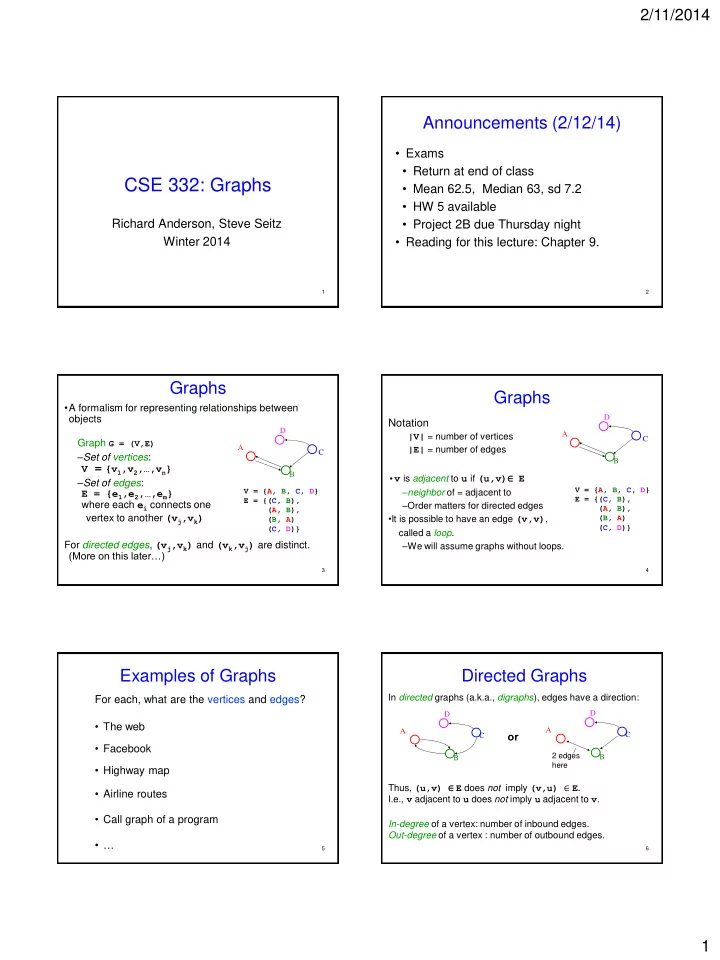
Graph G = (V,E) –Set of vertices: V = {v1,v2,…,vn} –Set of edges: E = {e1,e2,…,em} where each ei connects one vertex to another (vj,vk) For directed edges, (vj,vk) and (vk,vj) are distinct. (More on this later…)
A B C V = {A, B, C, D} E = {(C, B), (A, B), (B, A) (C, D)} D
4
Graphs
Notation
|V| = number of vertices |E| = number of edges
- v is adjacent to u if (u,v)∈ E
–neighbor of = adjacent to –Order matters for directed edges
- It is possible to have an edge (v,v),
called a loop. –We will assume graphs without loops.
V = {A, B, C, D} E = {(C, B), (A, B), (B, A) (C, D)} A B C D
5
Examples of Graphs
For each, what are the vertices and edges?
- The web
- Highway map
- Airline routes
- Call graph of a program
- …
6
Directed Graphs
In directed graphs (a.k.a., digraphs), edges have a direction: Thus, (u,v) ∈ E does not imply (v,u) ∈ E. I.e., v adjacent to u does not imply u adjacent to v. In-degree of a vertex: number of inbound edges. Out-degree of a vertex : number of outbound edges.
- r
2 edges here A B C D A B C D