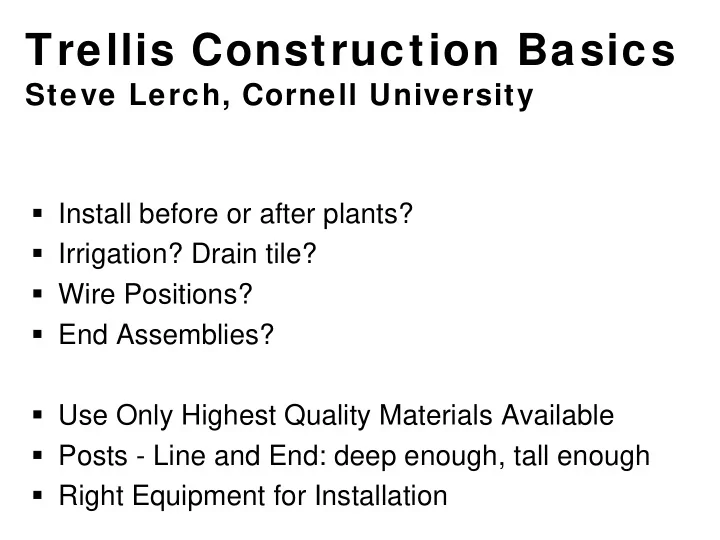
SLIDE 1 Trellis Construction Basics
Steve Lerch, Cornell University
- Install before or after plants?
- Irrigation? Drain tile?
- Wire Positions?
- End Assemblies?
- Use Only Highest Quality Materials Available
- Posts - Line and End: deep enough, tall enough
- Right Equipment for Installation
SLIDE 2
Some Common Training Systems
Low Cane/Cordon VSP
SLIDE 3 Divided Canopies
GDC Lyre Scott Henry Smart-Dyson Smart-Dyson Geneva Double Curtain Lyre
SLIDE 4 High Wire Systems
GDC Lyre Scott Henry Smart-Dyson
SLIDE 5
- All of these systems have some elements in
common!
- Posts
- Wire
- Anchor/Bracing systems
Trellising Systems
SLIDE 6 How to posts:
- Drive posts, try not to set in augered holes.
- Typically 3 - 4” 8’ PT Yellow Pine/Lodgepole Pine.
- Line posts: 2’ minimum deep, remainder above.
- FL standard is 24’ feet between posts.
- All must be same height (hedger, harvester).
- End posts: min 5 - 6” 8’, 3’ deep.
- Should be angled out, up to 60 degree angle.
SLIDE 7
Auguring end post holes
SLIDE 8
Post Pounding
SLIDE 9
Steel Posts
SLIDE 10
Can exclusive use of steel posts be a problem?
SLIDE 11 How to - Anchors:
- Screw in Anchors - screw in straight down with
auger or steel bar.
- Or bury (not as good), always to eye depth.
- Anchor wires: white pvc tubes for visibility.
- Pounded Post Anchors - min 5 - 6”, 7’, 4’ deep.
- MUST be pounded.
- Duck bill type anchors
- Must be driven with a special tool.
SLIDE 12
Earth Anchors
SLIDE 13 How to - Wire:
- Standard – 12.5 gauge high tensile
- Wire Source - packed and wound under tension!
- Wire: use a spinning jenny to apply.
- Splice correctly.
- Leave enough length at ends to work with!
- Tie offs:
- Compression sleeve
- Gripples
- Wire gripper/vice through hole in post
- Double wrap with staple
- Strainers - only need on wire carrying fruit loads.
SLIDE 14 How to - Wire (continued):
- Staples in wood posts -
- 1.75” minimum.
- Don’t drive tight!
- Top wire on top of posts?
- Proprietary fasteners for steel -
- Pre-bent wires/clips.
- Some posts have pre-formed wire slots.
SLIDE 15 How to - Catch Wires:
- Many people use 14 ga.
- Moveable
- Ends are problematic.
- Chains
- Strainers
- ?
- Fixed
- Can be more time
consuming.
SLIDE 16
Spinning Jennies
SLIDE 17
Wire Gripping Tools
SLIDE 18
Crimping Sleeves
SLIDE 19
Wire Gripping Devices
SLIDE 20
In-line Wire Strainers
SLIDE 21
On-line Wire Strainers
SLIDE 22
Bracing Systems
SLIDE 23
Angled End Post
SLIDE 24
Angled End Post
What not to do.
SLIDE 25
Angled End w/ Screw-in Anchor
SLIDE 26
Angled End w/ Screw-in Anchor
SLIDE 27
“H” Brace
SLIDE 28
“H” Brace
What not to do.
SLIDE 29
Angled Brace
SLIDE 30
Angled Brace
SLIDE 31
Angled End w/ Driven Post
SLIDE 32 Pruning Fundamentals
Prior to the Your First Cut
Mike White ISU Viticulture Specialist Cell: 515-681-7286 mlwhite@iastate.edu
32
SLIDE 33 33
Know the Vine
Sucker Trunk Persistent Lateral Cane Node/Bud Internode Cordon Arm Head Area
SLIDE 34 3 4
Know the Cultivar
Cold Tolerance Vigor Upright, Trailing, or Indeterminate Growth Habit Average Cluster Size Fruitful Basal Buds? % Fruitfulness on Secondary Buds Early or Late Budbreak?
SLIDE 35 3 5
Get Trunk(s) & Cordons Established in First 2 Years
SLIDE 36 36
Know Reasons Behind Single vs. Double Trunk
Single Trunk
vine
ripening
- easier to prune
- Less management
time
Double Trunk
winter-kill
crown gall
time
SLIDE 37 37
Know Balanced Pruning Concept
https://www.youtube.com/watch?v=uYLREQLn-lc
# Buds kept
30
40
50
60* * Max of 60
Concord Example
SLIDE 38 38
Know Long ( AKA Double) Pruning
1. Leave 50%+ more buds than needed
- 2. Final pruning after buds
begin swelling
- 3. Terminal buds break 2-5
days earlier than count buds you want to retain.
70-80 buds per vine vs. 40 – 60 buds per vine
Long vs. Short Pruned Marechal Foch, 3-22-13 9:35 min. video: http://www.youtube.com/watch?v=fUzbi7d8TpA
SLIDE 39 39
Know Optimum Vine Characteristics
- 1. Pruning wts. of 0.2 to 0.4 lbs./ft. of cordon
- 2. Crop load ratio (yield wt. / pruning wt.) of 5-10
for vinifera and 8-12 for hybrids.
- 3. Labrusca internode lengths of 4-6” and hybrid
internode lengths of 3 – 4”.
- 4. Minimal lateral shoot growth through the
season.
- 5. Untrimmed shoot lengths of 4 to 6 ft.
- 6. Maximum of 1.5 to 2.5 leaf layers in the
canopy.
- 7. A minimum of 12 to 15 nodes per shoot.
SLIDE 40 40
Know Optimum Vine Characteristics
- 8. Canopy gaps of 40 – 50%.
- 9. 50-75% of the clusters exposed to the sun.
- 10. Single trunks for cold hardy and double trunks for cold sensitive cultivars.
- 11. Maximum of 4-6 buds/shoots per foot of cordon.
- 12. 44 – 53 ratio of leaf area to fruit wt. (sq. inches / oz.).
- 13. Cane length / diameter ratio of 25 – 40.
- 14. Cessation of cane tip growth after veraison.
See “Canopy Management Concepts“ here: http://www.extension.iastate.edu/wine/viticulture
SLIDE 41 41
Watch Youtube Videos
Vineyard Pruning Tools, 3-17-11 by Mike White. 8:52 min. https://www.youtube.com/watch?v=MUzWnsTN1a8 Pruning a 4 Year Old Marechal Foch Vine, 3-22-13 by Mike White. 9:35 min. https://www.youtube.com/watch?v=fUzbi7d8TpA WGGA Munckhof Barrel Pre-Pruner, 3-27-14 by Mike White. 4:04 min. https://www.youtube.com/watch?v=VyX_4YRnYcs
Many, many others to view on Youtube.
SLIDE 42 42
Know Your Tools
Vineyard Pruning Tools, 3-17-11 by Mike White. 8:52 min. https://www.youtube.com/watch?v=MUzWnsTN1a8
Solution
gloves
pruners
- Loppers
- Sharpener
- Eye Protection
- Sun protection
- Ties
- Tool Carrier
SLIDE 44 44
Preguntas - Spanish Des Questions -
French
Domande - Italian Fragen – German Pytania – Polish Imibuzo -Zulu
в
Questions?
Michael L. White Extension Viticulture Specialist Cell: 515-681-7286 mlwhite@iastate.edu