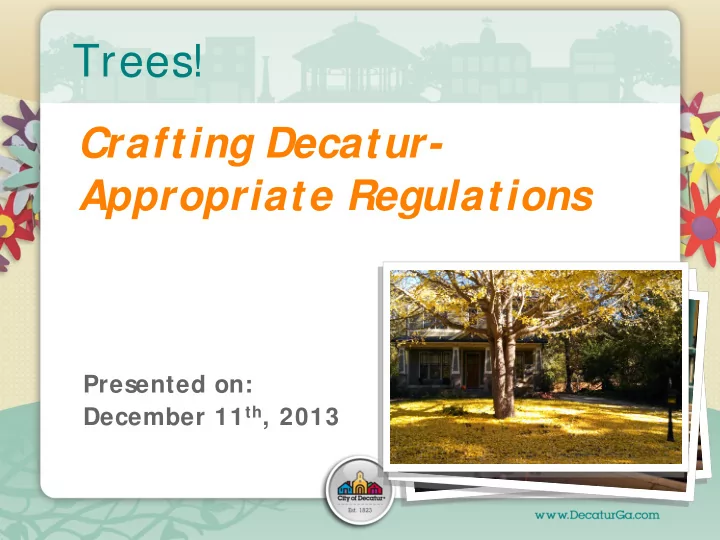
Trees! Crafting Decatur- Appropriate Regulations Presented on: - - PowerPoint PPT Presentation
Trees! Crafting Decatur- Appropriate Regulations Presented on: December 11 th , 2013 Background 1989 1999 City passes 2008 first Tree Ordinance 2013 Preservation amended Draft of Ordinance new tree Ordinance ordinance amended
Background
1989
City passes first Tree Preservation Ordinance
1999
Ordinance amended
2008
Draft of new tree
- rdinance
developed
2013
Ordinance amended
Background
- 12-month process to update land development
regulations started in October 2013
- Due to resident concerns, the following
actions were taken by the City Commission;
- 1. 90 day moratorium on tree removal
(Ends Jan 24)
- 2. Review of Tree Ordinance was expedited
S trategy
Current Ordinance 2008 Draft Ordinance S takeholder Input Technical Expertise
Final Recommendation to City Commission: Work Session: Jan 6 Consideration for Adoption: Jan 21
Reasons for Updating the Tree Ordinance
- Aging tree population
- Urban/ human impacts to soil
and trees
- Development pressures
- Maj ority of tree canopy is on
private property
- New best management practices
for tree conservation
Decatur’ s Trees by the Numbers
University of Georgia’s Natural Resource Spatial Analysis Laboratory (NARSAL)
- Canopy decreased 4.1%
in last 27 years
- Trend = 1%
canopy loss ever 6- 7 years
Current canopy cover = approx. 45% Trend declining canopy coverage
50.9% 50.4% 49.2% 46.8% 1991 2001 2005 2008
Tree Canopy Coverage: NARSAL
Decatur’ s Trees by the Numbers
2010 City of Decatur Study
- Analyzed tree canopy using
aerial photographs.
- Provides more detail than
NARS AL data.
45.7% 45.1% 2005 2010
Tree Canopy Coverage: Aerial Photos
Urban/ Human Impacts on Trees
- Restricted growing space
- Poor quality soils (compacted, no topsoil,
low volume)
- Improper maintenance (mulching, pruning)
- Physical wounding (roots, trunk, crown)
- Environmental changes (soil, moisture,
light, wind)
- S
tress and insect and disease infestations
Large, Canopy Trees are at Risk
- Healthy, large canopy trees are very valuable
and should be conserved whenever possible
- Large canopy trees are at the greatest risk for
damage and death; once gone, the replacement of their canopy will take 50 to 100 years
- S
pace is limited for the establishment of new large canopy trees; urban conditions and poor maintenance practices often make it difficult for trees to reach maturity
Development reduces soil quality (loss of topsoil, compaction) and can result in a loss of tree canopy cover. Trees planted on this property will struggle to survive due to poor soil conditions.
What Trees Need
- Good quality growing site with plenty of space for
growth, above and below ground
- Proper planting (handling, depth, size of planting
hole) and 3 years of post-planting maintenance to establish (water, mulch, inspections, and removal
- f staking and straps if tree was staked)
- Ongoing, routine maintenance (mulch, pruning,
inspection, pest management)
- Protection of roots, trunk, and crown from time of
planting through removal— throughout a tree’ s life
- Timely removal at end of useful service life
Tree Canopy Cover Goals
- Tree canopy cover is the ground area covered
by the proj ection of the tree’ s canopy
- Tree canopies provide shade, cooling, oxygen,
stormwater interception, and interception of pollutants including particulate matter
- A single mature canopy tree can provide 3,000
square feet or more of cover
- Tree root systems also provide uptake and
filtration of water
What would it take to increase the canopy in 25 years?
50% Canopy 3,600 trees 55% Canopy 7,320 trees 60% Canopy 10,980 trees
Current cover = 45% Increasing the canopy requires one-for-one replacement of all removed or fallen trees
+
70 % 34 % 100 % 8% Tree canopy cover typically varies by property as shown below. Consider the contribution of benefits to the neighborhood by each
- f these properties.
Canopy goals in your backyard
1/4 Acre Lot 1/3 Acre Lot
45% coverage 3 large 4 large 60% coverage 4 large 4 large + 1 medium
Current Tree Ordinance
- All building and soil erosion control permits must be
accompanied by a tree protection and replacement plan with the following exclusions:
- Renovation proj ects on single-family and two-family homes
- Construction and maintenance of public streets by government
authorities
- Diseased or dangerous trees
- Tree density is measured by using trunk diameter to calculate
basal area (cross sectional area of trunk)
- City’ s tree consultant conducts plan review & inspection
- All plans must be prepared by a certified arborist, forester or
landscape architect
Current Tree Ordinance
- Proj ects must have 30 tree density units per acre (15
for single-family residential)
- A portion of the required tree density must be met
- n-site through protection of significant trees
- If the tree consultant determines that a proj ect
cannot meet the tree density requirement , payments for the balance are accepted by the City for the tree bank
- There is currently no protection for boundary trees
Tree Conservation Recommendations
- S
et community tree canopy cover goals
- Focus on maintaining and replacing tree canopy cover on
a site, in a neighborhood, and across the community
- Focus on the placement of trees where their function is
maximized
- Require compliance with standards for soil quality,
planting, pruning, mulching, watering, and other arboricultural practices
- Require compliance with standards for tree protection
during construction for trees that will be conserved
- Allow for flexibility in the achievement of tree canopy
cover requirements
- Maintain an option for contributions to the Tree Bank in
lieu of fully meeting tree canopy cover requirements
Comments
- Posters located around the room
- Comment cards
- DecaturNEXT.com
- Final recommendation to City Commission:
- Work Session: Jan 6
- Consideration for Adoption: Jan 21