
SLIDE 1
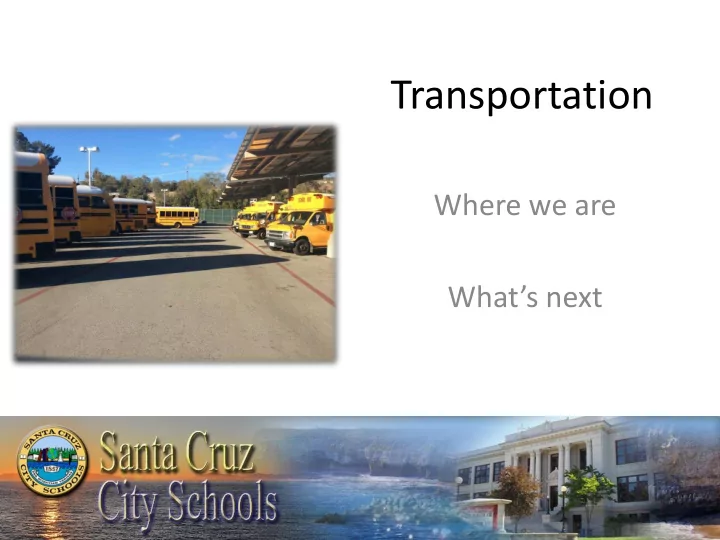
Transportation Where we are Whats next Overview of Services SCCS - - PowerPoint PPT Presentation
Transportation Where we are Whats next Overview of Services SCCS transports students in three programs daily: Special Needs students: 106 Special Needs students have transportation in their I.E.P. s; 75 are transported daily to
SCCS transports students in three programs daily:
daily to 14 school sites in and around Santa Cruz County. Half of the students attend Santa Cruz C.O.E. programs.
in morning and 75 students in the afternoon.
8 2 4
Special Need Bus Information
Bus # $ Repairs since 04/15 Proj Add’l Cost Notes Age Mileage Special Needs **19 $4,508 $3,000 Seat 20 99,081 1 16 $2,060 $3,000 Cold Start 16 161,546 2 15 $9,088 Bad Engine 11 75,725 3 11 $4,616 $3,500 Transmission 17 167,671 4 7 $16,587 Bad Engine 11 183,585 5 6 $15,570 $3,500 Transmission 17 169,502 6 2 $1,964 $1,500 Electrical 14 116,862 7 **1 $3,125 $5,500 Transmission 19 132,655 8 5 $4,635 $20,000 Body & Transmission 27 244,213 9 4 $1,639 $12,000 Engine 25 300,506 10 10 $16,345 $4,000 Bad Engine 11 71,904 3 $1,711 $2,300 Transmission 26 305,987 17 $4,855 $8,300 Wiring 20 264,358 9 $219 $15,000 Fire Damage 17 137,531 Min Need 9, +3 Spares = 12 Key * Eligible for Renewal NOW ** Eligible for Renewal in <5years 8 Working 2 Near Failure 4 Not Working
The Lower-Emission School Bus Grant Program and is administered by the Air Resources Board and locally implemented by Monterey Bay Air Pollution Control District . This program provides funds to purchase new buses to replace old, high-emitting public school buses, thereby significantly reducing toxic emissions. The program does not impose any regulatory requirements on school districts and their participation in the program is voluntary. Buses qualify if they are: → 23 years old or older → Current and continuous in their C.H.P. certification → Have a gross vehicle weight rating (GVWR) of over 14,000 lbs. The replacement funding cap is $165,000.00 per vehicle.
5 10 15 20 25 30 35 40 45 9 17 4 3 5 15 7 10 2 16 11 6 **1 **19 Years of Service
Bus #
Age
Grant Line (23 yrs)
Not Eligible for Grants
Grant Line (23 yrs)
5 10 15 20 25 30 35 40 45 18 12 8 14 Years of Service Bus # Age
Absolute minimal need is three 84 passenger buses.
service.
excessive emissions . The positive news is that all 4 buses will qualify for replacement grants through the Monterey Bay Air Pollution Control District.
1) Formally submit a grant proposal for 2 new large buses that are eligible for immediate replacement (#14, 8). 2) Purchase / lease two small wheelchair buses immediately with a projected cost of $145,000. 3) Plan and prioritize the repairs of current fleet at $18,500. 4) Reconfigure bus #18 for additional passenger seating. 5) Declare buses #5, 3, 17 and 9 obsolete. Dispose according to board policy. 6) In 2020-21, submit grant proposals for 2 new small buses that are eligible for replacement (#19, 1). 7) In 2023-24, submit grant proposal for 2 new large buses eligible for replacement (#12, 18).