Transition Year Mission Statement To promote the personal, social, - - PowerPoint PPT Presentation

transition year mission statement
SMART_READER_LITE
LIVE PREVIEW

Transition Year Mission Statement To promote the personal, social, - - PowerPoint PPT Presentation

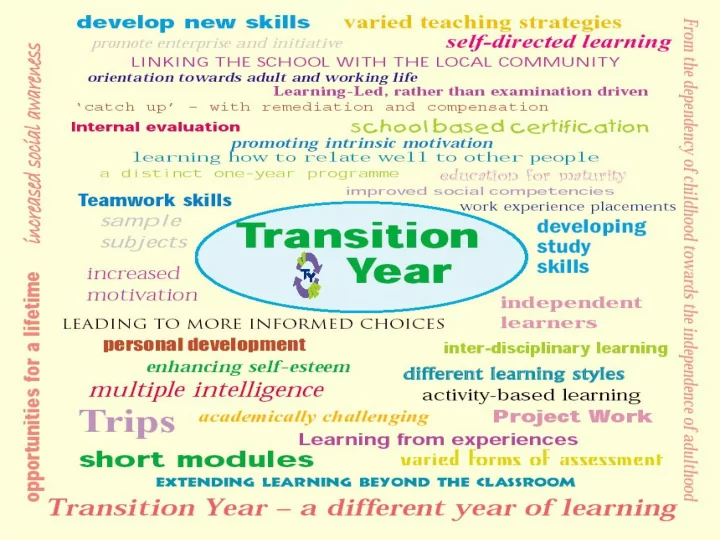
Transition Year Mission Statement To promote the personal, social, educational and vocational development of pupils and to prepare them for their role as autonomous, participative and responsible members of society. The above is


slide-1
SLIDE 1
slide-2
SLIDE 2

Transition Year Mission Statement

  • To promote the personal, social,

educational and vocational development of pupils and to prepare them for their role as autonomous, participative and responsible members of society.

  • The above is achieved through all the

elements of the TY Programme.

slide-3
SLIDE 3

Students

  • Need to move out of their comfort zone.
  • Try new activities and subjects.
  • Be open to new ideas.
  • Make new friends
  • Give of themselves to family,

community and the school.

  • Be active and get involved
slide-4
SLIDE 4

Main Elements Work Experience Community Care The Musical

slide-5
SLIDE 5

Important Elements

E.C.D.L Gaisce

slide-6
SLIDE 6

Open to all students in Transition Year in Holy Faith. Participants must be at least age 15 to enter. A minimum of one hour a week is required in the following areas: -

  • Community Involvement – 13 weeks
  • Personal Skill – 13 weeks
  • Physical Recreation – 13 weeks

(Additional activity in any section of your choice from the three above for a further 13 weeks)

  • Venture Journey

(Plan prepare and undertake a 2 day, 1 night adventure journey in a group covering a minimum total distance of : Walking;25– 35 km or Cycling 100 -130 km over two consecutive days)

GAISCE – The President’s Award

slide-7
SLIDE 7

Challenges are agreed with PAL (President’s Award Leader). Some examples listed below: - Community Involvement Charity shop, Help with a youth club, Helping with children – GAA Nursery, Nursing Home – quite a few students volunteer in Sybil Hill. Personal Skill - e.g. ECDL, Musical instrument, Dance, Singing lessons, Web design, Learn a foreign language (No sport allowed). Physical Recreation - e.g. Walking, Cycling, Tennis, Badminton, Golf, Soccer, Gaelic, Rugby, Swimming, A marathon. Adventure Journey/Research - e.g. walk/cycle, Mountain hike, Canoeing, (Those who would be unable to accomplish this due to a physical disability perform a suitable replacement activity such as research) In April 68 students covered a distance of 30 km in the Wicklow Way and stayed overnight in a hostel in Glendalough.

slide-8
SLIDE 8

The Year

  • Term 1

Blocked weeks of School work, Community Care and workshops

  • Term 2

Work Experience and the Musical

  • Term 3

School Work, Option Choices and some workshops / day trips

slide-9
SLIDE 9

Workshops

  • Film School/Song School
  • Personal Development
  • Garda Liaison
  • Cheerleading
  • First Aid
  • Career Day
  • Aware ‘Beat the Blues’
  • Enterprise Day
slide-10
SLIDE 10

Day Tours

  • Ploughing Championships
  • Collins Barracks
  • St. Patrick’s Cathedral
  • Botanic Gardens
  • Dublin Zoo
  • ‘Leaders on our level’
  • Theatre
  • TY Committee often organise a day tour
slide-11
SLIDE 11

Overnight Trip

Carlingford Adventure Centre September Cost €135 Activities: Three dry land Two water based

slide-12
SLIDE 12

Finance

Who Pays?

  • Parents
  • School
  • Parents Association
  • TY Fundraiser – Bag Packing
slide-13
SLIDE 13

Charity Fundraisers

  • Santa Bear Appeal
  • ‘Trick or Treat’ for Temple Street
  • CASA clothing collection
  • Fundraisers may be held for certain
  • rganisations after students have

heard a speaker e.g. Barnardos, Peter Mc Verry Trust

slide-14
SLIDE 14

Wednesday Options

» CRC Fast Friends » Photography » Art » Self Defence » Log on Learn

slide-15
SLIDE 15

TY Committee

  • Students choose their own

representatives.

  • Two from each class
  • Meet with Ms Molloy and we try to tailor

make their programme for them.

slide-16
SLIDE 16

Assessment

  • Work experience booklet
  • Attendance
  • Participation
  • TY Folder
  • Tutorial: oral and written presentations
  • Exams within each subject
  • Continuous assessment
slide-17
SLIDE 17

Achievements

  • Certification from Department
  • Certification from school
  • Certification from individual areas

e.g. Self Defence, CRC, Space Camp, and Gaisce

slide-18
SLIDE 18

Evaluation

  • The students evaluate the programme on three

separate occasions

  • Parents evaluate at end of year
  • Staff evaluate classes/modules throughout the

year

  • Ms Molloy and Ms Gogarty evaluate throughout

the year

slide-19
SLIDE 19

Important Dates

  • Return to School
  • Carlingford
  • Ploughing Championships
  • Community Care
  • Work Experience
slide-20
SLIDE 20

‘Holding on to Transition Year’

Irish Times March 22nd 2012

Sir, – I wish to express my staunch opposition to the arguments presented by Friends of

the Elderly (Home News, March 19th) for the abolition of Transition Year. As a TY student, aged 16, I am experiencing the intellectual and social benefits of fourth

  • year. As a result of TY I have become a more confident, mature and independent person

in facing different challenges. I have academically progressed in all subject areas. I am better at working with other people, I have developed many useful skills such as IT, cooking and organisation and above all I am more motivated. Are these not positive and worthwhile changes that not only benefit the students, but also society? Transition year students nationwide are involved in many community service projects such as Young Social Innovators, Gaisce and the Friends of the Elderly Transition Year Programme. A compulsory community service year (a suggestion by Friends of the Elderly) would be a poor substitute for TY. It would be difficult to keep most pupils satisfied with doing community service (in other words forced labour) for seven hours a day, five days a week,

  • ver the course of a nine-month school year, as they would not be able to attain the myriad
  • f other benefits Transition Year offers.

Surely, the fundamental purpose of any school programme such as Transition Year is to develop the student’s potential? Contrary to being “self-indulgent” and “a luxury we can’t afford”, transition year is a necessity we can’t afford to be without. Indeed, were it not for transition year, I would not have had the initiative to express my strong opinions with this letter. – Yours, etc,