Transactions: Buyer and Seller Considerations Drafting Enforceable - - PowerPoint PPT Presentation

transactions buyer and seller considerations
SMART_READER_LITE
LIVE PREVIEW

Transactions: Buyer and Seller Considerations Drafting Enforceable - - PowerPoint PPT Presentation

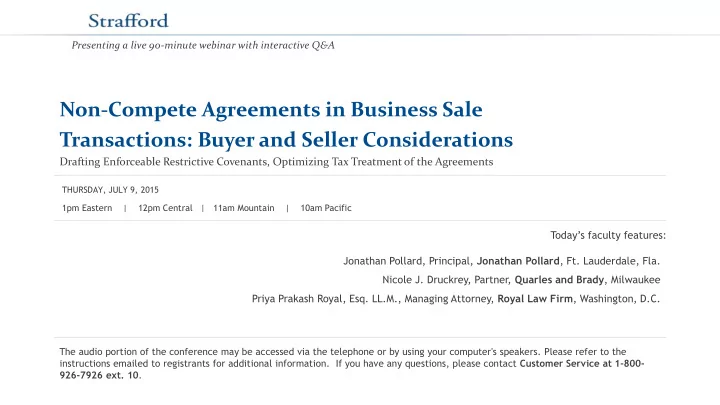
Presenting a live 90-minute webinar with interactive Q&A Non-Compete Agreements in Business Sale Transactions: Buyer and Seller Considerations Drafting Enforceable Restrictive Covenants, Optimizing Tax Treatment of the Agreements THURSDAY,


slide-1
SLIDE 1

The audio portion of the conference may be accessed via the telephone or by using your computer's speakers. Please refer to the instructions emailed to registrants for additional information. If you have any questions, please contact Customer Service at 1-800- 926-7926 ext. 10.

Presenting a live 90-minute webinar with interactive Q&A

Non-Compete Agreements in Business Sale Transactions: Buyer and Seller Considerations

Drafting Enforceable Restrictive Covenants, Optimizing Tax Treatment of the Agreements

Today’s faculty features:

1pm Eastern | 12pm Central | 11am Mountain | 10am Pacific THURSDAY, JULY 9, 2015

Jonathan Pollard, Principal, Jonathan Pollard, Ft. Lauderdale, Fla. Nicole J. Druckrey, Partner, Quarles and Brady, Milwaukee Priya Prakash Royal, Esq. LL.M., Managing Attorney, Royal Law Firm, Washington, D.C.

slide-2
SLIDE 2

Tips for Optimal Quality

Sound Quality If you are listening via your computer speakers, please note that the quality

  • f your sound will vary depending on the speed and quality of your internet connection.

If the sound quality is not satisfactory, you may listen via the phone: dial 1-888-450-9970 and enter your PIN when prompted. Otherwise, please send us a chat or e-mail sound@straffordpub.com immediately so we can address the problem. If you dialed in and have any difficulties during the call, press *0 for assistance. Viewing Quality To maximize your screen, press the F11 key on your keyboard. To exit full screen, press the F11 key again.

FOR LIVE EVENT ONLY

slide-3
SLIDE 3

Continuing Education Credits

In order for us to process your continuing education credit, you must confirm your participation in this webinar by completing and submitting the Attendance Affirmation/Evaluation after the webinar. A link to the Attendance Affirmation/Evaluation will be in the thank you email that you will receive immediately following the program. For additional information about CLE credit processing call us at 1-800-926-7926 ext. 35.

FOR LIVE EVENT ONLY

slide-4
SLIDE 4

Program Materials

If you have not printed the conference materials for this program, please complete the following steps:

  • Click on the ^ symbol next to “Conference Materials” in the middle of the left-hand column on your

screen.

  • Click on the tab labeled “Handouts” that appears, and there you will see a PDF of the slides for today's

program.

  • Double click on the PDF and a separate page will open.
  • Print the slides by clicking on the printer icon.

FOR LIVE EVENT ONLY

slide-5
SLIDE 5

PRELIMINARY CONSIDERATIONS

Jonathan Pollard

jpollard@pollardllc.com www.pollardllc.com

slide-6
SLIDE 6

Variation Tremendous state-to-state variation even in sale of business context.

6

slide-7
SLIDE 7

Sale of Business vs. Employment

  • Sale of business = more leeway / greater restraint
  • If hiring sellers, use both sale of business and employee non-compete.
  • See, e.g., Mohr v. Bank of New York Mellon, 371 F. App'x 10, 16 (11th Cir.

2010) (applying GA law and holding non-compete was ancillary to sale of a business where seller became employed by buyer under separate employment agreement)

7

slide-8
SLIDE 8

Necessity

  • If a sale agreement does not contain express restrictive covenants, the

buyer has no protection.

  • No implied duty not to compete.
  • See, e.g., Nationwide Emerging Managers, LLC v. Northpointe Holdings,

LLC, 112 A.3d 878, 899 (Del. 2015)

8

slide-9
SLIDE 9

BENEFITS

9

slide-10
SLIDE 10

Protection of Legitimate Business Interests (Usual Suspects)

  • Confidential information / trade secrets.
  • Customer relationships.
  • Employee relationships. See, e.g. InsureOne Indep. Ins. Agency, LLC v.

Hallberg, 2012 IL App (1st) 092385, ¶ 55, 976 N.E.2d 1014, 1029

10

slide-11
SLIDE 11

Protection of Goodwill

  • Goodwill should always be included as a separate category of

assets.

  • Goodwill is a catchall & more powerful than any other interest.
  • See, e.g., Payment Alliance Int'l, Inc. v. Ferreira, 530 F. Supp. 2d 477,

483 (S.D.N.Y. 2007); Gary's Implement, Inc. v. Bridgeport Tractor Parts, Inc., 270 Neb. 286, 303-04, 702 N.W.2d 355, 369 (2005).

11

slide-12
SLIDE 12

Absolute Right

  • Buyer has absolute right to that market space.
  • In some states, seller cannot reenter even if buyer exits.

12

slide-13
SLIDE 13

Absolute Right II

  • See, e.g., USI Ins. Servs. of Florida Inc. v. Pettineo, 987 So. 2d 763, 767

(Fla. Dist. Ct. App. 2008) (“The seller cannot sustain his defense that USI no longer operates in the pertinent ‘line of business.’ …. While the buyer may not currently serve that population, it purchased the right to do so.”).

  • See, e.g., PRYM Consumer USA, Inc. v. Rhode Island Textile Co., 388 F.

App'x 352, 357 (4th Cir. 2010) (holding non-compete no longer enforceable after 15 years when buyer sold the business and completely exited the market – SC law)

13

slide-14
SLIDE 14

Remedies

  • Injunctive relief
  • Actual damages
  • Liquidated damages

14

slide-15
SLIDE 15

Practice Tip

  • Include liquidated damages provision that calculates damages via
  • disgorgement. This is routinely upheld.
  • See, e.g., H & G Ortho, Inc. v. Neodontics Int'l, Inc., 823 N.E.2d 718,

732 (Ind. Ct. App. 2005) (enforcing liquidated damages / disgorgement provision in breach of sale of business non-compete).

15

slide-16
SLIDE 16

LIMITATIONS

16

slide-17
SLIDE 17

Geographic Scope

  • Limited to where the sold business operated
  • World-wide is permissible.
  • See, e.g., Uni-World Capital L.P. v. Preferred Fragrance, 2014

WL 3417281, at *24 (S.D.N.Y. July 10, 2014) (enforcing sale of a business non-compete throughout US, US territories and possessions and any country where business sold products).

17

slide-18
SLIDE 18

Geographic Scope II

  • Risk of overreaching.
  • Some states will not blue pencil.
  • See, e.g., Unlimited Opportunity, Inc. v. Waadah, 290 Neb. 629,

639, 861 N.W.2d 437, 444 (2015) (holding sale of business non- compete unenforceable in its entirety due to geographic over breadth).

18

slide-19
SLIDE 19

Temporal Scope

  • Extreme state-to-state variation.
  • Florida: 7+ years presumptively unreasonable.
  • Texas: Forever. Seriously. Heritage Operating, L.P. v. Rhine Bros.,

LLC, 2012 WL 2344864, at *5 (Tex. App. June 21, 2012) (collecting cases holding lifetime restriction enforceable in sale of business context).

19

slide-20
SLIDE 20

Temporal Scope II

  • Courts routinely modify time limits.
  • See, e.g., IKON Office Solutions, Inc. v. Dale, 22 F. App'x 647,

648 (8th Cir. 2001) (modifying from 5 to 3 years)

20

slide-21
SLIDE 21

Line of Business

  • Contract terms trump.
  • See, e.g., Coastal Loading, Inc. v. Tile Roof Loading, Inc., 908 So. 2d 609,

612 (Fla. 2d DCA 2005) (roof tile hauling v. roof tile loading).

  • Or-Cal Inc. v. Tessenderlo Kerley Inc., 2015 WL 751212, at *4 (D. Ariz.
  • Feb. 23, 2015) (lime sulfur vs. specific types of lime sulfur).

21

slide-22
SLIDE 22

Public Policy

  • Public policy still trumps.
  • See, e.g., Benchmark Med. Holdings, Inc. v. Barnes, 328 F. Supp.

2d 1236 (M.D. Ala. 2004) (holding sale of business non- compete unenforceable against professionals).

22

slide-23
SLIDE 23

DRAFTING NON-COMPETE AGREEMENTS

Nicole J. Druckrey

Quarles & Brady LLP nicole.druckrey@quarles.com www.quarles.com

slide-24
SLIDE 24

ENFORCEABILITY CONSIDERATIONS

24

slide-25
SLIDE 25

Terminology:

  • Collective Terms
  • Non-Compete
  • Customer Non-Solicitation
  • Non-Piracy/Anti-Raiding/No-Hire/Employee Non-Solicit
  • Non-Disclosure/Confidentiality Clause

25

slide-26
SLIDE 26
  • A. Step 1: Identify Applicable Law
  • B. Step 2: Identify Legitimate Business Interest and Tailor

Restriction Accordingly

  • 1. Sale of Business Context

a) Easily met as such covenants are necessary to protect the goodwill, customer relationships, and intellectual property being purchased by the buyer. b) Drafting Tip: The purchase agreement should specifically note that you are purchasing the seller’s “goodwill.”

26

slide-27
SLIDE 27
  • 2. Employment Context:

a) Why are we discussing employment context when this presentation is about purchase agreements? b) Legitimate interests:

(1) protecting trade secrets (2) protecting customer relationships (3) protecting detailed customer information (4) protecting high-level strategic information (5) specialized or extraordinary training. Florida, for example, has codified this as a legitimate business interest. See Fla. Stat. Ann. § 542.335(1)(b)(5). However, not all states recognize this as a legitimate interest.

  • 3. Not a Legitimate Interest: Stifling of ordinary competition (recall state

requirements that buyer continue to operate business in territory)

27

slide-28
SLIDE 28
  • C. Step 3: Limit Restrictions by Time, Activity, and Geography
  • 1. Your legitimate business interest will dictate how you limit

the restrictive covenant as to geography, time, and activity.

  • 2. Geographic Scope:

a) first look to applicable state law to determine if a specific type of restriction is required.

28

slide-29
SLIDE 29

b) In determining whether the geographic scope selected is appropriate, courts will consider a number of factors, including:

(1) The type of business sold. (2) Whether the restriction extends beyond the sold entity’s market. (3) If there is evidence that the buyer intends to expand the business into a new territory, it may be appropriate to include that territory in the geographic

  • scope. See Fogle, 539 N.E.2d at 504-05. However, some states may not allow

such a broad restriction. California law, for example, requires that a restrictive covenant be limited to the geographic area in which the sold business was carried on. See Calif. Bus. & Prof. Code § 16601. (4) Whether the buyer intends to continue doing business in the territory. If the buyer abandons the business in a certain area, it is unlikely that they will be able to enforce the restrictive covenant in the abandoned area. (5) The purchase price. The greater the purchase price, the greater the court’s tolerance for a restriction. See Fogle, 539 N.E.2d at 504.

29

slide-30
SLIDE 30

Case Example

In Fogle v. Shah, 539 N.E.2d 500 (Ind. App. 1989), the Indiana Court of Appeals considered whether a three (3)-year, twelve (12)-state restrictive covenant was reasonable. The plaintiffs, the Fogles, had sold their employee benefits consulting firm to the defendant for $1 million. At the time of the sale, the Fogles’ business had 600 customers spread across eleven (11) states, though the bulk of customers—approximately 572—were located in just five (5) states. During negotiations, the defendant stated that he wanted a five (5)-year restriction, spanning twelve (12) states: the eleven (11) states in which the Fogles’ clients were located and another state in which the defendant was actively trying to expand his own competing business. The Fogles agreed to the geographic scope requested by the defendant, but negotiated a three (3)-year term. Approximately a year after the sale of their business to the defendant, the Fogles began competing in the restricted territory. They then sued the defendant for breaching the parties’ purchase agreement, and the defendant counter-claimed for breach of the restrictive covenant. The Fogles defended the defendant’s counterclaim on the ground that the geographic scope was overbroad, including seven (7) states in which the Fogles—at the time of sale—had just a handful of customers and another state in which they had no customers at all. The court concluded that the geographic scope was reasonable. In doing so, the court noted that the defendant had paid a substantial price for the Fogles’ business ($1 million). The court noted that of the twelve (12) states included in the restricted territory, the Fogles’ had customers in eleven (11) of them. The court found that the addition of the twelfth state was reasonable because, at the time of sale, the defendant was actively trying to expand his own competing business into that state and the Fogles were aware of his efforts in that regard. Finally, the court noted that although the business at issue was in the service industry (which can sometimes signal that a smaller geographic scope is most appropriate), the business’s nature warranted the twelve (12)-state territory.

30

slide-31
SLIDE 31
  • 3. Temporal Scope

a) With respect to an appropriate temporal scope, you should first look to applicable state law to determine if it provides you with restrictions or guidance. b) In determining whether a temporal scope is appropriate, courts will consider a number of factors:

(1) The amount paid for the business. E.g., Western Insulation, L.P. v. Moore, 2006 WL 208590, *6 (E.D. Va.). (2) Temporal restrictions approved by other courts in the jurisdiction. See, e.g., Darius Int’l,

  • Inc. v. Young, 2008 WL 1820945, *41 (E.D. Pa.).

(3) The length of time the seller was connected to its business. Darius Int’l, 2008 WL 1820945 at *41. (4) The length of time it will take the purchaser to establish its own customer following. Darius Int’l, 2008 WL 1820945 at *40. (5) The length of time during which the confidential information belonging to the seller’s business remains valuable. Neocare Health Sys., Inc. v. Teodor, 2006 WL 198329, *6 (Mich. App.).

31

slide-32
SLIDE 32
  • 4. Scope of Restricted Activity

You should typically limit your restrictive covenants so that they relate to the sold business and not to the buyer’s business. The buyer’s business may be broader, and the buyer likely does not have an interest in prohibiting the seller from competing in the buyer’s business. See Strategix, LTD v. Infocrossing West, Inc., 142 Cal. App. 4th 1068 (Cal. App. 2006).

32

slide-33
SLIDE 33

Case Example

In Strategix, Ltd. v. Infocrosing West, Inc., 142 Cal. App. 4th 1068 (Cal. App. 2006), the plaintiff sold the assets of a subsidiary (including the subsidiary’s goodwill) to the defendant. As part of the transaction, the seller entered into a restrictive covenant prohibiting it from soliciting the buyer’s customers and employees. Litigation later ensued and the defendant secured an injunction prohibiting the plaintiff from soliciting its customers and employees. In overturning the trial court’s decision, the court of appeals noted that § 16601 of California Business & Professions code permits a “person who sells the goodwill of a business to refrain from carrying on a similar business within a specified geographic area in which the business so sold … has been carried on, so long as the buyer … carries on a like business therein.” Id. (quoting Cal. Bus. & Prof. Code § 16601). The court noted that the purpose of the statute was to “protect[] the value of the business acquired by the buyer” because it would be “unfair for the seller to engage in competition which diminishes the value of the asset [] sold.” “Thus, the thrust of … § 16601 is to permit the purchaser of a business to protect himself or itself against competition from the seller which competition would have the effect of reducing the value of the property right that was acquired.” The appellate court concluded that the restrictions could not extend beyond the sold asset’s customers and

  • employees. Extending the restriction to the buyer’s employees and customers would infringe upon the seller’s

“fundamental right to compete for employees and customers in the marketplace.” Practical issues also militated against such a finding, since it would be difficult for the seller to know who the buyer’s customers and employees were.

33

slide-34
SLIDE 34
  • 5. Blue-Penciling

a) is it allowed in your state? b) loose v. strict blue-penciling c) Overreaching d) poor deterrents

34

slide-35
SLIDE 35

Case Example

In Valley Medical Specialists v. Farber, 982 P.2d 1277 (Ariz. 1999), the defendant (“Farber”) was a former shareholder and employee of the plaintiff Valley Medical Specialists (“Valley Medical”). As a shareholder and employee of Valley Medical, Farber entered into various restrictive covenants each of which was subject to the following limitations: The restrictive covenants set forth herein shall continue during the term of this Agreement and for a period of three (3) years after the date

  • f termination, for any reason, of this Agreement. The restrictive covenants set forth herein shall be binding upon the Employee in that

geographical area encompassed within the boundaries measured by a five (5) mile radius of any office maintained or utilized by Employer at the time of execution of the Agreement or at any time thereafter. The trial court concluded that the restrictive covenants violated public policy or, alternatively, were too broad. “Specifically, the court found that: any covenant over six months would be unreasonable; the five-mile radius from each of the three [Valley Medical] offices was unreasonable because it covered a total of 235 square miles; and the restriction was unreasonable because it did not provide an exception for emergency medical aid and was not limited to pulmonology.” Because Arizona follows a strict blue-pencil rule, it can only strike (i.e., it cannot modify) offending language. Here if the offending language were struck, the clause would read as follows: The restrictive covenants set forth herein shall continue during the term of this Agreement and for a period of three (3) years after the date

  • f termination, for any reason, of this Agreement. The restrictive covenants set forth herein shall be binding upon the Employee in that

geographical area encompassed within the boundaries measured by a five (5) mile radius of any office maintained or utilized by Employer at the time of execution of the Agreement or at any time thereafter. Because what remains is not reasonable (and does not make any sense), Valley Medical was left without any protection.

35

slide-36
SLIDE 36

Case Example

In Strategix, Ltd. v. Infocrosing West, Inc., 142 Cal. App. 4th 1068 (Cal. App. 2006), discussed supra, the buyer asked the court to modify the customer and employee non-solicitation provisions so that they only applied to the sold entity’s customers and employees. Though the court had the authority to do so, it refused, noting that “courts will not strike a new bargain for the parties for the purpose of saving an illegal contract.” Accordingly, the buyer was left without any protection.

36

slide-37
SLIDE 37
  • D. Misc. Clauses to Consider

a) Choice-of-Law and Forum-Selection Clauses b) Arbitration Clause c) Assignment Clause d) Modification and Severability Clause e) Liquidated Damages Clause f) Integration Clause

37

slide-38
SLIDE 38

INTERPLAY WITH EMPLOYEE NON-COMPETE AGREEMENTS

38

slide-39
SLIDE 39

Who should sign a non-compete agreement?

a) Asset v. Stock sale b) Sellers c) Employees

39

slide-40
SLIDE 40

Non-Compete Agreements in in Business Sale Transactions

Priya Prakash Royal, Esq., LL.M.

ROYAL LAW FIRM PLLC

Tax & Non-Compete Agreements

Royal Law Firm PLLC | 800.409.0211 | www.royalesq.com

slide-41
SLIDE 41

Tax Issues: Context

  • Employee Agreements
  • Issues with compensation
  • Expense Issues
  • Deduction methodology and amortization
  • Purchase and Sale of Business
  • Issues regarding valuation
  • Treatment of income items
  • Capital Gain or Ordinary Income?
  • Non-compete provisions in Deferred Compensation Agreements

Royal Law Firm PLLC | 800.409.0211 | www.royalesq.com 41

slide-42
SLIDE 42

Employee Agreements: Tax

  • Payment for signing non-compete provision
  • Legitimate business expense
  • Compensation to employee, income issue
  • Accounting issues
  • Amortization requirements
  • Non-compete is an intangible under IRC Sec. 197
  • Amortize over 15 years
  • Recovery Group, Inc., et al. v. Comr., TC Memo. 2010-76
  • $400,000 paid to employee to sign non-compete.
  • Company should have amortized payment over 15 years as an intangible.

Royal Law Firm PLLC | 800.409.0211 | www.royalesq.com 42

slide-43
SLIDE 43

Business Purchase and Sale: Tax

  • Non-compete agreements as part of a business buy/sell
  • Treatments of payments for non-compete agreements
  • Ordinary income or capital gain
  • Usually ordinary income
  • Better for buyer, worse for seller
  • Expensed as incurred
  • Valuation
  • As personal goodwill
  • Capital Gain Treatment
  • Better for seller, worse for buyer
  • No expense deduction, no amortization
  • Issue for negotiations

Royal Law Firm PLLC | 800.409.0211 | www.royalesq.com 43

slide-44
SLIDE 44

Deferred Compensation Issues

  • Issue with nonqualified deferred compensation plans
  • Usually supplemental retirement benefits for key employees, disability

income benefits and, death benefits

  • Top-hat plans: 29 U.S.C. §1051(2)
  • Requirements: Fort Halifax Packing Co. v. Coyne, 482 U.S. 1, 11 (1987)
  • Key employee non-compete agreements
  • Violation of non-compete provision may result in termination of benefits

as determined by plan administrator

  • Potential Conflict Issue
  • Severe penalty and tax consequences under IRC Sec. 409(a)
  • Severance payment in connection with a non-compete can be a violation if employee

can influence year of payment

Royal Law Firm PLLC | 800.409.0211 | www.royalesq.com 44

slide-45
SLIDE 45

Royal Law Firm PLLC | 800.409.0211 | www.royalesq.com

Concluding Remarks

  • Non-compete agreements have tax implications in three

distinct contexts

  • In employee agreements
  • In Business buy/sell agreements
  • In nonqualified deferred compensation plan context for key employees
  • Consult a tax advisor prior to finalizing a non-compete

agreement

  • Tax advisor needs broad tax and business knowledge, including but not

limited to, relevant income tax, corporate tax, and ERISA provisions.

45

slide-46
SLIDE 46

Contact:

Priya Prakash Royal, Esq. LL.M.

DC, MD, PA, NJ & NY Royal Law Firm PLLC

1725 I St. NW, Ste 300, Washington DC 20006 202.380.9336 or 800.409.0211

pproyal@royalesq.com

Royal Law Firm PLLC | 800.409.0211 | www.royalesq.com

Comments?

46