Train-led traffic control as a chance for regional railways - - PowerPoint PPT Presentation

train led traffic control as a chance for regional
SMART_READER_LITE
LIVE PREVIEW

Train-led traffic control as a chance for regional railways - - PowerPoint PPT Presentation

Train-led traffic control as a chance for regional railways Dipl.-Ing. Otfried Knoll KNOLL TRAFFIC & TOURISTIC SOLUTIONS St. Plten, Austria 5.11.2012 IRIC 2012 1 Operations led by a traffic controller Introductory remarks Train


slide-1
SLIDE 1

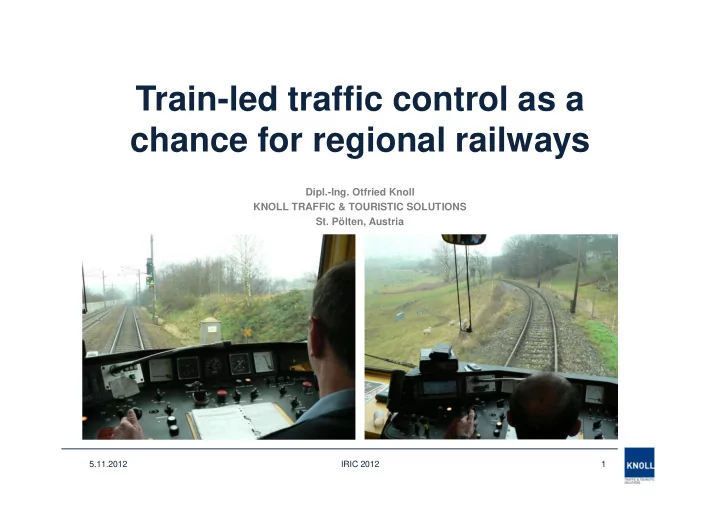
Train-led traffic control as a chance for regional railways

5.11.2012 IRIC 2012 1

Dipl.-Ing. Otfried Knoll KNOLL TRAFFIC & TOURISTIC SOLUTIONS

  • St. Pölten, Austria
slide-2
SLIDE 2

Operations led by a traffic controller

Introductory remarks

  • Train operation on local railway lines is often realised using simplified operating

regimes for centralised operations control.

  • Train led traffic control was originally designed for secondary lines with limited traffic

at lower speed.

  • The reason for introduction were the high personnel costs up to this point since the

stations which bounded the block sections had to be staffed.

  • Instead of that, on lines with train led traffic control a single line dispatcher is

responsible for all movements within the boundary of his area.

  • There exist several more or less sophisticated or tailored solutions.
  • The majority of these systems have in common, that the sequence of trains is

controlled without using stationary signals, signal boxes and block signalling systems.

  • There are also use cases where trains change over from main lines with full train

protection equipment onto secondary lines where they are guided with train led traffic

  • control. At the boundary of the train led traffic control section, the sequence of trains

is ensured by telephone block between the involved dispatchers.

5.11.2012 IRIC 2012 2

slide-3
SLIDE 3

5.11.2012

Change of operating method

IRIC 2012

3

Regional line with train-led

  • peration method

Main line with block equipment and stationary signals

slide-4
SLIDE 4

Why use train-led traffic control

Economic goals:

  • Moneysaving, but efficient management of train movements in terms of both

reasonable investments and operating costs

  • Only one dispatcher at each line
  • Enhancement of single-track line capacity (e.g. increasing the number of block

sections)

  • Avoidance of stationary signals and classical signal boxes
  • Tracing without track circuits, insulated track sections or axle counting installations
  • Avoidance of loss of time in stations with passing loop by using resetting trailable

points (spring switches)

Safety-related goals:

  • Centralised traffic control
  • Visualisation of occupancy of different track sections

New possibilities when using advanced systems:

  • Tracing of movements inside a track section
  • Interference with the brake system

5.11.2012 IRIC 2012 4

slide-5
SLIDE 5

Principles of train-led systems

  • A train dispatcher traces all the train‘s movements by receiving messages from the

engine drivers and by issuing orders to them. No single train is allowed to run without permission.

  • The sequence of trains is controlled by operating points (Zuglaufstellen),

predetermined in a route atlas. If messages are sent there, an operating point performs as unstaffed block post (Zuglaufmeldestelle).

  • Blocking and clearing of track sections is realised by standardised messages

between engine driver and train dispatcher.

  • If operation procedures (e.g. shunting, train crossing) have to occur in stations, the

train crew is involved in all local activities for route protection and route locking.

  • The clearing of a track section is done either by a message of arrival or by a

message of leave, dispatched from the train which arrives at or which leaves the next relevant operating point.

  • For this reason, operating points must have boundaries defined by conspicuous signs

(trapezoid plates etc.) or signals.

  • In any case it is important to verify that the trainset is still complete before sending a
  • message. The end-to-end brake pipe guarantees this condition in the normal case. In

special cases, special operations rules exist.

5.11.2012 IRIC 2012 5

slide-6
SLIDE 6

Development of methods

  • Operational status messages were initially given by track phone, later on by voice
  • radio. Those bilateral talks are usually recorded by voice recorders for preservation
  • f evidence.
  • Securing the sequence of trains and the two-way-traffic was initially achieved only

by writings and drawings, showing whether line portions were occupied or free.

  • Usually, the occupation of the line was recorded by the train dispatcher, drawing

lines with different colours in the actual graph of train running or, meanwhile rarely, by entering figures in the operating statement.

5.11.2012 IRIC 2012 6

slide-7
SLIDE 7

Key risk factor human

5.11.2012 IRIC 2012 7

slide-8
SLIDE 8

Risks of train-led traffic control

  • Several railway operators in Austria changed from telephone block with manned

stations to train-led control system since the 1970‘s (Zillertalbahn, Stern & Hafferl, Salzburger Lokalbahn).

  • Even ÖBB launched their train-led control system (V 5) on several lines, starting in

1983.

  • All these operating methods uses radio communication with verbal transmission of

messages and orders.

  • None of these systems has technical interferences to secure the surveillance of given

permissions (e.g. end of driving allowance).

  • Moreover, none of these systems provided protection devices against runs from the
  • pposite direction.
  • All these systems have in common, that the safety of railway operation depends

entirely on attention and observation of rules by humans.

  • Several accidents pointed out that humans make mistakes over and over again.
  • Causes were always forgotten orders or tasks not-kept-in-mind.
  • There were several methods to keep in mind the crossings with trains moving in the
  • pposite direction. See the following examples.

5.11.2012 IRIC 2012 8

slide-9
SLIDE 9

Reminder for train crossings

5.11.2012 IRIC 2012 9

slide-10
SLIDE 10

Disposal of reminders

5.11.2012 IRIC 2012 10

slide-11
SLIDE 11

Passing loop with reminders

5.11.2012 IRIC 2012 11

slide-12
SLIDE 12

Lessons learned

Risk factor human

  • Risk to forget crossings
  • Risk to forget request for running permission

Operational processes

  • Quickness should be increased (especially in stations with passing loops)
  • Dispatchers should be relieved from drawing and writing
  • Localisation of trains should be possible continuously

Therefore additional safety-related goals are required

  • Technical support for message-transmission
  • Transmittance of additional tasks onto DMIs in the driver‘s cab
  • Surveillance of driver‘s activities relevant for safety
  • Interference with brake system in case of emergency (automatic train stopping

device)

  • Integration of station areas in the tracing systems (e.g. selective visualisation of
  • ccupied station tracks)
  • Combination with local signal boxes for selected stations (e.g. for shunting purposes)

5.11.2012 IRIC 2012 12

slide-13
SLIDE 13

Further developments

Later control systems

  • During the last years, progressive systems were established step by step in Austria.
  • As a first step messages from the driver to the dispatcher were encoded and sent by

radio as sound sequences (Stern & Hafferl railways in Upper Austria).

  • ÖBB uses on local lines voice radio and GPS-localisation of trains, combined with a

warning device. It gives a sound signal to the driver in case of overrunning a driving permission, but there is no interference to the engine control and braking system.

  • State of the art is using digital radio data for transmission of messages and for

localisation of trains with dGPS-signals, combined in several cases with trackside transponders (balises) for a more exact train detection and other advantages.

  • Improved security at stations by track selective vehicle localisation is even possible

as well as the possibility of combination with local signal boxes.

  • These new systems are able to transfer running permissions, operational orders and
  • ther advices on a DMI-unit in the driver‘s cab.
  • These new systems also control the observance of given running permissions by

intervention in the braking system in case of emergency.

  • Furthermore, these systems realise a protection against head-on collisions.

5.11.2012 IRIC 2012 13

slide-14
SLIDE 14

Origins

5.11.2012 IRIC 2012 14

  • Early use of radio in the StH network.
  • Forced adaptation to train-led traffic

control by case: Total destruction of railway telephone lines by frozen rain.

  • 1990 commissioning of new train-led

traffic control radio system with industrial system partner AEG.

slide-15
SLIDE 15

Traffic control system StH 1990

5.11.2012 IRIC 2012 15

slide-16
SLIDE 16

Traffic control system StH 1990

What was new at that time:

  • Added to the train number, trains forward a coded status information via 8-sound call.
  • A track atlas includes two-digit location codes for all operation points incl. sidings.
  • Single-digit codes are used for operational status messages.
  • The driver stores the 5-digit train number at the beginning of the train’s journey. He

enters the respective location-and-message code at reaching the occasion giving place and sends the message.

  • The message consists of the five digit train number, the two digit location code of the
  • perating point and the single-digit message code; it is sent as 8-sound call.
  • At the control office a message converter decodes the 8-sound call and visualises it

via monitor as a text message, for example " 76975 in Waizenkirchen (30) arrived, proceeding inquiry (1)“=> 76975301.

  • The dispatcher does his disposition according to priority. He selects the train with the

highest priority on the screen with the mouse and assigns further orders.

  • Driving permission and other jobs are assigned the driver verbally via radio, he enters

them into appropriate printed materials.

5.11.2012 IRIC 2012 16

slide-17
SLIDE 17

Sound call System StH 1990

Engine Display at the control office

5.11.2012 IRIC 2012 17

From the dispatcher’s point of view dispositions become easier and less time consuming: In times with high frequency of dispatching activities processes are accelerated, partly automated and documented. Vague messages can be better controlled for plausibility. Errors are minimised, but not prevented.

slide-18
SLIDE 18

Development towards ZLS StH

Innovations since 2002:

  • Implementation of a radio data system between dispatcher and trains with track-

specific design, since the number of repeaters depends on the topography.

  • Ensuring permanent communication of a central computer in the control room with

the vehicles‘ equipment along the track.

  • All trains have on-board computers with the functions train location, data

communication, visualization of all orders in plain text, control over the braking action (collision protection, preventing unauthorized trips).

  • Detection of trains is carried out by differential GPS (dGPS) and distance

measurement (odometer), initially without track selective localisation.

  • Additional to the operational status messages, position telegrams are sent by the

trains in 10 – 20 sec. intervals. The dGPS correction data are generated at the control room and are sent via radio in ca. 30 sec. intervals to the trains.

  • Train location takes place redundantly via dGPS and wheel sensor, derived data are

connected with data from the track atlas. Final result of the detection is a position statement in line specific coordinates.

  • Windows standards for dispatcher’s interface, text-based interface on DMI.

5.11.2012 IRIC 2012 18

slide-19
SLIDE 19

Functionality of ZLS StH

5.11.2012 IRIC 2012 19 GPS satellite GPS data Workplace and server in the control room Vehicle with on-board computer Repeater station

slide-20
SLIDE 20

Characteristics ZLS StH I

  • Using ZLS StH (Zugleitsystem Stern & Hafferl), the operating procedures for train-led

traffic control remain largely unchanged.

  • Operational status messages sent before then verbally or as a sound call are sent in

the ZLS as digital data messages and are displayed on DMI panel in plain text.

  • Track occupancy and operating conditions are shown in the control room on both

track sketch as well as on the graphic schedule (electronic time-distance diagram).

  • Operational special cases (e.g. working crews, occupied tracks, low-speed sections

etc.) are sent together with the driving permission to the engine driver’s DMI.

  • All actions are computerized and monitored for plausibility, supported and partially

automatized.

  • Errors like incomplete or garbled text parts are visible to the operator by the

appropriate error messages.

  • For cost reasons, initially no hardware redundancy was foreseen in the control office

and on the vehicles.

  • In a further stage of development this redundancy can be added.

5.11.2012 IRIC 2012 20

slide-21
SLIDE 21

Visualization of track occupancy

5.11.2012 IRIC 2012 21

  • The continuous train

detection generates an ever sequenced time / distance display of all trips in the electronic train guiding sheet (target/actual graphic schedule with driving permission and track

  • ccupancy visualization).
  • In addition, the track
  • ccupancy is shown for all

controlled tracks on the route indicator and is updated continuously as well.

slide-22
SLIDE 22

Track occupancy, input mask

5.11.2012 IRIC 2012 22

  • Via an input mask operational special cases such as impaired crossings, way

maintenance crews, speed restrictions, etc. can be transmitted as orders to the driver.

  • The dispatcher can also trigger an emergency stop at any time.
slide-23
SLIDE 23

DMI in the driver‘s cab StH

5.11.2012 IRIC 2012 23

slide-24
SLIDE 24

Display (DMI)

5.11.2012 IRIC 2012 24

slide-25
SLIDE 25

Monitoring ZLS StH

5.11.2012 IRIC 2012 25

M onitoring the driving permission

Driving permission If not confirmed  emergency braking If too fast  emergency braking In case of overrun  emergency braking

End of driving permission Train speed supervision 100 m before end of permission Reminder through buzzer at breaking distance before end of permission

slide-26
SLIDE 26

On-board & central computers

5.11.2012 IRIC 2012 26

  • Security-related control actions of the driver are logged on the on-board computer .
  • Regular status reports of the vehicle computers ensure a quasi continuous monitoring
  • f the trains and the radio channel, so that lost and interchanged messages are

detected.

  • All operator‘s actions, events and messages, including all data traffic are logged and

stored on the central computer.

Block diagram board computer

Wireless modem GPS receiver Data storage (CF-card) Central unit with CPU (Elan SC 520) Display driver‘s cab 1 Display driver‘s cab 2 Display passenger information Driver‘s desk (buttons and lamps) and braking control

Block diagram central computer

Wireless modem GPS receiver

Server central unit

Wireless clock Monitor 1 Monitor n Log printer Uninterruptible power supply

slide-27
SLIDE 27

Characteristics ZLS StH II

  • The ZLS StH is not redundant and thus the system is neither constructed signal-

technically fail-safe, nor is it a fully automated system.

  • The operator is responsible for the correctness of the entries, the computer checks

for plausibility.

  • The system monitors in particular, that in a section of track no two driving permissions

are issued at the same time.

  • Working seperatly of the other software, a collission protection system monitors the

distance of opposing trains. It is responding when two trains between two stations come closer than 1600 m (even when the dispatcher is not working).

  • Compliance with the permission to move by the driver is monitored by a PZB 60

modelled functionality (vigilance button, command- and free-button, intervention in the vehicle control and braking system).

  • If there is no valid driving permission for a train or no permission for shunting,

emergency braking is initiated automatically.

  • In case of a failure in the ZLS radio system or a systemically important component,

the exchange of the trainrouting reports and orders is done with the reliable sound call guiding system.

5.11.2012 IRIC 2012 27

slide-28
SLIDE 28

Innovations at Pinzgaubahn

Due to a severe accident (Bramberg 2005) it was a clear goal to provide the busy Pinzgaubahn line with a train control system combined with protection devices against train collisions, including an interference to the braking system. The ZLS from Stern & Hafferl was further improved towards RZL for Pinzgauer Lokalbahn (PLB). RZL PLB contains the following innovations:

  • Use of track transponders (balises) to improve the detection of position, track and

moving direction. Balises are placed at the sites of the trapezoidal boards, shunting stop boards, ZLM boards and at the respective track beginnings.

  • Vehicle movements can now be transmitted and shown track-selectively.
  • The central computer communicates with station computers as well in order to ensure

local shunting- and key releases (including release of the station‘s central key which is locked in an electric lock).

  • Compliance with a granted, technically verified driving or shunting allowance or key

release can be monitored and, if necessitated, even be enforced by the train control system.

  • In the former block section Tischlerhäusl - Zell am See the existing switch box and

the conventional block operation were maintained. Transition from the block-secured section to the RZL-operated section is secured by a technically controlled interface.

5.11.2012 IRIC 2012 28

slide-29
SLIDE 29

System components RZL PLB

5.11.2012 IRIC 2012 29

Above: Balise on track, balise reader on the vehicle, vigilance button for the driver. Below: Mobile device for not fixed-equipped maintenance- and nostalgia vehicles, control room with track sketches and time-distance diagrams.

slide-30
SLIDE 30

RZL Pinzgaubahn

  • Each vehicle in duty exchanges data with the control office via a wireless modem.
  • The vehicle's own geolocation is performed by wheel revolution counter (Odometer),

GPS receiver and balise reader (surface wave identification system, fixed telegrams) for the balises installed at the relevant track locations.

  • The geolocation measurements and determination of the current route kilometer are

synchronized by a digital route atlas stored on the vehicle‘s onboard computer, in which the IDs and locations of all the balises are recorded.

  • Together with the permission to proceed given by the control office, the target track,

the associated permission-end balise and a list of excluding balises (e.g. entrance balises on a track that does not meet the target track) are transferred as well.

  • If an overshot at the end of the driving permission is detected (using dGPS +
  • dometer) the emergency brake is activated, as well as when passing the

corresponding balise at the end of the driving permission.

  • Monitoring of driving permissions using balises works even if the GPS system fails.
  • The determination of the track used is achieved exclusively through the balise

system.

  • If a wrong target track is used, an emergency brake is triggered when passing the

entrance balise.

5.11.2012 IRIC 2012 30

slide-31
SLIDE 31

Functional schematic RZL PLB

5.11.2012 IRIC 2012 31

Source: PLB, FH Wels, Siemens Wireless modem Central office Wireless modem Trains

Radio data transmission

Requirement of data radio system and system delimitation

Central computer On-board computer

Telegram storing Telegram storing

S ystem elements for key release at station Station computer Central office Train Wireless modem Wireless modem Wireless modem Station control Central computer On-board computer Control & display Input & display

Train operation messages on demand dGPS / RTCM correction data Train position in intervals of 10 to 20 sec.

slide-32
SLIDE 32

Control office Pinzgaubahn

5.11.2012 IRIC 2012 32

  • At the control office, the various operational statuses (track occupation, driving

permission, key release, shunting permission etc.) are shown "wandering" in real- time both in the track sketch and in the time-distance diagram.

  • Driving permissions are displayed in the graphic timetable and in the track sketch in

different colours depending on the direction of the trains.

  • The illumination on the track display is a function of the target track, i.e. for a given

permission within a station not the entire station is illuminated, but only the busy route as a portion of the station track.

slide-33
SLIDE 33

DMI in the driver‘s cab PLB

5.11.2012 IRIC 2012 33

On the DMI-panel in the driver’s cab are displayed:

  • Date, time, actual route mileage, train number, train data
  • Place and target track of the driving permission and the needed messages in this

location (Fa, TF, XF, An, Gr, VaS etc.) are displayed in plain text

  • Orders can be displayed as text, e.g. Vm (leave), driving on sight, Vmax, mechanical

barriers open, low-speed sections

  • Incoming messages (receipt of a driving permission and collision warning) are

highlighted by an acoustic signal.

slide-34
SLIDE 34

Interfaces to DMI PLB

5.11.2012 IRIC 2012 34

Source: PLB, FH Wels, Siemens

User terminal

Wireless modem On-board computer

GPS-receiver, balise,

  • dometer

Emergency braking / Dead man

Acustic signal

Schematic illustration of the vehicle‘s display interfaces

Vigilance button Command button Free- button Buzzer

slide-35
SLIDE 35

Monitoring PLB

5.11.2012 IRIC 2012 35

Three virtual signalling poles realize at the end of the range of validity of every driving permission a monitoring mechanism to prevent overshooting a stop. The virtual poles are stored in the track atlas and can be assigned to the sites of the balises.

Source: PLB, FH Wels, Siemens Approaching end of driving permission in 400m > vigilance button! Approaching end of driving permission in 100m > emergency braking when > 40km/ h!

slide-36
SLIDE 36

Safety even in a local world!

5.11.2012 IRIC 2012 36

slide-37
SLIDE 37

Thank you for your attention!

5.11.2012 IRIC 2012 37

Dipl.-Ing. Otfried Knoll Kremser Gasse 19 3100 St. Pölten +43/2742/72 522, +43/676/61 77 515

  • ffice@knoll-tts.com www.knoll-tts.com