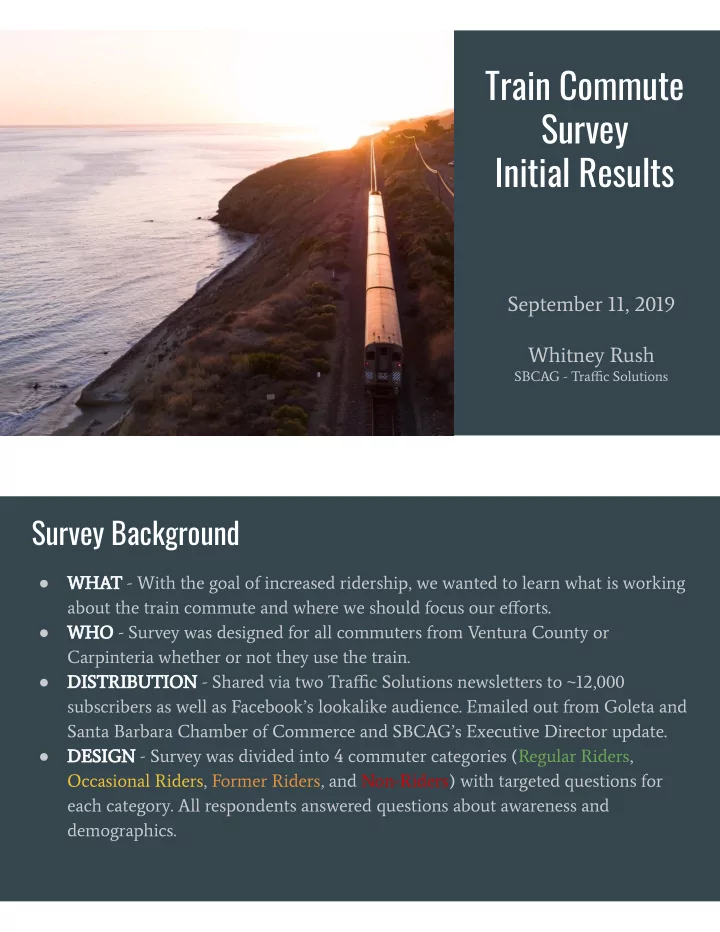
Train Commute Survey Initial Results September 11, 2019 Whitney - - PDF document

train commute survey initial results
SMART_READER_LITE
LIVE PREVIEW

Train Commute Survey Initial Results September 11, 2019 Whitney - - PDF document

Train Commute Survey Initial Results September 11, 2019 Whitney Rush SBCAG - Traffic Solutions Survey Background WHAT - With the goal of increased ridership, we wanted to learn what is working about the train commute and where we should


slide-1
SLIDE 1

Train Commute Survey Initial Results

September 11, 2019 Whitney Rush

SBCAG - Traffic Solutions

Survey Background

  • WHAT - With the goal of increased ridership, we wanted to learn what is working

about the train commute and where we should focus our efforts.

  • WHO - Survey was designed for all commuters from Ventura County or

Carpinteria whether or not they use the train.

  • DISTRIBUTION - Shared via two Traffic Solutions newsletters to ~12,000

subscribers as well as Facebook’s lookalike audience. Emailed out from Goleta and Santa Barbara Chamber of Commerce and SBCAG’s Executive Director update.

  • DESIGN - Survey was divided into 4 commuter categories (Regular Riders,

Occasional Riders, Former Riders, and Non-Riders) with targeted questions for each category. All respondents answered questions about awareness and demographics.

slide-2
SLIDE 2

Response

How often do you take the Amtrak Pacifi fic Surfl fliner train to and/or from work?

= non-riders = former riders = occasional riders = regular riders

Commute Survey Responses by zip-code

*Note Santa Cruz and Anacapa Island share zip code with city of Ventura.

slide-3
SLIDE 3

Regular Riders - n=78 good zip codes, selected train 759.

34% age 55-64 60% male 32% make $150k+

Regular Riders

n=78

slide-4
SLIDE 4

Awareness of Train Support Programs - 4-way Comparison

= regular riders n=78 = occasional riders n=47 = former riders n=120 = non-riders n= 113 Of 372 respondents, Amtrak.com, the Amtrak app and Traffjc Solutions site were the most popular locations to receive information.

Why Commuters Do Not Use the Train

= occasional riders n=47 = former riders n=120 = non-riders n= 113

Occasional, former and non-riders’ reasons they do not ride the train or do not ride it regularly. They were allowed to select all that apply.

slide-5
SLIDE 5

Occasional and former riders who did NOT select schedule as a reason why they no longer ride or do not ride regularly.

Beyond the Schedule -

= occasional riders n=17 = former riders n=80

**Examples of other reasons

“I mix train and drving [sic]” “Making a reservation for my bike must be done by phone, and that can take up to 20 minutes!” “No bike locker in Ventura” “I work for the SB County - Calle real

campus and we do not have a shuttle that could take me from work to train station or vis versa.” *commuter used to carpool when they did ride the train

Beyond the Schedule - Non-riders

Non-riders who did NOT select schedule as a reason why they have never tried the train

= non-riders n=70

**Examples of other reasons

“Lot of logistics when in SB to get

  • around. Longer down time.”

“takes too long especially if I have to figure out how to get to work from the train station” “No incentive to why would I?”

NOTE: Non-riders, with good zip codes, who marked ‘Connections from the station to my place of work’ as an issue also had only 43% awareness of free MTD shuttles. 22.68% of occasional and former riders listed reliability as a reason they no longer ride the train, compared with this 5.71%

slide-6
SLIDE 6

Female Riders

= occasional and former riders n=74 = non-riders n=62

Age 25-34 Ridership

= occasional and former riders n=37 = non-riders n=24

slide-7
SLIDE 7

Key Takeaways

Regular Riders - For those it works for, it can be an enormous positive change. Occasional Riders - tend to not ride when they need their car for errands or their schedule is variable. Former Riders - Many former riders stop taking the train due to reliability and connections to their workplace. For non-riders, perceived or actual connections to their workplace is the biggest barrier. What we are doing Clarifying and advertising workplace connections Highlighting reduced commute cost for the region Educating commuters about the Emergency Ride Home program Demonstrating flexible schedule

  • ptions using VCTC Coastal Express

Employing targeted marketing