Traffic Calming : Towards an Ambitious Target to Protect Children - - PowerPoint PPT Presentation

traffic calming towards an ambitious target to protect
SMART_READER_LITE
LIVE PREVIEW

Traffic Calming : Towards an Ambitious Target to Protect Children - - PowerPoint PPT Presentation

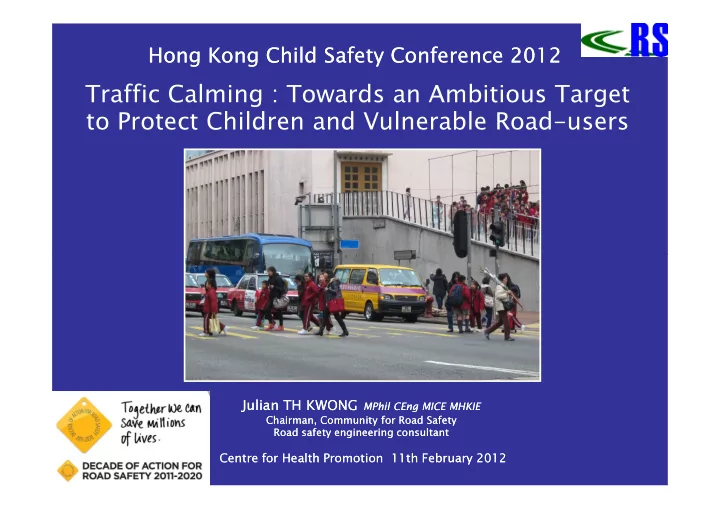
Hong Kong Child Safety Conference 2012 Hong Kong Child Safety Conference 2012 Traffic Calming : Towards an Ambitious Target to Protect Children and Vulnerable Road-users Julian TH KWONG Julian TH KWONG MPhil CEng MICE MHKIE MPhil CEng MICE


slide-1
SLIDE 1

Hong Kong Child Safety Conference 2012 Hong Kong Child Safety Conference 2012

Traffic Calming : Towards an Ambitious Target to Protect Children and Vulnerable Road-users

Julian TH KWONG Julian TH KWONG MPhil CEng MICE MHKIE

MPhil CEng MICE MHKIE Chairman, Community for Road Safety Chairman, Community for Road Safety Road safety engineering consultant Road safety engineering consultant

Centre for Health Promotion 11th February Centre for Health Promotion 11th February 20 2012 12

slide-2
SLIDE 2

Pedestrian Casualties remain a focus

  • In 2010, pedestrian fatalities and serious casualties are 69 (59%) 和

816 (38%)

  • During the decade 2001 to 2010, 871 pedestrians were killed and

9,782 were seriously injured

  • In 2010, urban minor streets and major streets accounted for 40%

and 50% of fatalities Trend of Pedestrian Fatalities 2001-2010 2011 figure is similar to 2010

slide-3
SLIDE 3

Time Distribution of Pedestrian Casualties

slide-4
SLIDE 4

Traffic Calming in the Urban and Rural Context

  • To reduce speed to a level commensurate with the

activities along the road

  • Facilitate walking and cycling
  • Enhance the environment, aesthetic and identity of

neighbourhoods

slide-5
SLIDE 5

13 m 23 m 28 m

< 5% STOP STOP

Lower Speed Limit Makes a Big Difference

0 m

30 km/h 50 km/h

> 50% probability of fatality < 5%

slide-6
SLIDE 6

SIGHTINES

slide-7
SLIDE 7

Visibility and Railings

  • Average height of 6 year old child in Hong

Kong : 1176mm (So et. Al, BMC Public Health. 2008; 8: 320)

  • Standard height of pedestrian railing : 1000mm
slide-8
SLIDE 8

Visibility at Pedestrian Crossings

  • Drivers should be able to observe the intention of

pedestrians both on the crossing and over the waiting area of the footpath

Required visibility splay

Vehicle 33m ahead

slide-9
SLIDE 9

A Safer Speed Distribution is Crucial

frequency Reduction of average speed

10 20 30 40 50 60 70

Speed (km/h) Elimination of grossly excessive speed

slide-10
SLIDE 10

Lower Speeds suppress a variety of collision scenarios

Pedestrian straight-on, turning Vehicle reversing Bicycles Between Vehicles Head-on, junction, rear-front Events not related to speed Bus passenger losing balance reversing Single Vehicle Loss of control

Lower Speed

Blind spot at Restart

slide-11
SLIDE 11

Lille, France

1 km

  • 600 km of 30km/h streets
slide-12
SLIDE 12

Oslo, Norway

  • Built-up Areas 50km/h, 40km/h, 30km/h
slide-13
SLIDE 13

Copenhagen, Denmark

  • Built-up Areas 50km/h, 40km/h, 30km/h, 15km/h
slide-14
SLIDE 14

The Netherlands

  • Home of the 30km/h Zone and Woonerf (home zone)
  • Leading the “Self-explaining” Road Design principle
slide-15
SLIDE 15

An Ever-growing Low speed Culture

  • Barcelona: 215 km 30km/h streets
  • Brussels : entire old city 30km/h except main

streets

  • Munich :> 300 30km/h zones (85% city road

length)

  • London : > 400 20mph zones
  • Australia : 40km/h school zones and city

centres

slide-16
SLIDE 16

50km/h 30km/h Minor Streets in residential, Historic, Market and Industrial areas

slide-17
SLIDE 17

40km/h

Main Streets in urban areas

50km/h (30km/h)

slide-18
SLIDE 18

Case Study : Tsim Sha Tsui

50

Default speed limit

slide-19
SLIDE 19

Total crashes Pedestrian Collisions 2005 379 160

Pedestrian Collisions (2005-2009)

2006 349 148 2007 327 116 2008 333 120 2009 299 104 Total 1,687 648

Slight Fatal or severe

Raw data from Transport Department Database

slide-20
SLIDE 20

Austin Road Average 50km/h Max 68km/h Nathan Road Average 40km/h Max 67km/h Nathan Road

Typical Speeds

Haiphong Road Nathan Road Average 42km/h Max 62km/h Average 34km/h Max 49km/h Mody Road Average 30km/h Max 47km/h

measured in busy daytime or evening hours for 70-110 vehicles at each site when traffic is moving freely or in platoons

slide-21
SLIDE 21

30 40 40

Vision of Speed Limit Strategy

30 40 30 30

slide-22
SLIDE 22

HIGHWAYS TRAVERSING RURAL COMMUNITIES

slide-23
SLIDE 23

Similar Issues Unique Circumstances

slide-24
SLIDE 24

General Principle

Major village Market town Small villages Isolated houses

90

Gateway Sign

90 Enhancement of safety level Traffic Calming with Speed Management 50 70

Sign Transition

slide-25
SLIDE 25

Village Entrance Gateway Signs

  • French system : 50km/h speed limit applies where

sign is posted

Photo from internet source

slide-26
SLIDE 26

Traffic Calming Design within Communities

  • Speed limit sign/special markings
  • Street redesign/Narrowing lanes
  • Trend of subtle design to weaken the perception of

a highway e.g. no centreline markings

slide-27
SLIDE 27

A Vision for Kam Tin Road through Kam Tin Town

70

street

30

street redesign

slide-28
SLIDE 28

Conclusion

  • Area-wide traffic calming with lower

speed limit will be the key of an ambitious road safety strategy in Hong Kong Kong

  • Lower speed limit on urban streets is

also the key to an attractive and vibrant streetscape conducive to the economy and living quality

slide-29
SLIDE 29

Acknowledgements

Transport Department Google Street View

Second United Nation’s Global Road Safety Week, 2013

“Pedestrians”