! Traditional data center network: tree-structure Ethernet Core - - PDF document

traditional data center network
SMART_READER_LITE
LIVE PREVIEW

! Traditional data center network: tree-structure Ethernet Core - - PDF document

T. S. Eugene Ng Rice University Guohui Wang, David Andersen, Michael Kaminsky, Konstantina Papagiannaki, Eugene Ng, Michael Kozuch, Michael Ryan, "c-Through: Part-time Optics in Data Centers , SIGCOMM'10 Hamid Bazzaz, Malveeka Tewari,


slide-1
SLIDE 1

1

  • T. S. Eugene Ng

Rice University

Guohui Wang, David Andersen, Michael Kaminsky, Konstantina Papagiannaki, Eugene Ng, Michael Kozuch, Michael Ryan, "c-Through: Part-time Optics in Data Centers”, SIGCOMM'10 Hamid Bazzaz, Malveeka Tewari, Guohui Wang, George Porter, Eugene Ng, David Andersen, Michael Kaminsky, Michael Kozuch, Amin Vahdat, "Switching the Optical Divide: Fundamental Challenges for Hybrid Electrical/Optical Datacenter Networks”, SOCC'11

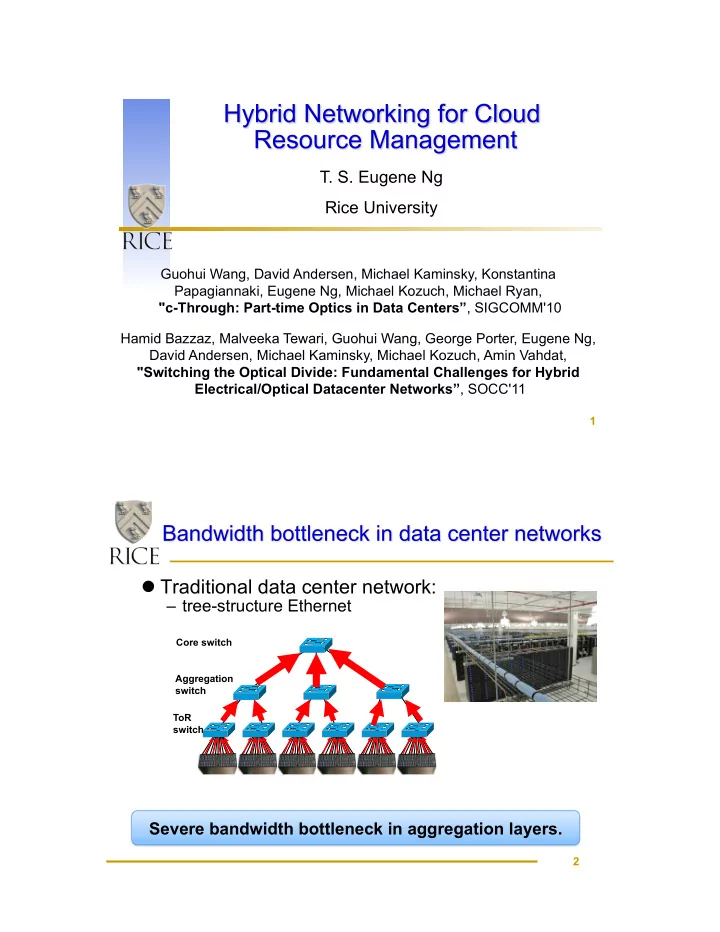
! Traditional data center network:

– tree-structure Ethernet

2

Aggregation switch ToR switch Core switch

Severe bandwidth bottleneck in aggregation layers.

slide-2
SLIDE 2

3

  • 1. Hard to construct
  • 2. Hard to expand

FatTree HyperCube

a bird nest?

4

! Ultra-high bandwidth ! Dropping prices

40G, 100Gbps technology has been developed. 15.5Tbps over a single fiber!

Price data from: Joe Berthold, Hot Interconnects’09

slide-3
SLIDE 3

Electrical packet switching Optical circuit switching Switching technology

Store and forward Circuit switching

Switching capacity Energy efficiency Switching time

5

10Gbps port is still the best practice 100Gbps on market, 15Tbps in lab Packet granularity Less than 10ms e.g. MEMS optical switch 12 W/port on 10Gbps Ethernet switch 240 mW/port Rate free

6 Full bisection bandwidth at packet level may not be necessary.

! Many measurement studies have suggested evidence of traffic concentration.

– [SC05]: “… the bulk of inter-processor communication is bounded in degree and changes very slowly or never. …” – [WREN09]: “…We study packet traces collected at a small number of switches in one data center and find evidence of ON-OFF traffic behavior… ” – [IMC09][HotNets09]: “Only a few ToRs are hot and most their traffic goes to a few other ToRs. …”

slide-4
SLIDE 4

7

Optical circuit-switched network for high capacity transfer Electrical packet-switched network for low latency delivery

! Optical paths are provisioned rack-to-rack

– A simple and cost-effective choice – Aggregate traffic on per-rack basis to better utilize optical circuits

8

! Control plane:

– Traffic demand estimation – Optical circuit configuration

! Data plane:

– Dynamic traffic de-multiplexing – Optimizing circuit utilization (optional) Traffic demands

slide-5
SLIDE 5

9

  • 1. Enlarge socket buffer

to estimate demand.

  • 2. De-multiplex traffic

using VLAN tagging. Centralized control for circuit configuration Configure VLAN to isolate electrical and

  • ptical network

Feasible to build a hybrid network without modifying Ethernet switches and applications!

10

Close-to-optimal performance even for applications with all-to-all traffic patterns.

100 200 300 400 500 600 700 800 900

128 KB 50 MB 100 MB 300 MB 500 MB Electrical network Full bisection bandwidth c-Through

Completion time (s) 153s 135s MapReduce performance Gridmix performance

slide-6
SLIDE 6

11

c-Through

[HotNets’09, SIGCOMM’10]

  • Rack level optical paths
  • Estimating demand from server

socket buffer

  • Traffic control in server kernel

Helios

[SIGCOMM’10]

  • Pod level optical paths
  • Estimating demand from switch

flow counters

  • Traffic control by modifying

switches

Others

  • Proteus [HotNets’10]: all optical data center network using WSS
  • DOS [ANCS’10]: all optical data center network using AWGR

! Sharing is the key of cloud data centers

12

Database Web server Data processing

  • Share at fine grain
  • Complicated data dependencies
  • Heterogeneous applications
slide-7
SLIDE 7
  • 1. Treating all traffic as independent flows

– Suboptimal performance for correlated applications

  • 2. Inaccurate information about traffic demand

– Vulnerable to ill-behaved applications

  • 3. Restricted sharing policies

– Limited by the control platform of Ethernet switches

13

! Effect of correlated flows

14

slide-8
SLIDE 8

! Problem formulation

15

Maximum weight matching with correlated edges

R1 R2 R3 R4 R5 R6 R7 R8 wxy= vol(Rx, Ry) + vol(Ry, Rx) Graph G: (V, E) w12 w14 w43 w38 w68 w36 w35 w27 w47

Basic configuration: a matching problem Modeling correlated traffic: Definition of correlated edge groups: EG = {e1, e2, …, en} , so that w(ei) += !(ei), i = 1, …, n when EG is part of the matching. Conflicting edge groups: Two edge groups are conflict if they have edges sharing one end vertex.

! If there is only one edge group – Intuition: test if including the edge group in the match will improve the overall weight. – Equation: ! If no conflict among edge groups: – A greedy algorithm

  • Iteratively accept all the edge groups with positive

benefits;

  • Proven to achieve maximum overall weight;

16

Accept Not accept

slide-9
SLIDE 9

! If there are conflicts among edge groups

– Finding the best non-conflict edge groups is NP-hard.

  • Equivalent to maximum independent set problem.

– An approximation algorithm based on simulated annealing works well.

17

! Locations known, demand unknown:

– Measuring maximal number of non-conflicting edge groups in each round.

18

slide-10
SLIDE 10

! Location unknown, demand unknown: – Hard problem

19

! Effect of bursty flow

20

slide-11
SLIDE 11

! An example problem: – Random hashing over multiple circuits.

21

! Potential solution: – Flexible control using programmable OpenFlow switches.

4 circuits 4 flows

Hashing

  • Hash collision
  • Limited to random sharing

! HyPaC architecture has lots of potentials by marrying the strengths of packet and circuit switching ! Lots of open problems in the HyPaC control plane ! New physical layer capabilities (e.g. optical multicast) bring additional benefits and challenges

22