
SLIDE 1
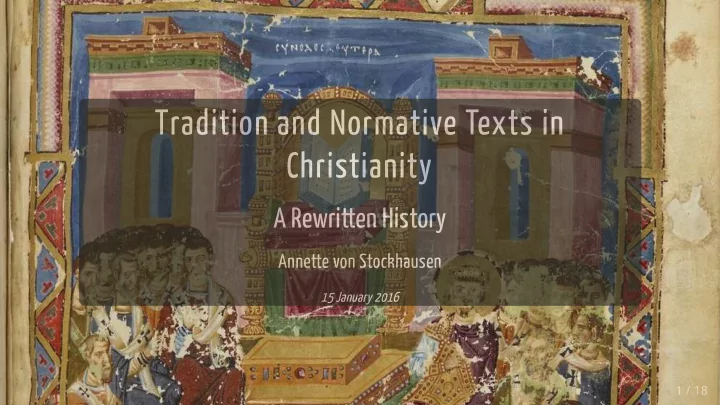
Tradition and Normative Texts in Christianity
A Rewritten History
Annette von Stockhausen
15 January 2016
1 / 18
Tradition and Normative Texts in Christianity A Rewritten History - - PowerPoint PPT Presentation
Tradition and Normative Texts in Christianity A Rewritten History Annette von Stockhausen 15 January 2016 1 / 18 Thirty - Nine Articles of Religion VIII. OF THE THREE CREEDS THE Three Creeds, Nicene Creed, Athanasius's Creed, and that which is
A Rewritten History
Annette von Stockhausen
15 January 2016
1 / 18
Thirty-Nine Articles of Religion
THE Three Creeds, Nicene Creed, Athanasius's Creed, and that which is commonly called the Apostles' Creed, ought thoroughly to be received and believed: for they may be proved by most certain warrants of holy Scripture.
https://www.churchofengland.org/prayer-worship/worship/book-of-common-prayer/articles-of-religion.aspx#VIII
2 / 18
The Creed in Liturgy – Anglican Tradition
Excerpt from “Common Worship”
3 / 18
The Creed in Liturgy – Orthodox Tradition
Excerpt from the “Liturgy of St John Chrysostom” (Αποστολική Διακονία της Εκκλησίας της Ελλάδος, 6th edition, Athens 1996.)
4 / 18
the 12th century), Image: e-codices (CC-BY-NC)
Missal/Lectionary (12th-14th century), Image: e-codices (CC-BY-NC)
The Creed in Liturgy – Two medieval Latin examples
5 / 18
The Creed in Liturgy – In Late Antiquity
… constituit synodus, ut per omnes ecclesias Spaniae et Galliae vel Gallitiae secundum formam orientalium ecclesiarum, concilii Constantinopolitani, hoc est centum quinquaginta episcoporum symbolum fidei
…the synod decided, that in all churches in Spain, Gaul and Galitia, according to the model of the eastern churches, the symbol of faith of the Council of Constantinople, i.e. of the 150 bishops, should be recited. And before the Lord’s prayer is said, it should be preached to the people in clear voice.
3rd Synod of Toledo (a. 589), can. 2
Τὸ σύμβολον ἐν ταῖς συνάξεσιν διὰ παντὸς Πέτρος ὁ Κναφεὺς ἐπενόησε λέγεσθαι, πρότερον μὴ λεγόμενον. In any case, Peter Fullo invented it that the symbol is said in the services, which was not said before.
Theodorus Lector, h.e. III 428 (GCS 118,27f. Hansen)
6 / 18
7 / 18
7 / 18
Theodosius I
Solidus of Theodosius I. (395), Classical Numismatic Group (CC-BY-SA)
Agenda
Confirmation of “Nicea” Appointment of new bishop of Constantinople
Decisions
Confirmation of “Nicea” and condemnation
Appointment of new bishop of Constantinople: Gregory, Nectarius No interfering of bishops in other dioceses Special status of Constantinople as “new Rome”
The Council of Constantinople (381)
8 / 18
9 / 18
Participants of the Synod
Online-Map
10 / 18
Detail (lower left corner): Makedonios
The traditional account of the Council of Constantinople
11 / 18
The traditional account of the Council of Constantinople
Καὶ λοιπὸν συνηθροίσθη ἡ ἁγία ἐν Κωνσταντινουπόλει οἰκουμενικὴ σύνοδος. κατὰ Μακεδονίου τοῦ εἰς τὸ ἅγιον πνεῦμα βλασφημήσαντος. ἧς κάνονες ζ` . And then the holy ecumenical synod in Constantinople was convened. Against Macedonius who blasphemed against the Holy Spirit. 7 canons of this (council).
Beneševič conciliar synopsis (p. 75)
12 / 18
The traditional account of the Council of Constantinople
Ἡ δὲ δευτέρα ἁγία οἰκουμενικὴ σύνοδος τῶν ἐν Κωνσταντινουπόλει ρνʹ ἁγίων πατέρων γέγονεν ἐπὶ Θεοδοσίου τοῦ μεγάλου βασιλέως κατὰ Μακεδονίου ἀρχιεπισκόπου Κωνσταντινουπόλεως κτίσμα λέγοντος τὸ πνεῦμα τὸ ἅγιον. Ἡ δὲ ἁγία σύνοδος καθελοῦσα Μακεδόνιον ὁμοούσιον ἐκήρυξε τῷ πατρὶ καὶ τῷ υἱῷ τὸ πνεῦμα τὸ ἅγιον προσθεῖσα ἐν τῷ συμβόλῳ τὸ καὶ εἰς τὸ πνεῦμα τὸ ἅγιον, τὸ κύριον καὶ ζωοποιόν, καὶ τὰ ἑξῆς. The 2nd holy ecumenical synod of the 150 holy fathers in Constantinople took place under the great emperor Theodosius against Macedonius, the archbishop of Constantinople, who declared the Holy Spirit a
Macedonius and declared that the Holy Spirit is of the same nature as the Father and the Son and added in the Symbol “and in the Holy Spirit, the Lord and the giver of life,” and so forth.
Anastasius Sinaita, Vitae dux 5
13 / 18
The Creed of Constantinople
P.Oxy. 1784, s. V (Image courtesy of Ambrose Swasey Library Colgate Rochester Crozer Divinity School and the American Theological Library Association.)
14 / 18
The Creed of Constantinople
P.Köln inv. 684, s. V (Uni Köln)
15 / 18
The Council of Chalcedon (451)
… προλάμπειν μὲν τῆς ὀρθῆς καὶ ἀμωμήτου πίστεως τὴν ἔκθεσιν τῶν τιη ἁγίων καὶ μακαρίων πατέρων τῶν ἐν Νικαίαι ἐπὶ τοῦ τῆς εὐσεβοῦς μνήμης Κωνσταντίνου τοῦ γενομένου βασιλέως συναχθέντων, κρατεῖν δὲ καὶ τὰ παρὰ τῶν ρν ἁγίων πατέρων ἐν Κωνσταντινουπόλει ὁρισθέντα πρὸς ἀναίρεσιν μὲν τῶν τότε φυεισῶν αἱρέσεων, βεβαίωσιν δὲ τῆς αὐτῆς καθολικῆς καὶ ἀποστολικῆς ἡμῶν πίστεως. … we decree the preeminence of the exposition of the correct and irreproachable faith by the 318 holy and blessed fathers who convened at Nicaea under the then emperor Constantine of pious memory, and also the validity of the definition of the 150 holy fathers at Constantinople for the uprooting of the heresies which had then sprung up and for the confirming of our same catholic and apostolic faith.
Acts of Chalcedon, sessio V (ACO II 1,2,127, translation by Price/Gaddis, Acts II 201.)
16 / 18
Conclusion: A Rewritten History
17 / 18