Christianity and the Constitution: Christianity and the - - PowerPoint PPT Presentation

christianity and the constitution christianity and the
SMART_READER_LITE
LIVE PREVIEW

Christianity and the Constitution: Christianity and the - - PowerPoint PPT Presentation

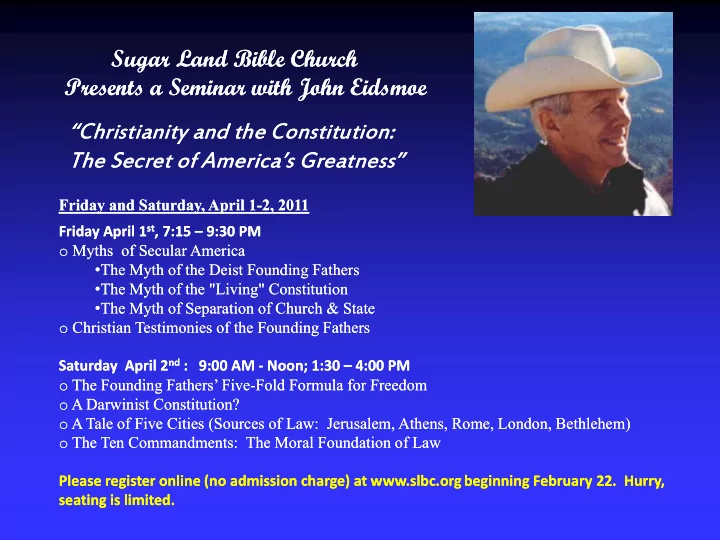
Sugar Land Bible Church Sugar Land Bible Church Presents a Seminar with John Eidsmoe Presents a Seminar with John Eidsmoe Christianity and the Constitution: Christianity and the Constitution: The Secret of Americas Greatness Th S


slide-1
SLIDE 1

Sugar Land Bible Church Sugar Land Bible Church Presents a Seminar with John Eidsmoe “Christianity and the Constitution: Th S f A i ’ G ” Presents a Seminar with John Eidsmoe “Christianity and the Constitution: Th S f A i ’ G ” The Secret of America’s Greatness”

Friday and Saturday, April 1-2, 2011 Friday April 1st 7:15 – 9:30 PM

The Secret of America’s Greatness”

Friday and Saturday, April 1-2, 2011 Friday April 1st 7:15 – 9:30 PM Friday April 1st, 7:15 – 9:30 PM

  • Myths of Secular America
  • The Myth of the Deist Founding Fathers
  • The Myth of the "Living" Constitution
  • The Myth of Separation of Church & State

Friday April 1st, 7:15 – 9:30 PM

  • Myths of Secular America
  • The Myth of the Deist Founding Fathers
  • The Myth of the "Living" Constitution
  • The Myth of Separation of Church & State
  • The Myth of Separation of Church & State
  • Christian Testimonies of the Founding Fathers

Saturday April 2nd : 9:00 AM ‐ Noon; 1:30 – 4:00 PM

  • The Founding Fathers’ Five Fold Formula for Freedom
  • The Myth of Separation of Church & State
  • Christian Testimonies of the Founding Fathers

Saturday April 2nd : 9:00 AM ‐ Noon; 1:30 – 4:00 PM

  • The Founding Fathers’ Five Fold Formula for Freedom
  • The Founding Fathers Five-Fold Formula for Freedom
  • A Darwinist Constitution?
  • A Tale of Five Cities (Sources of Law: Jerusalem, Athens, Rome, London, Bethlehem)
  • The Ten Commandments: The Moral Foundation of Law
  • The Founding Fathers Five-Fold Formula for Freedom
  • A Darwinist Constitution?
  • A Tale of Five Cities (Sources of Law: Jerusalem, Athens, Rome, London, Bethlehem)
  • The Ten Commandments: The Moral Foundation of Law

Please register online (no admission charge) at www.slbc.orgbeginning February 22. Hurry, seating is limited. Please register online (no admission charge) at www.slbc.orgbeginning February 22. Hurry, seating is limited.

slide-2
SLIDE 2

Romans 7:14 Romans 7:14‐25 and Sanctification 25 and Sanctification Romans 7:14 Romans 7:14 25 and Sanctification 25 and Sanctification

By Dr. Andy Woods By Dr. Andy Woods By Dr. Andy Woods By Dr. Andy Woods

slide-3
SLIDE 3

Preview: 4 Issues

1 Who is the “I”? Who is the “I”? 1. 1. Who is the I ? Who is the I ? 2. 2. Does Paul’s struggle represent a Does Paul’s struggle represent a pre pre or

  • r post

post conversion experience? conversion experience? 3. 3. What are the anthropological implications? What are the anthropological implications? 3. 3. What are the anthropological implications? What are the anthropological implications? (dual natured believer) (dual natured believer) 4 H d thi d l t d i f th H d thi d l t d i f th 4. 4. How does this dual natured view of the How does this dual natured view of the believer shape our understanding of believer shape our understanding of sanctification? sanctification? sanctification? sanctification?

slide-4
SLIDE 4

3 Views of the Pronoun “I”

1.

  • 1. Rhetorical

Rhetorical “I” “I” – Literary device depicting all Literary device depicting all humanity humanity 2.

  • 2. Representative

Representative “I” “I” – Life experience of a Life experience of a representative figure also reflecting Paul’s representative figure also reflecting Paul’s representative figure also reflecting Paul s representative figure also reflecting Paul s experience experience 3.

  • 3. Autobiographical

Autobiographical “I” “I” – Paul’s experience only Paul’s experience only

slide-5
SLIDE 5

Problems with the Rhetorical “I”

  • Paul elsewhere uses the “I” to describe himself

Paul elsewhere uses the “I” to describe himself (Rom 15:14) (Rom 15:14)

  • Paul’s depth, intensity of feeling, outcry and

Paul’s depth, intensity of feeling, outcry and confession (Rom 7:10 confession (Rom 7:10 11 15 23) 11 15 23) confession (Rom 7:10 confession (Rom 7:10‐11, 15, 23) 11, 15, 23)

  • Paul’s outcry and confession (Rom 7:24

Paul’s outcry and confession (Rom 7:24‐25) 25)

slide-6
SLIDE 6

Who is the “I”? Who is the I ? Conclusion

  • Not the Rhetorical “I”

Not the Rhetorical “I” R t ti t bi hi l “I” R t ti t bi hi l “I”

  • Representative or autobiographical “I”

Representative or autobiographical “I”

  • Debatable if Paul is depicting his experience

Debatable if Paul is depicting his experience p g p p g p alone or in solidarity with a representative alone or in solidarity with a representative

  • Rom 7:14

Rom 7:14 25 represents Paul’s experience 25 represents Paul’s experience

  • Rom 7:14

Rom 7:14‐25 represents Paul s experience 25 represents Paul s experience

slide-7
SLIDE 7

View 1 View 2 Pre‐conversion Post‐conversion Before salvation After salvation Unregenerate view Regenerate view

slide-8
SLIDE 8

Pre‐Conversion View Arguments g

1. 1. Bondage to sin Bondage to sin 2. 2. Contrast between Rom 7 & 8 Contrast between Rom 7 & 8 3 No reference to the Spirit in Rom 7 No reference to the Spirit in Rom 7 3. 3. No reference to the Spirit in Rom 7 No reference to the Spirit in Rom 7 4. 4. Belief of the early church Belief of the early church

slide-9
SLIDE 9

1. Bondage to Sin

  • Argument

Argument – Because Rom 6 & 8 depict the believer's Because Rom 6 & 8 depict the believer's liberty from sin and Rom 7 depict bondage to sin liberty from sin and Rom 7 depict bondage to sin Rom 7 depicts a pre Rom 7 depicts a pre‐conversion experience conversion experience

  • Response

Response – While Rom 6 & 8 depict the believer's While Rom 6 & 8 depict the believer's

  • Response

Response While Rom 6 & 8 depict the believer s While Rom 6 & 8 depict the believer s ability to resist sin, they also depict the fact that ability to resist sin, they also depict the fact that believers must wrestle with sin believers must wrestle with sin

slide-10
SLIDE 10

2. Contrast Between Rom 7 & 8

  • Argument

Argument – Transition from Rom 7 to 8 Transition from Rom 7 to 8 is too dramatic to indicate a post is too dramatic to indicate a post‐ conversion experience in both chapters conversion experience in both chapters

  • Response

Response – Contrast indicates a Contrast indicates a Response Response Contrast indicates a Contrast indicates a believer attempting to live the spiritual believer attempting to live the spiritual life without the Spirit’s empowerment life without the Spirit’s empowerment (Rom 7) in comparison to the believer (Rom 7) in comparison to the believer that lives with the Spirit’s enablement that lives with the Spirit’s enablement (R 8) (R 8) (Rom 8) (Rom 8)

slide-11
SLIDE 11

3 No Reference to the Spirit in Rom 3. No Reference to the Spirit in Rom 7:14‐25

  • Argument

Argument – The Spirit’s lack of mention in The Spirit’s lack of mention in Rom 7:14 Rom 7:14‐25 indicates that an unbeliever is in 25 indicates that an unbeliever is in view view

  • Response

Response – Rom 7 represents the believer Rom 7 represents the believer Response Response Rom 7 represents the believer Rom 7 represents the believer attempting to fulfill the spiritual life through attempting to fulfill the spiritual life through his own power and Rom 8 represents the his own power and Rom 8 represents the believer attempting to do so through the believer attempting to do so through the Spirit Spirit

slide-12
SLIDE 12

4. Belief of the Early Church

  • Argument

Argument – Church fathers, Origen, and Augustine Church fathers, Origen, and Augustine embraced the pre embraced the pre‐conversion view conversion view

  • Response

Response –

  • Non exegetical argument

Non exegetical argument

  • Augustine changed his view

Augustine changed his view

  • Augustine changed his view

Augustine changed his view

  • Reformers; Luther (

Reformers; Luther (simul simul justus justus et et peccator peccator)

  • Influence of late Pietism

Influence of late Pietism

slide-13
SLIDE 13

Post‐Conversion View Arguments g

1. 1. Change of tenses Change of tenses 2. 2. Desire of the “I” to keep God’s Law Desire of the “I” to keep God’s Law 3. 3. Desire of the “I” to be rescued Desire of the “I” to be rescued 4. 4. Similarities between Rom 7 and Gal 5 Similarities between Rom 7 and Gal 5 5. 5. Duality of the two “I’s” Duality of the two “I’s” 6. 6. Overall flow of Romans Overall flow of Romans l f b l f b 7. 7. Anti Anti‐climactic nature of Rom 7:25b climactic nature of Rom 7:25b 8. 8. Personal experience of the believer Personal experience of the believer

slide-14
SLIDE 14

1. Change of Tenses

  • Argument

Argument – The change of verb tenses The change of verb tenses from the past (7:7 from the past (7:7‐13) to the present 13) to the present (7:14 (7:14‐ ‐25) indicates that Paul is speaking of 25) indicates that Paul is speaking of a present experience 7:14 a present experience 7:14‐25 25

  • Response

Response – Historical present? Historical present? W ll W ll G 531 531 32 32

  • Wallace,

Wallace, Grammar Grammar, pp. 531 , pp. 531‐32 32

slide-15
SLIDE 15
  • 2a. Desire of the “I” to Keep God’s Law
  • Argument

Argument – The desire of the “I” to keep The desire of the “I” to keep God’s Law (7:22) cannot be describing an God’s Law (7:22) cannot be describing an unbeliever (3:11) unbeliever (3:11)

  • Response #1

Response #1 – It is possible for unregenerate It is possible for unregenerate Response #1 Response #1 It is possible for unregenerate It is possible for unregenerate Jews to delight in God’s Law (Rom 9:31 Jews to delight in God’s Law (Rom 9:31‐32; 32; 10:1 10:1‐2) 2)

  • Pharisees delighted in tradition rather

Pharisees delighted in tradition rather than the Law (Mark 7:13) than the Law (Mark 7:13) than the Law (Mark 7:13) than the Law (Mark 7:13)

slide-16
SLIDE 16

2b Desire of the “I” to Keep / Delight in

  • 2b. Desire of the I to Keep / Delight in

God’s Law

  • Argument

Argument – The desire of the “I” for God’s The desire of the “I” for God’s Law (7:22) cannot be describing an Law (7:22) cannot be describing an unbeliever (3:11) unbeliever (3:11)

  • Response #2

Response #2 – God has placed his Law in God has placed his Law in Response #2 Response #2 God has placed his Law in God has placed his Law in the hearts of all men including unbelievers the hearts of all men including unbelievers (Rom 2:14 (Rom 2:14‐15) 15)

  • Rom 2:14

Rom 2:14‐15 only says God’s Law in the 15 only says God’s Law in the hearts of unbelievers convicts them hearts of unbelievers convicts them hearts of unbelievers convicts them hearts of unbelievers convicts them

slide-17
SLIDE 17

3. Desire of the “I” to be Rescued

  • Argument

Argument – The desire of the “I” for The desire of the “I” for deliverance from the present body (7:24) is deliverance from the present body (7:24) is consistent with the believer's call for the consistent with the believer's call for the redemption of the bodies (8:23) redemption of the bodies (8:23)

  • Response

Response – Future tense of Future tense of ruomai ruomai indicates a indicates a call for salvation call for salvation

  • Call for glorification rather than justification

Call for glorification rather than justification

slide-18
SLIDE 18

Three Tenses of Salvation

Phase Justification Sanctification Glorification

Tense Past Present Future Saved from sin’s: Penalty Power Presence Scripture Eph 2:8-9; Titus 3:5 Philip 2:12 Rom 5:10

slide-19
SLIDE 19

4. Similarities Between Rom 7 & Gal 5

  • Argument

Argument – Because of the similarities between Rom Because of the similarities between Rom 7:14 7:14‐25 and Gal 5:16 25 and Gal 5:16‐18 and because believers are in 18 and because believers are in view in Gal 5, a believer must also be in view in Rom view in Gal 5, a believer must also be in view in Rom 7:14 7:14‐25 25

slide-20
SLIDE 20

5 D lit f th t “I’ ” 5. Duality of the two “I’s”

  • Argument

Argument – Because Rom 7 is a description Because Rom 7 is a description

  • f a divided man (7:25)and because
  • f a divided man (7:25)and because

unbelievers are unilaterally under sin’s unbelievers are unilaterally under sin’s control (Eph 4:17) a believer must be in view control (Eph 4:17) a believer must be in view in Rom 7 in Rom 7 in Rom 7. in Rom 7.

  • Response

Response – Divided self prevalent in Greek Divided self prevalent in Greek philosophy philosophy

  • Similarity is not the same as causation

Similarity is not the same as causation

  • Similarity is not the same as causation

Similarity is not the same as causation

slide-21
SLIDE 21

Romans Structure

  • Salutation (1:1

Salutation (1:1‐17) 17)

  • Sin (1:18

Sin (1:18–3:20) 3:20) Sin (1:18 Sin (1:18 3:20) 3:20)

  • Salvation (3:21

Salvation (3:21– –5:21) 5:21) S tifi ti (6 S tifi ti (6 8) 8)

  • Sanctification (6

Sanctification (6–8) 8)

  • Sovereignty (9

Sovereignty (9– –11) 11)

  • Service (12:1

Service (12:1– –15:13) 15:13)

  • Conclusion (15:14

Conclusion (15:14–16:27) 16:27) ( )

Ryrie Study Bible, p. 1786‐88

slide-22
SLIDE 22

6 O ll Fl f R 6. Overall Flow of Romans

  • Argument

Argument – Because Paul has left behind his Because Paul has left behind his discussion of unbelievers (1:18 discussion of unbelievers (1:18– –3:20) and moved 3:20) and moved into the salvation (3:21 into the salvation (3:21–5:21) and sanctification 5:21) and sanctification section of the letter (6 section of the letter (6– –8), a believer must be in 8), a believer must be in view in Rom 7 view in Rom 7 view in Rom 7 view in Rom 7

  • Response

Response – Occasional Pauline flashbacks to his Occasional Pauline flashbacks to his unsaved life unsaved life

  • Whole chapter?

Whole chapter?

  • Whole chapter?

Whole chapter?

slide-23
SLIDE 23

7. Anti‐Climactic Nature of Rom 7:25b

  • Argument

Argument – Because the chapter ends with a note of Because the chapter ends with a note of despair (7:25b) and because one would expect it to despair (7:25b) and because one would expect it to end with a note of optimism if the transition is from end with a note of optimism if the transition is from unbeliever to believer, a believer must be in view in unbeliever to believer, a believer must be in view in Rom 7 Rom 7 Rom 7. Rom 7.

  • Response

Response – Rom 7:25b is inauthentic Rom 7:25b is inauthentic MSS id ? MSS id ?

  • MSS evidence?

MSS evidence?

slide-24
SLIDE 24

8. Personal Experience of the Believer

  • Argument

Argument – Because believers identify with Because believers identify with Paul's struggle in Rom 7:14 Paul's struggle in Rom 7:14‐25, a believer 25, a believer must be in view in these verses must be in view in these verses

slide-25
SLIDE 25

Rom 7:14 25 Rom 7:14‐25 Conclusion

  • Paul is describing his personal experiences

Paul is describing his personal experiences P l h d th t l d i hi Ch i ti P l h d th t l d i hi Ch i ti

  • Paul had these struggles during his Christian

Paul had these struggles during his Christian life life

slide-26
SLIDE 26

Anthropological Implications Anthropological Implications The Dual Natured View of the Believer

1. 1. Paul’s use of Paul’s use of sarx sarx in Rom 7:14 in Rom 7:14‐25 25 2 Numerous theologians have advocated the dual Numerous theologians have advocated the dual 2. 2. Numerous theologians have advocated the dual Numerous theologians have advocated the dual nature view nature view 3. 3. The dual nature view does not advocate spiritual The dual nature view does not advocate spiritual schizophrenia schizophrenia

slide-27
SLIDE 27

1. Paul’s Use of the Sarx in Rom 7

  • Sarx

Sarx used in Rom 7:5, 18, 25 used in Rom 7:5, 18, 25

  • Sarx

Sarx is not always a negative term is not always a negative term

  • Sarx

Sarx is not always a negative term is not always a negative term

  • Paul’s use of

Paul’s use of sarx sarx is typically negative is typically negative

  • Residue of the old self remains even after

Residue of the old self remains even after conversion conversion conversion conversion

slide-28
SLIDE 28

2 Numerous Theologians Have

  • 2. Numerous Theologians Have

Advocated the Dual Nature View

  • Augustine

Augustine

  • Reformers

Reformers – Calvin Luther Calvin Luther Melancthon Melancthon

  • Reformers

Reformers Calvin, Luther, Calvin, Luther, Melancthon Melancthon

  • 19

19‐20 20th

th century Calvinists

century Calvinists – Hodge, Hodge, Hokema Hokema

  • Dispensationalists

Dispensationalists

  • Scofield

Scofield

  • Scofield

Scofield

  • Chafer

Chafer

  • Ryrie

Ryrie

slide-29
SLIDE 29

Scofield

  • “In this passage (7:15

“In this passage (7:15‐25) of profound spiritual and 25) of profound spiritual and Psychological insight, the apostle personifies the Psychological insight, the apostle personifies the struggle of struggle of the two natures within the believer the two natures within the believer – the the

  • ld Adamic nature, and the divine nature received
  • ld Adamic nature, and the divine nature received

through the new birth (1 Peter 1:23 2 Peter 1:4 through the new birth (1 Peter 1:23 2 Peter 1:4 through the new birth (1 Peter 1:23, 2 Peter 1:4, through the new birth (1 Peter 1:23, 2 Peter 1:4, Galatians 2:20, Colossians 1:27).” (underlining Galatians 2:20, Colossians 1:27).” (underlining added) added) added) added)

  • C. I. Scofield, ed. The NIV Scofield Study Bible (New York: Oxford University

Press, 1967), 1184.

slide-30
SLIDE 30

Ryrie

  • “The moment someone accepts Jesus as his personal

“The moment someone accepts Jesus as his personal Savior he becomes a new creation (2 Savior he becomes a new creation (2 Cor. 5:17). The

  • Cor. 5:17). The

lif f G d ithi hi b t t hi h lif f G d ithi hi b t t hi h life of God within him begets a new nature which life of God within him begets a new nature which remains with him along with the old as long as he remains with him along with the old as long as he

  • lives. Understanding the presence, position and
  • lives. Understanding the presence, position and

g p , p g p , p relationship of relationship of the old and new within the life of the the old and new within the life of the believer believer is essential to experiencing a wholesome is essential to experiencing a wholesome and balanced spiritual life ” (underlining added) and balanced spiritual life ” (underlining added) and balanced spiritual life.” (underlining added) and balanced spiritual life.” (underlining added)

Charles C. Ryrie, Balancing the Christian Life (Chicago: Moody, 1969), 34.

slide-31
SLIDE 31

3 Dual Nature View Does Not Teach 3. Dual Nature View Does Not Teach Spiritual Schizophrenia

  • Some theologians use language that steers clear of

Some theologians use language that steers clear of “dual nature” “dual nature” – Ryrie, Smith Ryrie, Smith

  • Jesus had 2 natures (human and divine)

Jesus had 2 natures (human and divine)

  • Jesus

Jesus was was not not schizophrenic schizophrenic

  • Christ

Christ was was one

  • ne person

person with with two two natures natures

  • Christ

Christ was was one

  • ne person

person with with two two natures natures

  • Believers

Believers are are one

  • ne person

person with with two two natures natures

slide-32
SLIDE 32

Anthropological Implications Anthropological Implications Conclusion

  • A saved person has an old and new

A saved person has an old and new nature nature

  • Old nature

Old nature – a complex set of attributes a complex set of attributes with a disposition toward sin with a disposition toward sin with a disposition toward sin with a disposition toward sin

  • New nature

New nature – a complex set of attributes a complex set of attributes th t i li d di th b li th t i li d di th b li that incline and dispose the believer that incline and dispose the believer toward holiness toward holiness

slide-33
SLIDE 33

Ramifications for a Sanctification Model

1. 1. Believers with two natures can only Believers with two natures can only achieve sanctification by availing achieve sanctification by availing themselves to the divine resources themselves to the divine resources 2. 2. Human responsibility plays a role in Human responsibility plays a role in 2. 2. Human responsibility plays a role in Human responsibility plays a role in the sanctification process the sanctification process 3 Ulti t f ti ill i Ulti t f ti ill i 3. 3. Ultimate perfection will occur in Ultimate perfection will occur in heaven rather than in the present heaven rather than in the present

slide-34
SLIDE 34

1 B li C E i S tifi ti

  • 1. Believers Can Experience Sanctification

Through the Divine Resources

  • Paul’s struggle shows that the new nature

Paul’s struggle shows that the new nature cannot by itself produce a righteous life cannot by itself produce a righteous life

  • Divine resources

Divine resources

  • Believer's identification with Christ

Believer's identification with Christ (Rom 6); position informs condition (Rom 6); position informs condition

  • Provision of the Holy Spirit (Gal 5:16)

Provision of the Holy Spirit (Gal 5:16)

slide-35
SLIDE 35

2 Human Responsibility Plays a Role in the

  • 2. Human Responsibility Plays a Role in the

Sanctification Process

  • Christians do not automatically experience

Christians do not automatically experience sanctification sanctification

  • A volitional response must be made toward

A volitional response must be made toward the appropriation of the divine resources the appropriation of the divine resources the appropriation of the divine resources the appropriation of the divine resources

  • Otherwise the biblical exhortations are

Otherwise the biblical exhortations are i l i l meaningless meaningless

slide-36
SLIDE 36

3 Ultimate Perfection Will Occur in

  • 3. Ultimate Perfection Will Occur in

Heaven; Not in the Present

  • Perpetual conflict between the old and new

Perpetual conflict between the old and new nature as long as the believer remains in the nature as long as the believer remains in the body body

  • Some degree of sin will always be present

Some degree of sin will always be present Some degree of sin will always be present Some degree of sin will always be present (Rom 7:24; Philip 3:12; 1 John 1:9) (Rom 7:24; Philip 3:12; 1 John 1:9) Ulti t f ti ill l t d th Ulti t f ti ill l t d th

  • Ultimate perfection will only occur at death

Ultimate perfection will only occur at death

  • r the rapture (Eph 5:27; 1 John 3:2; Rev
  • r the rapture (Eph 5:27; 1 John 3:2; Rev

21:8) 21:8) 21:8) 21:8)

slide-37
SLIDE 37

N dh Needham

“…if you have received “…if you have received J Ch i t L d d J Ch i t L d d Jesus Christ as Lord and Jesus Christ as Lord and Savior, you are Savior, you are not not a a , y , y sinner.” sinner.”

David C. Needham, Birthright! Christian, Do You Know Who You Are? (Portland: Multnomah, 1979), 47.

slide-38
SLIDE 38

Review: 4 Issues

1. 1. Paul is speaking of his personal experience in Paul is speaking of his personal experience in Rom 7:14 Rom 7:14‐25 25 2. 2. Paul’s struggle here represents a Paul’s struggle here represents a post post conversion experience conversion experience 3. 3. The believer is dual natured The believer is dual natured 4. 4. This dual natured view of the believer This dual natured view of the believer shapes our understanding of sanctification shapes our understanding of sanctification