Track European Public Management GOVERN- MENT Source: Porter, - - PDF document

track european public management
SMART_READER_LITE
LIVE PREVIEW

Track European Public Management GOVERN- MENT Source: Porter, - - PDF document

26/11/2018 Rationale Track European Public Management GOVERN- MENT Source: Porter, Michael E. (1990). The competitive advantage of nations. Basingstoke : Macmillan. Rationale Rationale Two elementary motivations 1. Understand policy


slide-1
SLIDE 1

26/11/2018 1

Track European Public Management

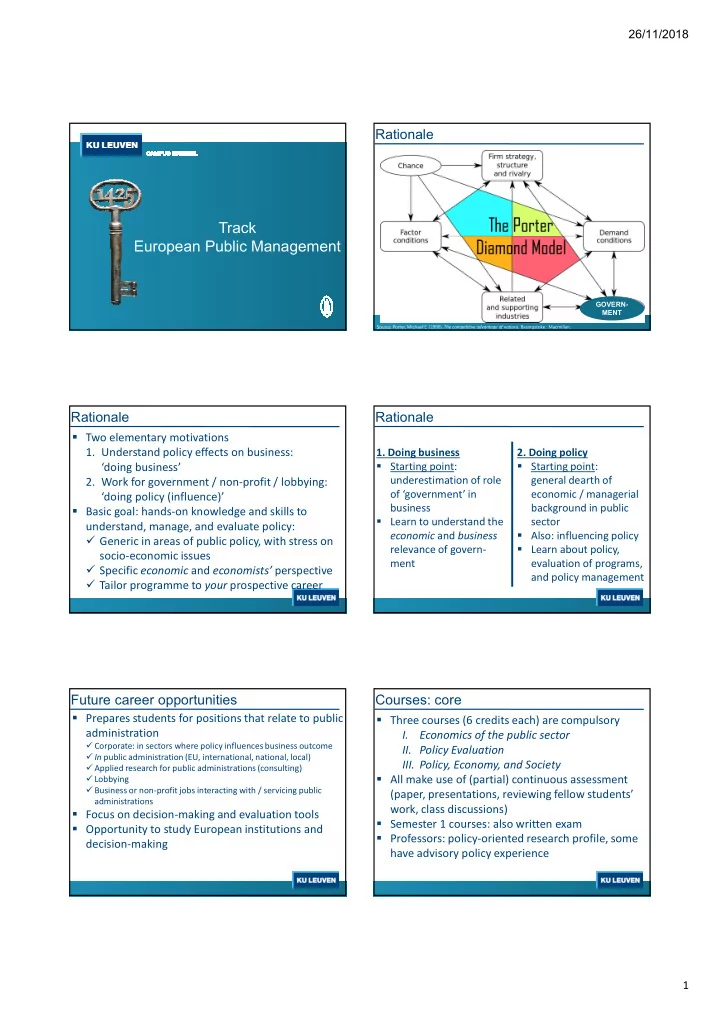
Rationale

Source: Porter, Michael E. (1990). The competitive advantage of nations. Basingstoke : Macmillan.

GOVERN- MENT

Two elementary motivations

  • 1. Understand policy effects on business:

‘doing business’

  • 2. Work for government / non-profit / lobbying:

‘doing policy (influence)’ Basic goal: hands-on knowledge and skills to understand, manage, and evaluate policy: Generic in areas of public policy, with stress on socio-economic issues Specific economic and economists’ perspective Tailor programme to your prospective career

Rationale

  • 1. Doing business

Starting point: underestimation of role

  • f ‘government’ in

business Learn to understand the economic and business relevance of govern- ment

Rationale

  • 2. Doing policy

Starting point: general dearth of economic / managerial background in public sector Also: influencing policy Learn about policy, evaluation of programs, and policy management

Future career opportunities

Prepares students for positions that relate to public administration

Corporate: in sectors where policy influences business outcome In public administration (EU, international, national, local) Applied research for public administrations (consulting) Lobbying Business or non-profit jobs interacting with / servicing public administrations

Focus on decision-making and evaluation tools Opportunity to study European institutions and decision-making

Courses: core

Three courses (6 credits each) are compulsory I. Economics of the public sector

  • II. Policy Evaluation
  • III. Policy, Economy, and Society

All make use of (partial) continuous assessment (paper, presentations, reviewing fellow students’ work, class discussions) Semester 1 courses: also written exam Professors: policy-oriented research profile, some have advisory policy experience

slide-2
SLIDE 2

26/11/2018 2 SEMESTER 1 I. Economics of the Public Sector (Tom Van Puyenbroeck) Economic framework for government interference in a market economy, as well as potential reasons for government failure Discussion of typical (EU/national) budget framework and components Measurement and evaluation of redistributive effects & welfare costs of taxes and subsidies, sustainability of public debt, fiscal federalism,…

Courses: core (cont.)

SEMESTER 1

  • II. Policy Evaluation (Nick Deschacht)

Hands-on discussion of contemporary methods for policy debates Case-based Goal: application and critical evaluation of evidence-based policy methods

Courses: core (cont.)

SEMESTER 2

  • III. Policy, Economy, and Society

(Stef Adriaenssens & Dieter Verhaest) Aims to show policy in action Applies knowledge and skills acquired in 1st-semester courses Focuses on ‘what works’ (what works not), and on the management and design dimension of policy 6 substantial policy themes with

  • Ex cathedra introduction (assessment: quiz)
  • Presentation of 1-2 crucial research papers by students

(assessment: presentation and discussion quality)

  • Review by other student (assessment: quality of review)

Courses: core (cont.) Courses: elective

Depending on your orientation, you choose two more courses (2*6 credits). Some suggestions (5): I. Standard ‘European’ orientation European Institutions and Decision Making (sem. 1) General outline of the architecture of European institutions → Alternative, oriented to more than the EU: International and European relations (sem. 1) European Affairs Management (sem. 2) Hands-on discussion about organizing influence in EU institutions II. Environmental policy Sustainable Management (sem. 1) Sustainable Economics (sem. 2) Both courses from the track in the MA Sustainability Management

Courses: elective (cont.)

  • III. Orientation public finance & accounting

Advanced Financial Statement Analysis (sem. 1) Management Control and Cost Management (sem. 2) Both courses from the track in the MA Accounting

  • IV. Data analysis option

Predictive Business Analytics (sem. 1, elective) Data Management and Business Intelligence (sem. 1, BIM) … or econometrics / methodology course in Leuven campus V. ‘Free as a bird’-option Choose any 12 credits in FEB-courses at MA level

Master Thesis

We advise students to apply and sharpen their acquired skills and knowledge in their thesis BEWARE: this is not compulsory! Preferred format: article We will provide a sufficient number of thesis topics related to policy and policy management, e.g. Studying the effect of a certain policy measure Ex-ante empirical research (e.g. discrete choice experiment) Literature review (systematic review, meta-analysis)

  • f a specific field or set of measures
slide-3
SLIDE 3

26/11/2018 3

Contact

More information required? stef.adriaenssens@kuleuven.be