SLIDE 1 2012 Nebraska Post-Construction Stormwater Workshop 3/20/2012 Towne Centre Case Study, by: Ryan Bentley 1
Towne Centre Case Study
Applying the Runoff Reduction Methodology Enables Credible Cost Comparative Analysis and Incentives for Innovative Implementation of BMPs
Impediments to Innovative Stormwater Solutions:
We know BMP practices are good . . . but:
- How much value do you get from them?
- Which practices are best for which situations?
- How do they integrate with detention
requirements?
- How many BMPs are too many? Isn’t more
always a good thing?
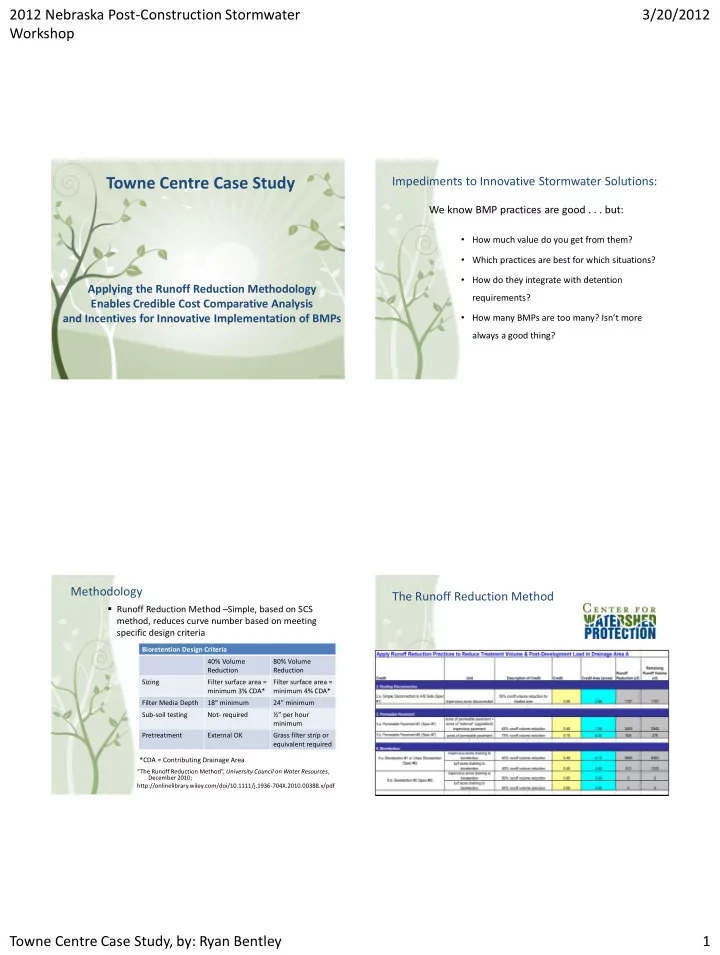
Methodology
- Runoff Reduction Method –Simple, based on SCS
method, reduces curve number based on meeting specific design criteria
“The Runoff Reduction Method”, University Council on Water Resources, December 2010; http://onlinelibrary.wiley.com/doi/10.1111/j.1936-704X.2010.00388.x/pdf
Bioretention Design Criteria 40% Volume Reduction 80% Volume Reduction Sizing Filter surface area = minimum 3% CDA* Filter surface area = minimum 4% CDA* Filter Media Depth 18” minimum 24” minimum Sub-soil testing Not- required ½” per hour minimum Pretreatment External OK Grass filter strip or equivalent required *CDA = Contributing Drainage Area
The Runoff Reduction Method
SLIDE 2 2012 Nebraska Post-Construction Stormwater Workshop 3/20/2012 Towne Centre Case Study, by: Ryan Bentley 2
The Runoff Reduction Method
- Planned commercial development with 35
individual buildings and 80 total units
- First phase built in 2007
- Site is located in Snellville, Georgia
Towne Centre Case Study
- Long rectangular shape required
long large pipes
- End-of-the-pipe solution required a
large extended dry detention pond with a freestanding wall
- Natural gravelly sandy loam soils
- Regulations require large tree
islands
Towne Centre Case Study Towne Centre Case Study – South East U.S.
SLIDE 3
2012 Nebraska Post-Construction Stormwater Workshop 3/20/2012 Towne Centre Case Study, by: Ryan Bentley 3
Towne Centre Case Study – Vicinity Map Towne Centre Case Study – Location Map Towne Centre Case Study –
Existing Design Layout & Grades
Towne Centre Case Study –
Existing Stormwater Layout
Required Water Quality Volume: 27,628 CF Required Channel Protection Volume: 82,497 CF 100 Year Storm Volume: 21,449 CF Total CF Pond Storage Provided: 131,574 CF
SLIDE 4 2012 Nebraska Post-Construction Stormwater Workshop 3/20/2012 Towne Centre Case Study, by: Ryan Bentley 4
Towne Centre Case Study-
Existing Design Developed Drainage Areas
Towne Centre Case Study –
Four Alternatives
- Bioretention Alternate - Bioretention only
- Porous Alternate - Porous pavement only
- Soil Alternate - Soil amendments only
- Multiple Alternate - Bioretention, porous
pavement, soil amendments & chamber system
Towne Centre Case Study –
- Bio. Alt. Stormwater Layout
Required Water Quality Volume: 10,722 CF Required Channel Protection Volume: 74,172 CF 100 Year Storm Volume: 19,564 CF Total CF Pond Storage Provided: 104,440 CF
Towne Centre Case Study –
Porous Alt. Stormwater Layout
Required Water Quality Volume: 6,340 CF Required Channel Protection Volume: 62,903 CF 100 Year Storm Volume: 22,121 CF Total CF Pond Storage Provided: 91,364 CF
SLIDE 5
2012 Nebraska Post-Construction Stormwater Workshop 3/20/2012 Towne Centre Case Study, by: Ryan Bentley 5
Towne Centre Case Study –
Soil Alt. Stormwater Layout
Required Water Quality Volume: 23,718 CF Required Channel Protection Volume: 66,749 CF 100 Year Storm Volume: 24,053 CF Total CF Pond Storage Provided: 114,520 CF
Towne Centre Case Study –
Multiple Alt. Stormwater Layout
Required Water Quality Volume: 3,460 CF Required Channel Protection Volume: 56,614 CF 100 Year Storm Volume: 16,072 CF Total CF Pond Storage Provided: 76,146 CF
Towne Centre Case Study –
Side-by-side Volumes
Towne Centre Case Study –
Side-by-side Costs
SLIDE 6 2012 Nebraska Post-Construction Stormwater Workshop 3/20/2012 Towne Centre Case Study, by: Ryan Bentley 6
Towne Centre Case Study –
Possible Extra lot Existing Layout Bioretention and Multiple Alternate Layout
Answers to Innovative Stormwater Solutions:
- How much value do you get from them?
- Which practices are best for which situations?
- How do they integrate with detention requirements?
- How many BMPs are too many? Isn’t more always a
good thing?
- To achieve more innovative stormwater
solutions we need to:
- Credit BMPs for their full contribution to
water quality & quantity
- Perform comparative analysis for promising
sites and situations
- Enact flexible stormwater regulations with
higher water quality and quantity standards
Conclusions from this case study?
- For appropriate sites, the initial cost of BMPs can be the same or
lower cost as traditional stormwater practices. This does not take into account the added landscape value of the site.
- The creative opportunity for stormwater designers is huge.
- Bioretention is not always the best or most cost effective BMP.
- BMPs make noteworthy contributions to water quantity.
- Regulations can significantly affect the motivation for innovative
design.