Towards a Science of Security Games : Key Algorithmic Principles, - - PowerPoint PPT Presentation

towards a science of security games
SMART_READER_LITE
LIVE PREVIEW

Towards a Science of Security Games : Key Algorithmic Principles, - - PowerPoint PPT Presentation

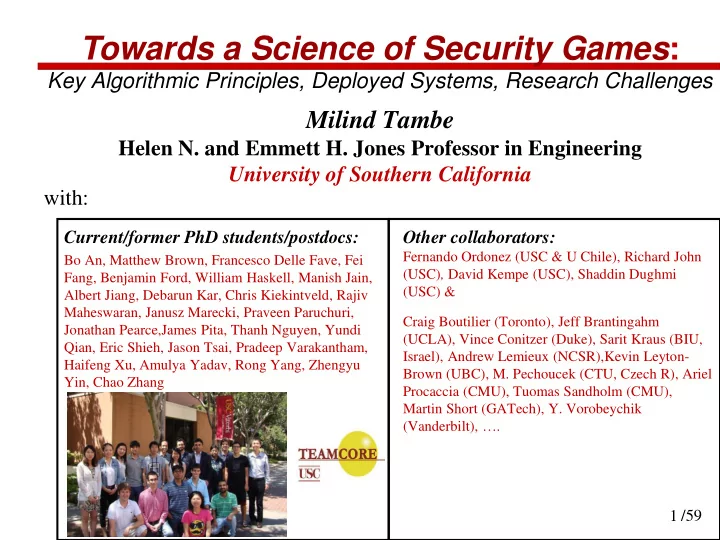
Towards a Science of Security Games : Key Algorithmic Principles, Deployed Systems, Research Challenges Milind Tambe Helen N. and Emmett H. Jones Professor in Engineering University of Southern California with: Current/former PhD


slide-1
SLIDE 1

/59 1

Towards a Science of Security Games:

Key Algorithmic Principles, Deployed Systems, Research Challenges

Milind Tambe

Helen N. and Emmett H. Jones Professor in Engineering University of Southern California with:

Current/former PhD students/postdocs:

Bo An, Matthew Brown, Francesco Delle Fave, Fei Fang, Benjamin Ford, William Haskell, Manish Jain, Albert Jiang, Debarun Kar, Chris Kiekintveld, Rajiv Maheswaran, Janusz Marecki, Praveen Paruchuri, Jonathan Pearce,James Pita, Thanh Nguyen, Yundi Qian, Eric Shieh, Jason Tsai, Pradeep Varakantham, Haifeng Xu, Amulya Yadav, Rong Yang, Zhengyu Yin, Chao Zhang

Other collaborators:

Fernando Ordonez (USC & U Chile), Richard John (USC), David Kempe (USC), Shaddin Dughmi (USC) & Craig Boutilier (Toronto), Jeff Brantingahm (UCLA), Vince Conitzer (Duke), Sarit Kraus (BIU, Israel), Andrew Lemieux (NCSR),Kevin Leyton- Brown (UBC), M. Pechoucek (CTU, Czech R), Ariel Procaccia (CMU), Tuomas Sandholm (CMU), Martin Short (GATech), Y. Vorobeychik (Vanderbilt), ….

slide-2
SLIDE 2

/59

Global Challenges for Security: Game Theory for Security Resource Optimization

2

slide-3
SLIDE 3

/59

Example Model: Stackelberg Security Games

Security allocation: Targets have weights Adversary surveillance

Target #1 Target #2 Target #1

4, -3

  • 1, 1

Target #2

  • 5, 5

2, -1

Adversary

3

Defender

slide-4
SLIDE 4

/59

Example Model: Stackelberg Security Games

Security allocation: Targets have weights Adversary surveillance

Target #1 Target #2 Target #1

4, -3

  • 1, 1

Target #2

  • 5, 5

2, -1

Adversary

4

Defender

slide-5
SLIDE 5

/59

Example Model: Stackelberg Security Games

Security allocation: Targets have weights Adversary surveillance

Target #1 Target #2 Target #1

4, -3

  • 1, 1

Target #2

  • 5, 5

2, -1

Adversary

5

Defender

slide-6
SLIDE 6

/59

Stackelberg Security Games

Security Resource Optimization: Not 100% Security Random strategy: Increase cost/uncertainty to attackers Stackelberg game: Defender commits to mixed strategy Adversary conducts surveillance; responds Stackelberg Equilibrium: Optimal random?

Target #1 Target #2 Target #1

4, -3

  • 1, 1

Target #2

  • 5, 5

2, -1

Adversary

6

Defender

slide-7
SLIDE 7

/59

Research Contributions: Game Theory for Security

Computational Game Theory in the Field

Computational game theory:

  • Massive games

Behavioral game theory:

  • Exploit human

behavior models

+ Planning under uncertainty, learning…

7

slide-8
SLIDE 8

8/59

Ports & port traffic US Coast Guard

Applications: Deployed Security Assistants

Airports, access roads & flights TSA, Airport Police Urban transport LA Sheriff’s/TSA Singapore Police Environment US Coast Guard, WWF, WCS…

slide-9
SLIDE 9

/59

Key Lessons: Security Games

Decision aids based on computational game theory in daily use Optimize limited security resources against adversaries Applications yield research challenges: Science of security games Scale-up: Incremental strategy generation & Marginals Uncertainty: Integrate MDPs, Robustness, Quantal response Current applications (wildlife security): Interdisciplinary challenge Global challenges: Merge planning/learning & security games

9

slide-10
SLIDE 10

/59 10

Outline: “Security Games” Research (2007-Now)

2007 2009 2011 2012 2013 2013-

Airports Flights Ports Roads Trains Environment

Evaluation II: Real-world deployments (Patience) Evaluation I: Scale up? Handle uncertainty?

Publications: AAMAS, AAAI, IJCAI… 2007 onwards

slide-11
SLIDE 11

/59 11

  • 6 plots against LAX

ARMOR: LAX (2007) GUARDS: TSA (2011)

Airport Security: Mapping to Stackelberg Games

GLASGOW 6/30/07

slide-12
SLIDE 12

/59 12

ARMOR Operation [2007]

Generate Detailed Defender Schedule

Pita Paruchuri

Mixed Integer Program

Pr(Canine patrol, 8 AM @ Terminals 3,5,7) = 0.33 Pr(Canine patrol, 8 AM @Terminals 2,5,6) = 0.17

…… Canine Team Schedule, July 28

Term 1 Term 2 Term 3 Term 4 Term 5 Term 6 Term 7 Term 8 8 AM Team1 Team3 Team5 9 AM Team1 Team2 Team4 10 AM Team3 Team5 Team2 Target #1 Target #2 Defender #1

2, -1

  • 3, 4

Defender #2

  • 3, 3

3, -2

slide-13
SLIDE 13

/59 13

ARMOR MIP [2007]

Generate Mixed Strategy for Defender

1 . . 

i i

x t s

j q i x ij R

X i Q j

 



 

max

1 

Q j j

q M q x C a

j i X i ij

) 1 ( ) (    

Maximize defender expected utility Defender mixed strategy Adversary best response

Pita Paruchuri Target #1 Target #2 Defender #1

2, -1

  • 3, 4

Defender #2

  • 3, 3

3, -2 Adversary response

slide-14
SLIDE 14

/59 14

ARMOR Payoffs [2007]

Previous Research Provides Payoffs in Security Game Domains

Target #1 Target #2 Defender #1

2, -1

  • 3, 4

Defender #2

  • 3, 3

3, -2

j q i x ij R

X i Q j

 



 

max

Maximize defender expected utility

slide-15
SLIDE 15

/59 15

ARMOR MIP [2007]

Solving for a Single Adversary Type

Term #1 Term #2 Defend#1

2, -1

  • 3, 4

Defend#2

  • 3, 1

3, -3

1 . . 

i i

x t s

j q i x ij R

X i Q j

 



 

max

1 

Q j j

q M q x C a

j i X i ij

) 1 ( ) (      

Maximize defender expected utility Defender strategy Adversary strategy Adversary best response

𝑦𝑗 ARMOR…throws a digital cloak of invisibility….

slide-16
SLIDE 16

/59

IRIS: Federal Air Marshals Service [2009] Scale Up Number of Defender Strategies

1000 Flights, 20 air marshals: 1041 combinations ARMOR out of memory

Strategy 1 Strategy 2 Strategy 3 Strateg y 1 Strateg y 2 Strateg y 3 Strateg y 4 Strateg y 5 Strateg y 6

Not enumerate all combinations: Branch and price: Incremental strategy generation

Strategy 1 Strategy 2 Strategy 3 Strategy 1 Strategy 2 Strategy 3 Strategy 4 Strategy 5 Strategy 6

16

slide-17
SLIDE 17

/59

IRIS: Scale Up Number of Defender Strategies [2009] Small Support Set for Mixed Strategies Small support set size:

  • Most xi variables zero

x124=0.239 x123=0.0 x135=0.0

Attack 1 Attack 2 Attack … Attack 1000

1,2,3.. 5,-10

4,-8 …

  • 20,9

1,2,4.. 5,-10

4,-8 …

  • 20,9

1,3,5.. 5,-10

  • 9,5

  • 20,9

… …

1041 rows

x378=0.123

} 1 , { ], 1 ... [ ) 1 ( ) ( 1 , 1 . . max ,        

   

   

j q x M q x C a q x t s q x R

i j i X i ij Q j j i i j i ij X i Q j q x

1000 flights, 20 air marshals:

1041 combinations

17

slide-18
SLIDE 18

/59

Target 3 Target 7 … … Resource Sink

Best new pure strategy: Minimum cost network flow

IRIS: Incremental Strategy Generation Exploit Small Support

Attack 1 Attack 2 Attack Attack 6 1,2,4

5,-10 4,-8 …

  • 20,9

3,7,8

  • 8, 10
  • 8,10

  • 8,10

500 rows NOT 1041

Attack 1 Attack 2 Attack… Attack 6

1,2,4 5,-10 4,-8 …

  • 20,9

Slave (LP Duality Theory) Master Converge: GLOBAL OPTIMAL

Attack 1 Attack 2 Attack… Attack 6

1,2,4 5,-10 4,-8 …

  • 20,9

3,7,8

  • 8, 10
  • 8,10

  • 8,10

18 Jain Kiekintveld

slide-19
SLIDE 19

/59

IRIS: Deployed FAMS (2009-)

“…in 2011, the Military Operations Research Society selected a University

  • f Southern California project with FAMS on randomizing flight

schedules for the prestigious Rist Award…”

  • R. S. Bray (TSA)

Transportation Security Subcommittee US House of Representatives 2012

19

Significant change in operations

slide-20
SLIDE 20

/59

Networks: Mumbai Police Checkpoints[2013]*

150 edges; 2 Checkpoints 150-choose-2 strategies

*With V Conitzer 20 Jain

slide-21
SLIDE 21

/59

Networks: Mumbai Police Checkpoints[2013]* Incremental Strategy Generation

*With V Conitzer 21 Jain

Double oracle: Converge to a global optimal

Path #1 Path #2 Checkpoint strategy #1

5, -5

  • 1, 1

Path #1 Path #2 Checkpoint strategy #1

5, -5

  • 1, 1

Checkpoint strategy #2

  • 5, 5

2, -1

Defender oracle

Path #1 Path #2 Path #3 Checkpoint strategy #1

5, -5

  • 1, 1
  • 2, 2

Checkpoint strategy #2

  • 5, 5

1, -1

  • 2, 2

Attacker oracle

Path #1 Path #2 Path #3 Checkpoint strategy #1

5, -5

  • 1, 1
  • 2, 2

Checkpoint strategy #2

  • 5, 5

1, -1

  • 2, 2
slide-22
SLIDE 22

/59

Double Oracle[2013]

Incremental Strategy Generation: Exploit Small Support

22

150 edges; 2 Checkpoints Only six candidate edges for checkpoints

Jain

slide-23
SLIDE 23

/59 23

Mumbai Police Checkpoints[2013] Results of Scale-up

20416 Roads,15 checkpoints: 20 min

slide-24
SLIDE 24

/59

Double Oracle: Social, Cyber Networks[2013] Incremental Strategy Generation

24

Social networks: e.g., counter-insurgency

Sources Intermediate Nodes Links Targets

Cyber networks:

Tsai

slide-25
SLIDE 25

/59

Outline: “Security Games” Research

2007 2009 2011 2012 2013 2013-

Airports Flights Ports Roads Trains Environment

25

slide-26
SLIDE 26

/59

Port Security Threat Scenarios

US Ports: $3.15 trillion economy USS Cole after suicide attack French oil tanker hit by small boat Attack on a ferry

26

slide-27
SLIDE 27

/59

PROTECT: Randomized Patrol Scheduling [2013]

27

Port Protection (Scale-up) and Ferries (Continuous Space/time)

slide-28
SLIDE 28

/59

PROTECT: Randomized Patrol Scheduling [2013] Port Protection (Scale-up) and Ferries (Continuous Space/time)

28

slide-29
SLIDE 29

/59

Ferries: Scale-up with Mobile Resources & Moving Targets Transition Graph Representation

A, 5 min A, 10 min A, 15 min B, 5 min B, 10 min B, 15 min C, 5 min C, 10 min C, 15 min

A B C 5 min 10 min 15 min

29

slide-30
SLIDE 30

/59

A, 5 min A, 10 min A, 15 min B, 5 min B, 10 min B, 15 min C, 5 min C, 10 min C, 15 min

A B C 5 min 10 min 15 min

Ferry

Ferries: Scale-up with Mobile Resources & Moving Targets Transition Graph Representation

30

slide-31
SLIDE 31

/59

A, 5 min A, 10 min A, 15 min B, 5 min B, 10 min B, 15 min C, 5 min C, 10 min C, 15 min

A B C 5 min 10 min 15 min

Ferry

31

Patrols protect nearby ferry location; Solve as done in ARMOR

Ferries: Patrol Routes Exponential Numbers of Patrol Routes

slide-32
SLIDE 32

/59

A, 5 min A, 10 min A, 15 min B, 5 min B, 10 min B, 15 min C, 5 min C, 10 min C, 15 min

A B C 5 min 10 min 15 min

Ferry

Patrols protect nearby ferry location; Solve as done in ARMOR

Ferries: Patrol Routes Exponential Numbers of Patrol Routes

32

Pr([(B,5), (C, 10), (C,15)]) = 0.17 Pr([(B,5), (C,10), (B,15)]) =0.13

NT variables

Pr([(A,5), (A,10), (B,15)]) = 0.07 Pr([(A,5), (A,10), (A,15)]) = 0.03

Jiang Kiekintveld Fang

slide-33
SLIDE 33

/59

A, 5 min A, 10 min A, 15 min B, 5 min B, 10 min B, 15 min C, 5 min C, 10 min C, 15 min

A B C 5 min 10 min 15 min

Ferry

Variables: NOT routes, but probability flow over each segment

Ferries: Scale-up Marginal Probabilities Over Segments

33

NT variables

Jiang Kiekintveld Fang

slide-34
SLIDE 34

/59

A, 5 min A, 10 min A, 15 min B, 5 min B, 10 min B, 15 min C, 5 min C, 10 min C, 15 min

A B C 5 min 10 min 15 min

Ferry

0.30

0.17 0.13

Obtain marginal probabilities over segments

0.10

0.07 0.03

N2.T variables

Extract: Pr([(B,5), (C, 10), (C,15)]) = 0.17

Pr([(B,5), (C,10), (B,15)]) =0.13

Ferries: Scale-up with Marginals Over Separable Segments Significant Speedup

34

NT variables

slide-35
SLIDE 35

/59

slide-36
SLIDE 36

/59 36

Outline: “Security Games” Research (2007-Now)

2007 2009 2011 2012 2013 2013-

Airports Flights Ports Roads Trains Environment

Evaluation II: Real-world deployments (Patience) Evaluation I: Scale up? Handle uncertainty?

slide-37
SLIDE 37

/59

TRUSTS: Frequent adversary interaction games Patrols Against Fare Evaders

A, 5 min A, 10 min A, 15 min B, 5 min B, 10 min B, 15 min C, 5 min C, 10 min C, 15 min

A B C 5 min 10 min 15 min

0.30

0.17 0.13

0.10 0.10

37

slide-38
SLIDE 38

/59

TRUSTS: Frequent adversary interaction Uncertainty in Defender Action Execution

A, 5 min A, 10 min A, 15 min B, 5 min B, 10 min B, 15 min C, 5 min C, 10 min C, 15 min

A B C 5 min 10 min 15 min

0.30

0.15 0.10

0.10

0.07 0.03

0.05

38 Jiang Delle Fave

slide-39
SLIDE 39

/59

Markov Decision Problems in Security games A, 5 min A, 10 min A, 15 min B, 5 min B, 10 min B, 15 min C, 5 min C, 10 min C, 15 min

A B C 5 min 10 min 15 min

0.30

0.15 0.10

0.10

0.07 0.03

0.05

39

TRUSTS: Frequent adversary interaction Uncertainty in Defender Action Execution

Jiang Delle Fave

slide-40
SLIDE 40

/59 40

Urban Transportation Security: MDPs & DEC-MDPs in Security Games

COPS: LA Metro System

(Against Opportunistic Crime)

STREETS: Singapore Roads

(Against Reckless Driving)

DEC-MDPs in Security Games: Teamwork + Uncertainty

A, 5 A, 10 A, 15 B, 5 B, 10 B, 15 C, 5 C, 10 C, 15 A, 5 A, 10 A, 15 B, 5 B, 10 B, 15 C, 5 C, 10 C, 15

Zhang Shieh

slide-41
SLIDE 41

/59

Uncertainty Space Algorithms: Bayesian and Robust Approaches

Adversary payoff uncertainty

Adversary observation & defender execution uncertainty

Adversary rationality uncertainty RECON BRASS Monotonic Maximin (Monotonic adversary)

41

URAC

Payoff interval; Not point estimate GMC HUNTER

Bayesian Robust

Yin Nguyen An 0.5 1 1.5

5 10 Defender's EU #Targets ISG RECON URAC

slide-42
SLIDE 42

/59

Security Games, Environmental Crime & Bounded Rationality

Fishery Gulf of Mexico

Nakai Nam Theun Forest Area, Laos

Wildlife Queen Elizabeth National Park Uganda

No patrols Higher density Lower density x

Yang Ford Brown

slide-43
SLIDE 43

/59

Uncertainty in Adversary Decision: Bounded Rationality Human Subjects as Poachers

slide-44
SLIDE 44

/59

Uncertainty in Adversary Decision[2009] Human subjects: Anchoring, e-Optimality*

  • 4
  • 3
  • 2
  • 1

1

Unobserved 5 Observations 20 Observations Unlimited Average expected reward

DOBSS Uniform COBRA

ARMOR

ARMOR: Outperforms uniform random COBRA:

M q x C a q X x x t s q x R

j i X i ij j X i Q j j i ij q x

) 1 ( ) ' ( ) 1 ( |) | / 1 ( ) 1 ( ' . . max ,         

 

  

e e  

Anchoring e-optimality

*With Sarit Kraus 44 Pita

slide-45
SLIDE 45

/59 45

Quantal Response: Stochastic choice, better choice more likely

Quantal Response Model of Adversary [2011]

Not Maximize Expected Utility

  

T j j x adversary EU j x adversary EU j

e e q

1 ' )) ' , ( ( )) , ( (  

  • 3
  • 2.5
  • 2
  • 1.5
  • 1
  • 0.5

0.5 1 1.5 2 Payoff 1 Payoff 2 Payoff 3 Payoff 4

Quantal Response COBRA ARMOR

Adversary’s probability

  • f choosing target j

Yang

1 ; . . ) , ( max

1 1 ' ) ' , ( . ) , ( .

  

  

  t t t defend T j T j j x EU j x EU x

x K x t s j x EU e e

adversary adversary

 

slide-46
SLIDE 46

/59

Uncertainty in Adversary Decision [2012] Robust vs Modeling Adversaries*

Robustness: Bound loss to defender; Not model attacker via QR Defeating Robust: Learned subjective utility

Robust wins Draw QR wins 42 52 6 Results on 100 games SU-QR wins Draw Robust 13 8 1 Results on 22 games

M q x C a q x R

j i X i ij j i ij X i Q j q x

) 1 ( ) ( max ,    

 

  

β * (Adversary’s utility loss if deviates from optimal) >= (Defender’s utility loss due to adversary deviation)

penalty attack w reward attack w prob capture w j a SEU       3 2 1 ) (

  

M j j x SEU j x SEU j

adversary adversary

e e q

1 ' ) ' , ( ) , (  

SU-QR wins Draw Robust 6 13 3 Results against security experts

*With Sarit Kraus 46

slide-47
SLIDE 47

/59 47

PAWS: Protection Assistant for Wildlife Security[2014] Repeated Stackelberg Game

Simulation Learn from crime data: Improve model Defender calculates mixed strategy Defender executes randomized patrols Poachers attack targets 𝑓𝑇𝐹𝑉𝑗(w1,w2,w3) 𝑙 𝑓𝑇𝐹𝑉𝑙(w1,w2,w3) Bayesian SUQR: Heterogeneous Poachers

slide-48
SLIDE 48

/59 48

PAWS Test: April 2014 Trials in Queen Elizabeth National Park

Andrew Lemieux with rangers

  • n PAWS patrol in Uganda
slide-49
SLIDE 49

/59

Security Resource Optimization:

Evaluating Deployed Security Systems Not Easy Game theory: Improvement over previous approaches Previous: Human schedulers or “simple random”

49

Lab Evaluation Simulated adversary Human subject adversaries Field Evaluation: Patrol quality Unpredictable? Cover? Compare real schedules Scheduling competition Expert evaluation Field Evaluation: Tests against adversaries “Mock attackers” Capture rates of real adversaries

slide-50
SLIDE 50

/59

Why Does Game Theory Perform Better? Weaknesses of Previous Methods

Human schedulers: Predictable patterns, e.g., US Coast Guard Scheduling effort & cognitive burden Simple random (e.g., dice roll): Wrong weights/coverage, e.g. officers to sparsely crowded terminals No adversary reactions Multiple deployments over multiple years: without us forcing them

50

slide-51
SLIDE 51

/59

Lab Evaluation via Simulations: Example from IRIS (FAMS)

  • 10
  • 8
  • 6
  • 4
  • 2

2 4 6

50 150 250 Defender Expected utility Schedule Size

Uniform Weighted random 1 Weighted random 2 IRIS

51

slide-52
SLIDE 52

/59

Day 1 Day 2 Day 3 Day 4 Day 5 Day 6 Day 7 Count

Field Evaluation of Schedule Quality:

Improved Patrol Unpredictability & Coverage

Patrols Before PROTECT: Boston Patrols After PROTECT: Boston

Day 1 Day 2 Day 3 Day 4 Day 5 Day 6 Day 7 Count Base Patrol Area

52

PROTECT (Coast Guard): 350% increase defender expected utility

slide-53
SLIDE 53

/59

Field Evaluation of Schedule Quality:

Improved Patrol Unpredictability & Coverage for Less Effort

53

IRIS for FAMS: Outperformed expert human over six months

Report:GAO-09-903T

ARMOR at LAX: Savings of up to an hour a day in scheduling

slide-54
SLIDE 54

/59

Field Evaluation: Human vs Game Theory Competition Counter-terrorism Patrol Scheduling

90 officers on LA Metro Trains Humans required significant effort Worse schedules than game theory Observer’s report on questions:

54

3 3.5 4 4.5 5 5.5 Q1 Q2 Q3 Q4 Q5 Q6 Q7 Q8 Q9 Q10 Q11 Q12 Security Score Human Game Theory

slide-55
SLIDE 55

/59

Field Test Against Adversaries: Mock Attackers Example from PROTECT

“Mock attacker” team deployed in Boston Comparing PRE- to POST-PROTECT: “deterrence” improved Additional real-world indicators from Boston: Boston boaters questions: “..has the Coast Guard recently acquired more boats” POST-PROTECT: Actual reports of illegal activity

55

slide-56
SLIDE 56

/59 56

Field Tests Against Adversaries Computational Game Theory in the Field Game theory vs Random 21 days of patrol Identical conditions Random + Human Not controlled

20 40 60 80 100 Miscellaneous Drugs Firearm Violations

5 10 15 20

# Captures /30 min # Warnings /30 min # Violations /30 min

Game Theory Rand+Human

Controlled

slide-57
SLIDE 57

/59

Expert Evaluation Example from ARMOR, IRIS & PROTECT

February 2009: Commendations LAX Police (City of Los Angeles) July 2011: Operational Excellence Award (US Coast Guard, Boston) September 2011: Certificate of Appreciation (Federal Air Marshals) June 2013: Meritorious Team Commendation

from Commandant (US Coast Guard) 57

slide-58
SLIDE 58

/59

Summary: Security Games

Decision aids based on computational game theory in daily use Optimize limited security resources against adversaries Applications yield research challenges: Science of security games Scale-up: Incremental strategy generation & Marginals Uncertainty: Integrate MDPs, Robustness, Quantal response Current applications (wildlife security): Interdisciplinar challenge Global challenges: Merge planning/learning & security games

58

slide-59
SLIDE 59

/59

Just the Beginning of “Security Games”….

Our next steps:

59

Thank you to sponsors:

Startup:ARMORWAY Game theory in the field

Follow on research & applications:

Privacy audits

(Sinha IJCAI’13)

Software testing

(Kukreja ASE’13)

Sport event security

(Yin AAAI’14)

Singapore train

(Varakantham IAAI’13)

Exam questions

(Li IJCAI’13)

slide-60
SLIDE 60

/59

THANK YOU tambe@usc.edu http://teamcore.usc.edu/security

60