TOW ARD ZERO-EMI SSI ON FREI GHT AT SOUTHERN CALI FORNI A'S PORTS - - PowerPoint PPT Presentation

tow ard zero emi ssi on frei ght at southern cali forni a
SMART_READER_LITE
LIVE PREVIEW

TOW ARD ZERO-EMI SSI ON FREI GHT AT SOUTHERN CALI FORNI A'S PORTS - - PowerPoint PPT Presentation

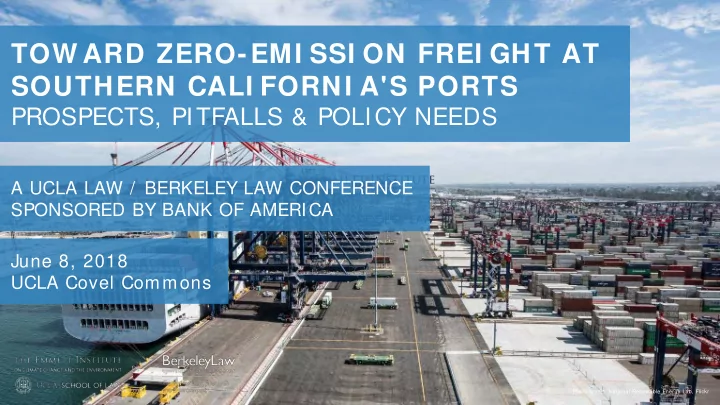
TOW ARD ZERO-EMI SSI ON FREI GHT AT SOUTHERN CALI FORNI A'S PORTS PROSPECTS, PITFALLS & POLICY NEEDS A UCLA LAW / BERKELEY LAW CONFERENCE SPONSORED BY BANK OF AMERICA June 8, 2018 UCLA Covel Commons Photo credit: National Renewable


slide-1
SLIDE 1

TOW ARD ZERO-EMI SSI ON FREI GHT AT SOUTHERN CALI FORNI A'S PORTS

PROSPECTS, PITFALLS & POLICY NEEDS

A UCLA LAW / BERKELEY LAW CONFERENCE SPONSORED BY BANK OF AMERICA June 8, 2018 UCLA Covel Commons

Photo credit: National Renewable Energy Lab, Flickr
slide-2
SLIDE 2

KEYNOTE ADDRESS | Mary Nichols Chair, California Air Resources Board

Photo credit: Jared eberhardt, Flickr
slide-3
SLIDE 3

PANEL 1 | State of Electrification Technologies Applicable to Goods Movem ent at the Ports

  • Joe Lyou, President and CEO, Coalition for Clean

Air; Governor's Appointee, South Coast Air Quality Management District Governing Board

  • Renee Moilanen, Manager of Air Quality Practices,

Port of Long Beach

  • Jim m y O'Dea, Senior Vehicles Analyst, Union of

Concerned Scientists

  • Cara Horow itz ( m oderator) , Co-Executive

Director, UCLA Law Emmett Institute

Photo credit: National Renewable Energy Lab, Flickr
slide-4
SLIDE 4

Panel 1: State of Electrification Technologies Applicable to Goods Movement at the Ports Joseph K. Lyou, Ph.D. President & CEO, Coalition for Clean Air Governor’s Appointee, South Coast AQMD Governing Board @joe_lyou

slide-5
SLIDE 5

The mission of the Coalition for Clean Air is to protect public health, improve air quality, and prevent climate change.

slide-6
SLIDE 6

L.A. Area Needs

45% NOx emission reductions by 2023 55% NOx emission reductions by 2031

slide-7
SLIDE 7

10 20 30 40 50

Heavy-Duty Diesel Trucks Off-Road Equipment Ships & Commercial Boats Aircraft RECLAIM* Locomotives

NOx (tons/day)

Top NOx Sources in 2031

Source: South Coast AQMD, 2016 Air Quality Management Plan

* ~300 largest stationary sources, including refineries & power plants.

slide-8
SLIDE 8

Source: State of California, July 2016, California Sustainable Freight Action Plan, p. G-7.

slide-9
SLIDE 9

Vincent Van Gogh ◦○◦ Crows Over the Wheat Field

The Path Forward

  • Deal with our prisoners’ dilemma
  • Be honest and admit shortcomings
  • Be an effective advocate
slide-10
SLIDE 10
slide-11
SLIDE 11

Compete Cooperate Compete

Alternative Fuel Supporters Win Petroleum Industry Wins Zero Emission Advocates Win

Cooperate

Near-Zero Emission Advocates Win

Zero Emission Advocates Near-Zero Emission Advocates

slide-12
SLIDE 12
slide-13
SLIDE 13

220-4939

Key Findings from a Survey of Voters Statewide and in Impacted Communities Conducted March 3-15, 2018

slide-14
SLIDE 14

14

Methodology

 638 interviews with registered voters in California  Margin of sampling error of ±3.9% at the 95% confidence level  Additional oversample in the following regions:

  • CA-99 Corridor: Fresno to Bakersfield within 1.5 miles of the highway (N=209)
  • I-710 Corridor: within 1.5 miles of the highway (N=222)
  • Inland Empire Cities: Chino, Colton, Corona, Fontana, Jurupa Valley, Ontario,

Redlands, San Bernardino (N=216)

  • West Oakland (N=206)

 Margin of sampling error of ± 6.6% to 6.8% at the 95% confidence level for each region  Interviews conducted March 3 - 15, 2018  Interviews available on landlines and cell phones in English and Spanish  Some percentages may not sum to 100% due to rounding

slide-15
SLIDE 15

15

Respondents were asked about two proposals: switching to zero-emissions vehicles when they are available and near-zero emissions vehicles now.

Question: “Does this goal sound like something you would support or oppose?” Questions were rotated.

Some people have said that we should set a goal that, at some specific date in the future, all trucks and heavy-duty vehicles in California should be zero-emission vehicles – meaning waiting until vehicles are available that are powered by electricity or hydrogen that do not create any emissions from the vehicles while they drive. Some people have said that there are trucks and heavy-duty vehicles that produce far less pollution than the trucks

  • n the road today, and could be put into

use by trucking companies and others right away. These are known as “near- zero vehicles” because they emit 90% less pollution than the cleanest diesel- powered trucks on the road today. These people have suggested we set the goal of switching to near-zero emissions trucks now.

slide-16
SLIDE 16

16

Two-thirds of respondents statewide support both proposals and fewer than one in ten want a ZEV-only approach.

Question: “Does this goal sound like something you would support or oppose?”

67% 7% 8% 13% 4% Support both ZEV only NZEV only Oppose both Don't know/other 63% 10% 11% 8% 7%

Impacted Areas Statewide

slide-17
SLIDE 17

My favorite podcast . . .

slide-18
SLIDE 18

Former U.S. Attorney Preet Bahrara Defense Attorney Ben Brafman

slide-19
SLIDE 19

Battery Electric

  • Too expensive
  • Too heavy
  • Limited range
  • Limited

availability

  • Takes a long

time to charge

  • Lack of charging

infrastructure

  • Currently relies
  • n fossil fuels

Hydrogen

  • Too expensive
  • Very limited

availability

  • Lack of fueling

infrastructure

  • Currently relies
  • n fossil fuels

Natural Gas

  • More expensive

than diesel

  • Bad experience

with 9L trucks

  • Not zero

emissions

  • Limited fueling

infrastructure

  • Currently relies
  • n fossil fuels
slide-20
SLIDE 20

Battery Electric

  • Battery technology

advancements will help with cost, weight, and range issues

  • More companies

developing trucks and equipment

  • Fast charging &
  • pportunity charging

being developed

  • SB 350 helping address

infrastructure needs

  • Reduced reliance upon

fossil fuels as use of renewable energy increases

Hydrogen

  • Cost will come down

with additional production

  • More companies

developing trucks and equipment

  • Short-term and long-

term fueling infrastructure options available

  • Reduced reliance upon

fossil fuels as use of renewable energy increases

Natural Gas

  • Total cost of ownership

can be less than diesel with large scale production

  • New 12L trucks are

performing well

  • Near-zero trucks are as

clean as the average car

  • Fueling infrastructure

will take care of itself if demand is there

  • Policies like the Low-

Carbon Fuel Standard make renewable natural gas cost competitive
slide-21
SLIDE 21

Policy Technology Money Leadership

  • Fulfill commitments
  • International agreements
  • Commercialization
  • Innovation
  • Agree on who pays what
  • Well structured incentives
  • Beneficial cargo owners
  • Everyone else
slide-22
SLIDE 22

The end.

slide-23
SLIDE 23

PANEL 1 | State of Electrification Technologies Applicable to Goods Movem ent at the Ports

  • Joe Lyou, President and CEO, Coalition for Clean

Air; Governor's Appointee, South Coast Air Quality Management District Governing Board

  • Renee Moilanen, Manager of Air Quality Practices,

Port of Long Beach

  • Jim m y O'Dea, Senior Vehicles Analyst, Union of

Concerned Scientists

  • Cara Horow itz ( m oderator) , Co-Executive

Director, UCLA Law Emmett Institute

Photo credit: National Renewable Energy Lab, Flickr
slide-24
SLIDE 24

Heavy-duty vehicles: The next frontier for electrification

Jimmy O'Dea, Senior Vehicles Analyst

slide-25
SLIDE 25

The need for electrification

slide-26
SLIDE 26

Heavy-duty vehicles in California…

Vehicle population

7%

Transportation GHG

20%

Transportation PM2.5

27%

Transportation NOx

40%

Source: California Air Resources Board

slide-27
SLIDE 27

Diesel particulate matter

Source: US EPA EJSCREEN

slide-28
SLIDE 28

California’s GHG emissions over time, by fuel

slide-29
SLIDE 29

CO2 emissions over time from select fuels in California

Natural gas Gasoline Diesel Coal

slide-30
SLIDE 30

Life cycle global warming emissions, e.g. buses

Diesel Natural gas Fuel cell Battery

Source: ucsusa.org/ElectricTrucks

slide-31
SLIDE 31

State of technology

slide-32
SLIDE 32
slide-33
SLIDE 33
slide-34
SLIDE 34
slide-35
SLIDE 35

Electric trucks are here and coming

24 hours 500 miles 300 miles 200 miles 100 miles 150 miles 92 miles 220 miles 500+ miles

slide-36
SLIDE 36

Electric trucks are high performing

slide-37
SLIDE 37
slide-38
SLIDE 38

Shenzhen

slide-39
SLIDE 39

Purchase incentives

slide-40
SLIDE 40

Charging infrastructure

slide-41
SLIDE 41

PANEL 1 | State of Electrification Technologies Applicable to Goods Movem ent at the Ports

  • Joe Lyou, President and CEO, Coalition for Clean

Air; Governor's Appointee, South Coast Air Quality Management District Governing Board

  • Renee Moilanen, Manager of Air Quality Practices,

Port of Long Beach

  • Jim m y O'Dea, Senior Vehicles Analyst, Union of

Concerned Scientists

  • Cara Horow itz ( m oderator) , Co-Executive

Director, UCLA Law Emmett Institute

Photo credit: National Renewable Energy Lab, Flickr
slide-42
SLIDE 42

LUNCH BREAK

Photo credit: Eric Fredericks, Flickr

slide-43
SLIDE 43

LUNCHTIME DISCUSSION | Challenges for Zero- Em ission Trucking

  • Vincent Pellecchia, Strategic Account

Manager, BYD Motors

  • Ryan Popple, Chief Executive Officer,

President and Director, ProTerra

  • Daniel W itt, Senior Manager of Business

Development and US Policy, Tesla Motors

  • Jordan Diam ond ( m oderator) ,

Executive Director, Center for Law, Energy, and the Environment, UC Berkeley School of Law

Photo credit: National Renewable Energy Lab, Flickr
slide-44
SLIDE 44

PANEL 2 | Financing and Other I m plem entation Challenges for Zero- Em ission Technologies

  • Michelle I turralde, Senior Vice President, Bank of

America

  • Victor La Rosa, Chief Executive Officer, President &

Founder, Total Transportation Services I nc. (TTSI)

  • Bryon Rockw ell, Managing Director, Western Region

Public Finance Bank of America Merrill Lynch

  • Chris Shim oda, Vice President of Government Affairs,

California Trucking Association

  • Ted Lam m ( m oderator) , Climate Law and Policy

Fellow, Center for Law, Energy & the Environment at UC Berkeley School of Law

Photo credit: borderhacker, Flickr
slide-45
SLIDE 45

Towards Zero-Emission Freight at Southern California Ports

Financing and Other Implementation Challenges Chris Shimoda Vice President, Government Affairs, California Trucking Association

slide-46
SLIDE 46

Who Operates at the Port?

  • 97% port fleet operates <100 trucks. Move ¾ of all freight.
slide-47
SLIDE 47

Current Fuel/Technology Mix

  • As of Nov 2017, 97% diesel and 3% LNG/CNG
slide-48
SLIDE 48

Current Fuel/Technology Mix

  • More than 50% of all moves by 2007-2009 MY Engines
slide-49
SLIDE 49

ZEV Deployment Challenges

  • Commercial availability
  • Service/Parts
  • Warranties
  • Infrastructure
  • Cost
  • Performance
  • Range
  • Weight
slide-50
SLIDE 50

NACFE Guidance Report: BEVs have potential to better baseline diesel performance

slide-51
SLIDE 51

Conclusions of NACFE Study

“BEVs will not be a solution for every application or market, but commercial BEVs will have an increasing role in freight transportation in Classes 3 through 8. The rapid pace of battery energy density improvement will spur increases in BEV efficiency that likely cannot be matched by evolutionary changes to the internal combustion engines. The transition in specific market segments will be drawn out over decades, sharing space with traditional gasoline, diesel, and other alternative-fuel powertrains and also competing with other emerging technologies like fuel cells and hybrids. Mixed fleets (including diesel, natural gas, hybrid, and BEV products)

  • ptimized for specific routes and duty cycles will likely be the norm through

2050.”

slide-52
SLIDE 52

Conclusions of NACFE Study

“BEVs will not be a solution for every application or market, but commercial BEVs will have an increasing role in freight transportation in Classes 3 through 8. The rapid pace of battery energy density improvement will spur increases in BEV efficiency that likely cannot be matched by evolutionary changes to the internal combustion engines. The transition in specific market segments will be drawn out over decades, sharing space with traditional gasoline, diesel, and other alternative-fuel powertrains and also competing with other emerging technologies like fuel cells and hybrids. Mixed fleets (including diesel, natural gas, hybrid, and BEV products)

  • ptimized for specific routes and duty cycles will likely be the norm through

2050.”

slide-53
SLIDE 53

PANEL 2 | Financing and Other I m plem entation Challenges for Zero- Em ission Technologies

  • Michelle I turralde, Senior Vice President, Bank of

America

  • Victor La Rosa, Chief Executive Officer, President &

Founder, Total Transportation Services I nc. (TTSI)

  • Bryon Rockw ell, Managing Director, Western Region

Public Finance Bank of America Merrill Lynch

  • Chris Shim oda, Vice President of Government Affairs,

California Trucking Association

  • Ted Lam m ( m oderator) , Climate Law and Policy

Fellow, Center for Law, Energy & the Environment at UC Berkeley School of Law

Photo credit: borderhacker, Flickr
slide-54
SLIDE 54

Alternative Fuel Vehicle Program

Victor La Rosa, CEO, President & Founder, TTSI

slide-55
SLIDE 55

At TTSI, we are committed to leaving as small a footprint as possible on our precious environment. That's why we are committed to several ecological goals designed to drastically reduce our operational emissions and subsequent environmental pollution. Our goal is to operate a zero emission fleet that services our customers while being a steward to the environment.

slide-56
SLIDE 56

2007 CAAP Announcement

TTSI announced during the press conference that it would convert it’s entire fleet to comply with the provisions of the CAAP

slide-57
SLIDE 57

The Beginning Pre-Clean Air Action Plan (CAAP)

Prior to the implementation of the CAAP, trucks that transported containers in and out of the port complex were much older trucks with little to no emission standards

slide-58
SLIDE 58

Progression to Zero Emissions

slide-59
SLIDE 59

Alternative Fuel Vehicle Demonstrations

Alternative Fuel Vehicle Type Manufacturer Projected Demonstation

Number

  • f Trucks

Electric Battery Truck BYD Motor April 2018 2 Compressed Natural Gas Hybrid (Electric Motor) CTE/Kenworth Mid 2018 1 Compressed Natural Gas Hybrid (Electric Motor) Efficient Drive Train Late 2018 2 Compressed Natural Gas Hybrid (Electric Motor) TransPower May 2018 1 Electric Battery Truck TransPower May 2018 4 Electric Battery Truck US Hybrid Corporation In Progess 2 Fuel Cell Battery Truck (Hydrogen) CTE/Kenworth May 2018 1 Fuel Cell Battery Truck (Hydrogen) Hydrogenics Late 2018 2 Fuel Cell Battery Truck (Hydrogen) TransPower May 2018 4 Fuel Cell Battery Truck (Hydrogen) US Hybrid Corporation Jan 2018 1 Liquid Natural Gas Hybrid (Electric Motor) US Hybrid Corporation In Progess 2 Liquid Natural Gas Hybrid (Electric Motor) US Hybrid Corporation/POLB Mid 2018 4 Repower 12 Liter, Low NOx Engine (LNG) Cummins/Clean Energy In Progess 5

Total 31

CTE - Center for Transportation and Environment

slide-60
SLIDE 60

Battery Electricity

slide-61
SLIDE 61

LNG/CNG Technology

slide-62
SLIDE 62

Hydrogen Fuel Cell

slide-63
SLIDE 63

Fueling Infrastructure

slide-64
SLIDE 64

Electric Truck Chargers

slide-65
SLIDE 65

LNG & CNG Fuels

slide-66
SLIDE 66

Hydrogen Fueling

Hydrogen Dispensing Equipment Hydrogen Generation Equipment

slide-67
SLIDE 67

HPEC

(Harbor Performance Enhancement Center)

X

slide-68
SLIDE 68

HPEC - 100 Acres (now)

Bridge

Customs House

slide-69
SLIDE 69

HPEC - Future

slide-70
SLIDE 70

For more information on TTSI, please visit our website at: www.tts-i.com Thank You

slide-71
SLIDE 71

PANEL 2 | Financing and Other I m plem entation Challenges for Zero- Em ission Technologies

  • Michelle I turralde, Senior Vice President, Bank of

America

  • Victor La Rosa, Chief Executive Officer, President &

Founder, Total Transportation Services I nc. (TTSI)

  • Bryon Rockw ell, Managing Director, Western Region

Public Finance Bank of America Merrill Lynch

  • Chris Shim oda, Vice President of Government Affairs,

California Trucking Association

  • Ted Lam m ( m oderator) , Climate Law and Policy

Fellow, Center for Law, Energy & the Environment at UC Berkeley School of Law

Photo credit: borderhacker, Flickr
slide-72
SLIDE 72

PANEL 3 | Policy Needs to Deploy Zero-Em ission Technologies

  • Laura Cortez, Community Organizer, East

Yard Communities for Environmental Justice

  • Veronica Eady, Assistant Executive Officer for

Environmental Justice, California Air Resources Board

  • Adrian Martinez, Staff Attorney, Earthjustice
  • Katie Sloan, Principal Manager – Innovation,

Development, & Controls, Customer Service Southern California Edison

  • Sean Hecht ( m oderator) , Co-Executive

Director, UCLA Law Emmett Institute

Photo credit: Cityfabrick, Flickr
slide-73
SLIDE 73

TOW ARD ZERO-EMI SSI ON FREI GHT AT SOUTHERN CALI FORNI A'S PORTS

PROSPECTS, PITFALLS & POLICY NEEDS

A UCLA LAW / BERKELEY LAW CONFERENCE SPONSORED BY BANK OF AMERICA June 8, 2018 UCLA Covel Commons

Photo credit: National Renewable Energy Lab, Flickr