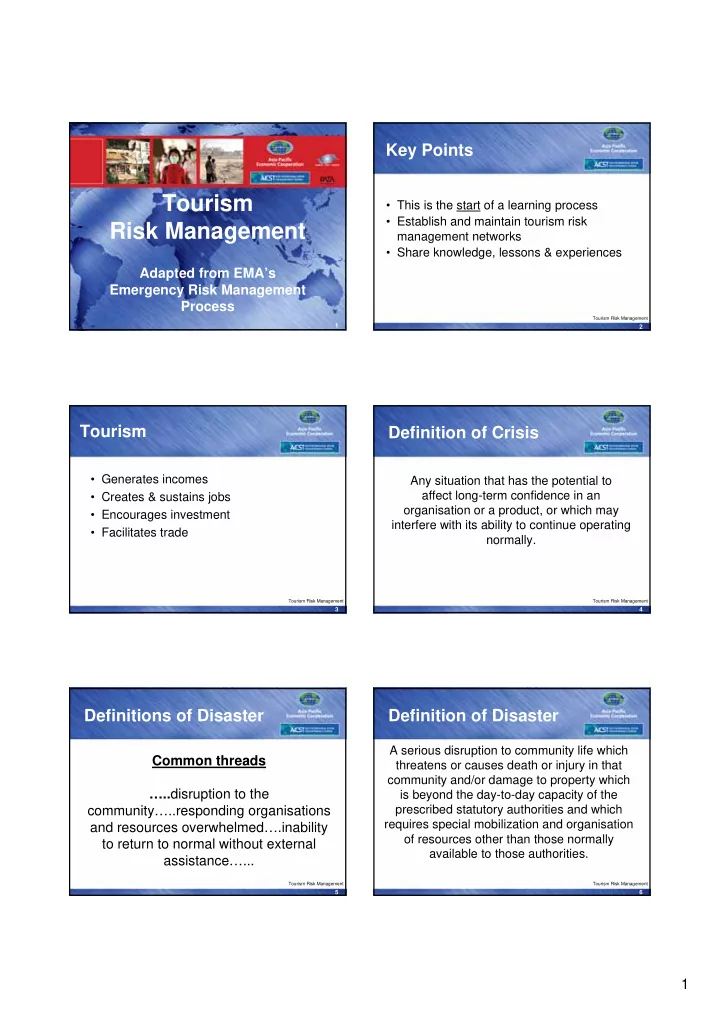
Tourism This is the start of a learning process Establish and - - PDF document

tourism
SMART_READER_LITE
LIVE PREVIEW

Tourism This is the start of a learning process Establish and - - PDF document

Key Points Tourism This is the start of a learning process Establish and maintain tourism risk Risk Management management networks Share knowledge, lessons & experiences Adapted from EMAs Emergency Risk Management Process


slide-1
SLIDE 1

1

1

Tourism Risk Management

Adapted from EMA’s Emergency Risk Management Process

2

Tourism Risk Management

Key Points

  • This is the start of a learning process
  • Establish and maintain tourism risk

management networks

  • Share knowledge, lessons & experiences

3

Tourism Risk Management

Tourism

  • Generates incomes
  • Creates & sustains jobs
  • Encourages investment
  • Facilitates trade

4

Tourism Risk Management

Definition of Crisis

Any situation that has the potential to affect long-term confidence in an

  • rganisation or a product, or which may

interfere with its ability to continue operating normally.

5

Tourism Risk Management

Definitions of Disaster

Common threads …..disruption to the community…..responding organisations and resources overwhelmed….inability to return to normal without external assistance…...

6

Tourism Risk Management

Definition of Disaster

A serious disruption to community life which threatens or causes death or injury in that community and/or damage to property which is beyond the day-to-day capacity of the prescribed statutory authorities and which requires special mobilization and organisation

  • f resources other than those normally

available to those authorities.

slide-2
SLIDE 2

2

7

Tourism Risk Management

Disasters

Have a significant impact upon PEOPLE & infrastructure & thus upon tourism facilities, operations and visitors. They produce LONG-TERM problems of restoration & rehabilitation and will affect the return to normal of tourism activities. Businesses reliant upon tourism will also be impacted.

8

Tourism Risk Management

What is needed?

An integrated disaster management system with an active partnership between all agencies, government and the community. The tourism industry participate where possible in the integrated system at local, regional and national levels.

9

Tourism Risk Management

  • Crisis affects an organisation or business
  • A disaster affects a community
  • Tourism will be affected by a community

disaster

  • Tourism operators are part of the disaster

management community

Key Points

10

Tourism Risk Management

The Risk Management Process

Risk Management

11

Tourism Risk Management

The Risk Management Process

Provides a generic framework for

  • rganisations to identify, analyse,

assess, treat and monitor risks to their organisations.

12

Tourism Risk Management

The Tourism Risk Management Process

A proactive process which enables tourism destinations and businesses/organisations to minimise losses and take advantage of opportunities.

slide-3
SLIDE 3

3

13

Tourism Risk Management

The Tourism Risk Management Process

14

Tourism Risk Management

  • Risk Management – an organisational

process

  • Disaster Risk Management – a community

based, multi-agency process. Tourism destinations and

  • perators should be involved in

both processes.

Risk Management…….. Disaster Risk Management

15

Tourism Risk Management

In the Pacific – CHARM – Comprehensive Hazard & Risk Management At ADPC – CBDRM – Community-based Disaster Risk Management

Disaster Risk Management

16

Tourism Risk Management

Tourism destinations and operators should undertake a tourism risk management process to identify, analyse, assess, treat and monitor risks to their tourism operations and business. YOU share the responsibility for the safety and security of visitors.

Tourism Risk Management

17

Tourism Risk Management

A two-way process of internal and external communication should be established and maintained with stakeholders so that different views and expertise are included.

Communication and Consultation

18

Tourism Risk Management

  • Risk management provides a generic framework
  • There is an organisational process and a

community process

  • Disaster risk management is a community, multi-

agency process

  • Tourism destinations and operators have a role to

play in both processes

  • Communication and consultation are critical
  • Tourism destinations should participate in

disaster management committees where possible.

Key Points

slide-4
SLIDE 4

4

19

Tourism Risk Management

  • 1. Establish the context
  • 2. Identify hazards, vulnerable elements &

risks

  • 3. Analyze & evaluate risks
  • 4. Treat risks
  • 5. Monitor & review
  • 6. Communicate & Consult

The Tourism Risk Management Process

Tourism Risk Management

20

Step 1 Establish the Context

The Tourism Risk Management Process

21

Tourism Risk Management

Establishes the stakeholders, policies, systems, procedures and relationships which are relevant to risk management for tourism organisations.

The Context

22

Tourism Risk Management

  • Perceptions, values & interests of visitors
  • Political & legal environment
  • Social influences
  • Competitors
  • Financial/economic factors
  • Key business drivers

The Context

23

Tourism Risk Management

Internal organisational factors

  • Organisational culture
  • Capabilities
  • Economic constraints
  • Goals & objectives
  • Community support
  • Organisational strengths, weaknesses,
  • pportunities & threats

24

Tourism Risk Management

Risk Criteria

Simple, basic statements of what is unacceptable or will not be tolerated.

slide-5
SLIDE 5

5

25

Tourism Risk Management

Examples of Tourism Risk Criteria

  • Any preventable crisis which results in

negative media reporting is unacceptable…

  • Any preventable crisis which makes

visitors reluctant to visit a destination or tourist facility is unacceptable…

26

Tourism Risk Management

  • The context establishes the parameters

within which tourism risk management activities take place

  • It establishes statements of what is

unacceptable to tourism destinations or

  • perators

Key Points

Tourism Risk Management

27

Step 2 Identify Risks

The Tourism Risk Management Process

28

Tourism Risk Management

Ways to Identify Risks to a Tourism Destination or Business/Organisation

  • Brainstorming
  • Checking historical records
  • Consulting experts
  • ‘What if it happened here?’

29

Tourism Risk Management

Elements at Risk

Which elements could be affected by a crisis impacting upon a tourist destination or business/organisation ?

  • Visitors
  • Employees
  • Services
  • Facilities
  • Reputation
  • Economic viability

30

Tourism Risk Management

  • Visitors
  • Employees
  • Reputation
  • Facilities
  • Economic viability

What elements would be affected if there was an epidemic?

Example - Poor safety record…..

slide-6
SLIDE 6

6

31

Tourism Risk Management

  • New sources of risk (hazards) will occur to

tourism destinations and businesses/organisations (e.g. Avian Flu).

  • Sources of risk must be monitored and

reviewed regularly.

Risk doesn’t remain STATIC

32

Tourism Risk Management

  • You need to identify all sources of risk to

your tourism destination or organisation

  • Identifying the elements at risk from each of

the sources of risk helps you identify priorities

Key Points

Tourism Risk Management

33

Step 3 Analyse Risk

The Tourism Risk Management Process

Tourism Risk Management

34

  • Once you’ve identified the sources of risk

to your tourism destination or business/organisation, you have to analyse their likelihood and consequences.

  • You need to know which will have the most

negative effects in order to prioritise your actions.

35

Tourism Risk Management

Qualitative and Quantitative Evaluation

Determining Likelihood & Consequence

36

Tourism Risk Management Likelihood Likelihood Consequences Consequences Insignificant 1 Minor 2 Moderate 3 Major 4 Catastrophic 5 A (almost certain) H B (likely) C (possible) D (unlikely) E (rare) H E E E M H H E E E E H M L L L L L M M H H H E E H M L

: Extreme risk; immediate action required : High risk; senior management responsibility must be specified : Moderate risk; management responsibility must be specified : Low risk; manage by routine procedures Note: The number of categories should reflect the needs of the study.

Risk Rating Matrix

slide-7
SLIDE 7

7

37

Tourism Risk Management

  • You need to understand sources of risk and

their consequences

  • You must decide which will have the most

negative effects on your destination or business/organisation and operations and which to address as a priority

Key Points

Tourism Risk Management

38

Step 4 Evaluate Risk

The Tourism Risk Management Process

39

Tourism Risk Management

  • Is the risk being managed by existing

measures?

  • What will happen if it’s not treated?
  • Will it affect other destinations/businesses?
  • Is it someone else’s responsibility?
  • What else do we need to know?
  • What are the values & expectations of

visitors?

Evaluate Existing Treatments

Tourism Risk Management

40

Always monitor & review those you decide not to treat. Priorities and circumstances may change.

41

Tourism Risk Management

  • Evaluate effectiveness of existing control

measure

  • Identify partnerships with relevant agencies
  • Know what visitors will and will not accept

Key Points

Tourism Risk Management

42

Step 5 Treat Risk

The Tourism Risk Management Process

slide-8
SLIDE 8

8

43

Tourism Risk Management

  • Consider risk treatment options
  • Assessment criteria
  • Select most appropriate options
  • Prepare risk treatment plan

Steps to Treat Risk

44

Tourism Risk Management

  • Avoid the risk
  • Reduce (likelihood & consequences)
  • Transfer the risk (share responsibility)
  • Retain the risk and plan to manage the

consequences.

Standard Risk Treatment Options

45

Tourism Risk Management

Prevention/mitigation examples:

  • Compliance programs
  • Inspection & process controls
  • Security devices, alarms and

processes

  • Preventive maintenance
  • Training & education.

Risk Treatment Options

46

Tourism Risk Management

Can the costs be shared between tourism destinations and operators, the community or government?

Who will benefit if the risk is managed?

Risk Treatment Options

47

Tourism Risk Management

  • Will it be acceptable to stakeholders

(visitors)?

  • Is it too complicated/difficult?
  • Long-term benefits?
  • How long will it take?
  • Will it adversely affect tourism?
  • Should others share the costs?
  • Will it create new risks to tourism?

Selecting Risk Treatment Options

48

Tourism Risk Management

  • Allocate responsibilities
  • Identify timelines
  • Decide methods of implementation
  • Establish expected outcomes
  • Allocate budget
  • Identify performance indicators & milestones

Risk Treatment Plans

slide-9
SLIDE 9

9

49

Tourism Risk Management

Crises will still occur, so you need to plan to respond to and recover from crises.

Residual Risk

50

Tourism Risk Management

  • Identify the best risk treatment options
  • Establish partnerships for risk treatment
  • Develop plans to implement risk treatments
  • Develop tourism crisis response and

recovery plans for residual risk

Key Points

Tourism Risk Management

51

Monitor & Review

The Tourism Risk Management Process

52

Tourism Risk Management

Essential to ensure continual improvement and the currency and relevance of the tourism risk management process.

Monitoring & Review

53

Tourism Risk Management

  • Repeat the tourism risk management cycle

regularly (annual basis)

  • Measure the progress of risk treatments
  • Learn from your organisation's crises and

those of other destinations and tourism

  • perators

Monitoring & Review

54

Tourism Risk Management

Risk doesn’t remain static…..nothing remains the same…..

Monitoring & Review

slide-10
SLIDE 10

10

55

Tourism Risk Management

  • Decisions and processes
  • Visitors’ expectations & attitudes
  • New sources of risk
  • Risk ratings/priorities
  • Elements at risk
  • Efficacy of existing risk treatment measures
  • New/additional risk treatment measures

Regular Monitoring & Review of:

56

Tourism Risk Management

  • Regular monitoring & review is essential
  • Tourism risk management is an on-going

process

  • Learn from others’ experiences
  • Share your experiences with other tourism

destinations and businesses/organisations

Key Points

57

Tourism Risk Management

Summary

Tourism Risk Management

58

Tourism Risk Management

  • This is the start of a tourism risk

management learning process

  • We all need to share information and learn

from the experiences of others

  • The tourism industry is vital to the

economic viability of all countries

  • Tourism operators share the responsibility

for the safety & security of visitors

Key Points

59

Tourism Risk Management

Adapted from EMA’s Emergency Risk Management Process