Topics skew ed picture 1 . Public fears versus facts about school - - PDF document

topics
SMART_READER_LITE
LIVE PREVIEW

Topics skew ed picture 1 . Public fears versus facts about school - - PDF document

Before the Gunman Arrives: School Threat Assessment Sept 25, 2019 Dewey Cornell, Ph.D. Before the Gunm an Arrives: Dewey G. Cornell, Ph. D. School Threat Assessm ent Professor of Education in the Curry School of Education and Human


slide-1
SLIDE 1

Before the Gunman Arrives: School Threat Assessment Dewey Cornell, Ph.D. Sept 25, 2019 Do not copy without permission dcornell@virginia.edu 1

Before the Gunm an Arrives: School Threat Assessm ent

Dewey Cornell, Ph.D. Curry School of Education and Human Development University of Virginia

434-924-0793

Email: youthvio@virginia.edu Website: youthviolence.edschool.virginia.edu

Dewey G. Cornell, Ph. D.

  • Professor of Education in the Curry

School of Education and Human Development at the University of Virginia.

  • Director of the UVA Youth Violence

Project

  • Dr. Cornell became interested in the prevention of youth

violence based on his experiences as a forensic clinical psychologist evaluating and treating violent offenders in the

  • 1980s. He led the development of threat assessment guidelines

for schools in 2001.

Disclosure: Dr. Cornell has a financial interest in the Comprehensive Student Assessment Guidelines and the Edclick software product, School Safety Manager.

Topics

1 . Public fears versus facts about school shootings 2 . Virginia threat assessm ent m odel 3 . Evidence that threat assessm ent w orks

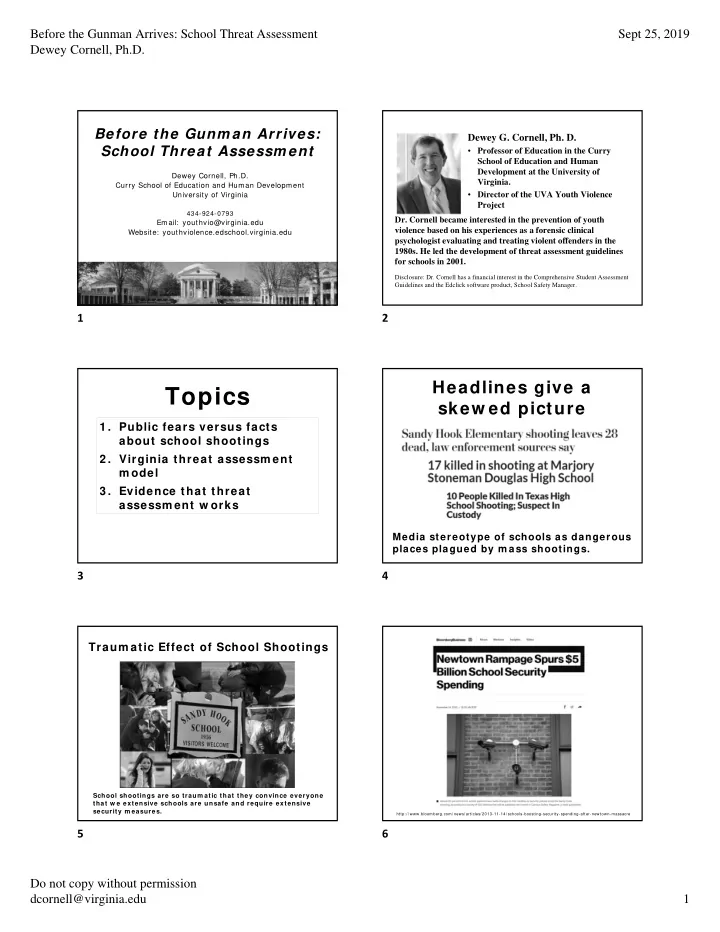
Headlines give a skew ed picture

Media stereotype of schools as dangerous places plagued by m ass shootings.

Traum atic Effect of School Shootings

School shootings are so traum atic that they convince everyone that w e extensive schools are unsafe and require extensive security m easures.

http: / / www.bloomberg.com/ news/ articles/ 2013-11-14/ schools-boosting-security-spending-after-newtown-massacre

1 2 3 4 5 6

slide-2
SLIDE 2

Before the Gunman Arrives: School Threat Assessment Dewey Cornell, Ph.D. Sept 25, 2019 Do not copy without permission dcornell@virginia.edu 2

https: / / www.nbcnews.com/ news/ us-news/ schools-are-spending-billions-high-tech-security-are-students-any-n875611 https: / / www.wzzm13.com/ article/ news/ education/ fruitport-designs-new-48m-high-school-with-places-to-hide-from-mass- shooters/ 69-6ee8154f-76a6-45bd-87c5-e3c60a0dce2f

Bullet-Resistant Entrances Safe Room s

https: / / www.newsweek.com/ oklahoma-schools-storm-shelters-shooting-824328

7 8 9 10 11 12

slide-3
SLIDE 3

Before the Gunman Arrives: School Threat Assessment Dewey Cornell, Ph.D. Sept 25, 2019 Do not copy without permission dcornell@virginia.edu 3

Research on School Security

Little evidence of increased safety. Concerns that students are m ore anxious.

W hat are the facts about school shootings?

389 shootings in 6 years since Sandy Hook shooting. Maps like this convey the idea that school shootings are pervasive.

https://everytownresearch.org/gunfire-in-school/#

How many shootings

  • utside of schools?

CDC Annual Records

36,000 deaths + 63,000 injuries ~ 1 0 0 ,0 0 0 total shootings

Shooting deaths from: National Vital Statistics http://webappa.cdc.gov/sasweb/ncipc/dataRestriction_inj.html Shooting injuries from: http://webappa.cdc.gov/sasweb/ncipc/nfirates2001.html

Six Years of Shootings

  • 389 in schools versus
  • 600,000 outside

schools For every shooting in a school, there are 1,500

  • utside of school

13 14 15 16 17 18

slide-4
SLIDE 4

Before the Gunman Arrives: School Threat Assessment Dewey Cornell, Ph.D. Sept 25, 2019 Do not copy without permission dcornell@virginia.edu 4

Six Years of Shootings

►389 in schools versus ►600,000 outside

schools For every shooting in a school, there are 1,500 outside

  • f school

9847 4455 1209 629 533 492 288 211 49

2000 4000 6000 8000 10000 12000

Residence Street Parking lot/garage Outdoors Restaurant/bar Store/gas station Public building/business Hotel/motel School

2005‐2010 Homicides in 37 States

Restaurants are 10x more dangerous than schools. Homes are 200x more dangerous than schools.

Source: FBI National Incident-Based Reporting System (NIBRS) database. Selected locations. School includes colleges. See Nekvasil, Cornell, & Huang (2015) Psychology of Violence, 5, 236-245.

4 3 1 incidents w ith a youth hom icide at school over 2 5 years 4 3 1 Youth Hom icide I ncidents at School

W hat percentage of youth hom icides occur at school? A) 5 0 % B) 1 0 % C) 2 %

Youth m eans school-age, 5 -1 8 School includes travel to and from school.

4 3 1 Youth Hom icide I ncidents at School

W hat percentage of youth hom icides occur at school? A) 5 0 % B) 1 0 % C) 2 %

Youth m eans school-age, 5 -1 8 School includes travel to and from school.

4 3 1 Youth Hom icide I ncidents at School

W hat percentage of victim s w ere killed on-cam pus?

A) 9 8 % B) 7 8 % C) 5 8 %

Off-cam pus includes travel to and from school

  • r attending off-cam pus school event.

19 20 21 22 23 24

slide-5
SLIDE 5

Before the Gunman Arrives: School Threat Assessment Dewey Cornell, Ph.D. Sept 25, 2019 Do not copy without permission dcornell@virginia.edu 5

4 3 1 Youth Hom icide I ncidents at School

W hat percentage of victim s w ere killed on-cam pus?

A) 9 8 % B) 7 8 % C) 5 8 %

Off-cam pus includes travel to and from school

  • r attending off-cam pus school event.

4 3 1 Youth Hom icide I ncidents at School

W hat percentage of youth hom icide incidents involve a single victim ?

A) 9 1 % B) 5 1 % C) 1 1 %

4 3 1 Youth Hom icide I ncidents at School

W hat percentage of youth hom icide incidents involve a single victim ?

A) 9 1 % B) 5 1 % C) 1 1 %

4 3 1 Youth Hom icide I ncidents at School

W hat percentage of perpetrators are students? A) 9 3 % B) 7 3 % C) 5 3 %

4 3 1 Youth Hom icide I ncidents at School

W hat percentage of perpetrators are students? A) 9 3 % B) 7 3 % C) 5 3 %

4 3 1 Youth Hom icide I ncidents at School

W hat percentage of perpetrators are W hite? A) 9 3 % B) 5 3 % C) 1 3 %

25 26 27 28 29 30

slide-6
SLIDE 6

Before the Gunman Arrives: School Threat Assessment Dewey Cornell, Ph.D. Sept 25, 2019 Do not copy without permission dcornell@virginia.edu 6

4 3 1 Youth Hom icide I ncidents at School

W hat percentage of perpetrators are W hite? A) 9 3 % B) 5 3 % C) 1 3 %

4 3 1 Youth Hom icide I ncidents at School

W hat w as the m ost com m on m otive for the perpetrator? A) Dating conflict B) Braw l/ street fight C) Gang activity

4 3 1 Youth Hom icide I ncidents at School

W hat w as the m ost com m on m otive for the perpetrator? A) Dating conflict B) Braw l/ street fight C) Gang activity

4 3 1 Youth Hom icide I ncidents at School

There is no single profile of a school hom icide. Cases differ w idely in circum stances, age, race, and m otive.

Prevention m eans “to keep som ething from happening” Crisis response is not prevention.

A crisis occurs w hen prevention has failed.

31 32 33 34 35 36

slide-7
SLIDE 7

Before the Gunman Arrives: School Threat Assessment Dewey Cornell, Ph.D. Sept 25, 2019 Do not copy without permission dcornell@virginia.edu 7

You don’t prevent forest fires by w aiting until the trees are blazing. You don’t prevent forest fires by w aiting until the trees are blazing.

https: / / www.npr.org/ 2019/ 08/ 09/ 748836909/ careful-with-those-birthday-candles-smokey-beloved-bear-turns-75

http: / / time.com/ 5201713/ what-is-stop-school-violence-act/

The nationw ide m ovem ent to place threat assessm ent team s in schools is a critical shift tow ard prevention.

States Are Moving Schools to Use Threat Assessm ent

  • State law s
  • State regulations
  • Model practices and guides
  • State training

W hat is Threat Assessm ent?

Threat assessm ent is a problem - solving approach to violence prevention that involves assessm ent and intervention w ith students w ho have threatened violence in som e w ay.

37 38 39 40 41 42

slide-8
SLIDE 8

Before the Gunman Arrives: School Threat Assessment Dewey Cornell, Ph.D. Sept 25, 2019 Do not copy without permission dcornell@virginia.edu 8 Threat Assessm ent is a violence prevention strategy.

1.Identification: friends, family members, or others seek

help when concerned about someone in distress/threatening violence.

2.Evaluation: Threat assessment team evaluates the

seriousness of the threat.

3.Intervention: The team initiates assistance to address

the underlying problem, conflict or need. In the most serious cases, protective action is taken. Threat Assessm ent For Schools

  • 2 0 0 0 FBI report recom m ending school threat assessm ent
  • 2 0 0 2 Secret Service and US Dept of Education study and

guide on school threat assessm ent

Threat Assessm ent

Threat Assessm ent in Schools

School-Based Threat Assessm ent

1 . Com pared to adults, students

  • frequently m ake threats;
  • often engage in fights;

2 . Over-reactions to student m isbehavior have serious negative consequences. 3 . Schools have a duty to educate all students.

43 44 45 46 47 48

slide-9
SLIDE 9

Before the Gunman Arrives: School Threat Assessment Dewey Cornell, Ph.D. Sept 25, 2019 Do not copy without permission dcornell@virginia.edu 9

Accurate Threat Assessm ent Avoids 2 Errors … 1 . Over-reaction Accurate Threat Assessm ent Avoids 2 Errors … 2 . Under-Reaction

  • Developed 2 0 0 1 at

University of Virginia

  • School-based team s gather

inform ation

  • Follow decision-tree to

determ ine w hether threat is transient or substantive

  • Take protective action if

substantive

  • Attem pt to resolve the

problem underlying the threat

2 0 1 8 Manual

Virginia Model of School Threat Assessm ent

Form s Freely Available

https:/ / w w w .schoolta.com /

Continuum of Threats

  • Warning of impending violence
  • Attempts to intimidate or frighten
  • Thrill of causing a disruption
  • Attention-seeking, boasting
  • Fleeting expressions of anger
  • Jokes
  • Figures of speech

Transient Substantive Step 1. Evaluate the threat.

Obtain a detailed account of the threat, usually by interviewing the person who made the threat, the intended victim, and other witnesses. Write the exact content of the threat and key observations by each party. Consider the circumstances in which the threat was made and the student’s intentions. Is there communication of intent to harm someone or behavior suggesting intent to harm?

No

Not a threat. Might be expression of anger that merits attention.

Yes Step 2. Attempt to resolve the threat as transient.

Attempt to resolve conflict or threat.

Yes

Case resolved as transient. Add services as needed. Is the threat an expression of humor, rhetoric, anger, or frustration that can be resolved so that there is no intent to harm?

No Step 3. Respond to a substantive threat.

For all substantive threats:

  • a. Take immediate precautions to protect potential victims.
  • b. Warn intended victim and parents.
  • c. Look for ways to resolve conflict.
  • d. Discipline student, when time is appropriate.

Serious

Case resolved as serious substantive threat. Add services as needed. Serious means a threat to hit, fight, or beat up whereas Very serious means a threat to kill, rape, or cause very serious injury with a weapon.

Very Serious Step 4. Conduct a safety evaluation for a very serious substantive threat.

In addition to a-d above, the student may be briefly placed elsewhere or suspended pending completion of the following:

  • e. Screen student for mental health services and counseling; refer as needed.
  • f. Law enforcement investigation.
  • g. Develop safety plan that reduces risk and addresses student needs. Plan should

include review of Individual Educational Plan or “child find” procedures if appropriate.

Step 5. Implement and monitor the safety plan.

Document the plan. Maintain contact with the student. Revise plan as needed.

49 50 51 52 53 54

slide-10
SLIDE 10

Before the Gunman Arrives: School Threat Assessment Dewey Cornell, Ph.D. Sept 25, 2019 Do not copy without permission dcornell@virginia.edu 10

Step 1. Evaluate the threat.

Obtain a detailed account of the threat, usually by interviewing the person who made the threat, the intended victim, and other witnesses. Write the exact content of the threat and key observations by each party. Consider the circumstances in which the threat was made and the student’s intentions. Is there communication of intent to harm someone or behavior suggesting intent to harm?

No

Not a threat. Might be expression of anger that merits attention.

Yes Step 2. Attempt to resolve the threat as transient.

Attempt to resolve conflict or threat.

Yes

Case resolved as transient. Add services as needed. Is the threat an expression of humor, rhetoric, anger, or frustration that can be resolved so that there is no intent to harm?

No Step 3. Respond to a substantive threat.

For all substantive threats:

  • a. Take immediate precautions to protect potential victims.
  • b. Warn intended victim and parents.
  • c. Look for ways to resolve conflict.
  • d. Discipline student, when time is appropriate.

Serious

Case resolved as serious substantive threat. Add services as needed. Serious means a threat to hit, fight, or beat up whereas Very serious means a threat to kill, rape, or cause very serious injury with a weapon.

Very Serious Step 4. Conduct a safety evaluation for a very serious substantive threat.

In addition to a-d above, the student may be briefly placed elsewhere or suspended pending completion of the following:

  • e. Screen student for mental health services and counseling; refer as needed.
  • f. Law enforcement investigation.
  • g. Develop safety plan that reduces risk and addresses student needs. Plan should

include review of Individual Educational Plan or “child find” procedures if appropriate.

Step 5. Implement and monitor the safety plan.

Document the plan. Maintain contact with the student. Revise plan as needed.

Step 1. Evaluate the threat.

Obtain a detailed account of the threat, usually by interviewing the person who made the threat, the intended victim, and other witnesses. Write the exact content of the threat and key observations by each party. Consider the circumstances in which the threat was made and the student’s intentions. Is there communication of intent to harm someone or behavior suggesting intent to harm?

No

Not a threat. Might be expression of anger that merits attention.

Yes Step 2. Attempt to resolve the threat as transient.

Attempt to resolve conflict or threat.

Yes

Case resolved as transient. Add services as needed. Is the threat an expression of humor, rhetoric, anger, or frustration that can be resolved so that there is no intent to harm?

No Step 3. Respond to a substantive threat.

For all substantive threats:

  • a. Take immediate precautions to protect potential victims.
  • b. Warn intended victim and parents.
  • c. Look for ways to resolve conflict.
  • d. Discipline student, when time is appropriate.

Serious

Case resolved as serious substantive threat. Add services as needed. Serious means a threat to hit, fight, or beat up whereas Very Serious means a threat to kill, rape, or cause very serious injury with a weapon.

Very Serious Step 4. Conduct a safety evaluation for a very serious substantive threat.

In addition to a-d above, the student may be briefly placed elsewhere or suspended pending completion of the following:

  • e. Screen student for mental health services and counseling; refer as needed.
  • f. Law enforcement investigation.
  • g. Develop safety plan that reduces risk and addresses student needs. Plan should

include review of Individual Educational Plan or “child find” procedures if appropriate.

Step 5. Implement and monitor the safety plan.

Document the plan. Maintain contact with the student. Revise plan as needed.

Step 1. Evaluate the threat.

Obtain a detailed account of the threat, usually by interviewing the person who made the threat, the intended victim, and other witnesses. Write the exact content of the threat and key observations by each party. Consider the circumstances in which the threat was made and the student’s intentions. Is there communication of intent to harm someone or behavior suggesting intent to harm?

No

Not a threat. Might be expression of anger that merits attention.

Yes Step 2. Attempt to resolve the threat as transient.

Attempt to resolve conflict or threat.

Yes

Case resolved as transient. Add services as needed. Is the threat an expression of humor, rhetoric, anger, or frustration that can be resolved so that there is no intent to harm?

No Step 3. Respond to a substantive threat.

For all substantive threats:

  • a. Take immediate precautions to protect potential victims.
  • b. Warn intended victim and parents.
  • c. Look for ways to resolve conflict.
  • d. Discipline student, when time is appropriate.

Serious

Case resolved as serious substantive threat. Add services as needed. Serious means a threat to hit, fight, or beat up whereas Very serious means a threat to kill, rape, or cause very serious injury with a weapon.

Very Serious Step 4. Conduct a safety evaluation for a very serious substantive threat.

In addition to a-d above, the student may be briefly placed elsewhere or suspended pending completion of the following:

  • e. Screen student for mental health services and counseling; refer as needed.
  • f. Law enforcement investigation.
  • g. Develop safety plan that reduces risk and addresses student needs. Plan should

include review of Individual Educational Plan or “child find” procedures if appropriate.

Step 5. Implement and monitor the safety plan.

Document the plan. Maintain contact with the student. Revise plan as needed.

Step 1. Evaluate the threat.

Obtain a detailed account of the threat, usually by interviewing the person who made the threat, the intended victim, and other witnesses. Write the exact content of the threat and key observations by each party. Consider the circumstances in which the threat was made and the student’s intentions. Is there communication of intent to harm someone or behavior suggesting intent to harm?

No

Not a threat. Might be expression of anger that merits attention.

Yes Step 2. Attempt to resolve the threat as transient.

Attempt to resolve conflict or threat.

Yes

Case resolved as transient. Add services as needed. Is the threat an expression of humor, rhetoric, anger, or frustration that can be resolved so that there is no intent to harm?

No Step 3. Respond to a substantive threat.

For all substantive threats:

  • a. Take immediate precautions to protect potential victims.
  • b. Warn intended victim and parents.
  • c. Look for ways to resolve conflict.
  • d. Discipline student, when time is appropriate.

Serious

Case resolved as serious substantive threat. Add services as needed. Serious means a threat to hit, fight , or beat up versus Very Serious means a threat to kill, rape, or cause very serious injury with a weapon.

Very Serious Step 4. Conduct a safety evaluation for a very serious substantive threat.

In addition to a-d above, the student may be briefly placed elsewhere or suspended pending completion of the following:

  • e. Screen student for mental health services and counseling; refer as needed.
  • f. Law enforcement investigation.
  • g. Develop safety plan that reduces risk and addresses student needs. Plan should

include review of Individual Educational Plan or “child find” procedures if appropriate.

Step 5. Implement and monitor the safety plan.

Document the plan. Maintain contact with the student. Revise plan as needed.

Research on Threat Assessm ent

1. Cornell, D., Sheras, P. Kaplan, S., McConville, D., Douglass, J., Elkon, A., McKnight, L., Branson, C., & Cole, J. (2004). Guidelines for student threat assessment: Field-test findings. School Psychology Review, 33, 527-546. 2. Kaplan, S., & Cornell, D. (2005). Threats of violence by students in special education. Behavioral Disorders, 31, 107-119. 3. Strong, K., & Cornell, D. (2008). Student threat assessment in Memphis City Schools: A descriptive report. Behavioral Disorders, 34, 42-54. 4. Allen, K., Cornell, D., Lorek, E., & Sheras, P. (2008). Response of school personnel to student threat assessment training. School Effectiveness and School Improvement, 19, 319-332. 5. Cornell, D., Sheras, P., Gregory, A., & Fan, X. (2009). A retrospective study of school safety conditions in high schools using the Virginia Threat Assessment Guidelines versus alternative approaches. School Psychology Quarterly, 24, 119-129. 6. Cornell, D., Gregory, A., & Fan, X. (2011). Reductions in long-term suspensions following adoption of the Virginia Student Threat Assessment Guidelines. Bulletin of the National Association of Secondary School Principals, 95, 175-194. 7. Cornell, D., Allen, K., & Fan, X. (2012). A randomized controlled study of the Virginia Student Threat Assessment Guidelines in grades K-12. School Psychology Review, 41, 100-115. 8. Cornell, D. & Lovegrove, P. (2015). Student threat assessment as a method for reducing student suspensions. In D. Losen (Ed.). Closing the School Discipline Gap: Research for Policymakers. New York, NY: Teachers College Press. 9. Nekvasil, E., Cornell, D. (2015). Student threat assessment associated with positive school climate in middle schools. Journal of Threat Assessment and Management 2, 98-113. http://dx.doi.org/10.1037/tam0000038 10. Burnette, A. G., Datta, P. & Cornell, D. G. (2017). The distinction between transient and substantive student threats. Journal of Threat Assessment and Management. http://psycnet.apa.org/record/2017-56103-001 11. Cornell, D., Maeng, J., Burnette, A.G., Jia, Y., Huang, F., Konold, T., Datta, P., Malone, M., Meyer, P. (2017). Student threat assessment as a standard school safety practice: Results from a statewide implementation study. School Psychology Quarterly. http://dx.doi.org/10.1037/spq0000220 12. Cornell, D., Maeng, J., Huang, F., Shukla, K., & Konold, T. (2018). Racial/ethnic parity in disciplinary consequences using student threat assessment. School Psychology Review 47, 183-195.

55 56 57 58 59 60
slide-11
SLIDE 11

Before the Gunman Arrives: School Threat Assessment Dewey Cornell, Ph.D. Sept 25, 2019 Do not copy without permission dcornell@virginia.edu 11

Research on Threat Assessm ent

1.Field-test

What happens when you try the model?

2.Controlled studies

Cross-sectional, retrospective study: How do schools using the model compare to other schools? Pre-post study: How do schools change after adopting the model? Randomized controlled trial: What happens to students in schools randomly chosen to use the model?

3.Large-scale implementation

What happens when the whole state adopts the model?

Concerns about School Threat Assessm ent

  • Criticism that it w ill result in

high rates of arrest

  • Belief that it w ill result in high

rates of suspension

  • Disproportionately affect

m inority youth

Research on Threat Assessm ent

  • 1. 99% of threats not carried out.
  • 2. Only 1% expelled, 1% arrested.
  • 3. Suspension rates decreased.
  • 4. Racial disparities reduced or absent.
  • 5. Counseling used more often.
  • 6. More positive school climate.

Routine Practice Study

  • Everyday practice results from 339

Virginia schools

  • 884 threat cases
  • Threat demographics
  • Racial/ ethnic differences

Selected sample of 841 threat assessment cases (652 transient and 189 substantive) reported by 339 Virginia public schools during the 2014-15 school year

6 26 37 70 67 106 82 78 93 79 81 54 36 26

25 50 75 100

P K 1 2 3 4 5 6 7 8 9 10 11 12

Number of threts

Threats by Grade

One case can involve m ore than one victim .

3 4 10 15 71

25 50 75

Administrator Staff Whole school/group Teacher Student

Intended Victim (%)

n = 861

61 62 63 64 65 66

slide-12
SLIDE 12

Before the Gunman Arrives: School Threat Assessment Dewey Cornell, Ph.D. Sept 25, 2019 Do not copy without permission dcornell@virginia.edu 12

20 40 60 80 100

Threat Type

77 17 6

Percent of Cases

Threat Classification (%)

n = 856

Very Serious Substantive Serious Substantive Transient

0 .5 2 9 7 .5

20 40 60 80 10 0

Threat Carried Out Attem pted but Averted Threat Not Attem pted

Threat Outcom es

(n = 844)

2 2 4 7 86

20 40 60 80 100

Other Transfer to regular school Homebound instruction Transfer to alternative school No change

School Placement Outcome (%) n = 844

Percentages for 8 4 4 threat cases from 3 3 9 schools. One case can involve m ore than one outcom e.

0.4 0.5 1 4 5 20 38 61

10 20 30 40 50 60 70

Juvenile detention (3) Expelled (4) Arrested (9) Court charges (31) Expulsion reduced to suspension Suspension in school Suspension out of school Reprimand

Disciplinary Outcomes (%)

n = 844

No statistically significant differences for W hite vs Black or W hite vs Hispanic students

38 17 0.9 0.4 0.4 41 16 1.3 0.9 0.4 34 12 1.4

10 20 30 40

Suspended out of school Change in school placement Arrested Expelled Placed in juvenile detention

Disciplinary Outcomes (%) n = 751

White (453) Black (225) Hispanic (73)

67 68 69 70 71 72

slide-13
SLIDE 13

Before the Gunman Arrives: School Threat Assessment Dewey Cornell, Ph.D. Sept 25, 2019 Do not copy without permission dcornell@virginia.edu 13 Challenges Facing School Threat Assessm ent

1 . Standards for high quality training and im plem entation 2 . I m prove public understanding of threat assessm ent 3 . Better integration of law enforcem ent on school team s

2 0 1 8 -1 9 Research Team

This work was supported in part by Grant # NI J 2014-CK-BX-0004 awarded by the National I nstitute of Justice, Office of Justice Programs, U.S. Department of Justice. The

  • pinions, findings, and conclusions or recommendations expressed in this report are those
  • f the authors and do not necessarily reflect those of the U.S. Department of Justice or

the Virginia Department of Criminal Justice Services. Disclosure: Dewey Cornell is the primary developer of the Virginia Student Threat Assessment Guidelines and author of the manual, Comprehensive School Threat Assessment Guidelines.

http:/ / youthviolence.edschool.virginia.edu

73 74 75