Topic Outline VENOUS THROMBOEMBOLISM: So Many QuestionsOy! 1. - - PowerPoint PPT Presentation

topic outline venous thromboembolism so many questions oy
SMART_READER_LITE
LIVE PREVIEW

Topic Outline VENOUS THROMBOEMBOLISM: So Many QuestionsOy! 1. - - PowerPoint PPT Presentation

6/20/2019 Topic Outline VENOUS THROMBOEMBOLISM: So Many QuestionsOy! 1. Direct Oral Anti-Coagulants (DOACs): A Little Review 2. Obesity 47 th Annual UCSF Advances in Internal Medicine 3. Gastric Bypass 4. Coagulation Tests and Drug


slide-1
SLIDE 1

6/20/2019 1

47th Annual UCSF Advances in Internal Medicine

VENOUS THROMBOEMBOLISM: So Many Questions…Oy!

Andrew D. Leavitt, MD

June 20, 2019

Topic Outline

1. Direct Oral Anti-Coagulants (DOACs): A Little Review 2. Obesity 3. Gastric Bypass 4. Coagulation Tests and Drug levels 5. Superficial Venous Thrombosis (SVT) 6. IVC Filters 7. Flight / Extended Travel 8. Your Cases

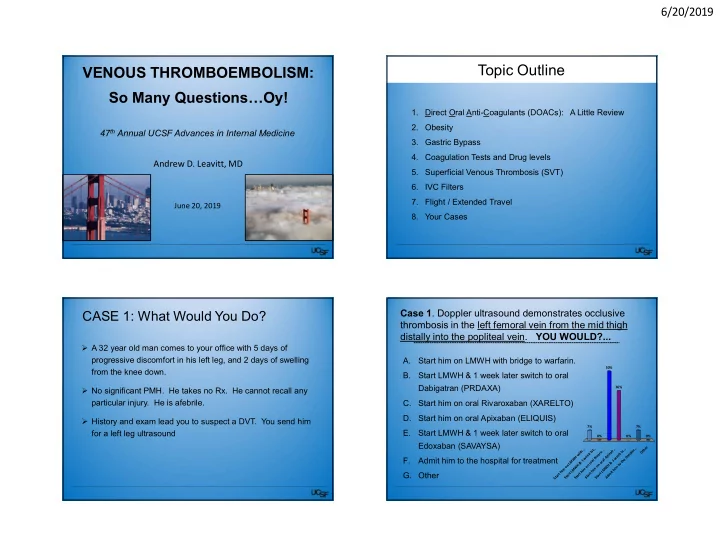
  • A 32 year old man comes to your office with 5 days of

progressive discomfort in his left leg, and 2 days of swelling from the knee down.

  • No significant PMH. He takes no Rx. He cannot recall any

particular injury. He is afebrile.

  • History and exam lead you to suspect a DVT. You send him

for a left leg ultrasound

CASE 1: What Would You Do?

Case 1. Doppler ultrasound demonstrates occlusive thrombosis in the left femoral vein from the mid thigh distally into the popliteal vein. YOU WOULD?...

A. Start him on LMWH with bridge to warfarin. B. Start LMWH & 1 week later switch to oral Dabigatran (PRDAXA) C. Start him on oral Rivaroxaban (XARELTO) D. Start him on oral Apixaban (ELIQUIS) E. Start LMWH & 1 week later switch to oral Edoxaban (SAVAYSA) F. Admit him to the hospital for treatment

  • G. Other

S t a r t h i m

  • n

L M W H w i t h . . . S t a r t L M W H & 1 w e e k l a t . . S t a r t h i m

  • n
  • r

a l R i v a r

  • .

. . S t a r t h i m

  • n
  • r

a l A p i x a b . . S t a r t L M W H & 1 w e e k l a . . . A d m i t h i m t

  • t

h e h

  • s

p i t a . . . O t h e r 7% 0% 50% 0% 7% 0% 36%

slide-2
SLIDE 2

6/20/2019 2

A LITTLE DOAC AND ANTICOAGULATION REVIEW

TF TF

XI XIa

Fibrinogen Fibrin X-linked Fibrin XIIIa

X II IIa (Thrombin) Xa Va

Ca++/Pl

TF/VIIa VIIa TF VII IX IXa VIIIa

Ca++/Pl

Coagulation Cascade in Patients

Tissue Factor Tissue Factor Tissue Factor Tissue Factor Tissue Factor Tissue Factor

TF TF = Warfarin

DabigaTran RivaroXaban ApiXaban EdoXaban BetriXaban

DOACs – A Few Summary Points

  • All have a black box warning with two key points:
  • Premature discontinuation increases risk of thrombotic events

These findings are from the Atrial Fibrillation trials Therefore: Parenteral bridging if DOAC to Warfarin

  • Spinal/Epidural Hematoma

Need protocols for stopping/starting around procedures

  • Decline in renal function leads to increased bleeding risk
  • Think Elderly, NSAIDs, Dehydration/nausea/vomiting (END)
  • Be sure proceduralist is aware your patient is taking the medication
  • Not for use with mechanical heart valves
  • Patients need follow up but you lack the INR clinic connection

EXTREMELY CONCERNED ABOUT THE FOLLOWING OUTCOMES: Recurrent VTE 33% Major bleeding 21% Moderate bleed 16% All-cause death 29% PREFERENCES FOR THEIR ANTICOAGULANT: Reversible 53% Blood test to monitor 30% AGREE WITH THESE STATEMENTS: Regular blood tests are inconvenient 18% Comfortable using the newest Rx 15% Difficult to change diet for for the Rx 17%

Anticoagulant Preference and Concerns among Venous Thromboembolism Patients

Lutsey et al. Thromb Haemost 2018:118:553-61

A Survey of 519 VTE Patients

slide-3
SLIDE 3

6/20/2019 3 Anticoagulation Care Tips

1. Everyone wants to know ‘how long?’ But you cannot please everyone. 2. I do not say life-long. Extended….indefinite…let’s see…? 3. What are the patient’s wants AND fears? 4. Extended use REQUIRES ongoing risk/benefit assessment. 5. DOACs and renal function! 6. DOACs and anti-platelet agents 7. Much we do not know. Admit this and gain the patient’s confidence and their participation 8. Have a visit before stopping anticoagulation – warn them about symptoms

DOACs and Obesity

  • A 32 year old man, 140 Kg (BMI 44 Kg/m2), comes to your
  • ffice with 5 days of progressive discomfort in his left leg, and

2 days of swelling from the knee down.

  • No significant PMH. He takes no Rx. He cannot recall any

particular injury. He is afebrile.

  • History and exam lead you to suspect a DVT. You send him

for a left leg ultrasound

CASE #2

Case 2. Doppler ultrasound demonstrates occlusive thrombosis in the left femoral vein from the mid thigh distally into the popliteal vein. YOU WOULD?...

A. Start him on LMWH with bridge to warfarin. B. Start LMWH & 1 week later switch to oral Dabigatran (PRDAXA) C. Start him on oral Rivaroxaban (XARELTO) D. Start him on oral Apixaban (ELIQUIS) E. Start LMWH & 1 week later switch to oral Edoxaban (SAVAYSA) F. Admit him to the hospital for treatment

  • G. Other

S t a r t h i m

  • n

L M W H w i t h . . . S t a r t L M W H & 1 w e e k l a t . . S t a r t h i m

  • n
  • r

a l R i v a r

  • .

. . S t a r t h i m

  • n
  • r

a l A p i x a b . . S t a r t L M W H & 1 w e e k l a . . . A d m i t h i m t

  • t

h e h

  • s

p i t a . . . O t h e r 27% 0% 18% 0% 9% 5% 41%

  • Extreme obesity/morbid obesity = BMI > 40 Kg/m2

7.7% of adult US population ~20 million people

  • CDC VTE estimates:

900,000 people affected in the US/year ~70,000 extreme obese patients will need anticoagulation

  • International Society of Thrombosis and Hemostasis (ISTH) 2016:

“Use of the DOACs in Obese People" Due to lack of data, suggest against us in patients weighing >120Kg, or with BMI >40kg/m2 But, if you do, obtain a peak and trough level

DOACs & Obesity

slide-4
SLIDE 4

6/20/2019 4

DOACs & Obesity

Efficacy and Safety of Direct Oral Factor Xa Inhibitors in 795 Morbidly Obese Patients Kushnir et al. Am Soc Hem Annual Mtg Abstract Dec 2018

Montefiore Medical Center Institutional Database Adults with BMI > 40 kg/m2 -- 366 VTE; 429 A Fib Apixaban, Rivaroxaban, or Warfarin for AF or VTE: 3/1/2013 – 3/1/2017 Reviewed charts for recurrent VTE and bleeding (366 VTE patients) VTE confirmed by imaging Bleeding per standard/accepted ISTH criteria Time from first Rx to recurrent VTE and bleed for 366 VTE patients Recurrent VTE: 2.1% apixaban; 2% rivaroxaban; 1.2% warfarin 92 of 366 had BMI >50 (!). No recurrent VTE Bleeding (clinically relevant and major): equal across the 3 groups

DOACs & Obesity

Piran S, et al. Res Pract Thromb Haemost. 2018;2:684-8

SUBJECTS:

  • 38 patients > 120 Kg
  • 7 Apixaban; 10 Dabigatran; 21 Rivaroxaban
  • Age (mean) 64 +/- 11 years
  • 30 of 38 Male
  • Median Weight 132.5 Kg

FINDINGS:

  • 1. 21% had a peak plasma concentration < the usual on-therapy range
  • 2. All but 2 had a peak higher than the median trough

DOACs and Gastric Bypass

  • The 32 year old 140 Kg (BMI 44 Kg/m2) man from the prior

question has gastric bypass and he drops his weight to 98 Kg (BMI 29 Kg/m2) and he comes to your office with 5 days of progressive discomfort in his left leg, and 2 days of swelling from the knee down.

  • No significant PMH. He takes no Rx. He cannot recall any

particular injury. He is afebrile.

  • History and exam lead you to suspect a DVT. You send him

for a left leg ultrasound

CASE #3

Case 3. Doppler ultrasound demonstrates occlusive thrombosis in the left femoral vein from the mid thigh distally into the popliteal vein. YOU WOULD?...

A. Start him on LMWH with bridge to warfarin. B. Start LMWH & 1 week later switch to oral Dabigatran (PRDAXA) C. Start him on oral Rivaroxaban (XARELTO) D. Start him on oral Apixaban (ELIQUIS) E. Start LMWH & 1 week later switch to oral Edoxaban (SAVAYSA) F. Admit him to the hospital for treatment

  • G. Other

S t a r t h i m

  • n

L M W H w i t h . . . S t a r t L M W H & 1 w e e k l a t . . S t a r t h i m

  • n
  • r

a l R i v a r

  • .

. . S t a r t h i m

  • n
  • r

a l A p i x a b . . S t a r t L M W H & 1 w e e k l a . . . A d m i t h i m t

  • t

h e h

  • s

p i t a . . . O t h e r 7% 0% 25% 0% 0% 11% 57%

slide-5
SLIDE 5

6/20/2019 5

Rou-en-Y Sleeve Gastrectomy Gastric Banding

Biliopancreatic Diversion with duodenal switch Martin KA et al., Am J Med 2017(130)517-24

Gastric Bypass

DOACs: Coagulation Testing & Drug Level Testing

DOACs & Laboratory Testing

We Lack Data Correlating Drug Level and Efficacy/Hemorrhage

aPTT and PT: too insensitive, too sensitive, no clear dose response Direct Thrombin Inhibitor – Dabigatran: aPTT more sensitive than PT

  • But, not standardized and prolongation not predictable
  • And, normal aPTT does not rule out ‘on therapy’ drug level

Thrombin Time is exquisitely sensitive If normal, then essentially no clinically significant drug in system Xa Inhibitors – Rivaroxaban, Apixaban & Edoxaban: PT is more sensitive than is the aPTT

  • But a normal PT does not rule out ‘on therapy’ drug level

Need chromogenic Factor Xa activity assay standardized to the Rx No effect on Thrombin Time

DOACs & Drug Level Testing

I have ordered DOAC drug level testing for:

  • A. Dabigatran (PRDAXA)
  • B. Rivaroxaban (XARELTO)
  • C. Apixaban (ELIQUIS)
  • D. Edoxaban (SAVAYSA)
  • E. None of the DOACs

Dabigatran (PRDAXA) Rivaroxaban (XARELTO) Apixaban (ELIQUIS) Edoxaban (SAVAYSA) None of the DOACs

0% 0% 96% 4% 0%

slide-6
SLIDE 6

6/20/2019 6

MyHealth.Alberta.Ca

Veins of the Leg – A Brief Overview

*

*The confusing “superficial femoral vein” segment of the deep vein system.

Superficial Venous Thrombosis

  • A 32 year old man comes to your office with a 5 days of a

cord-like ‘thing’ on his inner left thigh.

  • He has no significant past medical history and takes no
  • medications. He cannot recall any particular injury or trauma

to the area. He is afebrile.

  • You palpate the cord. It is tender and there is mild erythema.

You suspect a blood clot and send him for a Doppler US.

CASE 5: What Would You Do?

  • A. Warm soaks, elevation, NSAID, & Follow

up US

  • B. LMWH with bridge to warfarin x 6 weeks.
  • C. LMWH with bridge to warfarin x 12 weeks.
  • D. Fondaparinux or LMWH x 6 weeks.
  • E. Fondaparinux or LMWH x 12 weeks.

F. Rivaroxaban or Apixaban x 6 weeks

  • G. Rivaroxaban or Apixaban x 12 weeks
  • H. Other

Case 5. A Doppler Ultrasound demonstrates a 6 cm thrombus in the left saphenous vein. No DVT

  • identified. You recommend:

W a r m s

  • a

k s , e l e v a t i

  • n

, N S A I D , & . . . L M W H w i t h b r i d g e t

  • w

a r f a r i n x . . L M W H w i t h b r i d g e t

  • w

a r f a r i n x . . F

  • n

d a p a r i n u x

  • r

L M W H x 6 w e e k s . F

  • n

d a p a r i n u x

  • r

L M W H x 1 2 w e e k s . R i v a r

  • x

a b a n

  • r

A p i x a b a n x 6 w e e k s R i v a r

  • x

a b a n

  • r

A p i x a b a n x 1 2 w e e k s O t h e r

87% 0% 3% 0% 6% 3% 0% 0%

Superficial Vein Thrombosis: 2 Studies of Note

Decousus, et al., NEJM 363(13):1222-32, 2010.

Cumulative Risk (%) Years since SVT Diagnosis PE DVT HR @ 3mo: 87 (70-108) HR @ 5 Yr: 6.3 (5.6-7) HR @ 3 mo: 45 (34-61) HR @ 5 Yr: 2.9 (2.5-3.5)

Cannegieter, et al., BLOOD 125:1229-35, 2015.

Treatment: 2.5mg qD fonda x45D vs placebo Events: 13/1502 (0.9%) vs 88/1500 (5.9%) (Sx PE, DVT, Extension to Jxn, Recurrence) Rel Risk Reduction: 85% (95% CI: 74-92) DVT & PE (0.2% vs 1.3%): Rel Risk Reduction: 85% (50-95) Rel Risk Reduction maintained at day 77. CALISTO Study Danish National Registry Study 10,973 patients with SVT vs. 515,067 in comparison cohort Again found DVT and PE risk. Increased risk of MI and CVA Suggests ‘systemic disorder’

slide-7
SLIDE 7

6/20/2019 7

  • Recommends: Fondaparinux 2.5 mg sQ daily for 45 days for a new

diagnosis of isolated SVT ≥5 cm in length in the lower extremity. – Grade 2B recommendation

  • Recommends: Fondaparinux over LMWH

– Grade 3B recommendation

Superficial Vein Thrombosis & American College of Chest Physicians*

*Chest 2012;141(2)(suppl):e419S-e494S

  • Not all patients will agree due to cost and inconvenience.
  • In particular, anticoagulant treatment favored if:

(i) extensive (ii) above knee (iii) greater saphenous vein (iv) near saphenofemoral jxn (v) severe symptoms (vi) History of VTE or SVT (vii) active cancer (viii) recent surgery

Prevention of thromboembolic complications in patients with SVT given rivaroxaban or fondaparinux: The open-label, randomized, non-inferiority SURPRISE phase 3b trial

*Beyer-Westendorf et al., Lancet Haematol 2017 Mar;4(3)e105-113.

  • Age > 18
  • 27 sites in Germany
  • Enrollment: 4/25/2012 – 2/18/2016
  • Symptomatic SVT; 5cm or longer.
  • Randomized: 10 mg Rivarox qD (236) vs. 2.5 mg Fondaparinux qD (236)
  • Treatment: 45 days
  • Primary outcomes (@45 days:

Symptomatic DVT or PE Progression or recurrence of SVT All cause mortality at 45 days

  • Outcome: 3% (Rivaroxaban) vs 2% (Fondaparinux):
  • HR 1.9; 95% CI 0.6-6.4; p=0.0025 for non-inferiority
  • No increased bleeding with Rivaroxaban

IVC Filters – “You want to put that in ME?”

  • A. Simon Nitinol (Bard)
  • B. G2 (Bard)
  • C. Gunther-Tulip (Cook Medical)
  • D. Greenfield titanium (Boston Scientific)
  • E. Greenfield Stainless steel (Bos Sci)
  • F. Celect (Cook Medical)
  • G. Vena Tech LP (Braun Medical)
  • H. Vena Tech LGM (Braun Medical

I. TrapEase (Cordis Endovascular) J. OptEase (Cordis Endovascular)

  • K. Bird’s Nest (Cook Medical)

Carman & Alahmad, Update on Vena Cava Filters 2008

IVC Filter Placement in the U.S.

Stein, Arch Int Med (2004)164:1541; Smouse, Endovasc Today (2010) 74; Kuy J Vasac Surg (2014) 2:15.

Slide Adapted from Bill Geerts, THSNA 2016

slide-8
SLIDE 8

6/20/2019 8

RCT: IVC Filter for Proximal DVT

PREPIC-1 Decousus, et al., NEJM (1998) 338:409-15.

Patients at ‘high risk’ for PE; anticoagulated >3 months Outcomes No Filter (N=200) Filter (N=200) P

DAY 12 ALL PE 9 (4.8%) 2 (1.0%) 0.03 Symptomatic PE 5 (2.5%) 2 (1.0%) 0.25 Death 5 (2.5%) 5 (2.5%) 1.0 2 Years Symptomatic PE 12 (6.3%) 6 (3.4%) 0.16 Recurrent DVT 21 (12%) 37 (21%) 0.02 Death 40 (20%) 43 (22%) 0.65

Retrievable IVC Filter in Patients with PE

“PREPIC-2” JAMA (2015) 313:1627-35

RCT @ 18 centers in France (N=399) Unprovoked PE + DVT/SVT + >1 Additional Risk Factor(s)* Anticoagulation Anticoagulation + ALN Retrivable IVC Filter >3 mos

Outcome @ 3 months Anticoagulation (N=199) Anticoagulation + IVC Filter (N=200) P Recurrent PE 3 (1.5%) 6 (3%) 0.5 Fatal PE 2 6 DVT 1 1 1.04 Death 6.0% 7.5% 0.55

*Age >75: RV dysfunction; Active Cancer; Bilat or Iliocaval DVT; Cardioresp. failure

Guideline Recommendations

AACP/Chest (10th ed) 20161:

For patients with acute DVT or PE who are treated with anticoagulant, we recommend against the use of an IVC filter.

Anticoagulation Forum 20163:

Inferior vena cava filters are reserved for patients with acute VTE and contraindications to anticoagulation. Retrievable filters are strongly preferred.

AACP/Chest (9th ed) 20122

Recommend Against IVC filter as thromboprophylaxis in trauma or spinal cord injury.

Flight / Extended Travel – Some History

Simpson, K. Shelter deaths from pulmonary embolism. Lancet 1940 [prolonged sitting during WWII – soldiers sleeping in desk chairs] Homans, J. Thrombosis of the deep leg veins due to prolonged sitting. NEJM 1954 [VTE after confined sitting in car and air travel] Symington, IS. Medical hazard of air travel. Br Med J 1977 Prevalence and incidence are hard to pin down, but studies suggest…

(2001 NEJM) (2009) (2003) (2003 BMJ) (2003)

Gavish and Brenner Intern Emerg Med 2011(6):113-16.

(3,106 miles)

SFO to Chicago 1,846 miles; SFO to NYC 2,586 miles; SFO to London 5,367 miles

slide-9
SLIDE 9

6/20/2019 9

Flight / Extended Travel: Compression Stockings

Frequency and prevention of symptomless DVT in long-haul flights: a randomized trial

89 males; 142 females - all > 50 years old No personal VTE history. Negative baseline Ultrasound Randomized: 50% wore below the knee graduated (20-30 mm Hg) compression stockings (116 w/o; 115 w/; 100 from each arm had post travel ultrasound) Flight > 8 hours; Returned to UK within 6 weeks 12/116 (10%; 95% CI 4.8 – 16 %) developed calf DVT No DVT in those who wore the stockings Yes design problems, but a curious finding… LONFLIT5 JAP study supports the value of compression stockings

(Schurr JH, et al., Lancet 2001;357:1485-9) (Belcaro G, et al., Clin Appl Thromb Hemost 2003)

Flight / Extended Travel: Pharmacology

Venous Thrombosis from Air Travel: The LONFLIT3 Study:

(VTE prevention with ASA vs LMWH in high-risk subjects)

(Cesarone MR, et al., Angiology 2002;53:1-6)

300 Travelers, high risk* No Prophy vs. 400 mg asa daily x 3 days vs 1mg/kg enoxaparin 2-4 hours pre flight Control: 82 evaluable subjects - 4 DVT; 2 SVT ASA: 84 evaluable subjects - 3 DVT; 2 SVT LMWH: 82 evaluable subjects - 0 DVT; 1 SVT NOTE: 85% of the DVTs in non-aisle seats. 60% of thromboses were asymptomatic No gender bias Of the 7 women with thrombosis – 3 were taking OCPs

*VTE hx, coagulation disorder, obesity, limited mobility, cancer, large varicose veins

UCSF Non-malignant Hematology Clinic For Referrals: 415-353-2051 (phone line) 415-353-2467 (fax line)

Andrew D. Leavitt, MD 415-514-3432 andrew.leavitt@ucsf.edu

THANK YOU…QUESTIONS?

Courtesy of The New Yorker “Now, we’re not going to use the word ‘blame.’”

Flight / Extended Travel: What to do?

  • 1. As with all aspects of medicine, admit to lack of certainty, but provide advice…
  • 2. Thoughts
  • A. Compression stockings
  • B. Aisle seat
  • C. Keep space open under seat in front of you
  • D. Ankle flex/extension exercises every 1-2 hours (more is fine)
  • E. Stay hydrated - helps prevent stasis and makes you get up to us restroom
  • F. Avoid sleeping pills or set alarms to prevent extended stasis
  • G. Walk aisle every 2-3 hours
  • H. Avoid ETOH and other dehydrating/sedating drinks/items

I. Assess prior VTE provocation

  • J. Pharmacology for higher risk patients
slide-10
SLIDE 10

6/20/2019 10

Your Cases

UCSF Non-malignant Hematology Clinic For Referrals: 415-353-2051 (phone line) 415-353-7765 (fax line)

Andrew D. Leavitt 415-514-3432 leavitta@labmed2.ucsf.edu