Topic 6 Draw cdr pointers to the right Hierarchical Data and the - - PDF document

topic 6
SMART_READER_LITE
LIVE PREVIEW

Topic 6 Draw cdr pointers to the right Hierarchical Data and the - - PDF document

Box and pointer notation Topic 6 Draw cdr pointers to the right Hierarchical Data and the Closure Draw car pointers downward (cons 1 2) Property 2 Section 2.2.1 September 2008 1 Spring 2008 Programming Development 1 Spring 2008


slide-1
SLIDE 1

1

Spring 2008 Programming Development Techniques 1

Topic 6 Hierarchical Data and the Closure Property

Section 2.2.1 September 2008

Spring 2008 Programming Development Techniques 2

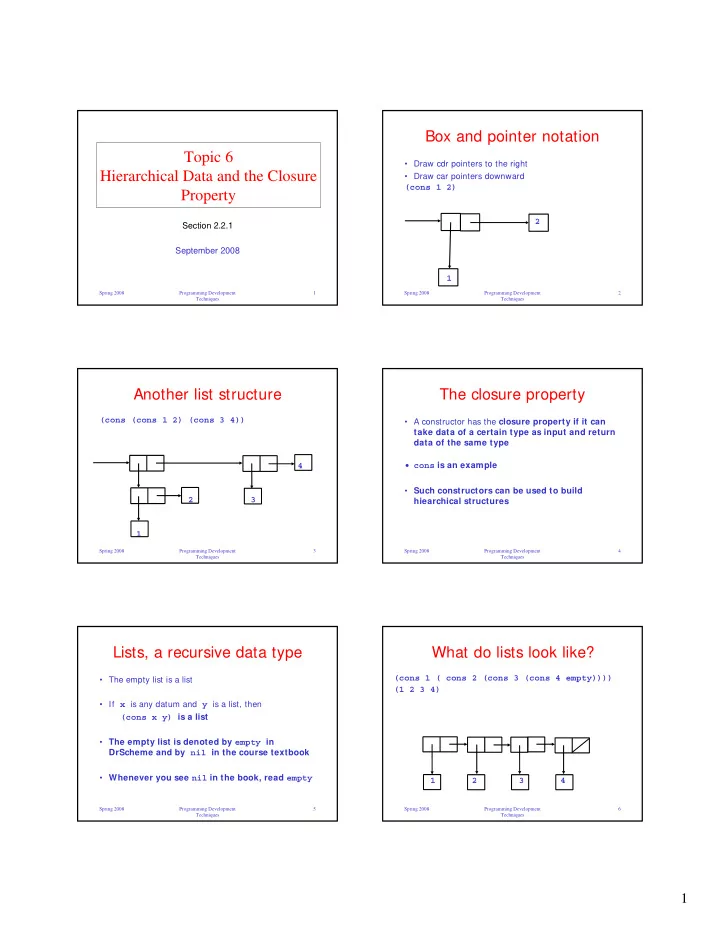
Box and pointer notation

  • Draw cdr pointers to the right
  • Draw car pointers downward

(cons 1 2) 2 1

Spring 2008 Programming Development Techniques 3

Another list structure

(cons (cons 1 2) (cons 3 4)) 4 2 3 1

Spring 2008 Programming Development Techniques 4

The closure property

  • A constructor has the closure property if it can

take data of a certain type as input and return data of the same type

  • cons is an example
  • Such constructors can be used to build

hiearchical structures

Spring 2008 Programming Development Techniques 5

Lists, a recursive data type

  • The empty list is a list
  • If x is any datum and y is a list, then

(cons x y) is a list

  • The empty list is denoted by empty in

DrScheme and by nil in the course textbook

  • Whenever you see nil in the book, read empty

Spring 2008 Programming Development Techniques 6

What do lists look like?

(cons 1 ( cons 2 (cons 3 (cons 4 empty)))) (1 2 3 4) 1 2 3 4

slide-2
SLIDE 2

2

Spring 2008 Programming Development Techniques 7

Lists can contain lists

(cons 1 (cons (cons 2 (cons 3 empty)) (cons 4 (cons (cons 5 (cons 6 empty)) empty)))) (1 (2 3) 4 (5 6))

Spring 2008 Programming Development Techniques 8

Box and pointer representation

1 4 2 3 3 5 6

Spring 2008 Programming Development Techniques 9

Printing out list structures

Printed like lists, but if the last cdr in a cdr chain points to a primitive datum other than empty, the primitive datum is printed with a dot in front of it.

Spring 2008 Programming Development Techniques 10

A comparison

1 2 3 4 (1 2 3 4) 4 1 2 3 (1 2 3 . 4)

Spring 2008 Programming Development Techniques 11

Some service procedures for lists

(list 1 2 3 4) --> (1 2 3 4) ;; takes a list with at least n elements ;; and returns the nth element of the list ;; note counting starts from 0 (define (our-list-ref lst n) (if (= n 0) (car lst) (our-list-ref (cdr lst) (- n 1)))) (our-list-ref (list 1 2 3 4) 0) --> 1 (our-list-ref (list 1 2 3 4) 2) --> 3

Spring 2008 Programming Development Techniques 12

More service procedures

(define (null? x) (equal? x empty)) ; takes a list and returns the number ; of elements in the list (define (our-length list) (if (null? list) (+ 1 (our-length (cdr list)))))

slide-3
SLIDE 3

3

Spring 2008 Programming Development Techniques 13

  • ur-member

; takes an element and a list and returns non-#f if ; ele is in the list (define (our-member ele lst) (cond ((null? lst) #f) ((equal? ele (car lst)) lst) (else (our-member ele (cdr lst)))))

Spring 2008 Programming Development Techniques 14

  • (first-n lst n)

Spring 2008 Programming Development Techniques 15

Append

; takes two lists and returns a list ; containing the elements of the ; original 2 (define (our-append list1 list2) (if (null? list1) list2 (cons (car list1) (our-append (cdr list1) list2)))) (our-append (list 1 2) (list 3 4))

  • -> (1 2 3 4)

Spring 2008 Programming Development Techniques 16

Notes

  • Procedures list-ref, null?, eq?, length,

and append are predefined procedures in Scheme

  • Procedure append can append any number of

lists together

  • Procedure pair? returns #t if its argument is a

pair, else #f