Tools to optimize use of current supply CITI: State of Telecom 2010 - - PDF document

tools to optimize use of current supply
SMART_READER_LITE
LIVE PREVIEW

Tools to optimize use of current supply CITI: State of Telecom 2010 - - PDF document

23.11.2009 streng vertraulich, vertraulich, intern, ffentlich Autor / Thema der Prsentation 1 Current expectations on Evolution of Traffic Volumes Tools to optimize use of current supply CITI: State of Telecom


slide-1
SLIDE 1

23.11.2009 1 –streng vertraulich, vertraulich, intern, öffentlich– Autor / Thema der Präsentation

1

Tools to optimize use of current supply

CITI: State of Telecom 2010 – New York, October 15th, 2010 Reinhard Wieck, Managing Director DT Washington Office*

*With Thomas Grob and Miguel Vidal, DT Group Headquarters

October 15, 2010 Reinhard Wieck, Managing Director, DT Washington Office / CITI State of Telecom 2010 2

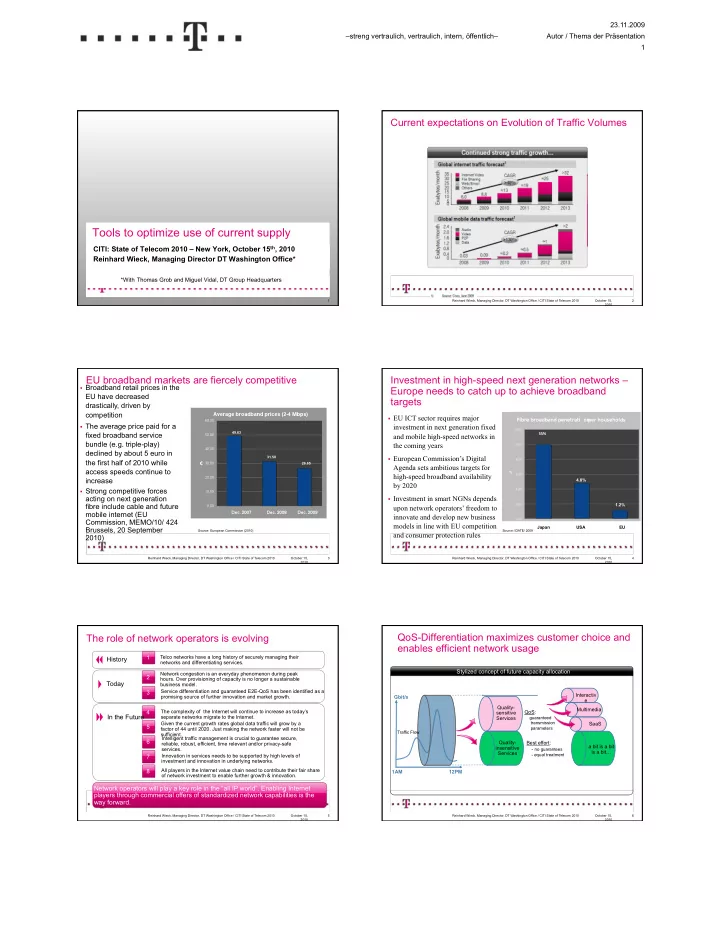
Current expectations on Evolution of Traffic Volumes

October 15, 2010 Reinhard Wieck, Managing Director, DT Washington Office / CITI State of Telecom 2010 3

EU broadband markets are fiercely competitive

  • Broadband retail prices in the

EU have decreased drastically, driven by competition

  • The average price paid for a

fixed broadband service bundle (e.g. triple-play) declined by about 5 euro in the first half of 2010 while access speeds continue to increase

  • Strong competitive forces

acting on next generation fibre include cable and future mobile internet (EU Commission, MEMO/10/ 424 Brussels, 20 September 2010)

Source: European Commission (2010) 49.63 31.50 26.65 October 15, 2010 Reinhard Wieck, Managing Director, DT Washington Office / CITI State of Telecom 2010 4

Investment in high-speed next generation networks – Europe needs to catch up to achieve broadband targets

Source: IDATE/ 2009 49.63 31.50 26.65

  • EU ICT sector requires major

investment in next generation fixed and mobile high-speed networks in the coming years

  • European Commission’s Digital

Agenda sets ambitious targets for high-speed broadband availability by 2020

  • Investment in smart NGNs depends

upon network operators’ freedom to innovate and develop new business models in line with EU competition and consumer protection rules

4.8% 1.2% Japan USA EU

October 15, 2010 Reinhard Wieck, Managing Director, DT Washington Office / CITI State of Telecom 2010 5

The role of network operators is evolving

Innovation in services needs to be supported by high levels of investment and innovation in underlying networks. All players in the Internet value chain need to contribute their fair share

  • f network investment to enable further growth & innovation.

6 7

Network operators will play a key role in the “all IP world”. Enabling Internet players through commercial offers of standardized network capabilities is the way forward.

Telco networks have a long history of securely managing their networks and differentiating services. Network congestion is an everyday phenomenon during peak

  • hours. Over provisioning of capacity is no longer a sustainable

business model.

1 2

History Today

The complexity of the Internet will continue to increase as today’s separate networks migrate to the Internet. Given the current growth rates global data traffic will grow by a factor of 44 until 2020. Just making the network faster will not be sufficient.

4 5

In the Future

Service differentiation and guaranteed E2E-QoS has been identified as a promising source of further innovation and market growth.

3

Intelligent traffic management is crucial to guarantee secure, reliable, robust, efficient, time relevant and/or privacy-safe services.

8

October 15, 2010 Reinhard Wieck, Managing Director, DT Washington Office / CITI State of Telecom 2010 6

QoS-Differentiation maximizes customer choice and enables efficient network usage

Stylized concept of future capacity allocation

Quality- insensitive Services 12PM 1AM Best effort:

  • no guarantees
  • equal treatment

Traffic Flow

Gbit/s QoS:

guaranteed transmission parameters

Quality- sensitive Services Interactiv e Multimedia SaaS a bit is a bit is a bit…

slide-2
SLIDE 2

23.11.2009 2 –streng vertraulich, vertraulich, intern, öffentlich– Autor / Thema der Präsentation

October 15, 2010 Reinhard Wieck, Managing Director, DT Washington Office / CITI State of Telecom 2010 7

Content Communication Commerce

Telcos have a number of unique digital assets that could be efficiently used as enablers, QoS being one

  • f them.

Top-level View Enabler-based Service Delivery Application enablers Network enablers

Address Book Presence and Location Device Management Personal Storage Search Calendar User Profiling Recom

  • mendation

Session Control Distribution Control QoS Authenticati

  • n and

Authorization Service Creation & Execution Service Composition Service Exposure

… … …

October 15, 2010 Reinhard Wieck, Managing Director, DT Washington Office / CITI State of Telecom 2010 8

DT Key Messaging in the EU Consultation on NN

  • Deutsche Telekom is committed to the Open Internet and to “net

freedoms”. The introduction of QoS-differentiation supports these goals.

  • Today’s “best effort” internet will continue to exist in a managed NGN
  • Customer transparency will be the key to success in the market place
  • Regulatory intervention in competitive markets would create distortions
  • The current EU regulatory framework safeguards the Open Internet
  • QoS-differentiation and price differentiation will contribute to financing

the roll out of broadband infrastructure

  • Competition will not only lead to better quality and individually tailored
  • ffers but safeguard a diverse and affordable internet experience

October 15, 2010 Reinhard Wieck, Managing Director, DT Washington Office / CITI State of Telecom 2010 9

The 2010 German spectrum auction – An example of optimizing the use of current spectrum supplies

October 15, 2010 Reinhard Wieck, Managing Director, DT Washington Office / CITI State of Telecom 2010 10

The 2010 German spectrum auction Starting position

  • On April 12, 2010 the German regulator (Bundesnetzagentur, BNetzA) started the auction
  • f additional spectrum for the German mobile telecom market
  • A total of close to 359 MHz was being offered, which actually exceeded the current total of

available spectrum in the market. More precisely: 41 blocks of overall 358.8 MHz of spectrum split between four bands (60 MHz around the 800 MHz band, 50 MHz (1.8 GHz band), 58.8 MHz (2 GHz band) and the largest part of 190 MHz around the 2.6 GHz band)

  • Auction participants were the four established network operators: T-Mobile, Vodafone, O2

(Telefonica) and E-Plus (KPN)

  • The BNetzA emphasizes competition aspects: (i) spectrum allocation via auction means

choosing a competitive mechanism; (ii) and this is a pre-requisite to provide unrestricted internet access under competitive conditions

  • Spectrum in the 800 MHz band (‘digital dividend’) received a lot of attention due to its

very good propagation characteristics and its suitability for the roll-out of mobile broadband in rural and other hard-to-reach areas

  • Operators acquiring spectrum in the 800 MHz band are required to prioritize the coverage
  • f rural areas, to fulfill the government’s promise of nation-wide broadband internet

coverage

  • Germany was the first European country to auction off the digital dividend => creates

first mover advantage

October 15, 2010 Reinhard Wieck, Managing Director, DT Washington Office / CITI State of Telecom 2010 11

Results of the German spectrum auction 360 MHz awarded for €4.4bn

SPECTRUM WON BY OPERATORS AND PRICE PAID PER BAND Price paid (per operator): T-Mobile €1.30bn, Vodafone €1.42bn, O2 €1.38bn, E-Plus €284m

Source: Cullen International, May 22 2010 October 15, 2010 Reinhard Wieck, Managing Director, DT Washington Office / CITI State of Telecom 2010 12

Spectrum auctions – lessons learned from the German auction

  • Link political goals (national broadband plans, white spots

coverage) and commercial goals (more bandwidth for mobile Internet)

  • Get competitive first-mover-advantage by insisting on

timeplan for spectrum auctions

  • Create strong political support from all stakeholders for

efficient use of spectrum

  • Create win-win situations for both broadcasters and telcos
  • Enhance competition by use of state-of-the-art spectrum

auctions

  • Spectrum caps
  • Increase efficient use of spectrum through realistic build-out

requirements -- avoid spectrum warehousing

slide-3
SLIDE 3

23.11.2009 3 –streng vertraulich, vertraulich, intern, öffentlich– Autor / Thema der Präsentation

October 15, 2010 Reinhard Wieck, Managing Director, DT Washington Office / CITI State of Telecom 2010 13

BACK- UP

October 15, 2010 Reinhard Wieck, Managing Director, DT Washington Office / CITI State of Telecom 2010 14

Auction design and key provisions in a nutshell

  • Design: BNetzA chose a ‘simultaneous

ascending auction’ design, i.e. bids on individual lots until no more bids

  • Coverage obligations: prioritize coverage of

rural areas (800 MHz band)

  • Generic vs. specific lots: 9 blocks are

awarded specifically, 32 blocks generically

  • Bidding right restrictions apply for spectrum

in the 800 MHz band

  • Essential spectrum package: designed to

encourage participation of new entrants

  • Activity rule ensures smooth progress
  • Cancellation of bids, waivers, recess may

be helpful to handle complex situations

  • Increments are predefined
  • Information policy: full transparency; bidders

see all bids on each block

  • Termination rule: in final phase and no new

bids

OVERVIEW: KEY FEATURES

October 15, 2010 Reinhard Wieck, Managing Director, DT Washington Office / CITI State of Telecom 2010 15

Bidding right restrictions on the 800 MHz band

  • T-Mobile, Vodafone: restricted to a maximum of 2 blocks
  • E-Plus (KPN), O2 (Telefonica): restricted to a maximum of 3 blocks
  • New entrants: restricted to a maximum of 4 blocks
  • No restrictions on other frequency bands
  • BNetzA rationale: allow for fair competition / sustainable competitive markets;

encourage infrastructure investment; avoid that just one bidder acquires all spectrum available in the 800 MHz band

October 15, 2010 Reinhard Wieck, Managing Director, DT Washington Office / CITI State of Telecom 2010 16

Coverage obligations: bidders acquiring spectrum in the 800 MHz band have to prioritize rural areas

COVERAGE OBLIGATIONS 800 MHz

  • Federal broadband initiative:

provide nation-wide broadband coverage by end of 2010

  • 800 MHz spectrum: good

propagation characteristics

  • Acquisition of spectrum in the

800 MHz band implies coverage obligations must be

  • bserved
  • Small communities need to be

served first (see scheme)

  • Federal states have provided

exhaustive lists of communities for each category

  • Reporting obligations for

spectrum holders (yearly)

Priority Stage 1: Communities with a total population of < 5,000 Priority Stage 2: Communities with a total population between 5,000-20,000 Priority Stage 3: Communities with a total population between 20,000-50,000 Priority Stage 4: Communities with a total population of > 50,000 Requirement: cover a min. of 90% pop to move to next stage Requirement: cover a min. of 90% pop to move to next stage Requirement: cover a min. of 90% pop to move to next stage Requirement I: cover 90%+ pop by Jan 1, 2016 (cat. 4)1) Requirement II: cover 50%+ pop by Jan 1, 2016 (n-w)2)

1) applies to communities >50,000 listed by federal states 2) nation-wide

October 15, 2010 Reinhard Wieck, Managing Director, DT Washington Office / CITI State of Telecom 2010 17

Results of the German spectrum auction 360 MHz awarded for €4.4bn

DEVELOPMENT OF BIDS (IN MILLION EURO) OVER THE 224 ROUNDS OF THE AUCTION

Source: Cullen International, May 22 2010