Tools Hand and Power OSHA Office of Training and Education 1 - - PowerPoint PPT Presentation

tools hand and power
SMART_READER_LITE
LIVE PREVIEW

Tools Hand and Power OSHA Office of Training and Education 1 - - PowerPoint PPT Presentation

Tools Hand and Power OSHA Office of Training and Education 1 Hazards Workers using hand and power tools may be exposed to these hazards: objects that fall, fly, are abrasive, or splash harmful dusts, fumes, mists, vapors, and


slide-1
SLIDE 1

OSHA Office of Training and Education 1
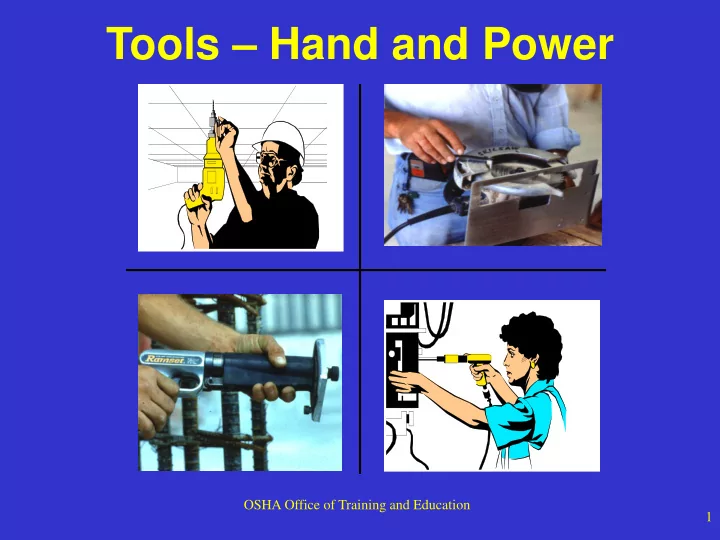
Tools – Hand and Power

slide-2
SLIDE 2

OSHA Office of Training and Education 2

Hazards

Workers using hand and power tools may be exposed to these hazards:

  • objects that fall, fly, are

abrasive, or splash

  • harmful dusts, fumes, mists,

vapors, and gases

  • frayed or damaged electrical

cords, hazardous connections and improper grounding

slide-3
SLIDE 3

OSHA Office of Training and Education 3

Basic Tool Safety Rules

  • Maintain regularly
  • Use right tool for the job
  • Inspect before use
  • Operate according to

manufacturers’ instructions

  • Use the right personal

protective equipment (PPE)

  • Use guards
slide-4
SLIDE 4

OSHA Office of Training and Education 4

Hand Tool Hazards

Hazards are usually caused by misuse and improper maintenance

Do not use:

  • wrenches when jaws are sprung
  • impact tools (chisels and wedges)

when heads have mushroomed

  • tools with loose, cracked or

splintered handles

  • a screwdriver as a chisel
  • tools with taped handles – they

may be hiding cracks

Crack

slide-5
SLIDE 5

OSHA Office of Training and Education 5

Hand Tools - Protection

Use PPE, such as safety goggles and gloves Keep floor surface where working free from debris and tripping or slipping hazards Keep cutting tools sharp

slide-6
SLIDE 6

OSHA Office of Training and Education 6

Power Tools

Must be fitted with guards and safety switches Extremely hazardous when used improperly Different types,determined by their power source:

  • Electric
  • Pneumatic
  • Liquid fuel
  • Hydraulic
  • Powder-actuated
slide-7
SLIDE 7

OSHA Office of Training and Education 7

Switches

Hand-held power tools must be equipped with one of the following: Constant pressure switch shuts off power upon release Examples: circular saw, chain saw, grinder, hand-held power drill On-Off Switch Examples: routers, planers, laminate trimmers, shears, jig saws, nibblers, scroll saws

slide-8
SLIDE 8

OSHA Office of Training and Education 8

Power Tools - Precautions

  • Disconnect tools when not in use, before servicing

and cleaning, and when changing accessories

  • Keep people not involved with the work away from

the work

  • Secure work with clamps or a vise, freeing both

hands to operate the tool

  • Don’t hold the switch button while carrying a

plugged-in tool

  • Keep tools sharp and clean
  • Consider what you wear – loose clothing and

jewelry can get caught in moving parts

  • Remove damaged electric tools & tag them: “Do

Not Use”

slide-9
SLIDE 9

OSHA Office of Training and Education 9

Power Tools – Precautions

Electric Cords

Don’t carry portable tools by the cord Don’t use electric cords to hoist or lower tools Don’t yank cord or hose to disconnect it Keep cords and hoses away from heat, oil, and sharp edges

slide-10
SLIDE 10

OSHA Office of Training and Education 10

To protect a worker from shock, these tools must:

  • have a 3-wire cord plugged into a grounded receptacle
  • be double insulated, or
  • be powered by a low-voltage isolation transformer

Electric Power Tools

Double insulated markings Plug with a grounding pin

slide-11
SLIDE 11

OSHA Office of Training and Education 11

Electric Tools – Good Practices

  • Operate within design limits
  • Use gloves and safety shoes
  • Store in a dry place
  • Don’t use in wet locations

unless approved for that

  • Keep work areas well lit
  • Ensure cords don’t present a

tripping hazard

slide-12
SLIDE 12

OSHA Office of Training and Education 12

Abrasive Wheels and Tools

May throw off flying fragments Equip with guards that:

  • Cover the spindle end, nut,

& flange projections

  • Maintain proper alignment

with the wheel

  • Don’t exceed the strength of

the fastenings Guard so that a minimal amount of the wheel is exposed

slide-13
SLIDE 13

OSHA Office of Training and Education 13

Inspecting Abrasive Wheels

Before mounting:

  • inspect closely for damage
  • perform sound- or ring-test

to ensure free from cracks / defects To test:

  • tap wheel gently with a light,

non-metallic instrument

  • if wheel sounds cracked or

dead, do not use it because it could fly apart

slide-14
SLIDE 14

OSHA Office of Training and Education 14

Abrasive Wheel Use

To prevent cracking:

  • fit the wheel on the spindle

freely

  • tighten the spindle nut enough

to hold the wheel in place without distorting the flange Let the tool come up to speed prior to grinding or cutting Don’t stand in front of the wheel as it comes up to full speed Use eye and/or face protection

Ensure the spindle speed doesn’t exceed the maximum speed marked on the wheel

slide-15
SLIDE 15

OSHA Office of Training and Education 15

Abrasive Wheel Work Rests

Keep work rests not more than 1/8th inch from wheel surface This prevents jamming the work between the wheel and the rest, which may cause the wheel to break Don’t adjust wheel while it’s rotating

slide-16
SLIDE 16

OSHA Office of Training and Education 16

Guarding

Guard exposed moving parts of power tools Guard belts, gears, shafts, pulleys, sprockets, spindles, flywheels, chains, or

  • ther moving parts

Never remove a guard when a tool is in use

slide-17
SLIDE 17

OSHA Office of Training and Education 17

The point of operation is where the work is actually performed on the materials – it must be guarded

Guarding - Point of Operation

This shows a radial arm saw equipped with proper point of

  • peration

guards

slide-18
SLIDE 18

OSHA Office of Training and Education 18

Guarding Protection

Machine guards must protect the operator and others from:

  • Point of operation
  • In-running nip points
  • Rotating parts
  • Flying chips and sparks

Nip Point

slide-19
SLIDE 19

OSHA Office of Training and Education 19

Guard to prevent the operator from coming in contact the the rotating blade

Radial Saw Guarding

Radial arm saw equipped with an upper and lower blade guard

slide-20
SLIDE 20

OSHA Office of Training and Education 20

Guard these saws above and below the base plate or shoe. The lower guard must cover the saw to the depth of the teeth.

Guarding Portable Circular Saws

slide-21
SLIDE 21

OSHA Office of Training and Education 21

Use a hood for guarding

Hood guard

Table Saw Guarding

slide-22
SLIDE 22

OSHA Office of Training and Education 22

Pneumatic Tools

Powered by compressed air Includes nailers, staplers, chippers, drills & sanders Main hazard - getting hit by a tool attachment or by a fastener the worker is using with the tool Take the same precautions with an air hose that you take with electric cords

Nail Gun - Cut-Away View

slide-23
SLIDE 23

OSHA Office of Training and Education 23

Pneumatic Tools - Fastening

Ensure tool is fastened securely to the air hose to prevent a disconnection Use a short wire or positive locking device attaching the air hose to the tool

Wire used to secure hose

slide-24
SLIDE 24

OSHA Office of Training and Education 24

Pneumatic Tool Connections

← Unacceptable ← Acceptable

Hose clamp

slide-25
SLIDE 25

OSHA Office of Training and Education 25

Pneumatic Tool Safety

Place a safety device on the muzzle to prevent the tool from ejecting fasteners, unless the muzzle is in contact with work surface Install a safety clip or retainer to prevent attachments, such as chisels on a chipping hammer, from being ejected Wear eye protection. Wear hearing protection with jackhammers.

Muzzle in contact with work surface

slide-26
SLIDE 26

OSHA Office of Training and Education 26

Compressed Air Cleaning

Don’t use compressed air for cleaning Exception - where reduced to less than 30 p.s.i. with effective chip guarding and PPE

slide-27
SLIDE 27

OSHA Office of Training and Education 27

Liquid Fuel Tools

Usually gas powered Main hazard – fuel vapors Use only approved flammable liquid containers Before refilling a fuel- powered tool tank, shut down the engine and allow it to cool

slide-28
SLIDE 28

OSHA Office of Training and Education 28

Powder-Actuated Tools

User must be trained and licensed to operate Test tool each day before loading to ensure the safety devices are working properly Wear suitable ear, eye, and face protection Select a powder level that will do the work without excessive force

slide-29
SLIDE 29

OSHA Office of Training and Education 29

Fatal Fact

Employee killed when struck in head by a nail fired from a powder actuated tool. Tool operator was attempting to anchor a plywood form in preparation for pouring a concrete wall

slide-30
SLIDE 30

OSHA Office of Training and Education 30

Easily Penetrated Material

Avoid driving into materials easily penetrated unless materials are backed by a substance that will prevent the pin or fastener from passing through Also, don’t drive fasteners into very hard or brittle material that might chip or splatter, or make the fasteners ricochet

slide-31
SLIDE 31

OSHA Office of Training and Education 31

Powder-Actuated Tool Safety Tips

  • Don’t use in explosive or flammable atmosphere
  • Inspect tool before use to ensure:
  • it is clean,
  • that moving parts operate freely
  • the barrel is free from obstructions and has

the proper shield, guard, and attachments

  • Don’t load the tool unless using immediately
  • Don’t leave a loaded tool unattended
  • Keep hands clear of the barrel end
  • Never point the tool at anyone
  • Store unloaded in a locked box
slide-32
SLIDE 32

OSHA Office of Training and Education 32

Jacks

To set up a jack, ensure:

  • The base is on a firm, level

surface

  • It’s centered
  • The jack head is placed

against a level surface

  • You apply the lift force evenly

Lubricate and inspect jacks regularly

slide-33
SLIDE 33

OSHA Office of Training and Education 33

Jacks - Capacity

The manufacturer's rated capacity must be marked on all jacks and must not be exceeded All jacks must have a stop indicator that is not exceeded

slide-34
SLIDE 34

OSHA Office of Training and Education 34

Immediately block the load after it is lifted. Put a block under the base of the jack when the foundation is not firm, and place a block between the jack cap and load if the cap might slip.

Jacks - Blocking

Photo - handyman jack is provided a firm base by using the railroad tie. The load is cribbed to prevent it from falling.

slide-35
SLIDE 35

OSHA Office of Training and Education 35

Summary

Hazards are usually the result of improper tool use or not following one or more of these protection techniques:

  • Inspecting the tool before use
  • Using PPE (Personal Protective Equipment)
  • Using guards
  • Properly storing the tool
  • Using safe handling techniques