Todays programme: Programming language PLN - syntax Limitations of - - PowerPoint PPT Presentation

todays programme programming language pln syntax
SMART_READER_LITE
LIVE PREVIEW

Todays programme: Programming language PLN - syntax Limitations of - - PowerPoint PPT Presentation

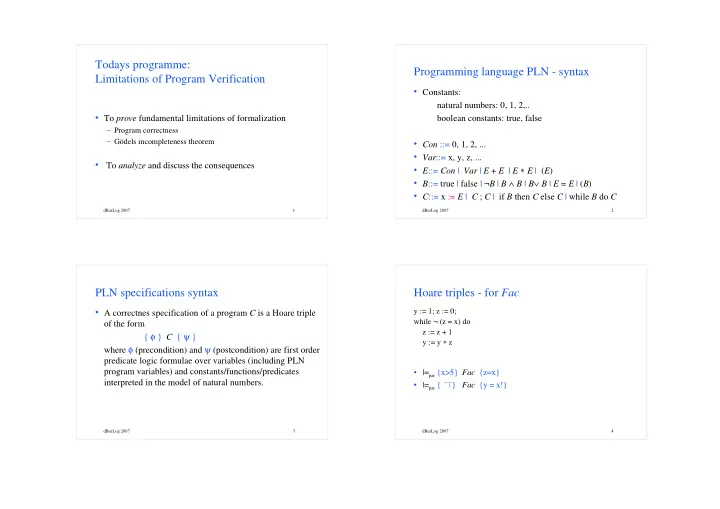
Todays programme: Programming language PLN - syntax Limitations of Program Verification Constants: natural numbers: 0, 1, 2,.. To prove fundamental limitations of formalization boolean constants: true, false Program correctness


slide-1
SLIDE 1

1 dBerLog 2007

Todays programme: Limitations of Program Verification

  • To prove fundamental limitations of formalization

– Program correctness – Gödels incompleteness theorem

  • To analyze and discuss the consequences

2 dBerLog 2007

Programming language PLN - syntax

  • Constants:

natural numbers: 0, 1, 2,.. boolean constants: true, false

  • Con ::= 0, 1, 2, ...
  • Var::= x, y, z, ...
  • E::= Con | Var | E + E | E ∗ E | (E)
  • B::= true | false | ¬B | B ∧ B | B∨ B | E = E | (B)
  • C::= x := E | C ; C | if B then C else C | while B do C

3 dBerLog 2007

PLN specifications syntax

  • A correctnes specification of a program C is a Hoare triple
  • f the form

{ φ } C { ψ } where φ (precondition) and ψ (postcondition) are first order predicate logic formulae over variables (including PLN program variables) and constants/functions/predicates interpreted in the model of natural numbers.

4 dBerLog 2007

Hoare triples - for Fac

y := 1; z := 0; while ¬ (z = x) do z := z + 1 y := y ∗ z

  • |=par {x>5} Fac {z=x}
  • |=par { | } Fac {y = x!}
slide-2
SLIDE 2

5 dBerLog 2007

Hoare triples - semantics

  • { φ } C { ψ } is said to be satisfied under partial correctness

|=par { φ } C { ψ } iff for all states s, if N |=s φ, and Sem[C](s) is defined and equal to s’ then N |=s’ ψ

  • { φ } C { ψ } is said to be satisfied under total correctness

|=tot { φ } C { ψ } iff for all states s, if N |=s φ, then Sem[C](s) is defined, and if Sem[C](s) = s’ then N |=s’ ψ

6 dBerLog 2007

Incompleteness theorem for Hoare triples

  • Theorem

There does not exist any sound and complete proof system for PLN partial correctness specifications in the form of Hoare triples!

7 dBerLog 2007

Proof system - definition

  • Given a logical language with formulae Φ.
  • A proof system for Φ consists of an alphabet Σ (for writing

proofs) and a set of rules, such that for all π in Σ* and formula Φ, it is decidable whether π is a proof of Φ

8 dBerLog 2007

Proof system - property

  • Theorem

For any proof system, the set of provable formulae is recursively enumerable

slide-3
SLIDE 3

9 dBerLog 2007

Incompleteness theorem for Hoare triples

  • Theorem

There does not exist any sound and complete proof system for PLN partial correctness specifications in the form of Hoare triples!

  • Proof

SHOW: the set of triples par {φ} C {ψ} is NOT recursively enumerable!

10 dBerLog 2007

Post’s correspondence problem - example

  • List A:

List B:

α1 = b β1 = bbb α2 = babbb β2 = ba α3 = ba β3 = a

Solution? YES: 2 1 1 3 α2 α1 α1 α3 = babbb b b ba = babbbbbba β2 β1 β1 β3 = ba bbb bbb a = babbbbbba

11 dBerLog 2007

Post’s Correspondence Problem PCP

  • PCP instance over alphabet Σ:

A = {w1, w2,.., wk} B = {x1, x2,.., xk} where wi and xi are strings over Σ

  • A,B solution:

i0 i1… il-1 ∈ {1, 2, .., k}+ such that wi0 wi1..wil-1 = xi0 xi1..xil-1

12 dBerLog 2007

Post’s Correspondence Problem PCP

  • Theorem

The complement of PCP (i.e. the set of PCP instances with no solutions) is not recursively enumerable

slide-4
SLIDE 4

13 dBerLog 2007

Incompleteness theorem for Hoare triples

Lemma The set of triples par {φ} C {ψ} is NOT recursively enumerable! Proof:Reduction from the complement of PCP Given: An instance of PCP, A,B Construct: {φA,B} CA,B {ψA,B} such that A,B has NO solution iff par {φA,B} CA,B {ψA,B}

14 dBerLog 2007

Reduction PCP A,B -> CA,B (over strings!)

Given: PCP: A = {w1, w2,..wk} B = {x1, x2,...xk} CA,B: let in = i0i1..ile-1 {1,2,..,k}* w := ; x := ; j:= le; while j > 0 do {in=i0..il-1∧ w=wij.. wil-1∧ x=xij.. xil-1} j:= j-1; w := wij • w; x := xij • x; if w = x the skip else loop

15 dBerLog 2007

Representation of strings as numbers

  • Given a base number b > 1
  • For all v = i0i1...in-1 ∈ {0, 1, ..., b-1}* of length n

the b-ary representation of v, numb(v) is defined as numb(v) = numb(i0i1...in-1) = i0∗b0 + i1∗b1 + ... + in-1∗bn-1 = i0 + b∗ numb(i1...in-1)

  • numb: {0, 1, ..., b-1}* → N

16 dBerLog 2007

Representation of strings as numbers

num2 (1001) = 1∗20 + 0∗21 + 0∗22 + 1∗23 = nine num3 (102) = 1∗30 + 0∗31 + 2∗32 = nineteen

slide-5
SLIDE 5

17 dBerLog 2007

Representation of strings as numbers

  • Given a base number b > 1
  • For any n ∈ N, let

repb(n) = Λ if n = 0 rem(n,b) • repb(div(n,b)) if n > 0 where n = rem(n,b) + b∗div(n,b) and 0 rem(n,b) < b ≤

  • repb: N → {Λ} ∪ {0, 1, ..., b-1}*{1, ..., b-1}
  • repb: N → Nb (notation)

18 dBerLog 2007

Representation of strings as numbers

num2 (1001) = 1∗20 + 0∗21 + 0∗22 + 1∗23 = nine num3 (102) = 1∗30 + 0∗31 + 2∗32 = nineteen rep2(six) = 0 • rep2(three) = 0 • (1 • rep2(one)) = 0 • (1 • 1) = 011 rep3(eleven) = 2 • rep3(three) = 2 • (0 • rep3(one)) = 2 • (0 • 1) = 201

19 dBerLog 2007

Representation of strings as numbers

  • Propositions

For all b>1 For all n ∈ N, numb ( repb(n) ) = n For all w ∈ Nb, repb ( numb(w) )= w i.e. numb and repb are bijections between N and Nb!

20 dBerLog 2007

Representation of strings as numbers

  • Propositions

For all n, i ∈ N, 0 i < ≤ repb(n) the (unique) i’th digit in repb(n) is: rem(div(n, bi), b) For all v, w ∈ Nb numb(vw ) = numb(v) + numb(w) ∗ b|v|

  • Question

Can the operations above be computed in PLN?

slide-6
SLIDE 6

21 dBerLog 2007

PLN macros

  • ”x := monus (m, n)”

where monus (m, n) = m - n, if m > n 0,

  • therwise

can be computed in PLN by: x:= 0; y:= 0; while ¬(y = m ∨ y = n) do y := y+1; while ¬(y = m) do y := y+1; x := x+1

22 dBerLog 2007

PLN macros

  • ”m ≤ n”

can be computed in PLN by: monus (m, n) = 0

  • ”m > n”

can be computed in PLN by: ¬(monus (m, n) = 0)

23 dBerLog 2007

PLN macros

  • ”d := div(m, n)” (integer division of m by n, where n ≠ 0)
  • ”r := rem(m,n)” (remainder of int.div. of m by n, n≠ 0)
  • (m = d∗n + r, where 0 r < n)

≤ can be computed in PLN by d:= 0; while ((d + 1)∗n m) do d := d + 1; ≤ r:= monus (m, d ∗n)

24 dBerLog 2007

PLN macros

  • ”x := m ↑ n” (”m to the power n”)

can be computed in PLN by x := 1; y := 0; while ¬(y = n) do x := x∗m; y := y+1

slide-7
SLIDE 7

25 dBerLog 2007

Incompleteness theorem for Hoare triples

Given: PCP over Σ: A = {w1, w2,..wk} B = {x1, x2,...xk} where Σ = {1, 2,..,Σ} Construct: φA,B = ψA,B = and CA,B such that PCP has NO solution iff par {} CA,B {} (i.e. iff CA,B diverges for all initial states)

26 dBerLog 2007

Reduction PCP A,B -> CA,B (over strings!)

Given: PCP: A = {w1, w2,..wk} B = {x1, x2,...xk} CA,B: let in = i0i1..ile-1 {1,2,..,k}* w := ; x := ; j:= le; while j > 0 do {in=i0..il-1∧ w=wij.. wil-1∧ x=xij.. xil-1} j:= j-1; w := wij • w; x := xij • x; if w = x the skip else loop

27 dBerLog 2007

Reduction PCP A,B -> CA,B - intuition

  • Given a number in (input)

– Convert in to a string of small numbers repb(in) – View this string as a potential solution to PCP A,B – Construct (the numb-versions of) the corresponding concatenation

  • f A- and B-strings

– Check for equality of these numbers

  • If equal: terminate, if not: loop!
  • Claim: this algorithm terminates for some input iff A,B has

a solution!

28 dBerLog 2007

Reduction PCP A,B -> CA,B

  • Given PCP A = {w1, w2,..wk} B = {x1, x2,...xk}
  • ver Σ = {1, 2,..,Σ} !!!!
  • Compute base number b = max{k,Σ} +1

and constants numb(wi) and numb(xi), wiand xi

slide-8
SLIDE 8

29 dBerLog 2007

PLN shorthand notation

  • ”skip”

shorthand for ”y := y”

  • ”loop”

shorthand for ”while true do skip”

30 dBerLog 2007

Reduction PCP A,B -> CA,B

Given: PCP: A = {w1, w2,..wk} B = {x1, x2,...xk} CA,B: if in=0 then loop; j:= 1; while div(in,bj) > 0 do j:= j+1; w := 0; x := 0; while j > 0 do

{repb(in)=i0..ile-1∧w=numb(wij.. wile-1)∧ x=numb(xij.. xile-1)}

j:= j-1; i := rem( div(in, bj), b); if i = 1 then w := numb(w1) + w∗(b↑|w1|); x := numb(x1) + x∗(b↑|x1|) else ........ if i = k then w := numb(wk) + w∗(b↑|wk|); x := numb(xk) + x∗(b↑|xk|) else loop if w = x the skip else loop

31 dBerLog 2007

Reduction PCP A,B -> CA,B

Example: PCP: A = {12, 2} B = {1, 22} CA,B: ??

32 dBerLog 2007

Reduction PCP A,B -> CA,B

Example: PCP: A = {12, 2} B = {1, 22} CA,B: if in=0 then loop; j:= 1; while div(in,bj) > 0 do j:= j+1; w := 0; x := 0; while j > 0 do j:= j-1; i := rem( div(in, 3j), 3); if i = 1 then w := 7 + w∗(3↑2 ); x := 1 + x∗(3↑1 ) else if i = 2 then w := 2 + w∗(3↑1 ); x := 8 + x∗(3↑2 ) else loop if w = x the skip else loop

slide-9
SLIDE 9

33 dBerLog 2007

Incompleteness theorem for Hoare triples

  • Claim:

A,B has solution iff CA,B terminates for some input

34 dBerLog 2007

Todays programme: Limitations of Program Verification

  • To prove fundamental limitations of formalization

– Program correctness – Gödels incompleteness theorem

  • To analyze and discuss the consequences

35 dBerLog 2007

Hoare proof rules if and while

{φ} if B then C1 else C2 {ψ} If-rule {ψ ∧ B} C {ψ} {ψ} while B do C {ψ ∧ ¬B} While-rule {φ ∧ B} C1 {ψ} {φ ∧ ¬B} C2 {ψ}

36 dBerLog 2007

A proof of Euclid’s gcd algorithm

{ m = m0 ≥ 1 ∧ n = n0 ≥ 1 } while ¬ (m = n) do { gcd(m,n) = gcd(m0, n0) } if m > n then m:=m-n else n:= n-m; {m = gcd(m0, n0) } r:= m { r = gcd(m0, n0) }

{gcd(m,n) = gcd(m0, n0) ∧ ¬ (m = n) } if m > n then m:=m-n else n:= n-m;

{gcd(m,n) = gcd(m0, n0) }

{gcd(m,n) = gcd(m0, n0) } while ... {gcd(m,n) = gcd(m0, n0) ∧ ¬ ¬(m = n) } While-rule

slide-10
SLIDE 10

37 dBerLog 2007

A proof of Euclid’s gcd algorithm

{ m = m0 ≥ 1 ∧ n = n0 ≥ 1 } while ¬ (m = n) do { gcd(m,n) = gcd(m0, n0) } if m > n then m:=m-n else n:= n-m; {m = gcd(m0, n0) } r:= m { r = gcd(m0, n0) }

Proof obligations Comp rule: |-N m = m0 ≥ 1 ∧ n = n0 ≥ 1

  • > gcd(m,n) = gcd(m0,n0)

|-N gcd(m,n)= gcd(m0,n0) ∧¬¬(m=n)

  • > m = gcd(m0, n0)

38 dBerLog 2007

Hoare proof rules - implied

{φ’} C {ψ’} Impl-rule |- N φ’ → φ {φ} C {ψ} |- N ψ→ ψ’ NOTE We assume here that we have some underlying extension of the proof system for predicate logic, in which we prove formulae of the form φ’ → φ valid for N - the model of natural numbers!!!!

39 dBerLog 2007

A simple N vocabulary

  • Let N↑ be the predicate logic interpretation with

– natural numbers as the univers of values, – constants 0,1 – function symbols +, ×, and ↑ – predicate symbol =

all interpreted ”as usual”

40 dBerLog 2007

Peano proof rules

∀n. ¬(n = n+1) ∀m ∀n. (m+1 = n+1) → (m = n) ∀n. n+0 = n ∀m ∀n. m+(n+1) = (m+n) + 1 ∀n. n∗0 = 0 ∀m ∀n. m∗(n+1) = (m∗n) + m ∀n. n↑0 = 1 ∀m ∀n. m↑(n+1) = (m↑n) ∗ m ϕ(0) ∀n. (ϕ(n) → ϕ(n+1)) ∀n. ϕ(n)

slide-11
SLIDE 11

41 dBerLog 2007

Incompleteness of Peano axioms

∀ ∀n. ( (¬ (n = 0) ) → ∃ m (n = m+1) ) can NOT be shown in Peano’s proof system

42 dBerLog 2007

Gödel’s incompleteness theorem

  • There does not exist any sound and complete proof system

for the model of natural numbers N↑ with constant 0,1, function symbols +, ∗, ↑, and predicate symbol =

  • Proof

SHOW: The set {φ | N↑ φ} is NOT recursively enumerable!

43 dBerLog 2007

Gödel’s incompleteness theorem

Lemma: The set {φ | N↑ φ} is NOT recursively enumerable! Proof: reduction from the complement of PCP Given: An instance of PCP: A,B Construct: φA,B such that A,B has NO solution iff N↑ φA,B

44 dBerLog 2007

Gödel’s incompleteness theorem

Given: PCP over Σ: A = {w1, w2,..wk} B = {x1, x2,...xk} compute b > max{k, |Σ|} + 1 max = max{|wi|, |xi| | 1 i k } ≤ ≤ and for 1 i k: ≤ ≤ numb(wi) |wi | numb(xi) |xi |

slide-12
SLIDE 12

45 dBerLog 2007

Reduction PCP A,B -> ψA,B

Given: PCP: A = {w1, w2,..wk} B = {x1, x2,...xk} ψA,B : ∃ le. ∃ m. (le ≥ l) ∧ (m ≥ le∗max) ∧ ∃ w, x. FIRST(m,w,x) ∧ NEXT (le,m,w,x) ∧ LAST (le,m,w,x)

46 dBerLog 2007

N↑ expressiveness

  • ”m ≥ n”

may be expressed as ”∃ a. (m = n + a)”

  • ”m > n”

may be expressed as ”(m ≥ n ∧ ¬(m = n))”

47 dBerLog 2007

Operations on strings in arithmetic

  • Assume n = numb(i0i1...ij............)

div(n, bj) = numb(ijij+1,.......) rem(n, bj) = numb(i0i1, ...ij-1) sel(n, j, k) = rem( div(n,bj),bk) = numb(ij, ij+1...ij+k-1)

48 dBerLog 2007

N↑ expressiveness

  • ”div(m, n) = d” (d is integer division of m by n)

may be expressed as ” ∃ r. (m = n∗ d + r ∧ r < n)”

  • ”rem(m, n) = r” (r is remainder of int. division of m by n)

may be expressed as ”m = n∗ div(m, n) + r ”

  • ”selb(m, j, k)” (the number repesented by the k digits

starting from digit j in repb(m)0* may be expressed as ” selb(m, j, k) = rem( div(m, b↑j), b↑k) )”

slide-13
SLIDE 13

49 dBerLog 2007

Reduction PCP A,B -> ψA,B

Given: PCP: A = {w1, w2,..wk} B = {x1, x2,...xk} ψA,B : ∃ le. ∃ m. (le ≥ l) ∧ (m ≥ le∗max) ∧ ∃ w, x. FIRST(m,w,x) ∧ NEXT (le,m,w,x) ∧ LAST (le,m,w,x) FIRST(m,w,x) : selb(w, 0, m) = 0 ∧ selb(x, 0, m) = 0

50 dBerLog 2007

Reduction PCP A,B -> ψA,B

Given: PCP: A = {w1, w2,..wk} B = {x1, x2,...xk} ψA,B : ∃ le. ∃ m. (le ≥ l) ∧ (m ≥ le∗max) ∧ ∃ w, x. FIRST(m,w,x) ∧ NEXT (le,m,w,x) ∧ LAST (le,m,w,x) FIRST(m,w,x) : selb(w, 0, m) = 0 ∧ selb(x, 0, m) = 0 LAST(le,m,w,x): selb(w, m*le, m) = selb(x, m*le, m)

51 dBerLog 2007

Reduction PCP A,B -> ψA,B

Given: PCP: A = {w1, w2,..wk} B = {x1, x2,...xk} NEXT: ∀j. ((0 j ≤ ∧ j<le) → ∃i. (1 i ≤ ∧ i ≤ k ∧ MATCH(m,w,x,j,i) MATCH(m,w,x,j,i): (i=1 → selb(w, (j+1)∗m, m) = numb(w1) + selb(w, j∗m, m) ∗b|w1| ∧ selb(x, (j+1)∗m, m) = numb(x1) + selb(x, j∗m, m) ∗b|x1| ) ∧ ....... (i=k → selb(w, (j+1)∗m, m) = numb(wk) + selb(w, j∗m, m) ∗b|wk| ∧ selb(x, (j+1)∗m, m) = numb(xk) + selb(x, j∗m, m )∗b|xk| )

52 dBerLog 2007

Reduction PCP A,B -> ψA,B

Given: PCP: A = {w1, w2,..wk} B = {x1, x2,...xk} CLAIM: A,B has NO solution iff N↑ φA,B (= ¬ψA,B)

i.e

A,B HAS a solution iff N↑ ψA,B

slide-14
SLIDE 14

53 dBerLog 2007

Todays programme: Limitations of Program Verification

  • To prove fundamental limitations of formalization

– Program correctness – Gödels incompleteness theorem

  • To analyze and discuss the consequences

54 dBerLog 2007

Exercises

  • All exercises in the following referring to the note

Limitations of Program Verification [LiProVer07]

  • Describe representations of numbers

– [LiProVer07] 2 (p 16), 3, 4 (p 17) : understanding number representations – [LiProVer07] 9 (p 23): understanding selection predicate

  • Prove limitations of formalization

– [LiProVer07] 5, 6, 8 (p 21): understanding the reduction to Hoare specifications – [LiProVer07] 10 (p 27): understanding the reduction to predicate logic over the natural numbers

55 dBerLog 2007

dBerLog Compulsory Assignments 2007

  • Write manuscripts for a 15 minutes exam presentation for

each of the two exam questions: Computability and Logic

  • 2-3 pages each
  • dBerLog curriculum follows from dBerLog home page -

Weekly Schedules (and Final Exam)

  • Second assignment: Logic
  • Hand in to your tutor no later than Wednesday October 10!

OBS: HARD DEADLINE!!!!!