Todays Topic This lecture is about Differentiated Service(s) & - - PowerPoint PPT Presentation

today s topic
SMART_READER_LITE
LIVE PREVIEW

Todays Topic This lecture is about Differentiated Service(s) & - - PowerPoint PPT Presentation

Lic.(Tech.) Marko Luoma (1/20) Lic.(Tech.) Marko Luoma (2/20) Todays Topic This lecture is about Differentiated Service(s) & Services architecture Customers Service Level Agreement [SLA] S38.180 Palvelunlaatu Internetiss


slide-1
SLIDE 1

Lic.(Tech.) Marko Luoma (1/20)

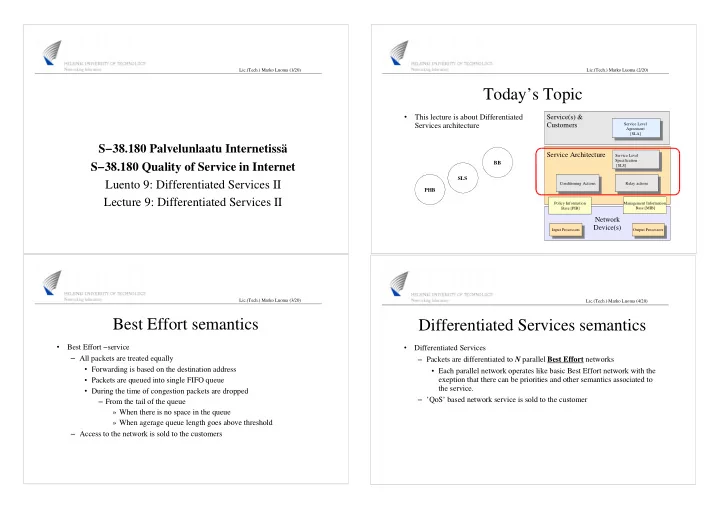
S−38.180 Palvelunlaatu Internetissä S−38.180 Quality of Service in Internet Luento 9: Differentiated Services II Lecture 9: Differentiated Services II

Lic.(Tech.) Marko Luoma (2/20)

Today’s Topic

  • This lecture is about Differentiated

Services architecture

Network Device(s) Service Architecture

Management Information Base [MIB] Policy Information Base [PIB] Relay actions Conditioning Actions Service Level Specification [SLS]

Service(s) & Customers

Service Level Agreement [SLA] Input Processors Output Processors

PHB SLS BB

Lic.(Tech.) Marko Luoma (3/20)

Best Effort semantics

  • Best Effort −service

All packets are treated equally Forwarding is based on the destination address Packets are queued into single FIFO queue During the time of congestion packets are dropped From the tail of the queue » When there is no space in the queue » When agerage queue length goes above threshold Access to the network is sold to the customers

Lic.(Tech.) Marko Luoma (4/20)

Differentiated Services semantics

  • Differentiated Services

Packets are differentiated to N parallel Best Effort networks Each parallel network operates like basic Best Effort network with the exeption that there can be priorities and other semantics associated to the service. ’QoS’ based network service is sold to the customer

slide-2
SLIDE 2

Lic.(Tech.) Marko Luoma (5/20)

EF semantics

  • ’End−to−end’ service

Single domain end−to−end Quality is defined by two constrains: Provisioning Class should be provisioned with enough resources to handle worst case aggregate Sharing No resource reservation for individual flows. Under and overflows possible Timing and delays can not be held or guaranteed

Lic.(Tech.) Marko Luoma (6/20)

AF semantics

  • No end−to−end semantics

Service can be deployed Point−to−point Any−to−any Uncontrollable resource usage inside the network Problem of commons

AF11 AF21 AF31 AF41 AF12 AF13 AF22 AF23 AF32 AF33 AF42 AF43

Class Precedence −> drop probability Lic.(Tech.) Marko Luoma (7/20)

What a customer wants ...

  • Lets face the music

Customer is only interested in the perceived quality How things are rolling compared Minute ago Year ago Customer is not interested in the novel technology which is behind the service This means end−to−end service quality

Lic.(Tech.) Marko Luoma (8/20)

End−to−end service

  • What prohibits ???

Structure of DiffServ is based on local control (policies) Classification based on the policies at the edge of the network Forwarding based on the policies in the core of the network We can stretch through single domain (ISP) with EF We may stretch through single domain (ISP) with AF

  • End−to−end

Is not within single ISP It is between source and destination

slide-3
SLIDE 3

Lic.(Tech.) Marko Luoma (9/20)

Let us strech a little bit ...

  • If we want to have end−to−end

semantics to the AF: We need to control resources and

  • ffered load hand in hand

Load to a single link in some class increases Can we adjust scheduling Do we need to reroute some of the classes » Class and constraint based routing

Lic.(Tech.) Marko Luoma (10/20)

Still stretching ...

  • Lets modify CBQ heuristics:

If class green is unsatisfied and class turquoise is unsatisfied but at the scale of the network only class green is unsatisfied we allow only green to borrow.

  • Is this possible ?

Not with the logic which we have today build inside DiffServ Single router does not know network scale situation No state information associated

W1 W2 W3 W4 Lic.(Tech.) Marko Luoma (11/20)

Still a little bit further

  • What if we have intelligence (bandwidth broker) outside the network which

would control the scheduling of classes

W1 W2 W3 W4

Change w1 to 0.4, w2 to 0.1 w3 to 0.2 and w4 to 0.3

Lic.(Tech.) Marko Luoma (12/20)

Bandwidth Broker

  • Outside intelligence which controls the network provisioning

Makes possible to offer end−to−end semantics Domain wide Thats what we just talked about (however there are still some caps in the story) Inter−domain We need to » translate domain specific service attributes at the border of two domains (pretty fixed) » Dynamically adjust resource requests to the other domain...

slide-4
SLIDE 4

Lic.(Tech.) Marko Luoma (13/20)

Inter−domain issues

  • Inter−domain traffic forwarding is based on bilateral of multilateral peering

agreements These tend to be business of lawyers and therefore rather static Our demand is varying rapibly and therefore we need to be dynamic Peering agreements must change to more flexible Rule of thumb: more money −> more lawyers −> more static We need to brake that rule by defining peering more dynamically » One idea: charging should be based on the aggregate traffic in the classes and rate of change requests

Lic.(Tech.) Marko Luoma (14/20)

Other issues

  • What is potential problem in this scenario:

Corporate A

100Mbps LAN 2Mbps WAN

ISP B

2.4Gbps DiffServ net

Lic.(Tech.) Marko Luoma (15/20)

Other issues

  • 2Mbps access link is eaily overloaded when both sides have higher capacities

Access link is not DiffServ if ISP does not deliver customer premises equipements.

  • Corporate LAN may cause service degradation to the traffic passing out the

corporate LAN Solution is to use some mechanism to guarantee that traffic is not degraded inside high speed LAN IntServ

Lic.(Tech.) Marko Luoma (16/20)

IntServ / DiffServ co−existence

  • We need to be able to pass reservation attributes to and from IntServ cloud.

IntServ cloud may be Corporation Outbound / inbound traffic is delivered as guaranteed traffic » Mapping to DiffServ classes based on policy Other ISP having IntServ as backbone Mapping between IntServ and DiffServ classes

IntServ DiffServ

slide-5
SLIDE 5

Lic.(Tech.) Marko Luoma (17/20)

IntServ / DiffServ co−existence

  • Bandwidth Broker can be used to do this also

Edge router has dual capabilities Passes RSVP messages to the BB to be processed to the domain specifig weight and filter modifications

Local Network (IntServ) Bandwidth Broker RSVP Provider Network (DiffServ) Local Network (IntServ) RSVP RAR COPS RAR RAR

Lic.(Tech.) Marko Luoma (18/20)

Reality check

  • Are we rotating things back to IntServ ?

BB:s require knowledge from the network (offered load, provisioning) By measuring itself By signaling from the users BB:s modify conditioning and forwarding actions of network routers

  • What is the difference to the IntServ ?

If we provide end−to−end service we need fixed routes and resources that at the minimum match the requirements We need state information somewhere Centralized − DiffServ BB:s Distributed − IntServ routers

Lic.(Tech.) Marko Luoma (19/20)

Reality check

  • Is it so that we tend to re−invent the

wheel Sometimes it may not be bad thing Sometimes we dare to say it straight to the people

http://www.caspiannetworks .com

Lic.(Tech.) Marko Luoma (20/20)

Conclusion

  • Differentiated Services is service architecture which allows to build N locically

separated Best Effort networks into a single physical network

  • Differentiated Services provides tools to offer QoS which is only assured
  • Differentiated Services does not provide end−to−end semantics to the services

which are build upon it

  • End−to−end semantics are only achieved with outside intelligence − like

bandwidth brokers