Todays Session Trends in government and commercial health plan - - PDF document

today s session
SMART_READER_LITE
LIVE PREVIEW

Todays Session Trends in government and commercial health plan - - PDF document

Todays Session Trends in government and commercial health plan payments Community Hospital Strategies for a Private payer cost containment strategies Changing Private Insurance Market Community hospital market context Discussion


slide-1
SLIDE 1

1

Community Hospital Strategies for a Changing Private Insurance Market

Stuart Altman, Ph.D and Robert Mechanic, MBA Brandeis University The Estes Park Institute February 10, 2015

Today’s Session

  • Trends in government and commercial health

plan payments

  • Private payer cost containment strategies
  • Community hospital market context
  • Discussion of strategic options

Brandeis University

2

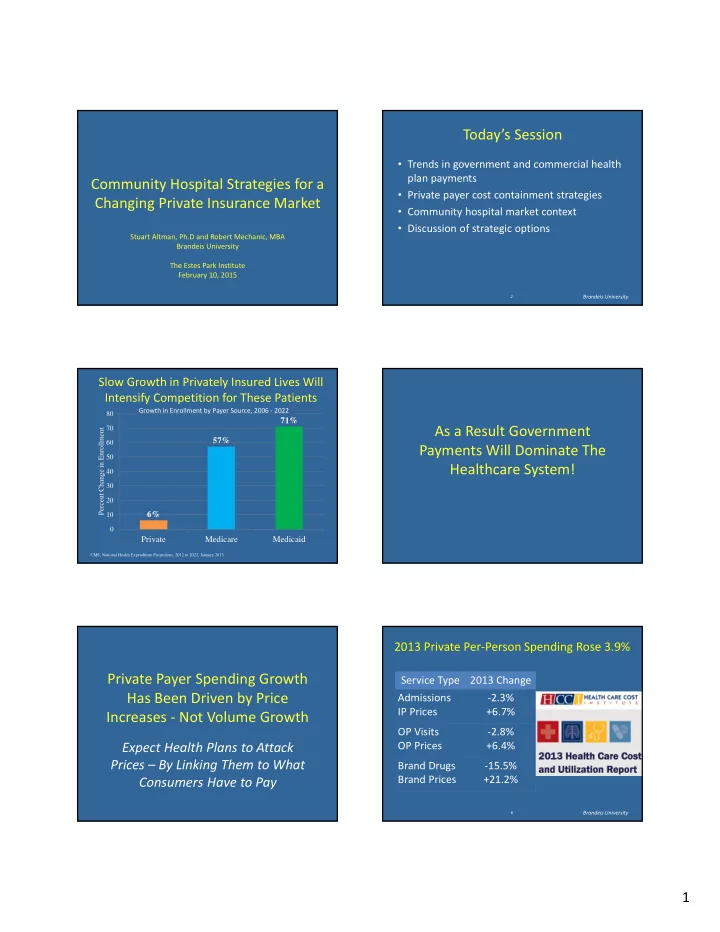
6% 57% 71%

10 20 30 40 50 60 70 80

Private Medicare Medicaid

Percent Change in Enrollment

CMS, National Health Expenditure Projections, 2012 to 2022, January 2013.

Slow Growth in Privately Insured Lives Will Intensify Competition for These Patients

Growth in Enrollment by Payer Source, 2006 ‐ 2022

As a Result Government Payments Will Dominate The Healthcare System! Private Payer Spending Growth Has Been Driven by Price Increases ‐ Not Volume Growth

Expect Health Plans to Attack Prices – By Linking Them to What Consumers Have to Pay

Service Type 2013 Change Admissions IP Prices ‐2.3% +6.7% OP Visits OP Prices ‐2.8% +6.4% Brand Drugs Brand Prices ‐15.5% +21.2%

Brandeis University

6

2013 Private Per‐Person Spending Rose 3.9%

slide-2
SLIDE 2

2

Emerging Payer Strategies

  • Tiered and narrow network plans
  • Defined contribution benefit plans and

health exchanges (public & private)

  • Consumer cost sharing changes
  • Reference pricing + consumer incentives
  • Payment reforms

Brandeis University

7

Narrow Network Health Plans Dominate Many Individual Exchanges

8

Narrow Networks Have Substantially Lower Premiums

9

How much volume will shift with a 15% premium discount?

Subsidy Dollar Subsidy Narrow Network Premium Broad Network Premium Effective Discount None $0 $425 $500 15% 50% $213 $213 $288 26% 75% $319 $106 $181 41% 90% $383 $42 $117 64%

Brandeis University

10

Broad Network = $500/mo Narrow Network = $425/mo Subsidy Based on Low Cost Plan

NOTE: This assumes that all states choose to expand Medicaid eligibility up to 138% FPL January 2014. SOURCE: Congressional Budget Office, February 2013. Total may not equal 100% due to rounding

Estimated Health Insurance Coverage in 2017

58% 56% 10% 8% 9% 13% 16% 19% 10%

Without Health Reform (56 Million Uninsured) With Health Reform (29 Million Uninsured)

Total Nonelderly Population = 279 million

Uninsured Medicaid/CHIP Private Non- Group/Other Employer- sponsored Insurance Uninsured Medicaid/CHIP Private Non-Group / Other Employer- sponsored Insurance Exchange

Percentage of Large Firms Considering Offering Benefits Through a Private Exchange and the Percentage of Covered Workers Currently in a Private Exchange, by Firm Size, 2014

NOTES: 2% of large firms did not know if they were considering a private exchange and 3% did not know if they were considering a defined contribution approach. A private exchange is one created by a consulting company, not by either a federal or state government. Private exchanges allow employees to choose from several health benefit options offered on the exchange. SOURCE: Kaiser/HRET Survey of Employer‐Sponsored Health Benefits, 2014. 12% 23% 2% 18% 24% 3% 20% 25% 3% 13% 23% 3% 0% 5% 10% 15% 20% 25% 30% Firm Considering Offering Benefits through a Private Exchange Firm Considering a Defined Contribution Approach Covered Workers Enrolled at a Firm Offering Benefits Through a Private or Corporate Exchange 200‐999 Workers 1,000‐4,999 Workers 5,000 or More Workers ALL LARGE FIRMS (200 or More Workers)

slide-3
SLIDE 3

3

Brandeis University 13

Now Republicans Control The Congress

Brandeis University

14

Does Anyone Remember the Ryan Plan?

6% 7% 12%* 16% 20% 28%* 27% 31% 34% 1% 1% 2% 3%* 4% 5% 7% 8% 11%* 3% 3% 5%* 7%* 10% 12%* 14% 15% 18% 0% 10% 20% 30% 40% 50% 2006 2007 2008 2009 2010 2011 2012 2013 2014 All Small Firms (3‐199 Workers) All Large Firms (200 or More Workers) All Firms * Estimate is statistically different from estimate for the previous year shown (p<.05). Note: These estimates include workers enrolled in HDHP/SO and other plan types. Average general annual health plan deductibles for PPOs, POS plans, and HDHP/SOs are for in‐network services. SOURCE: Kaiser/HRET Survey of Employer‐Sponsored Health Benefits, 2006‐2014.

Percentage of Covered Workers Enrolled in a Plan with a General Annual Deductible of $2,000 or More for Single Coverage, By Firm Size, 2006‐2014

Patients Are Paying More and Looking for Hassle Free Services That Cost Less

Brandeis University 16

Brandeis University

17

Large Employers Are Taking Matters into Their Own Hands

Brandeis University 18

slide-4
SLIDE 4

4

Continuum of Payment Options

19

Fee‐For Service with P4P Shared Savings1 Bundled Payment Capitation/ Risk‐Share Medicare Advantage

1 With risk sharing starting in 3‐5 years.

Less Risk More Risk What New Models Lie Between the Current Models?

20

Volume Value

Competitive Consolidated Consolidated Competitive

Insurance Market Hospital Market Collaborate with Local Insurer to Achieve “Reasonable” Spending Growth Cultivate Support Among Local Physicians and Key Employers Move Aggressively to Earn Preferred Status with High‐ Value Care and Population Health Management Promote Status as “Must Have” Hospital and Aggressively Build High‐Value Care Model

Options

Do We Really Need Insurance Companies? Why Don’t We Cut Out the Middleman? Discussion of Options

  • For reducing unit costs?
  • For managing total medical expenses?
  • For new payment models?
  • For attracting more patients?
  • For partnering with health plans?

Brandeis University

23

Questions

Stuart Altman and Robert Mechanic The Heller School for Social Policy & Management The Health Industry Forum Brandeis University altman@brandeis.edu mechanic@brandeis.edu www.healthforum.brandeis.edu

24